


TL;DR: RBI’s new AI underwriting guidelines turn lightning-fast loan approvals into a compliance maze. The rules demand explicit consent, continuous fairness checks, and immutable audit trails, which most in-house builds can’t deliver at speed. A platform-first approach gives you a ready-made, audit-ready stack that keeps the approvals fast and legal.
Key Takeaways - RBI’s 2025 Directions and 2026 Guidelines add mandatory consent, fairness, and monitoring layers that erode raw AI speed. - Off-the-shelf platforms can be production-ready in 3-6 months, while custom pipelines need 18-24 months to meet the same controls. - Building compliance into the architecture - not as an afterthought - lets you keep sub-day loan decisions without risking fines or license restrictions.
Why RBI's AI Underwriting Rules Threaten Your Fast-Lane Launches
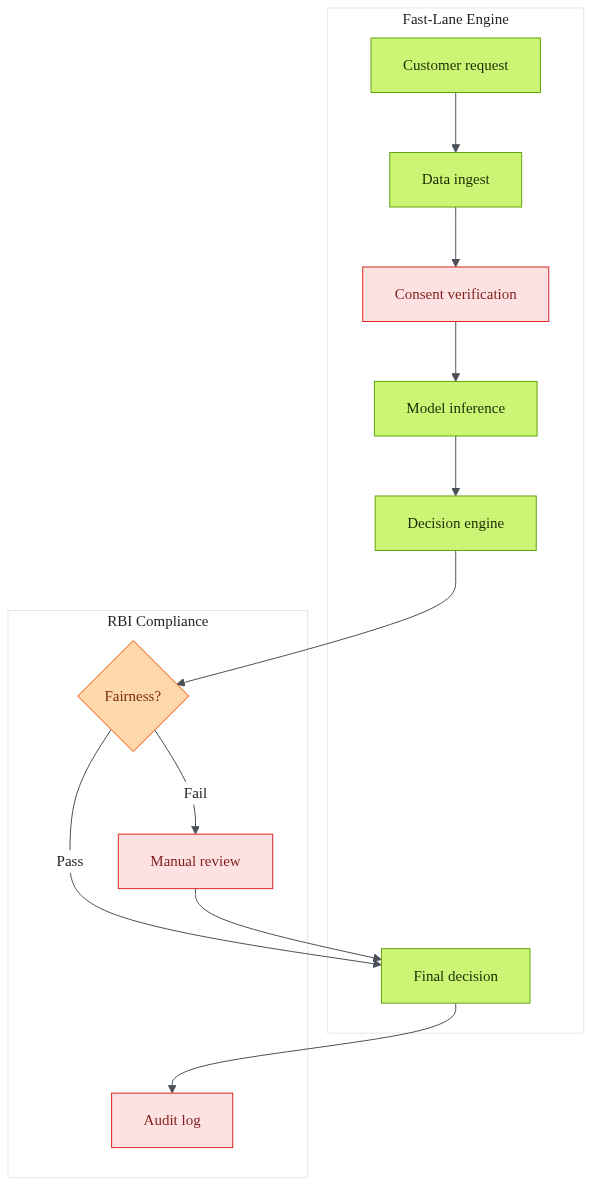
You’ve built a lightning-fast AI underwriting engine, but RBI's new rules could grind it to a halt overnight. Most fintechs assume that swapping a rule-based scorecard for a neural net automatically halves decision latency. The reality is that the Digital Lending Directions, 2025 now require every model output to be traceable, explainable, and auditable.
A typical loan flow looks like this:
1flowchart TD2 A[Customer submits request] --> B[Data ingest & consent check]3 B --> C[Model inference (ms)]4 C --> D[Decision engine]5 D --> E[Regulatory audit log]
The new RBI checks insert B and E. Consent verification alone can add 50-100 ms per request. Persisting an immutable log doubles the write volume. Multiply that by thousands of requests per second and the sub-second promise evaporates.
Beyond latency, the guidelines demand a fairness metric for every model release. If the model’s disparate impact exceeds a regulator-defined threshold, the loan must be flagged for manual review. That extra branch creates a hidden bottleneck most teams aren’t prepared to handle.
The compliance maze isn’t just paperwork - it’s a technical roadblock most teams can’t see coming, and the hidden complexity lies deeper.
What does that hidden complexity look like?
The Hidden Complexity Behind the RBI's AI Requirements
The 2026 RBI Digital Lending Guidelines turn “ethical AI” from a buzzword into a legal contract. Data privacy and explicit consent are now enforceable, meaning every third-party data source must be tagged with a consent flag that survives the entire pipeline.
RBI also mandates continuous monitoring: a live dashboard that surfaces drift, fairness degradation, and model-performance regressions. No roadmap is provided, so teams must invent the monitoring stack from scratch.
Consider this snippet from a typical model-serving config:
1model:2 name: loan_risk_v23 version: 2.14 consent_required: true5 fairness_threshold: 0.05 # max allowed disparate impact6logging:7 audit_sink: s3://audit-bucket/rbi/8 immutable: true9monitoring:10 drift_check: true11 fairness_check: true
Every field above becomes a compliance requirement. If `consent_required` is false, the RBI audit will reject the entire batch. If `fairness_threshold` isn’t set, the model can’t be deployed.
Because the guidelines lack an implementation roadmap, many fintechs try to bolt on a consent flag or a fairness library after the fact. That approach breaks the data lineage: the system can no longer prove which raw fields fed the model, nor can it reproduce the exact training snapshot for an audit.
Understanding this maze explains why off-the-shelf AI models stumble - yet there’s a way to cut through.
Can a platform truly simplify this labyrinth?
The Real Lever: Platform-Based AI Underwriting vs Building From Scratch
Speed alone isn’t enough; compliance-first architecture is the real differentiator. A pre-built platform arrives with consent pipelines, fairness dashboards, and immutable logging baked in. The typical timeline looks like: - Platform: 3-6 months from contract to production. - In-house: 18-24 months to design, implement, and certify the same controls.
A platform also ships with a zero-trust security layer that satisfies RBI’s data-protection expectations. That’s why many banks already trust its core for security-critical workloads, and hundreds of regulated enterprises rely on its compliance-ready stack.
Here’s a quick comparison: - Data ingestion - Platform uses encrypted Kafka topics with built-in consent metadata. - Model lineage - Platform records every feature version in a versioned data lake; custom builds often skip this step. - Audit logs - Platform writes to an immutable object store with SHA-256 hashes; DIY solutions may use mutable databases, which RBI rejects.
The advantage isn’t just faster rollout; it’s a guarantee that the system will survive an RBI audit without retrofitting.
How does a platform achieve that certainty?
Designing an RBI-Compliant AI Pipeline: Architecture and Controls
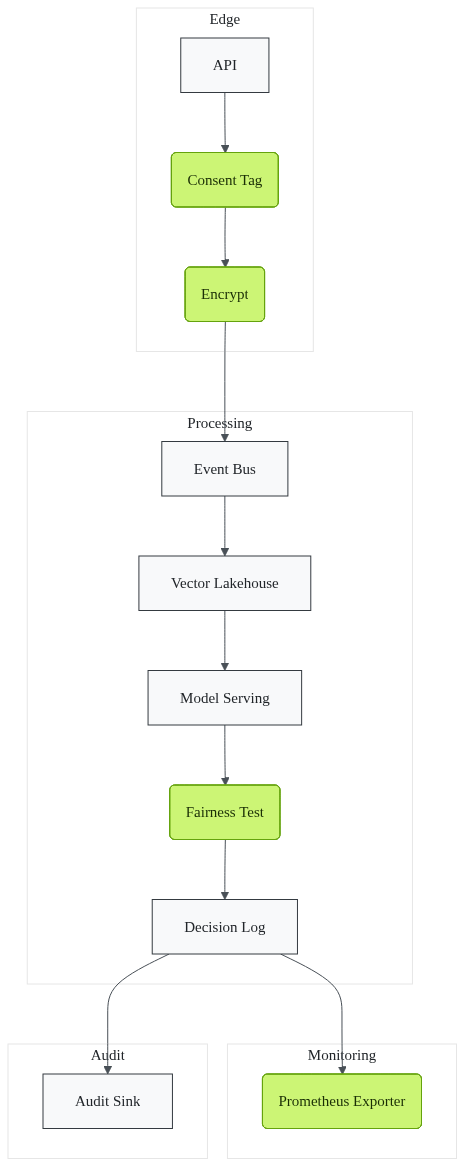
A compliant pipeline starts with explicit consent tagging at the edge. Every API that collects borrower data must attach a signed consent record, then encrypt the payload before it hits the event bus.
1apiVersion: v12kind: ConfigMap3metadata:4 name: consent-flags5data:6 consent_required: "true"7 encryption_key: "arn:aws:kms:us-east-1:123456789012:key/abcd-efgh"
Next, the pipeline stores raw events in a vector-enabled lakehouse that preserves feature provenance. Each transformation writes a manifest entry: - `raw_id`: UUID of the original event - `features_hash`: SHA-256 of the feature vector - `consent_id`: reference to the consent record
The model serving layer reads the manifest, runs a fairness test, and emits a decision together with a fairness score. The score is persisted alongside the decision in an immutable log:
1{2 "loan_id": "L12345",3 "decision": "APPROVED",4 "fairness_score": 0.97,5 "audit_hash": "d4c3b2a1..."6}
RBI’s 2025 Directions also require real-time monitoring hooks. A simple Prometheus exporter can expose drift and fairness metrics:
1from prometheus_client import Gauge23fairness_gauge = Gauge('model_fairness', 'Current fairness score')4drift_gauge = Gauge('data_drift', 'Feature drift metric')56def update_metrics():7 fairness_gauge.set(compute_fairness())8 drift_gauge.set(compute_drift())
Finally, an immutable audit sink (e.g., an S3 bucket with Object Lock) guarantees that logs cannot be altered. The bucket policy enforces read-only access for any external auditor.
With the pipeline in place, the next question is: what tangible business impact will you see?
Checklist: 7 Compliance Traps That Kill Speed
Even a well-architected pipeline can fall into hidden traps. Avoid these pitfalls: - Missing consent records - Third-party data without a signed flag will be rejected at audit. - No automated fairness testing - Deploying a model without a pre-flight fairness run forces manual reviews for every loan. - Improper audit log format - RBI expects logs in a specific JSON schema; mismatched fields cause re-submission delays. - Black-box LLMs - Using a large language model without explainability layers breaks the “transparent decision” rule. - Skipping drift re-validation - Model performance degrades over time; without periodic checks, RBI will flag the pipeline. - Ignoring 2026 data-protection alignment - Data stored outside approved jurisdictions or without encryption violates the upcoming law. - Missing post-deployment reporting cadence - RBI requires daily summary reports; a missing cron job triggers penalties.
Each item can be scripted. For example, a CI step that validates consent metadata:
1#!/usr/bin/env bash2# Fail the build if any payload lacks consent3if grep -q "\"consent_required\": false" data/*.json; then4 echo "Consent missing!" && exit 15fi6echo "All good."
Or a numbered validation sequence that runs before every release:
- Pull the latest manifest from the lakehouse.
- Verify that every record contains a non-null `consent_id`.
- Run the fairness test suite; abort if the score falls below the threshold.
- Generate a SHA-256 hash of the audit payload and store it in the immutable bucket.
Automating these steps turns a slow, brittle system into a compliant speed machine.
What happens when you miss a single trap?
The Payoff: Faster, Safer Loans and a Protected Reputation
When the compliance layer is baked in, you can keep sub-day loan approvals without fearing RBI enforcement. The audit-ready logs mean regulators can verify every decision in minutes rather than weeks, eliminating costly remediation cycles.
Consider a real-world query a regulator might run:
1SELECT loan_id, decision, audit_hash2FROM loan_audit3WHERE decision = 'APPROVED'4AND audit_timestamp >= CURRENT_DATE - INTERVAL '1 day';
Because the `audit_hash` is immutable, the query result cannot be tampered with. The lender can hand over the exact set of approved loans within seconds, proving both speed and transparency.
A compliant reputation also becomes a competitive moat. Borrowers trust lenders who can prove transparent, fair decisions, especially in a market where hidden charges and unauthorized apps have eroded confidence.
The net effect is a virtuous loop: faster approvals attract more customers, compliance protects the brand, and the brand draws even more business.
But how do you measure that loop in real time?
Frequently Asked Questions
What specific RBI guidelines affect AI-driven loan underwriting?
The 2025 Digital Lending Directions and the 2026 Digital Lending Guidelines require data consent, fairness testing, audit-ready logs, and continuous monitoring for any AI underwriting model.
How long does it take to deploy a compliant AI underwriting platform?
Ready-made platforms can be live in 3-6 months, compared with 18-24 months for a custom in-house solution.
Can I reuse existing AI models without re-training for RBI compliance?
Only if you add a compliance layer that records consent, runs fairness checks, and produces immutable audit logs; otherwise the model fails RBI standards.
What penalties does RBI impose for non-compliant AI underwriting?
Violations can lead to fines up to 2 % of the loan portfolio, mandatory remediation, and possible restriction of the lender's operating license.
How do I prove that my model’s fairness score stayed within limits over time?
Publish the fairness metric to a Prometheus endpoint and configure an alert that fires when the score drops below the threshold. The alert history is stored in the same immutable bucket used for audit logs, giving regulators a tamper-proof trail.
Is there a way to automate consent collection for third-party data feeds?
Yes. Deploy a lightweight consent microservice that signs each inbound payload with a JWT containing the consent timestamp and scope. The service writes the JWT to a Kafka header, and downstream consumers can verify it before processing. See our guide on Consent Management at Scale for a full implementation.
What monitoring tools integrate smoothly with the RBI-required dashboard?
Open-source stacks like Prometheus + Grafana, combined with Loki for log aggregation, satisfy the real-time visibility requirements. They can be containerized and run on Kubernetes, matching the cloud-native stack we recommend in Building a Zero-Trust Data Pipeline.
Related reading: - Fintech AI Stack vs RBI Governance - a deep dive into why many stacks stumble on compliance. - Why Your Vector DB Is Bleeding Compliance Money - lessons on storage choices that survive audits. - The State of AI Regulation - broader context for global AI rules.
Ready to move faster and stay compliant? Learn more today.
Sources
Research and references cited in this article:
- The Future of AI-Based Loan Underwriting - BillCut
- Digital Loans & RBI Rules India 2026: Mobile Lending App Guide
- RBI Eases DLG Rules in 2026: Impact on Digital Lending
- Digital Lending in India: Transformation, Regulation, and the Road ...
- Rbi Banking Rules India | Global Law Experts
- Ethical Artificial Intelligence (AI): What does it mean for digital lenders?
- How Precisa Addresses RBI's Model-Based Lending Risks
- Decoding RBI's Digital Lending Directions 2025 - YouTube
- PDF Role of AI in Financial Risk Management and RBI Guidelines on ...
- RBI Digital Lending Guidelines 2026: What Borrowers Must Know - Saarathi FinBiz Pvt Ltd
- Press Release Page | Press Information Bureau
- 2026 Vision: New Rails, New Rules, No Regrets
About the author
Mayank Singh is a software developer at Levitation Infotech, where he builds web and AI-powered applications across the company’s fintech, healthcare, and enterprise projects.