


CTOs often trust REST APIs as secure. However, a silent man-in-the-middle attack can steal credentials, user records, or internal service tokens before detection. The breach often goes unnoticed because the traffic looks like ordinary HTTP. By the time the alarm sounds, the attacker has already exfiltrated data. The root cause isn’t a missing firewall rule; it’s a structural gap in the protocol itself.
The Silent MITM Doorway in Every REST API

HTTP/1.1 was designed for human-readable requests, not for immutable security guarantees. It allows a client to speak to a server over an unencrypted socket. However, the application must explicitly upgrade to TLS. In practice, that “unless” is the problem.
When a client connects, the TCP handshake establishes a channel. There is no built-in proof that the other end is who it claims to be. An attacker who can ARP-spoof, DNS-poison, or compromise a router can sit between the two parties. Then, they read the payload and inject malicious data. Because REST relies on ad-hoc headers for authentication (Bearer tokens, API keys), the attacker can replay those headers. Then, the attacker can also swap those headers. Meanwhile, the protocol remains intact.
1# Example of a simple curl request over HTTP (vulnerable)2curl http://api.example.com/orders -H "Authorization: Bearer $TOKEN"
If an adversary intercepts that traffic, they see the raw token and can reuse it elsewhere. The protocol itself offers no way to bind the token to the transport layer. - No mandatory encryption in HTTP/1.1. - No transport-level identity verification. - Schema is negotiated at the application layer, not the wire.
These gaps are invisible until a breach surfaces. Adding TLS on top of REST seems like the obvious fix, but TLS only encrypts the channel. However, it does not enforce that the client is authentic. Moreover, it does not guarantee that the payload conforms to a contract at the wire level. Can encryption alone close this hidden door?
Why Traditional REST Hardening Fails to Plug the Gap
Enter the common response: API gateways, rate limiters, and token introspection services. They add layers of defense, but each layer lives outside the core protocol.
A gateway can reject malformed requests, but it cannot stop a man-in-the-middle from replaying a previously captured. Then, a well-formed request can be sent. Rate limiting thwarts brute-force attacks, yet it does nothing for a passive eavesdropper who only watches traffic.
Developers often reach for third-party libraries that add request signing or HMAC verification. The problem is consistency. In a microservice landscape, some services use `express-jwt`. Others use `spring-security`. Then, a few still rely on custom middleware. This heterogeneity creates blind spots where an attacker can target the weakest link.
1// Inconsistent request signing across services2func VerifySignature(r *http.Request) bool {3 // Service A uses SHA256, Service B uses MD54 // Missing uniformity leads to verification gaps5}
- Gateways enforce policies at the edge, not between services. - Token checks are still application-level; they don’t bind the client to the TLS session. - Library drift creates a patchwork of security that is hard to audit.
Because the protocol itself does not mandate these safeguards, each microservice becomes a potential entry point. The real fix lives in the protocol itself, not in an after-the-fact add-on. What protocol change could finally seal the breach?
gRPC's Built-In TLS and Strong Contracts Close the Door
gRPC rides on HTTP/2, which requires TLS for any production deployment. The TLS handshake happens before any application data is exchanged. Both sides present certificates. This mutual TLS (mTLS) authenticates the client and the server at the transport layer. As a result, it eliminates the need for separate token verification for identity.
1# Example server TLS config (Go)2grpcServer := grpc.NewServer(3 grpc.Creds(credentials.NewTLS(&tls.Config{4 Certificates: []tls.Certificate{serverCert},5 ClientAuth: tls.RequireAndVerifyClientCert,6 })),7)
Beyond encryption, gRPC uses Protocol Buffers (`.proto` files) to define the contract. The contract is compiled into language-specific stubs. Then, the binary format is validated by the runtime before the application sees it. If the wire payload deviates from the schema, the call fails immediately. This provides a built-in schema guard that REST lacks.
Research shows gRPC can be roughly 7 × faster when receiving data. It is also 10 × faster when sending data compared to traditional REST JSON payloads. The gains come from: - Binary serialization (protobuf) vs. text-based JSON. - Header compression in HTTP/2. - Multiplexed streams that avoid TCP handshakes per request.
How does a team actually adopt this protocol?
But adopting gRPC means re-thinking how you model your API contracts.
Step-by-Step: Migrating a REST Endpoint to gRPC
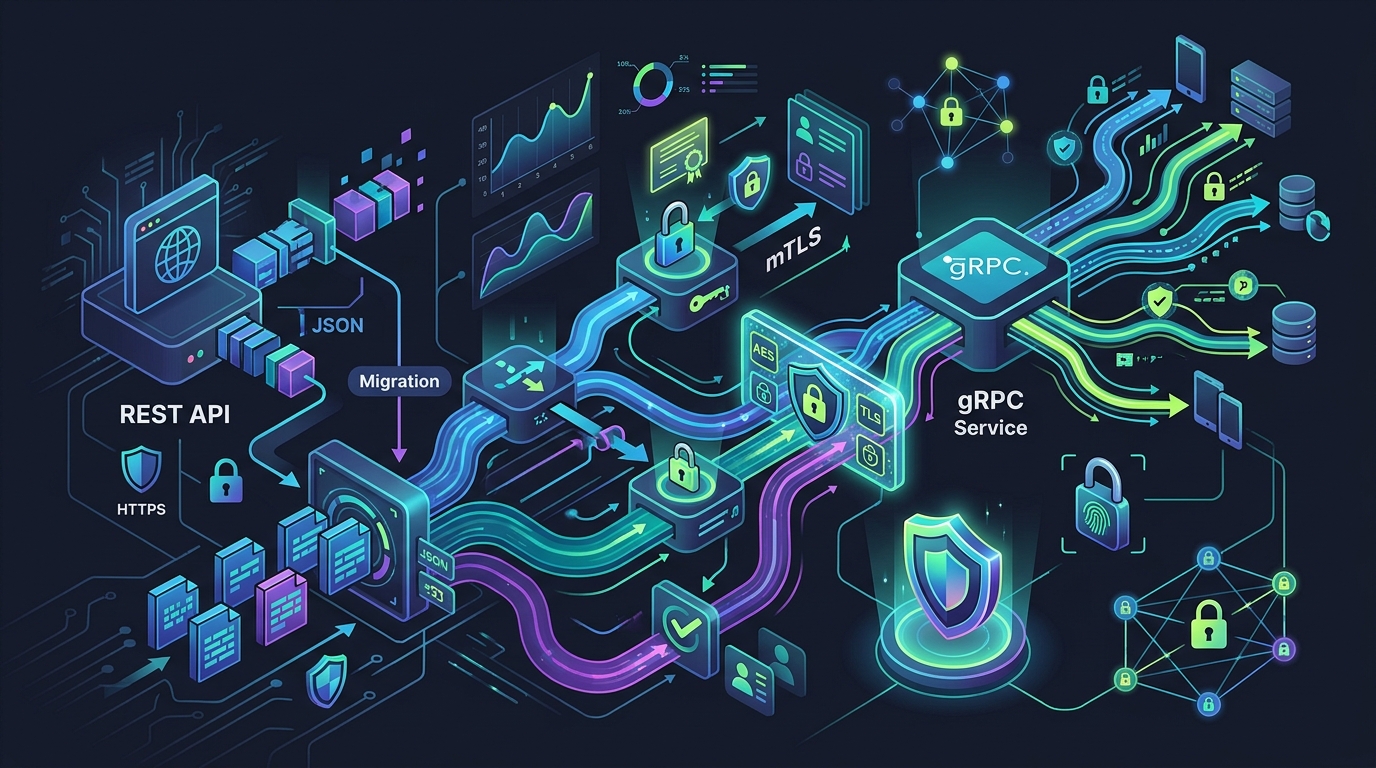
- Extract the existing JSON schema. Identify the fields, types, and validation rules used by the REST endpoint.
- Write a matching `.proto` file.
```proto
syntax = "proto3";
package orderpb;
message OrderItem {
string sku = 1;
int32 qty = 2;
}
message CreateOrderRequest {
string user_id = 1;
repeated OrderItem items = 2;
}
message CreateOrderResponse {
string order_id = 1;
bool accepted = 2;
}
service OrderService {
rpc CreateOrder(CreateOrderRequest) returns (CreateOrderResponse);
}
```
- Generate stubs for your language stack.
```bash
# Go example
protoc --go_out=. --go-grpc_out=. order.proto
```
- Implement the service method.
```go
func (s server) CreateOrder(ctx context.Context, req orderpb.CreateOrderRequest) (*orderpb.CreateOrderResponse, error) {
// Business logic replaces the old HTTP handler
orderID := uuid.New().String()
return &orderpb.CreateOrderResponse{OrderId: orderID, Accepted: true}, nil
}
```
- Configure mTLS. Then, create a CA, issue server and client certificates, and point both sides to the cert files.
- Replace the HTTP handler.
```go
// Old REST handler
http.HandleFunc("/orders", createOrderHandler)
// New gRPC server start
lis, _ := net.Listen("tcp", ":50051")
grpcServer.Serve(lis)
```
- Update the client.
```python
import grpc
import order_pb2
import order_pb2_grpc
creds = grpc.ssl_channel_credentials(
root_certificates=open('ca.pem','rb').read(),
private_key=open('client.key','rb').read(),
certificate_chain=open('client.crt','rb').read()
)
channel = grpc.secure_channel('api.example.com:50051', creds)
stub = order_pb2_grpc.OrderServiceStub(channel)
resp = stub.CreateOrder(order_pb2.CreateOrderRequest(user_id='123', items=[...]))
``` - Pro tip: Keep the old REST endpoint behind an API gateway that forwards to the gRPC service using `grpc-gateway`. - Then, this lets external consumers continue using HTTP/JSON while your internal mesh speaks pure gRPC.
Secure transport alone is powerful. However, you can amplify it with a service mesh. What role does a service mesh play after the migration?
Layering Service Mesh for Zero-Trust Enforcement
A service mesh injects a sidecar proxy (Envoy, Linkerd, or Istio) alongside each service pod. The proxy handles all inbound and outbound traffic, automatically applying mTLS without code changes.
1# Istio sidecar injection annotation2apiVersion: v13kind: Pod4metadata:5 name: order-service6 annotations:7 sidecar.istio.io/inject: "true"8spec:9 containers: - name: order10 image: myorg/order-service:latest
Once injected, you can define mesh-wide policies: - AuthenticationPolicy - require mTLS for all services. - AuthorizationPolicy - fine-grained RBAC based on service identity. - RateLimit - enforce request quotas per client identity.
1# Example AuthorizationPolicy (Istio)2apiVersion: security.istio.io/v1beta13kind: AuthorizationPolicy4metadata:5 name: order-access6 namespace: prod7spec:8 selector:9 matchLabels: { app: order-service }10 action: ALLOW11 rules: - from: - source:12 principals: ["cluster.local/ns/prod/sa/payment-service"]
Observability plugins (Prometheus, Jaeger) hook into the sidecar. They give you latency histograms and security event traces. Then, this happens without instrumenting the application code. - Auto-inject sidecars for every gRPC pod. - Enforce mesh-wide mTLS and RBAC. - Monitor latency and security events centrally.
With these controls, a compromised pod cannot talk to another service. It must present a valid certificate. Then, any deviation is logged and blocked by the mesh. What does this technical upgrade affect the bottom line?
What Happens When You Get It Right: Tangible Business Wins
When the API surface is locked down by gRPC and a zero-trust mesh, the breach perimeter shrinks dramatically. Fewer attack vectors mean lower cyber-insurance premiums and simpler compliance audits. Performance gains ripple through the
About the author
Mayank Singh is a software developer at Levitation Infotech, where he builds web and AI-powered applications across the company’s fintech, healthcare, and enterprise projects.