


TL;DR: Approval walls can stall releases while compute sits idle. Track approval as a state machine, split active review from organizational waiting, and tie governance timing to post-release safety. The goal is faster releases without weaker controls.
Key Takeaways: - Measure approval from release-candidate submission to production authorization, excluding training and deployment. - Track active review, wait share, handoffs, rework, and first-pass evidence completeness separately. - Read release speed beside model health and governance quality, never as a standalone score.
Approval Delay Can Be Organizational
A release stalls when the deployment stack is ready but the organization is not. No amount of compute can drain a queue the company cannot see.
Approval is therefore a deployment concern, not a governance footnote. It delays customer launches, model refreshes, and production decisions. It also delays business value from engineering work.
What the approval clock includes
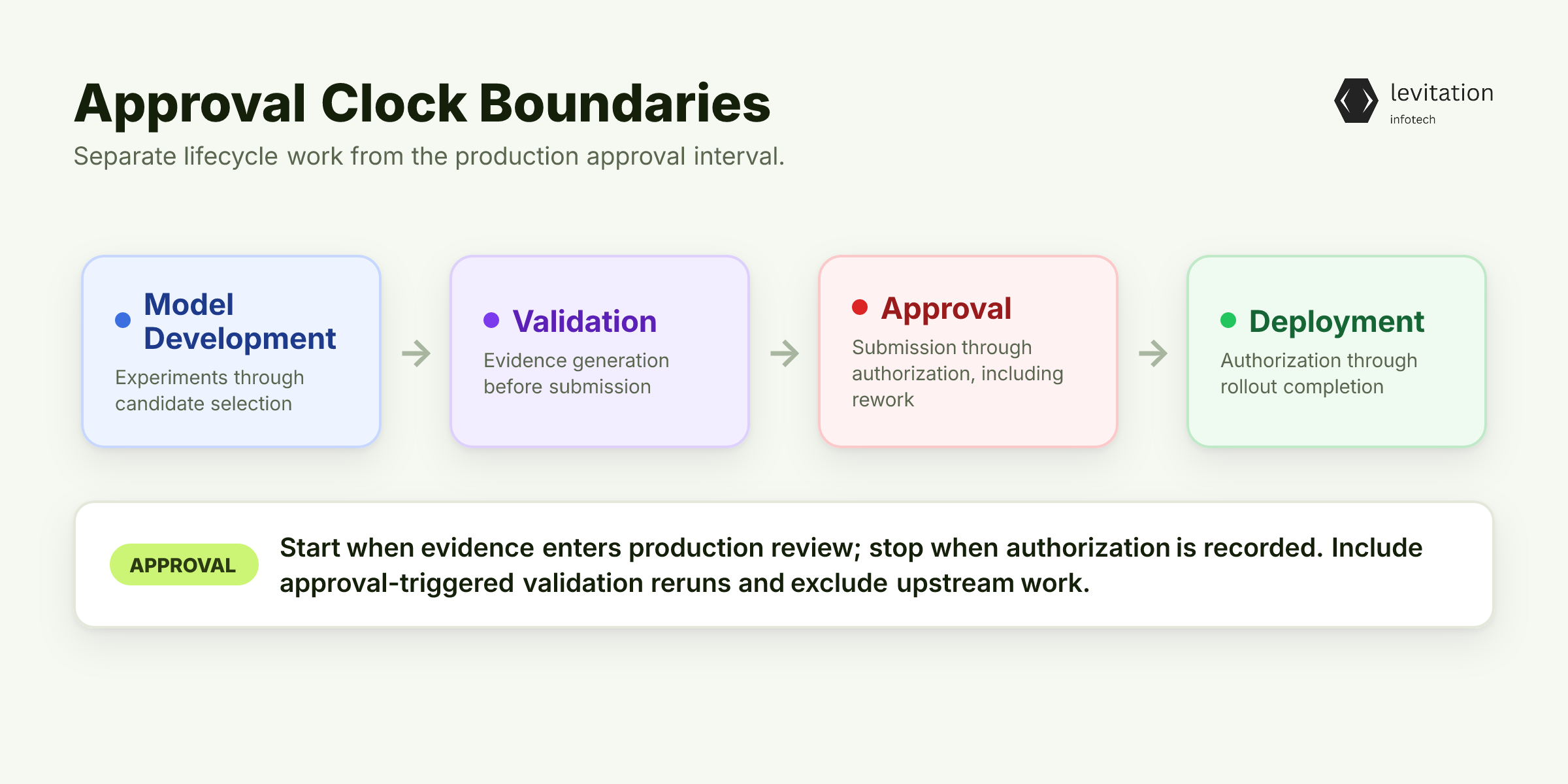
The approval clock begins when a release candidate and required evidence enter production review. It ends when production authorization is recorded. The surrounding lifecycle needs separate clocks: - Model development: Experiment work through candidate selection. - Validation: Evidence generation and evaluation before submission. - Approval: Submission through authorization, including review rework. - Deployment: Authorization through rollout completion.
Exclude upstream work from the approval clock. Approval-triggered validation reruns stay inside it because they delay authorization. With those boundaries set, can one trace support an industry claim?
Elapsed approval time is wall-clock time across all approval states. Active reviewer effort covers only intervals when a named reviewer evaluates evidence. Waiting for missing evidence, ownership, or a decision counts as elapsed time, not review effort.
Why this is not a universal benchmark
Any single trace is a case-level finding, not an industry benchmark. Timestamps show where observed candidates waited. They cannot establish causation, a universal distribution, or reviewer capacity without stronger coverage and method.
The how to measure MLOps approval time process must define submission, authorization, exclusions, and reporting windows before comparing results. An enterprise MLOps delivery overview explains workflow design, but it cannot turn a sample into a general standard.
A trace becomes a useful benchmark only after the clock has a precise starting point. Where should that clock start, and what should it exclude?
Why MLOps Deployment Benchmarks Can Hide Approval Delay
A DevOps-derived scorecard tracks deployment frequency, lead time for changes, mean time to restore, and change failure percentage. The DORA metrics adapted for machine learning remain useful, but approval disappears in three ways: - Approval is folded into total lead time. - Approval is excluded from delivery reporting. - Governance and deployment execution are averaged into one figure.
MLOps adds another complication. A release connects code, model, and data streams. The team must approve artifacts and evidence as well as application code.
This turns a code handoff into a decision across systems. Deployment is the key transition. Experimental work becomes a production system through handoffs between people, tools, and infrastructure.
A weak handoff erases good validation work before it reaches production.
A governance gate is not a queue. A valid gate has four properties: - An explicit risk decision - An accountable owner - A defined evidence contract - A service level for action
A queue merely accumulates work. It provides neither accountability nor a clear exit condition. The model governance workflow design should expose both.
The first diagnostic step is simple: request start, stop, and handoff timestamps for every approval state. Do not ask only for the final approval date.
The same gap appears when release cadence drifts from risk-review cadence. The underlying issue is not reviewer speed. It is missing state-level evidence.
The missing number is not another average. It is the split between human review effort and organizational waiting inside the approval clock. Which clocks should teams report?
The Clock That Matters: Separate Work From Waiting
Approval lead time
Approval lead time starts at release-candidate submission. It ends at production authorization. Exclude model training and downstream deployment.
Keep changes-requested cycles inside the elapsed clock. The candidate was not authorized, even if the first review was quick. A short first review followed by incomplete evidence still produces a slow approval.
Elapsed time alone cannot show how much of that wait was review effort. Which measure separates the two?
Active review effort
Active review effort measures intervals when a named reviewer is evaluating evidence. A ticket marked “assigned” does not prove active review.
For parallel reviewers, report two measures. Use the union of review intervals for cycle-time analysis. Use reviewer minutes for staffing and capacity analysis.
Adding them without adjustment inflates the apparent review effort. What accounts for the rest of the elapsed clock?
Wait share
Calculate wait share as elapsed approval time minus the union of active review intervals. Divide the result by total approval time.
A high wait share points to ownership, handoffs, or evidence assembly. A high active-review share puts the focus on difficult decisions, unclear policies, or excessive review scope.
The production deployment metrics taxonomy should keep these clocks separate. It should also prevent approval delay from being mislabeled as infrastructure delay.
Add four diagnostic measures: - Handoff count: How many ownership or queue transitions occurred? - State duration: Where did each candidate spend its time? - Change cycles: How often did review send the candidate back? - First-pass completeness: Was required evidence complete at the first review?
These measures expose flow, but speed alone cannot judge governance. What must the benchmark also include?
The benchmark is a vector
A governance benchmark should be a vector, not one score. The model governance benchmark framework should assess speed, evidence quality, policy consistency, and post-release safety together.
Segment comparisons by model risk, change type, and release path. Blend unlike pipelines only when an executive view requires a portfolio result.
Report medians and upper-percentile values such as p50 and p85 when the sample supports them. State the reporting window and inclusion rules.
A practical state model contains five states: - `submitted` - `waiting` - `in_review` - `changes_requested` - `approved`
The transition from `waiting` to `in_review` shows when reviewers pick up work. The return from `changes_requested` to `submitted` exposes rework.
The move from `in_review` to `approved` records the actual risk decision. Once waiting is visible, teams can challenge each gate on evidence and purpose. Which states still need to exist, and what data can prove it?
Instrument the Approval Path as a State Machine
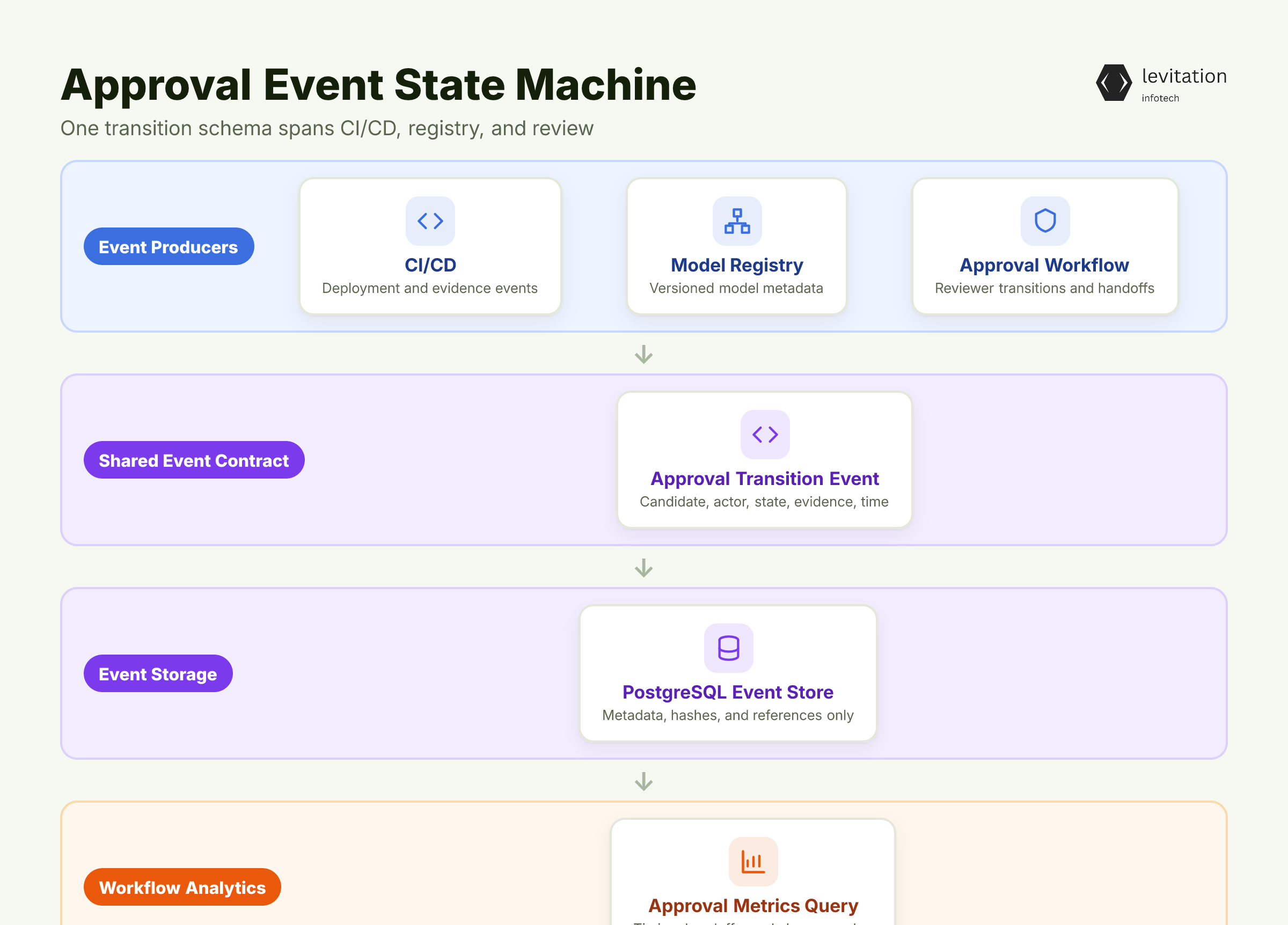
Each transition should record the candidate, actor, state, evidence version, and time. CI/CD, the model registry, and the approval workflow should record the same fields.
The MLOps approval event schema template stores metadata without storing sensitive model content. Store hashes and references, not training records or customer data.
1{2 "event_id": "evt-01J2A7G9D4",3 "approval_id": "apr-1048",4 "model_id": "credit-risk-v4",5 "model_version": "2026.10.25",6 "artifact_digest": "sha256:8f3c9a2e",7 "risk_tier": "high",8 "event_type": "handoff",9 "from_state": "waiting",10 "to_state": "in_review",11 "actor_role": "model_risk_reviewer",12 "queue": "tier-2-risk",13 "evidence_bundle_version": "evb-42",14 "evidence_status": "complete",15 "occurred_at": "2026-10-25T09:30:00Z"16}
The CI/CD evidence automation guide explains how each system produces this event. Consistent fields let teams query the workflow without rebuilding state from email later.
Derive the metrics
Given a PostgreSQL `approval_events` table with these fields, this query derives the core approval measures:
1WITH ordered AS (2 SELECT3 approval_id,4 from_state,5 to_state,6 event_type,7 evidence_status,8 occurred_at,9 occurred_at - LAG(occurred_at) OVER (10 PARTITION BY approval_id11 ORDER BY occurred_at12 ) AS state_seconds13 FROM approval_events14),15facts AS (16 SELECT17 approval_id,18 MIN(occurred_at) FILTER (19 WHERE to_state = 'submitted'20 ) AS submitted_at,21 MAX(occurred_at) FILTER (22 WHERE to_state = 'approved'23 ) AS approved_at,24 COALESCE(25 SUM(state_seconds) FILTER (26 WHERE from_state = 'in_review'27 ),28 029 ) AS review_seconds,30 COUNT(*) FILTER (31 WHERE event_type = 'handoff'32 ) AS handoffs,33 COUNT(*) FILTER (34 WHERE to_state = 'changes_requested'35 ) AS change_cycles36 FROM ordered37 GROUP BY approval_id38),39first_review AS (40 SELECT DISTINCT ON (approval_id)41 approval_id,42 evidence_status43 FROM approval_events44 WHERE from_state = 'waiting'45 AND to_state = 'in_review'46 ORDER BY approval_id, occurred_at47)48SELECT49 f.approval_id,50 EXTRACT(EPOCH FROM (51 f.approved_at - f.submitted_at52 )) AS approval_lead_seconds,53 EXTRACT(EPOCH FROM f.review_seconds) AS active_review_seconds,54 1 - f.review_seconds / NULLIF(55 EXTRACT(EPOCH FROM (56 f.approved_at - f.submitted_at57 )),58 059 ) AS wait_share,60 f.handoffs,61 f.change_cycles,62 r.evidence_status = 'complete' AS first_pass_complete63FROM facts f64LEFT JOIN first_review r USING (approval_id)65WHERE f.submitted_at IS NOT NULL66 AND f.approved_at IS NOT NULL;
Match these transitions with workflow tickets and audit records before publishing the first dashboard. Flag missing events as unknown. Never treat missing telemetry as zero waiting.
A clean metric also needs a clean evidence package. What belongs in that package?
Automate the evidence bundle
The evidence bundle should link: - Model artifact hash - Data snapshot and provenance - Validation results - Evaluation metrics - Test logs - Packaging status - Relevant approval policy version
Before human review, run preflight checks. Immediately return incomplete, stale, or untested packages. A broken package should never occupy a reviewer's queue.
Assign one accountable release owner for each candidate. Define reviewer service levels and explicit escalation paths. Cap work in progress when parallel review creates dependency chains.
Apply risk-tiered gates. Simplify low-risk, pre-validated changes while preserving deeper review for higher-risk releases. Record every exception against a defined policy.
Keep the workflow inside the deployment toolchain. Rebuilding approval state later from spreadsheets and meeting notes creates another data product with another set of errors.
Instrumentation reveals the queue, but flow improves only when each state has an owner, an evidence contract, and a service level. How should the scorecard connect these controls to release safety?
Build a Scorecard That Links Governance to Release
A release scorecard needs four layers. The MLOps deployment benchmark scorecard provides a useful starting structure.
Flow layer
Track approval lead time, active review effort, wait share, handoff count, first-pass evidence completeness, and time spent resolving changes.
Flow alone cannot show whether deployment absorbed the delay. Which delivery measures can test that?
Delivery layer
Pair flow measures with deployment frequency, total lead time for changes, change failure percentage, and mean time to restore. This shows whether faster approval merely moves delay into deployment.
Delivery speed still leaves one question: is the released model healthy?
Model-health layer
Include rollback rate, drift-detection time, rollback time, and post-deployment incidents. Track the relationship between approved changes and later stability.
Model health shows outcomes, but governance quality still needs its own measures. Which governance measures can explain the difference?
Governance layer
Measure lineage completeness, evidence freshness, unresolved policy exceptions, and manual overrides. Keep these measures separate from the speed score.
The production model observability guide closes the loop between pre-release approval and production behavior. It also helps preserve evidence when teams delete model artifacts during rollback.
Those controls need a view that connects flow to ownership. What should that view show?
The executive view should combine a flow chart with trends that show where candidates wait and which owner can move them.
Map metrics to interventions: - Long waits: Assign ownership and introduce service levels. - Repeated evidence requests: Automate bundle assembly and preflight checks. - Slow post-approval releases: Improve CI/CD execution and deployment controls. - Poor rollback performance: Strengthen canary, rollback, and monitoring controls.
Review trends by cohort across quarters. Do not compare a new low-risk path with a mature high-risk path, and do not reward teams for bypassing necessary controls.
Speed must never come at the expense of safety. Every pre-release measure needs a connection to what happens after the model reaches production. What changes when approval becomes a production metric?
What Changes When Approval Becomes a Production Metric
The first payoff is more predictable release dates. More importantly, accountable states replace dependence on individual heroes. Governance decisions also retain their evidence.
Observed approval time is a diagnostic starting point, not a universal target. The goal is less unexplained waiting without weaker model controls. A CTO can issue a three-step plan:
- Instrument the approval clock.
- Identify the longest controllable wait states.
- Review governance and production metrics together each quarter.
MLOps deployment benchmarks should measure the entire path from candidate to safe production. That includes the organizational time conventional delivery dashboards erase.
Make that distinction impossible to miss on the scorecard. Then ask: will the next release improve because the model learned more, or because the organization stopped waiting?
Frequently Asked Questions
What is a good MLOps approval time?
There is no defensible universal target because risk tiers, evidence requirements, and release paths differ. Treat an observed approval trace as a diagnostic case. Establish your own p50 and p85 by cohort, then reduce the longest controllable wait states while preserving governance controls.
Which MLOps deployment benchmarks should a CTO track first?
Start with approval-flow measures: approval lead time, active review effort, wait share, and first-pass evidence completeness. Then include deployment frequency, total lead time, change failure percentage, and mean time to restore.
Add model health and governance measures next so faster releases remain tied to safer outcomes. The first review should reveal which constraint matters most: the queue, the evidence package, or post-release stability.
About the author
Mayank Singh is a software developer at Levitation Infotech, where he builds web and AI-powered applications across the company’s fintech, healthcare, and enterprise projects.