


TL;DR
mTLS encrypts traffic, but a single mis-configuration lets an attacker hijack a workload’s identity and roam the mesh. The fix is to bind each certificate to an immutable process fingerprint and enforce runtime attestation.
Key Takeaways - Mutual TLS alone does not guarantee zero-trust; identity can be spoofed. - Default cert policies often issue weak, reusable keys that become backdoors. - Binding workload identity to a process hash and continuously verifying it closes the tunnel.
mTLS Isn't the Bulletproof Bouncer You Think It Is
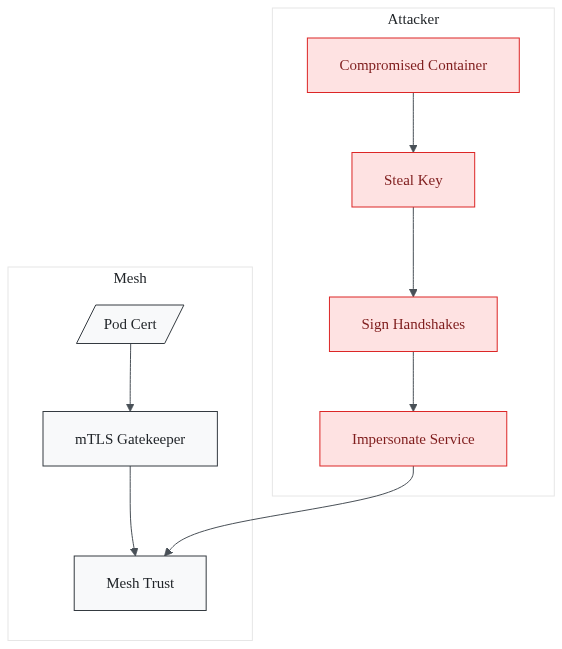
mTLS is often treated as the ultimate gatekeeper. However, it only proves “someone in the mesh” and not “the right process.”
1apiVersion: security.istio.io/v1beta12kind: PeerAuthentication3metadata:4 name: default5spec:6 mtls:7 mode: STRICT
The snippet forces every pod to present a certificate. That certificate, however, only confirms membership; it does not tie the certificate to the binary that generated it. - A compromised container can steal the pod’s private key. - The key allows the attacker to sign new TLS handshakes, impersonating any service that trusts the mesh’s root. - Because the mesh trusts any cert signed by its CA, the attacker passes the “bouncer” unchallenged.
The missing link is between identity and execution context. What happens when that link is broken?
Why Default Certificate Policies and Identity Gaps Leak Access
Most operators rely on the platform’s built-in CA. The CA rotates certs but does not tie them to anything immutable.
1openssl x509 -in /etc/certs/cert-chain.pem -noout -text | grep Subject
The output shows only the service name and namespace - no hash of the binary, no pod UID. This weak binding creates two dangerous gaps:
- Weak key material - many default CAs still generate 1024-bit RSA keys, which can be cracked with modest resources.
- Shared root trust - every workload trusts the same root, so a stolen cert works everywhere.
SPIFFE IDs label workloads, e.g. `spiffe://cluster.local/ns/default/sa/frontend`. But they carry no proof that the process inside the pod matches the ID.
1apiVersion: security.istio.io/v1beta12kind: RequestAuthentication3metadata:4 name: spiiffe-id5spec:6 selector:7 matchLabels:8 app: frontend9 jwtRules: - issuer: "spiffe://cluster.local"
A malicious sidecar can reuse the same SPIFFE ID. The mesh sees a valid cert and a valid SPIFFE ID, and assumes the request is legitimate. How can we create that immutable link?
Concrete Mechanism: Certificate Field Extraction
To illustrate the gap, extract the SAN from a running pod’s cert:
1kubectl exec -it frontend-abcde -- \2 cat /etc/certs/cert-chain.pem | \3 openssl x509 -noout -text | grep -i "Subject Alternative Name"
The SAN lists only DNS entries like `frontend.default.svc.cluster.local`. There is no reference to the container image digest or the pod’s UID. An attacker who copies the cert can present it from any container that runs on the same mesh. Since the mesh never checks the underlying binary, the attack succeeds. What comes next?
The Real Guardrail: Binding Workload Identity to Immutable Process State
Imagine the mesh’s bouncer now checks a fingerprint and a retinal scan. In the cloud world, the fingerprint is a hash of the container image. The retinal scan is the pod UID.
1apiVersion: v12kind: ConfigMap3metadata:4 name: attestation-manifest5data:6 manifest.json: |7 {8 "imageHash": "sha256:3b2a7f9c5d8e0f9a...",9 "podUID": "c5f8e9a1-4d2b-11ed-b878-0242ac120002"10 }
A sidecar reads this manifest and computes the runtime hash of the binary it’s about to launch. Then it compares the two. If they differ, the sidecar aborts the TLS handshake.
Step-by-Step Manifest Signing
- Compute the image digest at build time and store it in a CI artifact.
- Create a JSON manifest containing the digest and the pod UID (available from the Downward API).
- Sign the manifest with a private key held in a vault.
1cat manifest.json | openssl dgst -sha256 -sign /etc/vault/attest.key -out manifest.sig
- Upload the signed pair (`manifest.json` + `manifest.sig`) to a trusted secret store.
The sidecar fetches the pair at startup:
1func verifyManifest(manifest, sig []byte, pubKey crypto.PublicKey) error {2 hash := sha256.Sum256(manifest)3 return rsa.VerifyPKCS1v15(pubKey.(*rsa.PublicKey), crypto.SHA256, hash[:], sig)4}
If verification passes, the sidecar hands the TLS cert to the mesh. Otherwise it exits with a non-zero status. This causes the pod to fail. What does the rollout look like?
Bullet List: What the Agent Checks - Image digest matches the one signed in the manifest. - Pod UID matches the UID recorded at manifest creation. - Signature validates against the vault’s public key. - Certificate’s SPIFFE ID aligns with the manifest’s namespace and service name.
When any check fails, the agent refuses to start the main container. The mesh never sees a rogue cert. How do we apply this across a production mesh?
Step-by-Step Hardening: From Cert Issuance to Continuous Verification
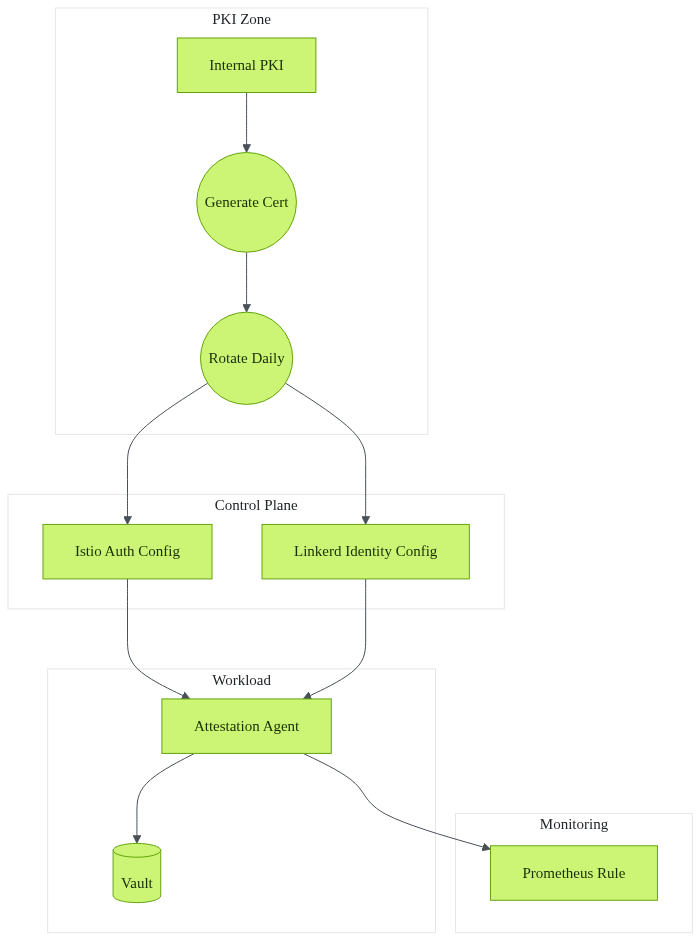
- Enforce a strong certificate lifecycle - Use 2048-bit RSA or ECDSA-P256 keys. - Rotate every 24 hours. - Replace the mesh’s default root CA with an internal PKI that enforces these rules.
```bash
openssl genpkey -algorithm RSA -pkeyopt rsa_keygen_bits:2048 -out key.pem
openssl req -new -key key.pem -out csr.pem -subj "/CN=frontend.ns.svc.cluster.local"
```
- Enable workload identity validation in the control plane - For Istio, add a `PeerAuthentication` with `STRICT`. Also add a `RequestAuthentication` that checks the SPIFFE ID against the pod UID.
```yaml
apiVersion: security.istio.io/v1beta1
kind: RequestAuthentication
metadata:
name: uid-check
spec:
selector:
matchLabels:
app: frontend
jwtRules: - issuer: "spiffe://cluster.local"
audiences: - "frontend"
``` - For Linkerd, set `identityIssuer` to a custom CA and enable `identityTrustAnchors`.
See the detailed guide in Zero-Trust in Kubernetes for more on configuring custom CAs.
- Deploy sidecar runtime attestation - Use a lightweight agent (e.g., `kube-attest`) that runs before the main container. - The agent fetches the signed manifest from Vault, hashes the binary (`sha256sum`), and aborts on mismatch.
```yaml
apiVersion: v1
kind: Pod
metadata:
name: frontend
spec:
initContainers: - name: attest
image: levitation/attest-agent:latest
env: - name: VAULT_ADDR
value: "https://vault.internal"
command: ["./attest"]
```
- Add continuous monitoring - Deploy a Prometheus rule that fires when a pod’s cert expiration is under 12 hours. Also fire when the attestation agent reports a failure.
```yaml
groups: - name: mesh-attestation
rules: - alert: AttestationFailure
expr: kube_pod_status_phase{phase="Failed"} == 1
for: 5m
labels:
severity: critical
annotations:
summary: "Pod {{ $labels.pod }} failed runtime attestation"
```
The rule is described in depth in our post on Monitoring Mesh Health.
- Automate drift detection - Run a nightly job that compares the current image hash in the cluster with the hash stored in the manifest.
```bash
kubectl get pods -o json | jq -r '.items[] | "\(.metadata.name) \(.status.containerStatuses[0].imageID)"' > live_hashes.txt
diff live_hashes.txt /opt/expected_hashes.txt && echo "No drift"
```
If drift is detected, the job triggers a redeploy with a fresh manifest. What does this mean for the business?
What Happens When the Backdoor Is Closed - Real Business Impact - Breach surface shrinks dramatically - a stolen cert cannot be reused because the sidecar rejects mismatched hashes. - Compliance audits become smoother - the signed manifest provides a provable chain of trust that satisfies “least privilege” requirements. - Developer velocity improves - teams stop writing ad-hoc scripts to rotate certs manually; automation handles rotation, attestation, and alerting.
These benefits translate into tangible ROI. A tighter mesh reduces incident response time, cuts forensic costs, and eliminates the need for emergency patches.
Concrete Business Gains - Faster time-to-remediation: incidents that once took days now resolve in hours. - Lower operational overhead: automation replaces manual key distribution. - Stronger vendor confidence: partners can verify the immutable identity link before granting access.
Enterprises that run AI workloads at scale already rely on this pattern. Levitation has helped organizations lock down their service meshes using the same principles. If you still treat mTLS as a set-and-forget toggle, you’re leaving a secret tunnel open. How can you start closing that tunnel?
Frequently Asked Questions
Can mTLS alone guarantee zero-trust in a service mesh?
No. mTLS encrypts traffic and authenticates workloads. But without strong identity binding and strict certificate management, it can be bypassed.
What's the most common misconfiguration that creates a backdoor?
Using default, long-lived certificates that aren’t tied to a specific process or pod. This allows an attacker who hijacks a process to reuse the cert.
How do I verify that my workload identity can't be spoofed?
Enable runtime attestation in each sidecar. Hash the binary at start-up and compare it against a signed manifest stored in a trusted vault.
Do I need to rewrite my application code to fix these issues?
No. All hardening steps are applied at the mesh or sidecar level. YAML policies, certificate rotation, and attestation agents are used, so existing services stay unchanged.
Secure your mesh today.
Sources
Research and references cited in this article:
- The Hidden Risk in Service Mesh mTLS: When Your Sidecar ...
- Zero trust, mTLS, and the service mesh explained - Buoyant.io
- Service Mesh Security: mTLS, Zero Trust, and Fine-Grained Authorization | Sayli R. posted on the topic | LinkedIn
- Advanced Istio mTLS Explained: Securing Microservices ... - YouTube
- Blog - Mesh Security
- Lab 7. Secure your service mesh - Istio 101 Workshop
- Securing Service Meshes with Authorization Policies and Non ...
- Why Mutual TLS (Mtls) Is Critical For Securing Microservices ...
- Service Meshes in 2026: mTLS, Traffic Shaping, and Operational ...
- PDF MisMesh: Security Issues and Challenges in Service Meshes _(academic)_
- How a Service Mesh Can Help With Microservices Security
About the author
Mayank Singh is a software developer at Levitation Infotech, where he builds web and AI-powered applications across the company’s fintech, healthcare, and enterprise projects.