
TL;DR: Most Indian SaaS founders default to SOC 2 without checking what their buyers actually demand. When the buyer base skews to EU enterprise, BFSI, or large Indian conglomerates, that default becomes a lost-deal signal. The fix is a buyer-geography test, a sequenced 12-month roadmap, and a shared evidence base that makes the second certification a marginal cost, not a second project.
Key Takeaways: - SOC 2 is the default first certification for Indian SaaS because the US ecosystem is built around it, not because your buyer base asked for it. - ISO 27001 certifies a management system. SOC 2 attests to controls. Buyers asking for ISO 27001 want the former, and they will not accept a SOC 2 report in lieu. - A combined 12-month roadmap reuses the same evidence base for both certifications, avoiding duplicate work and double spend.
The Compliance Identity Crisis Most Indian SaaS Founders Don't Notice
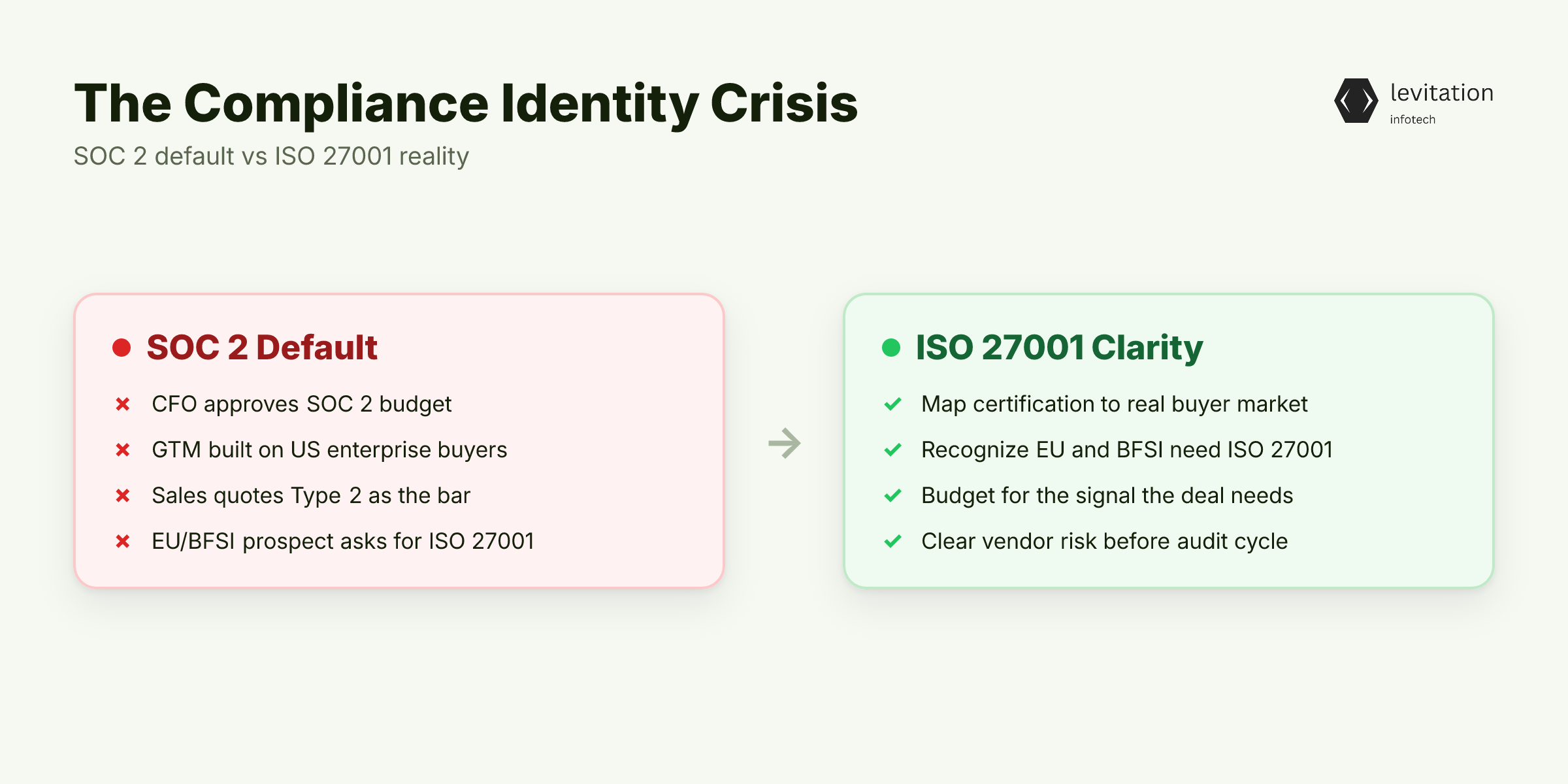
Your CFO approved the SOC 2 budget last quarter. Your largest EU prospect just asked for ISO 27001 in the security questionnaire. One of those decisions is about to cost you the deal.
Most Indian SaaS founders do not realise they have made a choice. They assume "security certification" is one thing, and SOC 2 is the obvious starting point. The data room fills with SOC 2 reports. The sales team quotes Type 2. The GTM motion is built around US enterprise, where SOC 2 Type 2 is now considered the minimum bar for any meaningful deal. Then a security questionnaire arrives from an EU prospect, a regulated BFSI buyer, or a large Indian conglomerate. The form asks for an ISO 27001 certificate. The answer comes back blank. The deal slips two quarters, or dies in vendor risk.
The mismatch shows up late, after the budget is spent and the audit cycle has begun. By then, the founder is paying for the wrong signal and the procurement team is explaining why the deal is stuck. This pattern repeats across Indian SaaS, from horizontal products selling to European mid-market to vertical products selling into Indian BFSI. The structural difference matters more than founders realise, and a practical iso 27001 certification guide for indian saas clarifies it before the next audit cheque is signed.
The default did not happen randomly. It was the path of least resistance, shaped by tooling, advisors, and the dominant buyer narrative in the founder community. Here is why SOC 2 won that mindshare in the first place.
Why SOC 2 Won the Indian Founder's Default
Three forces made SOC 2 the default. None of them are about your actual buyer.
First, the SaaS tooling stack is built around it. Vanta, Drata, Sprinto, Scrut, and a dozen other GRC platforms template their onboarding, evidence collection, and audit coordination around the SOC 2 Trust Services Criteria. The Indian founder who signs up in week one is gently herded into SOC 2 by the tool, not by the buyer.
Second, US enterprise procurement has standardised on SOC 2. Mid-market SaaS deals in the US treat SOC 2 Type 2 as a gate. If you are chasing the US mid-market first, SOC 2 is a rational first move.
Third, SOC 2 is structurally lighter. It is an attestation, not a certification. An auditor tests your controls against the Trust Services Criteria over an observation window and issues a report. There is no management system to run, no Statement of Applicability, no formal management review cycle. You can scope it tightly to one product. You can renew it annually with continuous monitoring.
ISO 27001 is a different animal. It is a management system standard that requires a formal ISMS: documented risk treatment, leadership accountability, internal audits, management review, and a Statement of Applicability. That is heavier to build and heavier to keep running.
This structural difference, not buyer demand, is the real reason SOC 2 became the default. The soc 2 vs iso 27001 comparison walks through the artefact-by-artefact difference, and why they are not interchangeable in a buyer's eyes. For a broader view on why compliance frameworks matter at all, why information security compliance is not optional lays out the cost of skipping it.
But ease of compliance is not the same as coverage of what your buyers actually demand. The buyer who specifically asks for ISO 27001 is not going to accept a SOC 2 report in lieu. That is where ISO 27001 enters the picture, not as a "better" certification, but as a different one.
What ISO 27001 Actually Proves That SOC 2 Cannot
ISO 27001 proves something SOC 2 cannot. It proves your security program survives people leaving. That is the buyer's actual question.
A SOC 2 Type 2 report covers an observation window, usually three to twelve months. It tells you the controls were operating during that window. It says nothing about what happens when the CISO quits, when the security engineer takes long leave, or when the founder pivots the product.
ISO 27001 certifies the management system behind the controls. It requires risk-based thinking, a Statement of Applicability, leadership accountability, internal audits, and management review at planned intervals. The auditor is not just testing whether access reviews happened. The auditor is testing whether your organisation can keep doing them when the original implementer is gone.
This is why EU enterprise procurement teams, large Indian conglomerates, and regulated BFSI buyers ask for ISO 27001 by name. They have been burned by vendors who passed a SOC 2 audit and then drifted within six months. The ISMS framework is the buyer's hedge against that drift.
The standard is part of the broader ISO/IEC 27000 family, and its controls align with modern threat models. Most buyers, however, do not read the standard. They read the certificate. The iso 27001 isms framework explained walks through the artefacts a buyer actually inspects: the SoA, the risk treatment plan, the internal audit reports, the management review minutes. These artefacts are why the buyer is asking.
For regulated segments like BFSI, the cybersecurity solutions for financial services playbook shows how the ISMS becomes the procurement gate.
So which one do you actually need first? It depends on a test almost no Indian SaaS founder runs before signing the audit cheque.
The Buyer Geography Test: Picking the Right First Step
Stop and look at your pipeline. Look at your qualified pipeline, not your total lead list. Count deals above your median annual contract value. Note the buyer's country and industry.
If the majority of that pipeline is US SaaS mid-market and enterprise, SOC 2 Type 2 first is the correct call. You will close more US deals in the next twelve months, and the SOC 2 investment compounds across that buyer base.
If you have meaningful EU enterprise exposure, regulated Indian BFSI buyers, healthcare buyers, or any deal that crosses a procurement team with an ISO 27001 requirement, ISO 27001 first is non-negotiable. Starting with SOC 2 means you will be back in audit within a year to start the ISMS work anyway.
Here is the mechanism that makes sequencing matter. Many of the same controls, including access reviews, change management, incident response, and vendor risk assessments, are required by both ISO 27001's Annex A and SOC 2's Trust Services Criteria, and the evidence collected for one framework can largely satisfy the other. The ISMS-specific artefacts (SoA, management review, risk treatment) have no SOC 2 equivalent. If you build the ISMS first, the access reviews, change management records, vendor risk assessments, and incident response evidence you generate already satisfy large parts of SOC 2. If you build SOC 2 first, the ISMS work still has to be done from scratch.
The asymmetric overlap is the real sequencing insight. Picking the harder standard first makes the second certification a marginal-cost add-on rather than a second project. For cost planning around the harder path, the iso 27001 certification cost in india breakdown shows why the first certification is the expensive one, not the second.
Whichever you pick first, the cost question is the next one the founder and CFO will ask. Here are the real numbers from the Indian market.
What ISO 27001 Certification Actually Costs in India
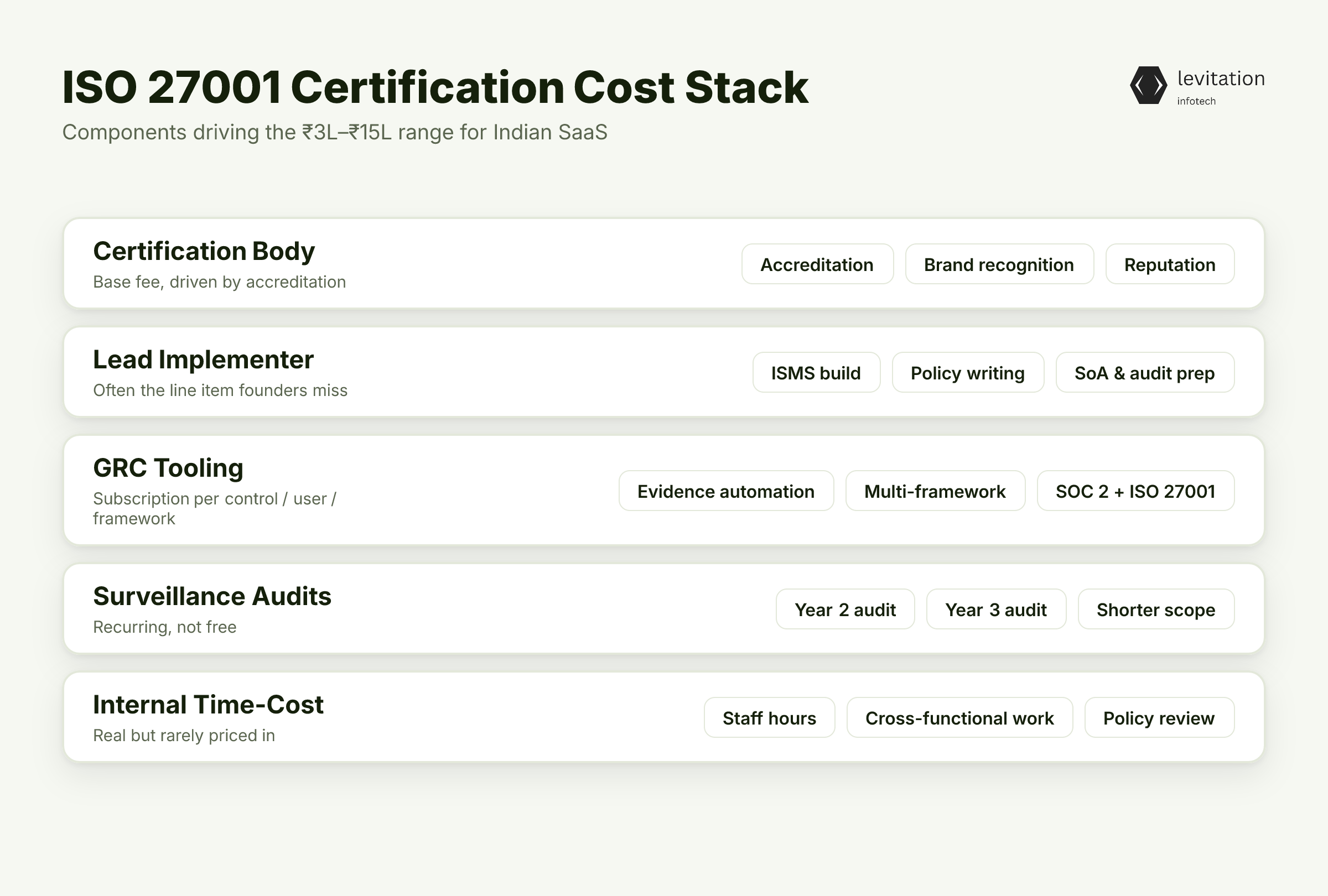
First-time ISO 27001 certification in India typically lands between ₹3,00,000 and ₹15,00,000. The wide range is not vendor opportunism. It reflects three real variables: headcount, scope, and the certification body. A 20-person SaaS company with a single product and one location sits at the low end. A 200-person company with multiple products, multiple geographies, and a BFSI customer base sits at the high end. The certification body's reputation, accreditation, and brand recognition also move the number. Accredited bodies with stronger international recognition cost more, and buyers in regulated segments notice the difference.
The number most founders miss is the consultant or lead implementer fee. The lead implementer helps you build the ISMS, write the policies, draft the SoA, and prepare for Stage 1 and Stage 2 audits. Without one, most first-time ISO 27001 attempts fail at Stage 1, because the documentation burden is steeper than it looks from the outside.
Then there is the tooling layer. GRC platforms charge per control, per user, or per framework. Annual subscriptions for a tool that supports both SOC 2 and ISO 27001 vary widely with company size, headcount, and the number of controls in scope. Surveillance audits happen in year 2 and year 3. They are shorter and cheaper than the initial certification, but they are not free. Plan for them.
SOC 2 Type 2 is usually cheaper upfront, especially with a GRC platform automating evidence collection. The hidden cost is the recurring annual audit plus continuous monitoring tooling. Over a three-year horizon, the lifetime cost of SOC 2 and ISO 27001 converges, especially if you run them on the same platform and the same evidence base.
The full picture, including consultant, tooling, surveillance, and internal time-cost, is laid out in this compliance cost breakdown for indian saas. The legal compliance rules that come into play for healthcare and BFSI buyers also affect the total cost picture.
Cost alone does not tell you the sequence. It tells you the price of the choice. The playbook that follows shows how to avoid paying for the same controls twice.
The 12-Month Sequencing Playbook: Both Without Doubling Spend
The goal is to reach both certificates in twelve months, on one evidence base, without doubling your team's audit workload.
Months 1 to 3: Build the ISMS scaffolding once. This is the foundation both certifications will share. You will write a risk register, a Statement of Applicability, an asset inventory, and an access control policy. You will stand up a change management process and a vendor risk process. None of this work is wasted. Every artefact here is reused downstream.
Months 4 to 8: Run the SOC 2 Type 1 observation window in parallel with the ISO 27001 Stage 1 audit. The Stage 1 audit is a documentation review. The auditor checks that your ISMS exists on paper. The SOC 2 Type 1 observation starts collecting evidence on the same controls: access reviews, change tickets, vendor reviews, backup logs. Your GRC platform becomes the single source of truth for both.
Months 9 to 12: Close out SOC 2 Type 2 and finish the ISO 27001 Stage 2 certification audit. Stage 2 is the on-site (or remote) audit where the certification body tests whether the ISMS actually works. Vulnerability scans, incident response records, HR offboarding evidence, and penetration test reports all flow to both auditors from the same repository.
The internal time cost runs across the twelve months and depends on how much engineering time you can dedicate versus hiring a dedicated compliance lead. Spread across two certifications, the combined effort is dramatically cheaper than running the projects sequentially from scratch. For a detailed month-by-month plan with artefact checklists, the soc 2 and iso 27001 combined roadmap walks through the same evidence reuse logic.
When the sequence is right, the certifications stop competing for budget and start compounding on the same evidence base. The cumulative effect on your deal pipeline is more interesting than the cumulative effect on your audit bill.
What Changes When You Stop Choosing One
Trust signals compound. SOC 2 closes the US mid-market deal that was stuck in vendor risk. ISO 27001 unlocks the EU enterprise expansion your AE has been chasing. Together, they clear regulated-industry procurement, where the questionnaire asks for both on the same audit trail.
The operational lift of running both is smaller than founders assume, especially once the ISMS exists. The cultural lift is larger. A functioning ISMS changes how engineering, product, and HR think about security, because the management review surface forces recurring conversations that SOC 2 alone does not.
Buyers in regulated segments do not ask "SOC 2 or ISO 27001". They require both, on the same audit trail. More on this in the levitation security and compliance practice.
The deeper point is that compliance is not a marketing line. It is the operating system that lets regulated buyers trust you with their data. The founder who picks one certification and stops is paying for a partial signal. The founder who builds the ISMS once and reuses it across frameworks is paying for a system. The choice is not which certificate to buy. The choice is whether to build a system or rent a checkbox.
Frequently Asked Questions
Is SOC 2 enough for European enterprise buyers?
No. Most EU enterprise procurement teams and financial services buyers specifically ask for ISO 27001 certification. SOC 2 is treated as a US-market signal and does not satisfy the ISMS requirement those buyers carry.
How much does ISO 27001 certification cost in India?
First-time ISO 27001 certification in India typically ranges from ₹3,00,000 to ₹15,00,000. Costs vary with headcount, number of sites, scope of the ISMS, and the chosen certification body. Surveillance audits in year 2 and year 3 add to the lifetime cost.
Can a company get SOC 2 and ISO 27001 at the same time?
Yes. Many of the same controls (access reviews, risk assessments, policies, incident response) are required by both frameworks, and the evidence collected for one can largely satisfy the other. A combined 12-month roadmap avoids duplicate work and keeps total audit cost lower than running the two certifications sequentially from scratch.
Which is harder to achieve: SOC 2 or ISO 27001?
ISO 27001 is generally harder because it requires a functioning ISMS, management review, and a Statement of Applicability. It tests the operating system of security, not just the controls.
Sources
Research and references cited in this article:
- ISO 27001 vs SOC 2: What's the Difference?
- SOC 2 vs ISO 27001: Which One Do You Need in 2026?
- SOC 2 vs ISO 27001: Which Cybersecurity Standard Fits ...
- ISO 27001 vs SOC 2 Certification: What's the Difference?
- ISO 27001 vs. SOC 2: What is the difference?
- ISO 27001 Certification Cost 2026
- ISO 27001 Certification Cost in 2026: A Complete Guide
- ISO 27001 Certification India: Cost & Process | IncorpX
- ISO 27001 Certification Cost in India - Complete Pricing Guide 2026 | TCSA
- Understanding ISO 27001 Certification Cost in India for 2026
- SOC 2 to DPDP: India Privacy Compliance Guide for ...
- SOC 2 Compliance for Indian SaaS Startups for USA Market 2026
About the author
Mayank Singh is a software developer at Levitation Infotech, where he builds web and AI-powered applications across the company’s fintech, healthcare, and enterprise projects.