


TL;DR: Most internal developer platforms (IDPs) fail quietly. They try to do too much for too many teams. They take years to ship. A golden paths model gives developers paved roads for common workflows in a fraction of that time. It costs less to maintain and produces measurable adoption once it's in place.
Key Takeaways: - Only 22% of platform initiatives are described as "extremely successful," and 45% of platform teams track no metrics at all - A first golden path can ship far sooner than a full in-house IDP, which typically takes years - Track three metrics, including adoption rate, lead time to production, and platform team time-to-value, to make the investment provable
The 78% Problem: Why Platform Engineering Is Failing Quietly
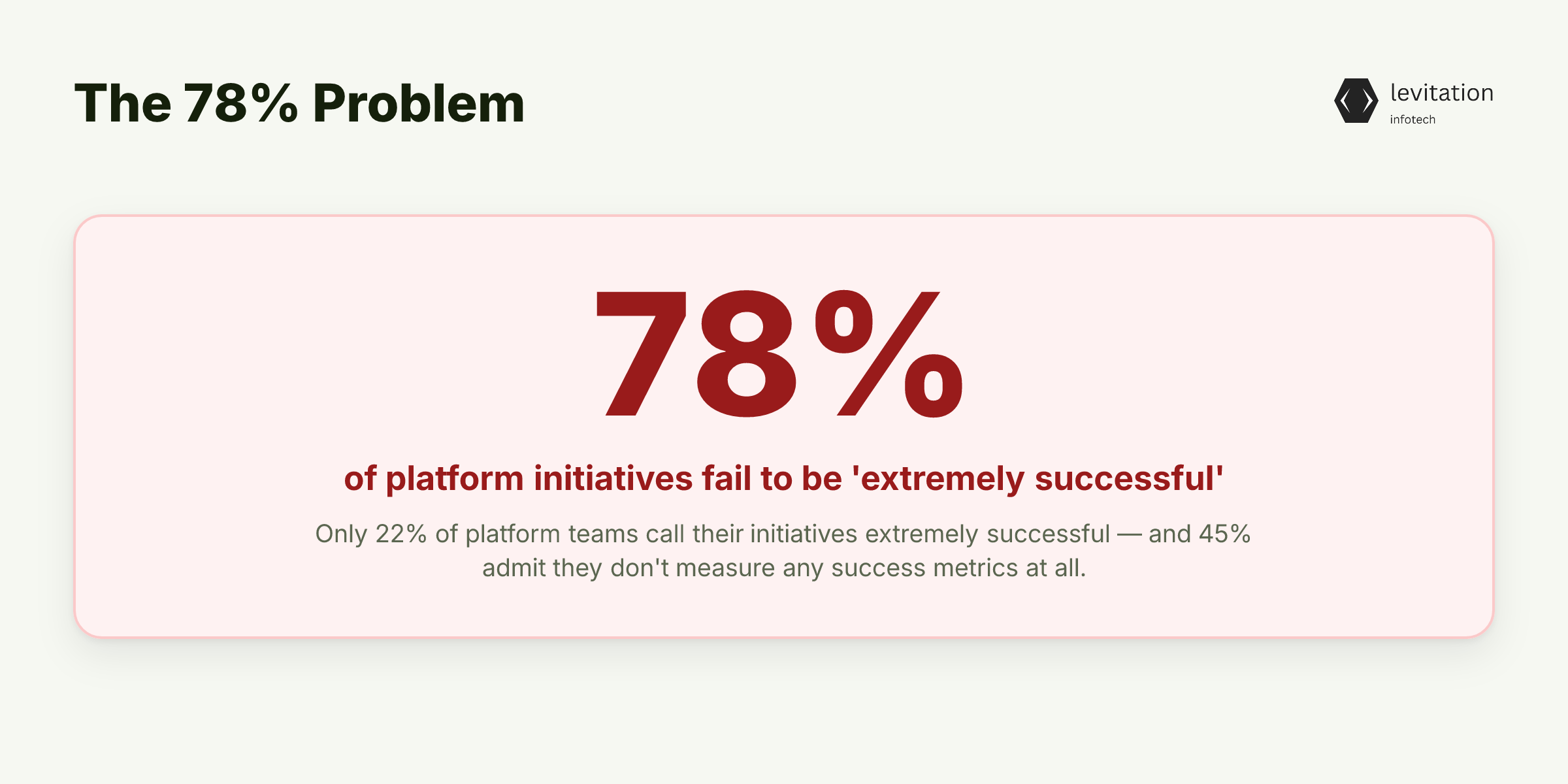
Your platform team just shipped v2.0 of the internal developer platform after a multi-year build. The uncomfortable truth: only 22% of platform engineers and IT decision-makers describe their platform initiatives as "extremely successful."
The remaining 78% sit somewhere between "moderate" and "very successful." That's a polite way of saying "we shipped it, but we can't prove it changed anything."
Even more telling, 45% of platform teams admit they don't measure any metrics to assess platform success. No adoption tracking. No lead-time data. No developer NPS. Just vibes and a roadmap deck.
The gap between investment and outcome is now the defining problem in platform engineering. Every new feature shipped to an internal developer platform is a feature a small team has to maintain, document, and support.
If you want a primer on what platform engineering is, the platform engineering overview is a solid starting point. Most teams skip the framing and jump straight to architecture diagrams.
If the core problem isn't tooling or talent, what is it? And why does the obvious fix, building a better platform, keep making things worse?
Why Building a Bigger Platform Makes the Problem Worse
The instinct when an IDP underperforms is to add more features. A service catalog. A secrets manager. A cost dashboard. A policy engine.
Each addition feels small. The cumulative effect is brutal. Every new IDP feature expands the surface area a small platform team has to maintain, document, and support. The math is simple: every service added is a service the team owns forever, including its 3am pages.
Then there's the time problem. Multi-year in-house build windows mean several full release cycles pass before the first paved road ships to developers. By the time the platform is "ready," the workflows it was designed for have shifted. The Kubernetes version has changed. The team's preferred language has changed. Developers have built their own scripts to avoid waiting for the platform team.
The common internal developer platform pitfalls almost always trace back to this combination: over-scoped surface area plus a long delivery window.
For comparison, a focused golden path can ship in a fraction of that time with a small team. The shape of the work is different.
You're not building a general-purpose platform. You're encoding one opinionated workflow that works end to end.
Less code. Fewer integrations. Faster feedback.
So the fix to "too much complexity" can't be "more platform." It has to be a different shape of solution entirely, one that gives developers speed without giving the platform team a maintenance burden.
The Golden Path Model: Paved Roads Over Skyscrapers
A golden path is a preconfigured, opinionated route for a common developer task. Deploy a service. Provision a database. Run a CI pipeline.
Each path has been built, tested, and documented end to end.
The developer doesn't pick tools from a menu. They walk a road.
The key shift is that golden paths are products, not infrastructure. Each one has an owner, a versioning policy, a deprecation date, and a metric for how many developers are walking it. The deeper explanation lives in golden paths explained. The short version: a path without a product owner is just a script that breaks silently.
The model works because it inverts the default. Developers don't choose a platform, they choose a path.
The platform team has made the right path the easy path. Wrong choices are still possible, but they're harder.
For a deeper look at treating platforms as products, the platform as a product framing is essential reading.
Here's what a minimal golden path template looks like in practice: a Backstage scaffold for a new microservice:
1apiVersion: scaffolder.backstage.io/v1beta32kind: Template3metadata:4 name: microservice-golden-path-v15 title: Deploy a New Microservice6 description: Opinionated path for spinning up a production-ready service7spec:8 type: service9 owner: platform-team10 parameters: - title: Service Info11 properties:12 serviceName:13 type: string14 pattern: '^[a-z][a-z0-9-]{2,40}$'15 owner:16 type: string17 tier:18 type: string19 enum: [standard, regulated]20 default: standard21 steps: - id: fetch-base22 action: fetch:cookiecutter23 input:24 url: https://git.internal/templates/microservice - id: configure25 action: github:repo:create - id: provision26 action: kubernetes:create-namespace - id: deploy27 action: argocd:bootstrap
Three fields, four steps, one service in production. This minimal shape reflects teams who scope ruthlessly to one workflow at a time.
If golden paths sound simpler, they are. The next question is when you should still build a full IDP, because sometimes the skyscraper is the right answer.
When You Should (and Shouldn't) Build a Full IDP
Not every team should be on golden paths. Some teams genuinely need a full IDP, and forcing them onto a paved-road model will leave gaps that hurt the business. The decision is a function of organizational complexity, not engineering ambition.
Build a full IDP when you have: - Engineering orgs large enough that the abstraction tax is worth the cost - Multiple distinct compliance or regulatory surfaces - Centralized policy enforcement that can't be opt-in
Stick to golden paths when: - Your team is small enough to share context easily - Your product surface is narrow - Your platform function is still early
The bigger the org, the more the abstraction tax is worth paying. A small startup that builds a Backstage instance full of plugins it doesn't need is paying for complexity it can't sustain. A large regulated bank that skips centralization is paying in audit failures. The IDP vs golden paths decision framework walks through this tradeoff. The rule of thumb: match the abstraction to org size, not platform team ambitions.
For most teams, the answer is golden paths, but the execution is where most roadmaps stall. So the practical question becomes: how do you actually ship one without repeating the multi-year mistake?
How to Ship a First Golden Path Without the Multi-Year Build
A focused first golden path is realistic when you scope the work to one workflow. The right starting point is almost always "deploy a new microservice to production." It's the workflow every team repeats. It has the most variation in practice. If your existing deployment scripts are scattered, the architecting microservices on Kubernetes guide shows a clean target. Look at it before you templatize.
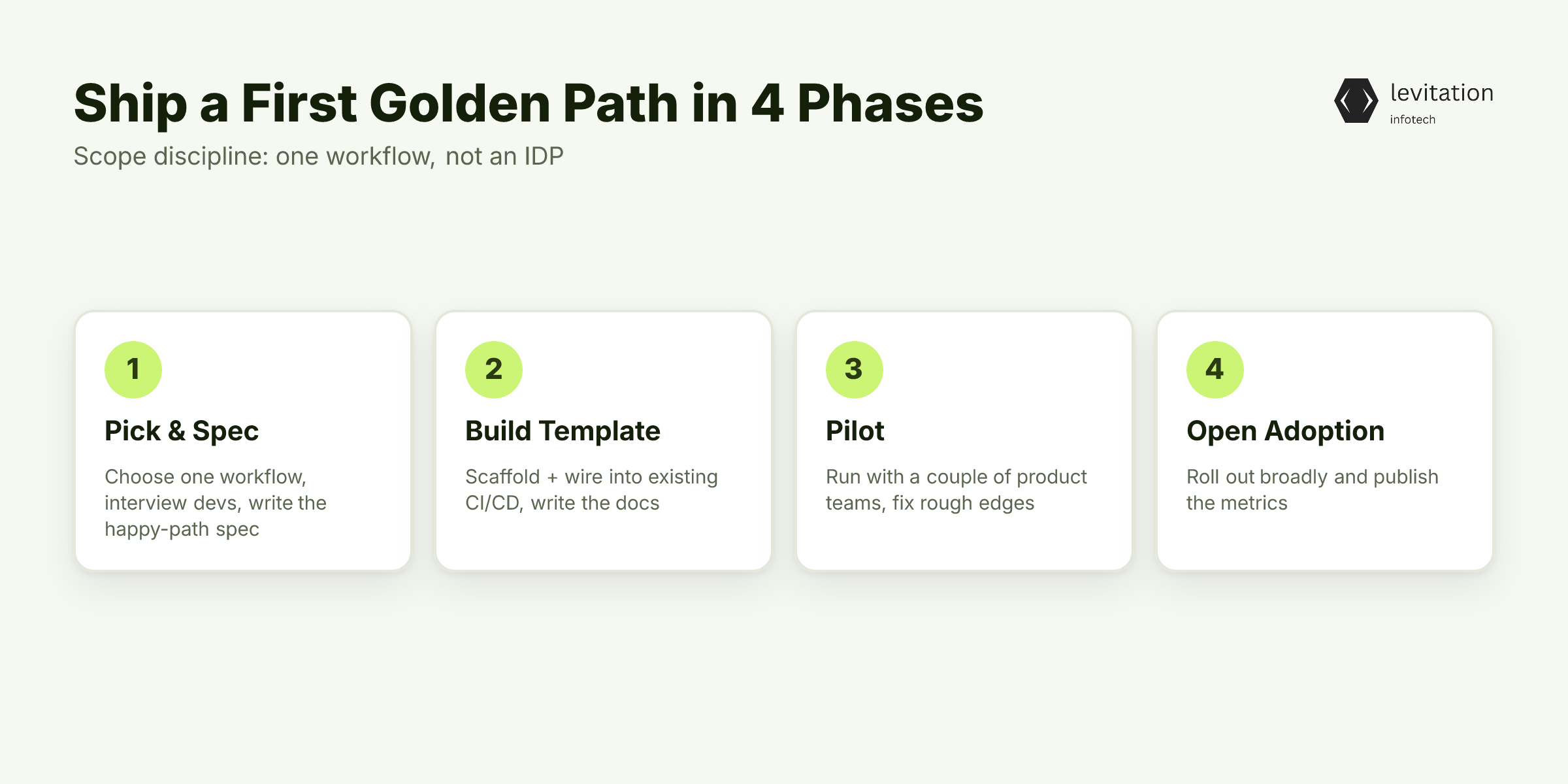
The pace is set by scope discipline. Anything that slips beyond a focused effort means you're building an IDP, not a golden path. You should reset scope. Here's a realistic four-phase breakdown: - Phase 1: pick the workflow, interview developers, write the "happy path" spec - Phase 2: build the template, wire it to your existing CI/CD, write the docs - Phase 3: pilot with a couple of product teams, fix the rough edges - Phase 4: open adoption broadly, publish the metrics
The pitfall is letting the template scope creep.
A Backstage scaffolder for a "new microservice" is a golden path. A Backstage scaffolder that supports a dozen languages, multiple databases, several deployment targets, and configurable observability is an IDP.
If you're past the early phase and still debating tech choices, you've over-scoped.
For regulated industries, this pattern is even more valuable. Opinionated defaults can encode compliance controls directly into the template.
A "regulated" tier in your scaffolder can wire in audit logging. It can add encryption-at-rest. It can enforce access policies before the developer writes a line of code.
The pattern treats compliance baseline as a first-class concern. Compliance-aware scaffolder patterns for healthcare, finance, and payments are worth studying for the regulatory angle.
Shipping the path is half the work. The other half is proving it's working, which is the part 45% of platform teams skip entirely. The right platform engineering metrics are the ones that tell you whether developers are actually walking the path.
The Three Metrics That Actually Prove Platform Value
Tracking everything is worse than tracking nothing, because "everything" gets ignored. Pick three. Make them visible in a dashboard leadership sees once a month. - Adoption rate. Percentage of eligible developers who used the golden path in the last 30 days. Low adoption almost always means the path is wrong, not the developers. The fix is rarely "tell them again." It's usually "the path is missing the workflow they actually need." - Lead time reduction. Time from "first commit on a new service" to "running in production." The gold standard is short enough that a developer can ship same-day. Pre-platform, this is often measured in weeks. If your path doesn't move this number, it isn't a path. It's a decoration. - Platform team time-to-value. Hours from a developer Slack message to a working fix or new template. This is the operational health metric most teams ignore. A platform team that takes days to ship a new template is a bottleneck, not an enabler.
The developer velocity measurement framework goes deeper on each metric. The trio above makes the platform function's value legible to a CFO. Track these three and leadership stops asking whether platform engineering is worth the headcount.
So what does life look like on the other side of the switch?
What Changes When You Stop Building and Start Paving
The platform team shifts from building a product to curating a catalog. The work gets smaller, faster, and more measurable. Instead of a multi-quarter roadmap, you ship one path per cycle, watch adoption, deprecate what doesn't work.
Developers get a default that works on day one instead of a platform they have to learn. Cognitive load drops. Velocity climbs.
The "how do I deploy this?" Slack thread goes silent.
Teams that make this switch see the partnership between platform and product teams stabilize. The platform is delivering something concrete every cycle, not a roadmap that may or may not ship.
For platform teams that go through this transition, the engagement is sticky. Organizations that adopt this model keep the investment because the value is provable cycle after cycle. The platform engineering case studies bear this out: durable retention follows durable value, not the other way around.
If you're staring at a multi-year IDP roadmap and wondering whether to keep going, the answer is usually "stop, and ship one path quickly." Paved roads beat skyscrapers for most teams. The pattern holds across platform functions of every size. The teams that switch almost never go back.
Frequently Asked Questions
Q: What is the difference between platform engineering and an internal developer platform?
A: Platform engineering is the discipline: the team, the product mindset, the practices. An internal developer platform is one possible output of that discipline. You can practice platform engineering by shipping golden paths. You can do this without ever building a full IDP. That is the point of the paved-roads model.
Q: How do I know if my platform team should build an IDP or use golden paths?
A: Use the scale test: small teams with a narrow product surface usually win with golden paths. Large teams across multiple regulated domains usually justify a full IDP. Most teams sit in the middle and over-build. That is the failure pattern we keep seeing.
Q: What metrics should platform teams track to prove success?
A: Three: golden path adoption rate, lead time from first commit to production, and platform team time-to-value on developer requests. 45% of platform teams track none of these, which is why leadership trust erodes.
Q: How long does it take to implement a golden path approach vs. a full IDP?
A: A first golden path can ship within a single quarter with a small focused team. A full internal developer platform typically takes years for an in-house team to reach a comparable state of usefulness. The difference reflects scope discipline, not team speed.
Q: Can a golden path strategy work in regulated industries like healthcare?
A: Yes, and arguably better than a configurable IDP. The opinionated defaults can encode HIPAA, SOC 2, or PCI controls directly into the template. The platform team's job becomes maintaining that compliance baseline rather than policing configuration drift. This pattern treats compliance as a paved road rather than a configurable layer.
Sources
Research and references cited in this article:
- Top 6 Internal Developer Platforms for 2026 | Blog — Northflank
- Internal Developer Platform Benefits + Best Practices | Atlassian
- Five product management principles for internal developer platforms
- Internal Developer Platforms: Top 5 Use Cases & 5 Key Components
- Accelerating Adoption with Internal Developer Platforms
- 5 Crucial Benefits of Internal Developer Platforms - Platform Engineering
- 10 Reasons NOT to Invest in an Internal Developer Platform and What to Do Instead | LinearB Blog
- Common Pitfalls of Internal Developer Platforms (and How ...
- Platform Engineering in 2026: 5 Shifts Driving the Rise of Internal ...
- PDF BARRIERS TO ADOPTION OF INTERNAL DEVELOPER PORTALS ...
- What are Golden Paths in platform engineering?
- How to Build Golden Paths Your Developers Will Actually Use
About the author
Mayank Singh is a software developer at Levitation Infotech, where he builds web and AI-powered applications across the company’s fintech, healthcare, and enterprise projects.