


TL;DR: A low ISO 27001 quote may cover the certificate path without pricing every risk-treatment cost. Compare vendors through one scope, one debt register, explicit treatment choices, and acceptance criteria. The cheapest visible total may hide the largest engineering exposure.
Key Takeaways: - An ISO 27001 certificate assures ISMS conformity within scope, not clean or vulnerability-free code. - Technical debt becomes audit-relevant when it affects risk treatment, control operation, or evidence. - Every quote should separate fixed certification work from estimated, excluded, and change-triggered remediation.
Why a Low ISO 27001 Quote Can Hide Expensive Work
A reassuring ISO 27001 quote can still conceal the work most likely to trigger change requests. The issue is not whether the certificate guarantees clean code. It does not.
An ISO 27001 certificate gives independent assurance that an organization's information security management system, or ISMS, conforms within its stated scope. It doesn't attest that every product or codebase is defect-free.
That boundary matters when comparing ISO 27001 certification cost in India estimates. A low quote isn't inherently wrong. It becomes misleading when excluded remediation can still alter evidence, timelines, control effectiveness, or final cost.
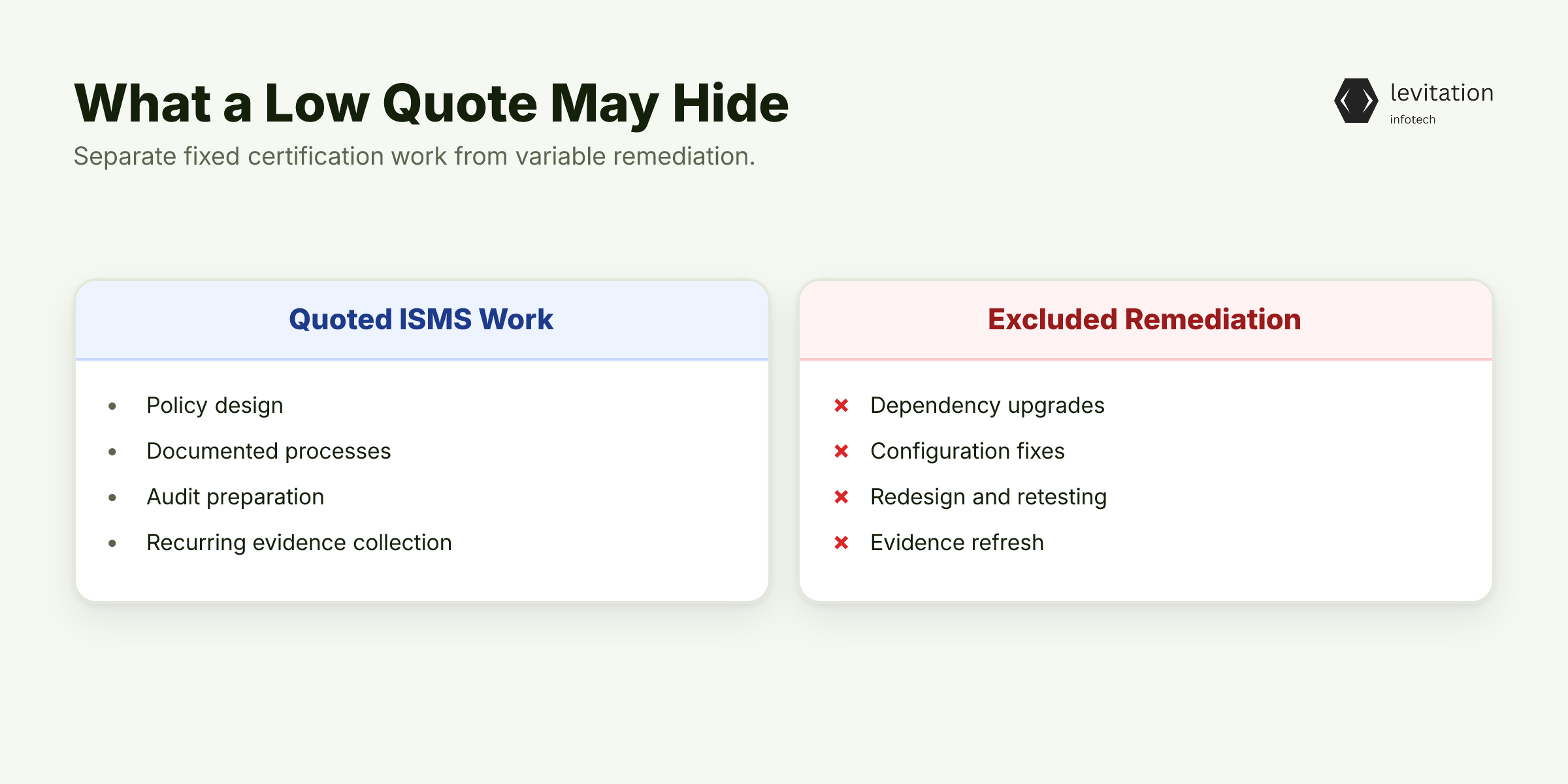
Commercial packages may separate two kinds of work. Repeatable ISMS and audit work may have a fixed price. Variable remediation work may sit outside it.
Repeatable work includes policy design, documented processes, audit preparation, and recurring evidence collection. Variable work includes dependency upgrades, configuration fixes, documentation reconstruction, redesign, and retesting.
Imagine a customer portal with an unsupported library. A readiness package may document vulnerability scanning while excluding the upgrade, regression testing, and evidence refresh. Those exclusions can look harmless until the control must work in production.
Verified data does not show a universal India-wide omission.
The more useful diagnosis is commercial. One provider may sell the certification engagement. Another may price risk treatment.
The first move is to separate what the certificate covers from the work the business still owns. Which costs belong to each side?
The Annex A Checklist Can Hide the Current-State Backlog
A control checklist can look reassuring on a slide. It still doesn't tell you what your engineers must fix before the audit.
What the Annex A controls actually tell you
ISO/IEC 27001's Annex A organizes controls across organizational, people, physical, and technological themes. Together, they form a risk-management framework rather than a complete inventory of existing weaknesses.
Think of the checklist as a destination map. It shows required risk-management outcomes, but it doesn't measure the broken bridges between your current state and those outcomes.
Why control coverage isn't a remediation estimate
A control describes an outcome the organization must manage. A technical-debt item describes a specific gap in the current state.
For example, access control is a control outcome, while a dormant administrator account without a review trail is a debt item. Counting the control doesn't reveal the account's ownership, dependencies, remediation effort, or acceptance evidence.
The estimate therefore depends on several factors: the asset's condition and exposure, risk treatment, dependent changes, required evidence, and any retesting needed for closure.
Where debt disappears
Dependency and security debt is often tracked separately from code quality. This creates visibility gaps. Outdated libraries, known vulnerabilities, and unpatched CVEs can remain outside the conversation that produced the quote.
When technical-debt tracking stops, ownership can sit in a security tool. Remediation can sit in an engineering backlog. Neither team then sees the full commercial exposure.
Why documentation debt changes readiness
Missing or outdated documentation increases tribal-knowledge risk. When the engineer who understands a system leaves, the remaining team inherits a black box.
That black box slows evidence collection, incident response, and control verification. It can also delay remediation because reviewers cannot confirm affected assets, workflows, or data flows.
Build the scope ledger
Create a scope ledger before asking vendors to price the work. Use the ISO 27001 audit scope checklist to record business units, locations, services, systems, and data flows. The ledger must also record third-party dependencies, exclusions, and accountable owners.
List material dependencies separately. This prevents supplier-managed or excluded assets from disappearing inside a broad scope statement.
Once scope and backlog are visible, the omission looks less like a standards gap. It looks more like a packaging decision. Is the quote selling a repeatable engagement, a risk-treatment program, or only the certificate path?
Technical Debt Becomes Audit-Relevant When Risk Makes It Visible
A vulnerable library does not become an audit issue merely because it sits in a repository. It becomes audit-relevant when it affects risk treatment inside the ISMS scope.
No universal cause, but a practical commercial mechanism
Research does not establish one definitive reason technical debt is absent from Indian quotes. One practical commercial mechanism is the handoff among three workstreams: repeatable certification packages, variable implementation backlogs, and ongoing operational ownership.
The handoff can look sensible from each team's perspective: the consultant may own documentation and audit readiness, engineering may own backlog delivery, and operations may own recurring control operation. The customer still carries the combined exposure.
Translate debt into risk scenarios
Map each debt item to a plausible scenario, not a vague risk statement. A useful technical debt remediation estimate starts with that connection.
For example, an unpatched CVE may be linked to potential exploitation, a weak configuration to control failure, and missing documentation to delayed or incorrect incident response. Inconsistent APIs can lead to brittle changes or control drift.
The treatment changes with the scenario. A patch may require redesign and regression testing. A configuration correction may require control validation. Accepted risk requires explicit ownership and review.
Keep the distinction explicit
Technical debt is not automatically an ISO 27001 non-compliance finding. It becomes relevant when it affects risk treatment, control objectives, or evidence for in-scope activities.
This distinction protects the project from two opposite errors. The first treats every backlog item as a certification blocker. The second assumes the certificate removes the business need to address exposed risk.
Connect three ledgers
Maintain three linked ledgers. The compliance ledger records clauses, controls, and evidence. The risk ledger records scenarios, impact, and treatment.
The debt ledger records assets, observed weaknesses, dependencies, and engineering work. Each material debt item needs traceable links across all three.
A compliance item without an asset is hard to test. A debt item without risk is hard to prioritize.
Make the treatment decision explicit
Remediation, mitigation, formal risk acceptance, deferral, and exclusion create different cost and evidence implications. The quote should name the selected option. Do not let an unresolved item become an audit surprise.
A risk-linked debt item can now be estimated, accepted, or excluded deliberately. Which treatment can you defend when evidence collection begins?
Build a Scope-to-Remediation Quote in Seven Steps
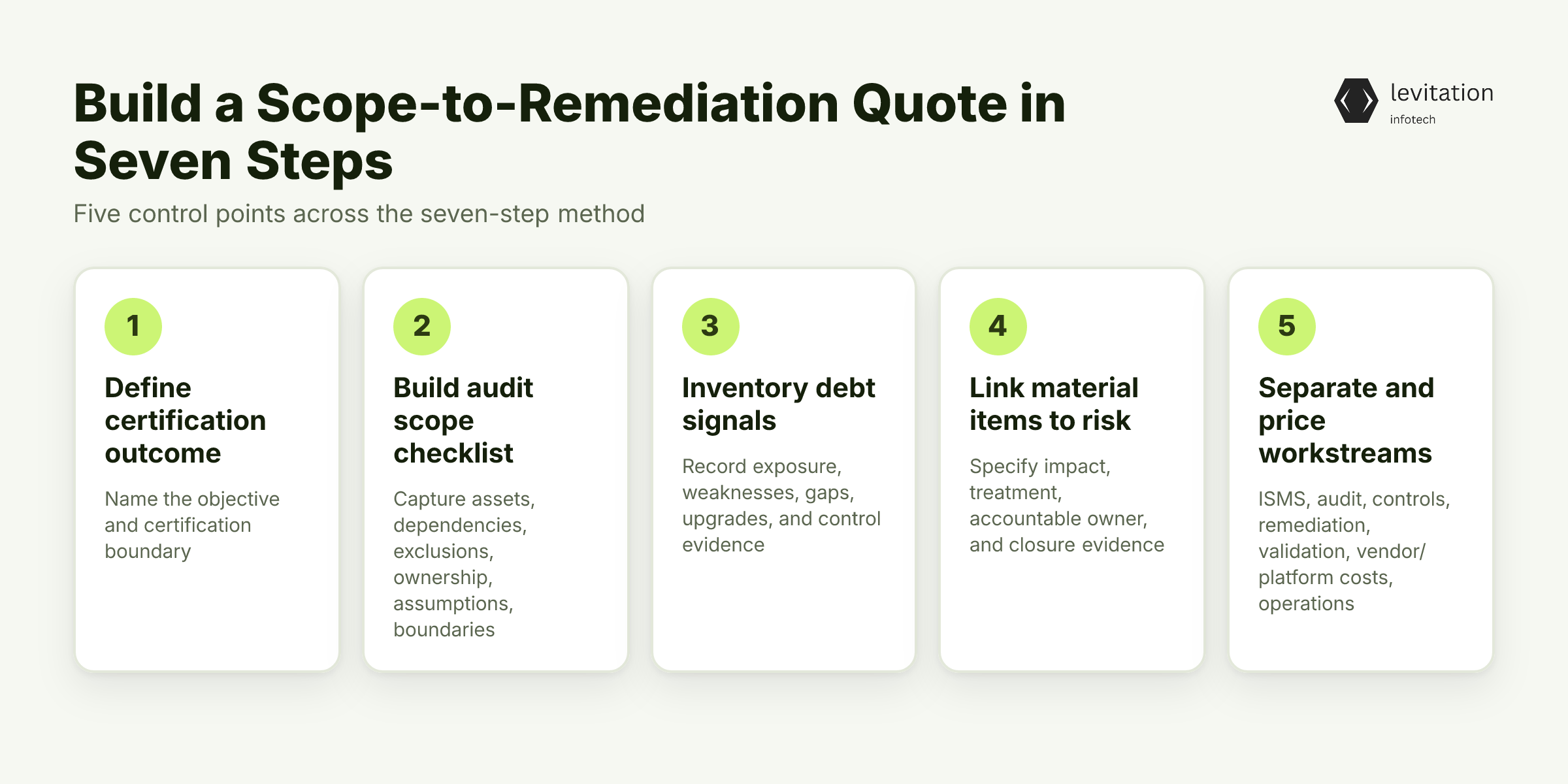
A useful estimate acts as a control system for commercial decisions. It connects scope, risk, debt, work, and acceptance in one visible chain.
1. Define the certification outcome
Name the business objective the engagement must support. Then identify the activities, services, and information intended for the stated ISMS scope.
If the objective is customer assurance, state that directly. The certification boundary must support the claim, not merely surround it.
2. Build the audit scope checklist
Use the ISO 27001 audit scope checklist to record in-scope entities and assets. It should also include material dependencies, supplier-managed components, exclusions, ownership, and assumptions.
Mark every boundary that could affect audit evidence but sits outside the quotation. This includes legacy services, shared platforms, inherited cloud resources, and critical supplier systems.
3. Inventory debt signals
Examine dependency and vulnerability exposure, configuration weaknesses, documentation gaps, knowledge concentration, and design inconsistencies. Also assess the upgrade paths for unsupported components. Record the control evidence each system can produce.
Keep this inventory factual until each item has been assessed and linked to risk. Raw findings aren't estimates, and they shouldn't inflate the quote.
4. Link every material item to risk
For each material item, record the affected asset, relevant scenario, potential impact, and control relationship. Also specify the treatment option, accountable owner, and evidence required for closure.
This is where the technical debt remediation estimate becomes commercially meaningful. The unit of work now has a reason, an owner, and a closure condition.
5. Separate the quote into visible workstreams
Split the quote into seven visible workstreams. The first four are ISMS design and documentation, audit preparation, control implementation, and technical-debt remediation. The last three are validation or retesting, third-party and platform expenses, and recurring control operation.
This prevents an inexpensive certification package from hiding an expensive operating model.
6. State the pricing basis
Distinguish fixed fees from estimates. Separate labor from licence or platform costs. Distinguish included work from excluded assets.
Place assumptions, dependencies, and named exclusions beside every amount. An amount without a pricing basis isn't a commitment.
7. Define acceptance and change control
Each remediation line should specify its owner, dependencies, deliverables, acceptance evidence, retest requirement, price, and renegotiation trigger.
The final quote schedule should let a CTO trace every cost back to scope, risk, and treatment. If that trace fails, the estimate is still a guess.
A structured estimate only helps when every vendor presents it on the same boundary and with the same assumptions. What changes when one quote contains assumptions the others hide?
Compare Indian ISO 27001 Quotes on Total Exposure
Two providers can describe similar certification work while quoting different products. One may include remediation, audit support, internal evidence, and recurring maintenance. The other may cover only readiness or audit assistance.
Comparing headline totals therefore compares different boundaries.
Compare the same scope
Normalize scope and workstreams before comparing prices. This is why why ISO 27001 projects vary so widely must be read as a boundary problem, not merely a vendor comparison.
The ISO 27001 certification cost in India becomes meaningful only when every proposal describes the same organization, assets, controls, evidence, and operating period.
Use a decision checklist
Ask vendors to confirm specific project parameters. These include the precise ISMS boundary, included and excluded assets, and the treatment of dependencies. Also confirm ownership of each debt item, acceptance criteria, and retesting requirements.
Confirm the assumptions, recurring costs, and process for approving scope changes. A written answer exposes commercial assumptions. A verbal reassurance usually doesn't.
Recognize warning signs
Several warning signs indicate an underdeveloped estimate: a single all-inclusive number, a checklist based on Annex A offered as a complete implementation plan, undefined exclusions, remediation described vaguely as future enhancement work, and no requirement to validate the result.
An all-inclusive number can be reasonable. It becomes risky when the provider cannot explain its boundaries.
Evaluate delivery evidence
Relevant experience in regulated environments is a useful due-diligence signal. Deployment volume isn't proof of a specific ISO 27001 outcome. It cannot replace scope, methodology, ownership, and acceptance review.
The lowest visible quote may carry the largest unpriced exposure. A quote exposing boundaries and treatment assumptions gives the CTO a stronger basis for comparison. Does your evaluation process expose them?
A Defensible Budget Is the Real Certification Payoff
A certificate is a milestone. It isn't the budget. A properly scoped quote helps reduce late surprises because engineering, security, and audit leaders share one asset inventory and risk register.
A defensible certification budget delivers four operational benefits. It supports traceable treatment decisions, clearer ownership, fewer late changes, and a board narrative that separates certification from sustainable control operation.
Imagine a board asking why a library upgrade sits inside certification spending. The answer is precise. Establishing the ISMS is one investment. Making the selected treatment sustainable is another.
Documented decisions also improve evidence quality. Auditors can see not only that a control operates, but why a technical-debt exposure was remediated, mitigated, accepted, or excluded. The technical debt remediation planning record becomes part of the operating model, rather than a disposable spreadsheet.
Don't overpromise clean code. The payoff is a credible control environment, transparent risk decisions, and a certification boundary matching the real technology estate. Can your board approve that evidence from one clear page?
Frequently Asked Questions
Why is technical debt missing from ISO 27001 certification quotes in India?
Research doesn't show one definitive India-wide cause. One commercial boundary to test is that repeatable ISMS and audit work may be priced separately from variable remediation. Ask each vendor to classify every item as included, excluded, estimated, or subject to change.
Does ISO 27001 certification mean all technical debt has been fixed?
No. The certificate attests that the organization's ISMS conforms within its stated scope. It doesn't certify clean code or the absence of vulnerabilities.
Technical debt can remain when it is risk-assessed, treated appropriately, and supported by evidence within scope.
What should an ISO 27001 audit scope checklist include?
Use it to map in-scope business activities, services, systems, data, locations, dependencies, exclusions, and accountable owners. Can you map those fields before accepting a quote?
About the author
Mayank Singh is a software developer at Levitation Infotech, where he builds web and AI-powered applications across the company’s fintech, healthcare, and enterprise projects.