


TL;DR: The best Salesforce partners in Delhi NCR turn down roughly 40% of inbound leads. That rejection is a quality filter, not arrogance. If a partner says yes to every RFP, founders should read it as a red flag about staffing, scoping discipline, and delivery model. Below are the five criteria elite partners screen against, a self-audit for founders, and the evaluation framework that works in India.
Key Takeaways: - A "yes to everything" partner is the most expensive one you'll ever hire. The 40% rejection rate protects delivery teams from misfit projects. - Top partners screen every lead against five filters: team composition, delivery model, industry expertise, multi-cloud capability, and documented methodology. - Founders who audit themselves first clear the partner's intake filter faster and get better proposals back.
The 40% Rejection Rate Nobody Talks About
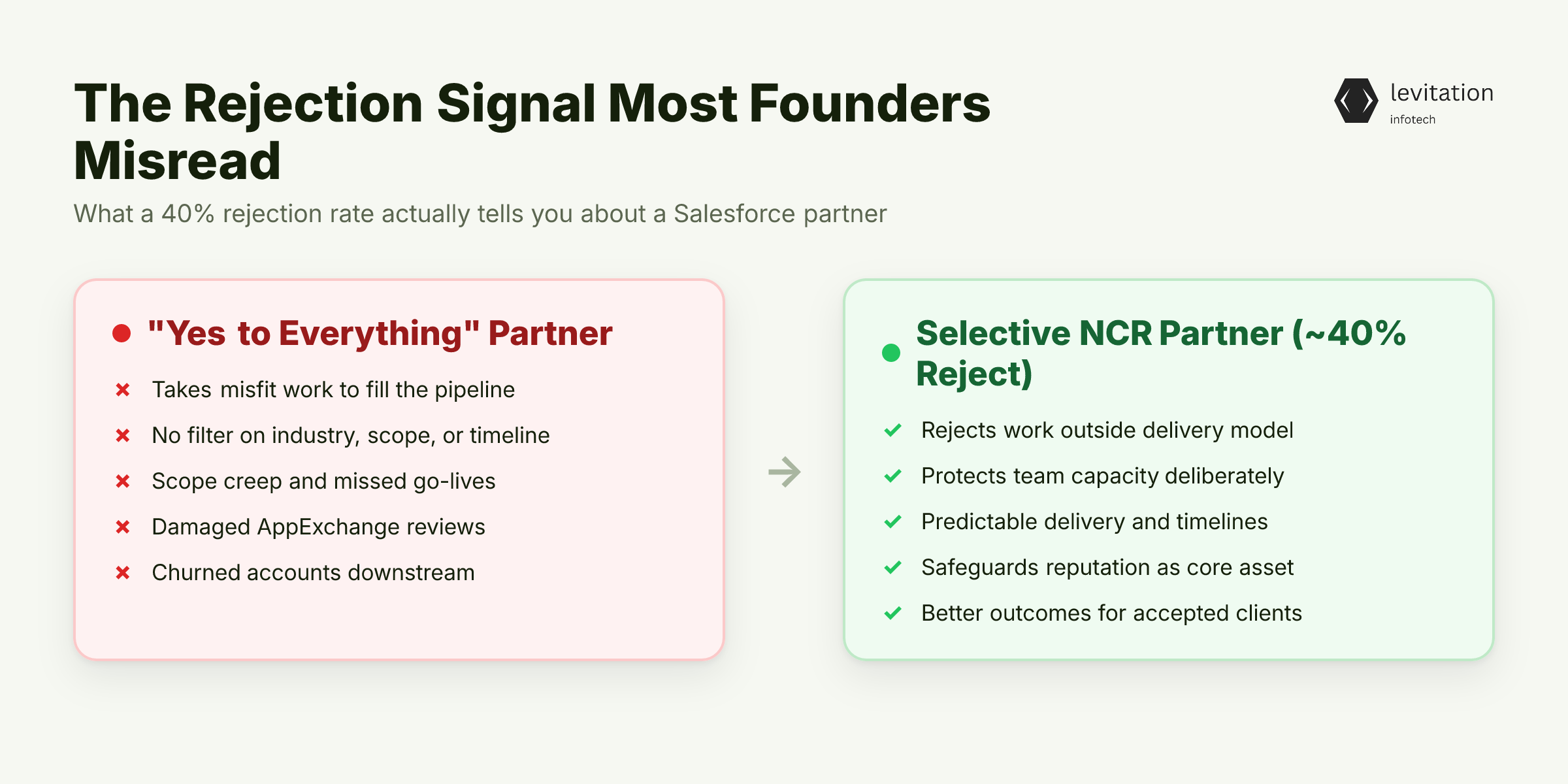
The best Salesforce partners in NCR turn away nearly 40% of inbound leads. If a partner says yes to everything, that is not enthusiasm. It is a warning sign.
Most founders read rejection as arrogance. They get three quotes, see one partner say no, and move on. That instinct costs them the most useful signal in the entire sales process.
The partner who declines is telling you, in advance, how they will treat your project once the contract is signed.
Top NCR partners do not reject leads because their calendars are full. They reject because the engagement does not fit their delivery model. Wrong industry, wrong scope, wrong timeline, wrong team availability. Each rejection is a deliberate act of capacity protection, not customer avoidance.
Partners with deep enterprise deployment experience across regulated industries have learned what happens when they take misfit work. Scope creep, missed go-lives, churned accounts.
A bad delivery does not just lose one client. It poisons the AppExchange reviews that drive the next ten clients. The 40% rejection rate protects the asset that matters most: their reputation.
So what does the "yes to everything" approach look like in practice?
What 'Yes to Everything' Actually Signals
When a partner says yes to every lead, the bill shows up later. Not on day one. On day sixty.
Accept-all shops staff projects with whoever is available that week, not the certified consultants they promised in the pitch. The architect you met in the sales call disappears into a "resource allocation" email three weeks after kickoff. The people doing the work are juniors learning on your org, billed at senior rates.
Scope estimation gets optimistic to win the deal. The proposal undercounts integrations. It skips data migration complexity. It assumes your user base is cleaner than it is. Then change orders appear 60 days in, erasing the budget you set aside for the rollout. This is not an accident. It is the business model.
These shops do not invest in vertical specialisation. A hospital chain ends up with the same generic lead-to-cash flow as an e-commerce startup. The partner has no template for clinical workflows, no compliance muscle memory, no idea what an audit trail means in practice.
Healthcare deployments show this clearly. A partner that has not delivered HIPAA-compliant systems for Indian hospital chains will underestimate consent management, data residency, and audit trail requirements. They will scope a healthcare rollout the same way they scope a B2B SaaS rollout. The go-live will fail, or succeed in a way that fails its first external audit. The cost of that failure compounds for years.
So if rejection is a quality signal, what exactly are the top partners screening for?
The 5 Criteria Top Partners Screen Every Lead Against
Every elite NCR partner runs incoming leads through the same five filters. Here is what they look for, in order.
1. Team composition. Can they assign named, certified architects with verifiable AppExchange reviews to back the claim? Or will the proposal say "a team we will allocate later"? The first answer means a real delivery. The second means a staffing scramble. The pattern to watch: a senior architect in the pitch deck, then a different name in the kickoff email.
2. Delivery model. Is it fixed-scope with milestones and hypercare baked in, or T&M with vague deliverables and no post-go-live ownership? Top partners with strong Salesforce consulting in India bake hypercare into the contract because adoption is where implementations die. Accept-all shops treat hypercare as an upsell.
3. Industry expertise. Have they shipped in your vertical, healthcare, BFSI, manufacturing, or will you be the case study they learn on? Vertical depth shows up in their discovery questions. A healthcare-experienced partner will ask about consent, audit trails, and NABH alignment in the first call. A generalist will ask about your budget.
4. Multi-cloud capabilities. Can they execute across Sales, Service, Experience, and Data Cloud with real certifications? Or only one cloud with bolt-ons? Multi-cloud depth separates Summit and Platinum-tier partners from Gold-tier generalists. This is also where most NCR firms quietly fail the test.
5. Implementation methodology. Do they follow a documented discovery-to-go-live process with named checkpoints? Or is every proposal a custom template, which usually means no template at all? Documentation signals repeatability. Repeatability signals predictable delivery.
These are the same five filters you should run in reverse on any Salesforce partner in NCR. Before any of that works, the founder has to clear a filter most skip entirely: auditing themselves.
Audit Yourself Before the Partner Ever Does
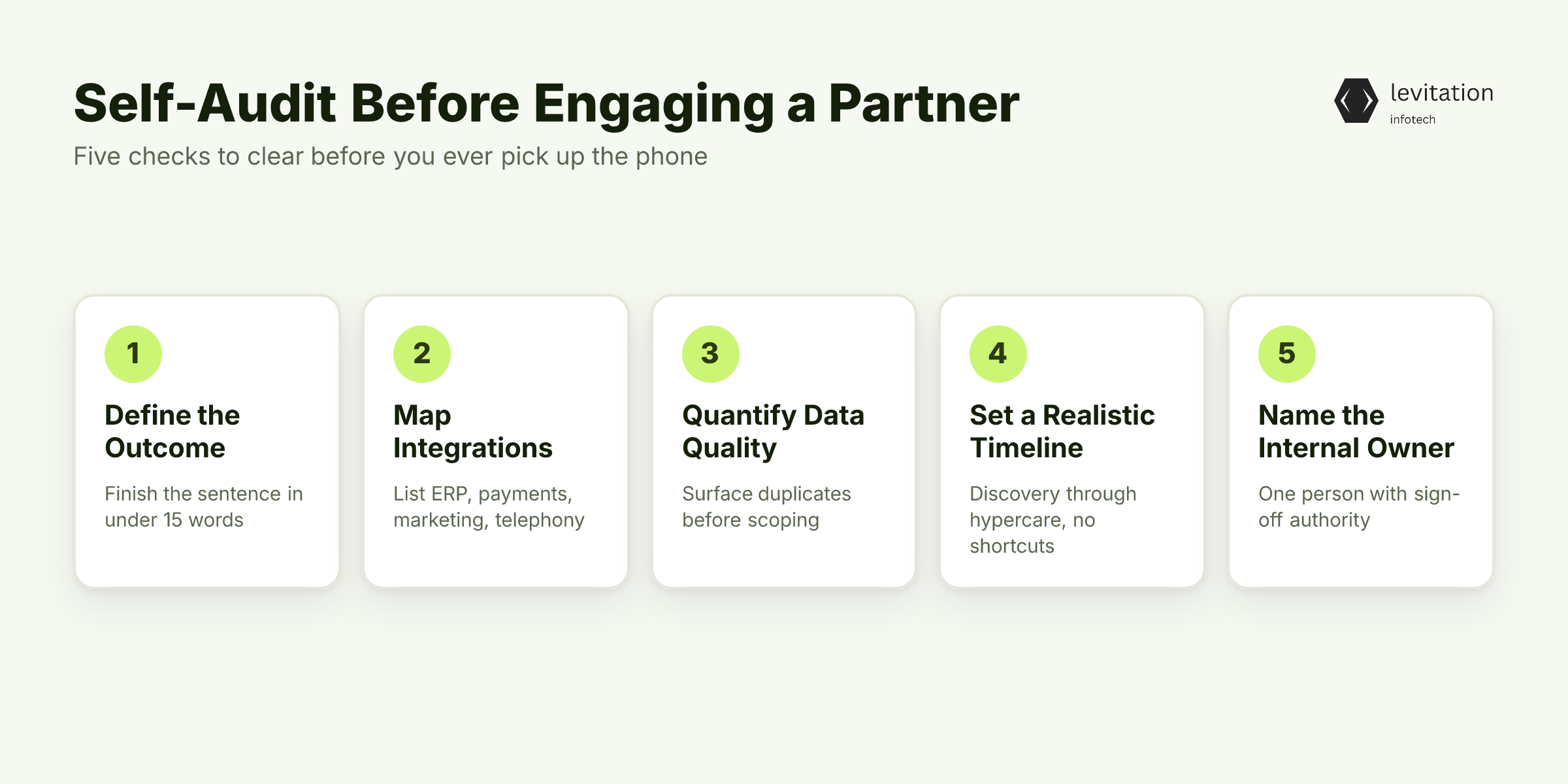
Founders blame partners for bad fits. They forget to audit their own intake. The partner who rejects your lead is often doing both of you a favour. Here is how to clear the filter before you ever dial.
Define the business outcome in one sentence. "Replace Zoho with Salesforce and reduce lead-response time from 4 hours to 15 minutes." That is a scoped outcome. A feature wishlist is not. If you cannot finish the sentence "We are buying Salesforce to..." in under 15 words, you are not ready to buy.
Map your must-have integrations. ERP, payment gateway, marketing automation, telephony. Flag any that need middleware the partner must be certified on. MuleSoft, SAP, Oracle, HubSpot. Each integration has a cost and a risk. The partner needs to see the list before they can quote honestly.
Quantify your data quality. If your contacts are 30% duplicates, a top partner will reject the lead because no CRM fix can rescue dirty data mid-implementation. Data cleanup is a separate engagement, and pretending otherwise is how projects blow up by week six.
Set a realistic timeline. First-time Salesforce implementations in regulated industries cannot be compressed into a single sprint. Discovery, design, build, UAT, training, and hypercare each take real time. Skipping any of them turns adoption into a fight. Any partner who promises a first-time multi-cloud rollout on a single-sprint timeline is selling a sales tactic, not a delivery plan.
Decide who owns the project on your side. Partners reject leads where the founder is the sole stakeholder because decision latency kills delivery. You need a named internal owner with authority to sign off on scope changes without a board meeting. If that person does not exist, the project is not ready.
The guide to choosing a Salesforce partner covers most of what an evaluation should look like. Once you have done the self-audit, the partner evaluation becomes a structured filter instead of a sales call.
The Partner Evaluation Framework That Works in NCR
The Indian Salesforce market has a quality gradient most buyers never see. Here is how to surface it.
Start with Salesforce AppExchange. Filter by location (Delhi NCR), industry tag, and Navigator level. Prioritise partners with a high volume of verified customer reviews and consistently strong ratings. Volume and consistency matter more than a single glowing testimonial.
Weight Platinum and Crest tier status heavily, but verify it is current. Tiers lapse when certification counts drop. Many NCR firms display outdated badges from three years ago. Salesforce publishes current tier status publicly. Check it.
Demand proof of similar engagements. Ask for two reference customers in your industry and call them. A top partner confident in their delivery will hand over references without hesitation. If they stall or offer only one reference, treat it as a signal.
Score the proposal on the five criteria from the previous section. Reject any proposal that cannot answer multi-cloud certification and named-architect staffing in writing. Vague answers are the partner telling you, politely, that they do not have the team to do what they just sold you.
Watch for below-market hourly rates. Unusually low rates in NCR usually mean junior staffing or offshoring you were not told about. The price looks attractive until the architect in the proposal is replaced by someone less experienced on day one.
Cross-check against known reseller patterns. A surprising number of firms list themselves as Salesforce partners in India when most are just resellers. The badge count does not equal the delivery depth. Filter for partners who have direct delivery references, not partner-channel references.
Run that framework and you will likely end up with a shortlist of two to three partners who have already passed their own internal screening. That is when the engagement gets interesting.
What Changes When You Land the Right Partner
The difference between a top partner and a yes-to-everything shop shows up in three places, and they are all visible within the first six months.
Go-live dates become commitments instead of targets. The discovery phase produced a scope both sides agreed on, so the project plan holds. The go-live lands on the date the contract promised, not the date everyone had to renegotiate.
Post-launch adoption holds because the partner trained your team, not just handed over a manual, and their retention model depends on it. Adoption is the metric that determines whether the CRM earns its seat cost in year one, and most CRM rollouts fail here for non-technical reasons. Top partners know this and build training into the delivery.
Year-two expansion (Marketing Cloud, Service Cloud, Data Cloud) happens with the same team that knows your org, not a new vendor learning from scratch. The same architects who delivered Sales Cloud in year one are still on the account in year two. No re-onboarding. No relearning your data model.
You stop being a customer and become a reference. Partners with strong client retention actively manage the relationship because your renewal is their next AppExchange review. That is the structural reason the right partner behaves differently: their business model is built around keeping you, not closing you.
The pattern repeats across elite NCR partners with deep regulated-industry experience. The partners who reject four of ten leads end up with the clients who renew. The partners who accept all ten end up chasing the next ten. The founder's job is to land in the first group, and the framework above is how you do exactly that.
Frequently Asked Questions
Q: Why do top Salesforce partners in NCR reject so many leads?
A: Elite partners reject roughly 40% of leads because the engagement does not fit their delivery model, wrong industry, wrong team availability, or a scope they know will fail. Rejection protects their delivery capacity and their retention rate, which depends on saying yes only to projects they can finish well.
Q: How do I choose a Salesforce implementation partner in India?
A: Filter Salesforce AppExchange by NCR location, industry tag, and Navigator tier (Platinum or Crest). Then verify current certifications, ask for two reference customers in your vertical, and score the proposal on team composition, delivery model, multi-cloud capability, and documented methodology before signing.
Q: What's the difference between a Summit, Platinum, and Gold Salesforce partner?
A: Summit is the top tier (highest revenue, certifications, and customer satisfaction scores), Platinum is the second tier with strong multi-cloud capability, and Gold is entry-tier with fewer certified consultants and narrower cloud expertise. Tier status also lapses when certification counts drop, so always verify the badge is current.
Q: How long does a Salesforce implementation take in India?
A: A first-time Salesforce implementation for a mid-market company in India takes several months from discovery to go-live, with regulated industries (healthcare, BFSI) running longer because of compliance, data residency, and integration complexity. Any partner promising a first-time multi-cloud rollout on a single-sprint timeline is under-scoping.
Q: How much does Salesforce implementation cost from an Indian partner?
A: Hourly rates for certified Salesforce consultants in India vary by seniority, city, and engagement scope. Full first-time implementations for mid-market companies scale with cloud count, integration complexity, and data migration scope. Below-market rates usually signal junior staffing or undisclosed offshoring.
Sources
Research and references cited in this article:
- Top 15 Salesforce Consulting Partners in India (2026)
- Best Salesforce Implementation Partners | 2026 Report
- Top Salesforce Consulting Partners in India: 2026 Guide - Cymetrix Software
- Top Salesforce Consulting Partners in India 2026 Guide
- How to Evaluate Salesforce Partner Companies in India
- 40 Sales Statistics to Watch for in 2026 | Salesforce
- Salesforce's slowing growth impacts partners, leading to ...
- Lead Rejection Reason | Salesforce Trailblazer Community
- Why B2B Lead-to-Opportunity Conversion Rates Decline - LeanData
- Does Salesforce Have an Issue With Bad Consultancy ...
- Choosing A Salesforce Implementation Partner: 2026 Guide
- Salesforce Implementation Partners | Starting at $15/Hour.
About the author
Mayank Singh is a software developer at Levitation Infotech, where he builds web and AI-powered applications across the company’s fintech, healthcare, and enterprise projects.