


TL;DR: Enterprise AI bills roughly triple per user between pilot and 10K-user scale. The cause is not per-seat fee changes. Consumption layers like tokens, credits, inference calls, and agent retries activate on top of those fees. The fix is architectural. Design for unit economics from day one, or run a six-question diagnostic. The diagnostic exposes the gap before the invoice does.
Key Takeaways: - Per-user pricing hides consumption charges that look trivial at pilot scale and become the dominant cost line at 10K users. - A single AI feature can trigger four independent bills, each with its own meter, minimum, and dashboard. - Salesforce's Flex Credit model illustrates a silent multiplier: actions above 10,000 tokens consume multiple credit blocks without any contract change. - The per-seat-plus-consumption pattern shows up across major enterprise AI vendors, not just one. - A six-question diagnostic turns AI cost from a finance surprise into a forecastable unit-economic lever.
The 3x Cliff: Where AI Unit Economics Break
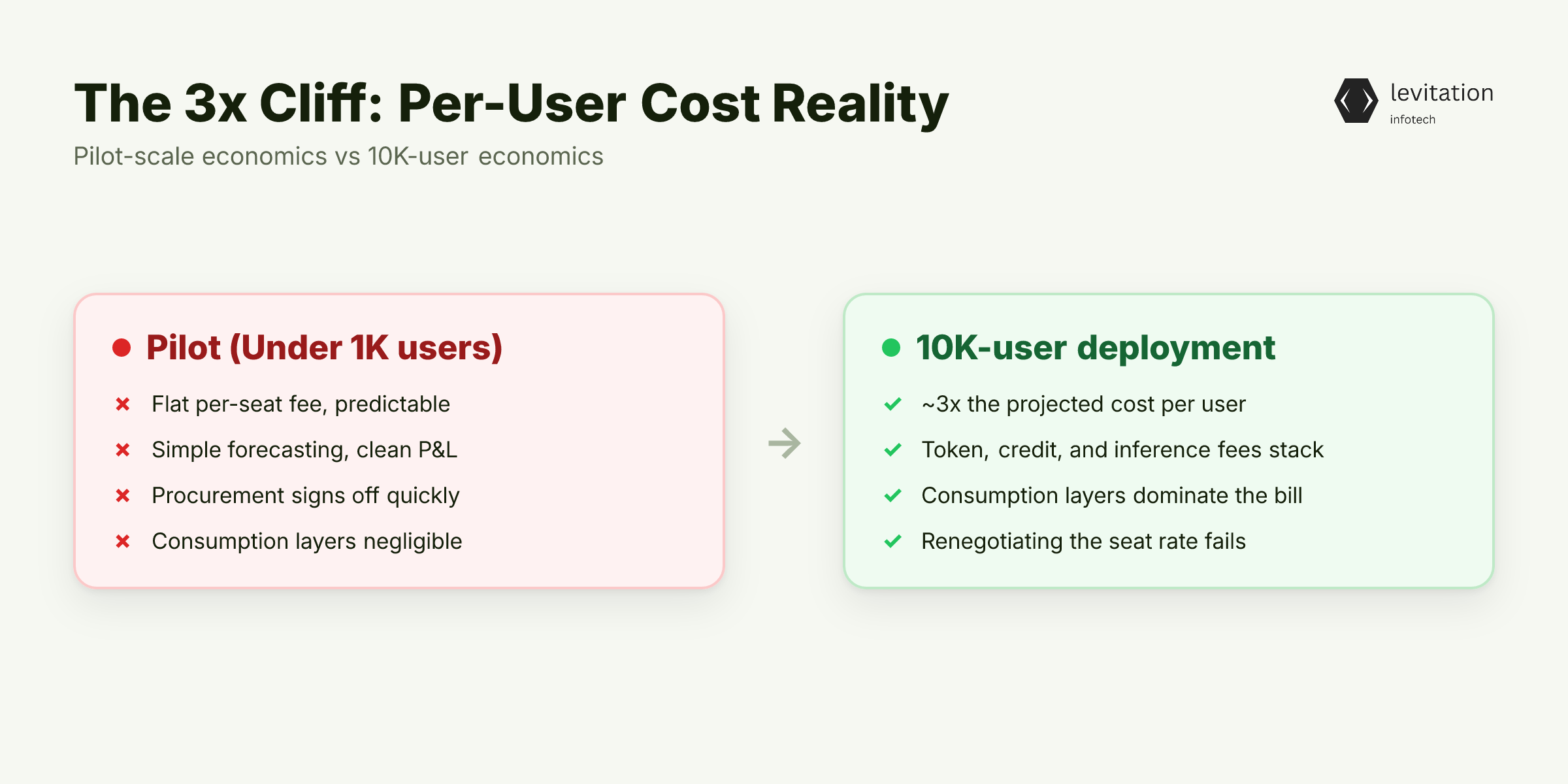
Your AI pilot ran at a modest per-user cost. Your 10K-user deployment is hitting roughly triple that. The contract didn't change. The vendor didn't raise prices.
So where did the difference go? The answer is hiding in plain sight. Consumption layers scale on top of your per-user fee, not instead of it.
At under 1K users, per-user pricing looks predictable. A flat fee per seat, simple forecasting, clean P&L line items. Finance signs off.
Procurement negotiates the per-seat rate and walks away. The whole deal feels like classic SaaS economics.
At 10K users, the same contract produces several times the projected cost per user. Consumption layers that were negligible at pilot scale now dominate. Token fees, action credits, inference calls, retrieval requests, agent invocations. Each is small in isolation.
Stack them across thousands of users running thousands of actions per day, and they become the largest line on the bill.
The CFO sees the total. The CTO sees the same dashboard. Neither sees the mechanism behind it. That gap between "the number went up" and "here is exactly why" is the entire problem.
The obvious fix, renegotiate the per-user rate, fails. The per-user fee is not where the money is actually going.
Per-User Pricing Is a Trojan Horse
A per-user fee feels like SaaS economics: predictable, scalable, defensible to finance. Every procurement team knows how to model seat counts against headcount plans.
The quote looks familiar. The contract terms look familiar. The renewal looks familiar.
But every major AI vendor has layered consumption charges on top. Token fees, action credits, inference calls, agent invocations, retrieval requests. The list varies by vendor.
The structure is the same: a per-seat anchor that makes the quote look like SaaS, plus one or more consumption meters. These meters activate the moment real users start running real workloads.
These consumption layers are priced in fractions of a cent so they look harmless in the quote. A standard agent action at $0.10 is rounding error against a typical per-seat monthly fee. At small user counts with light daily usage, it is still rounding error. At large user counts with heavy daily usage, it is the entire P&L line.
The same trap shows up across FinOps and AI cost visibility: tools built for VM accounting miss the consumption-meter layer entirely. The line item never appears in the dashboard the finance team trusts.
To see how this stacks, you have to follow a single feature through every bill it touches.
The Four Bills Behind One AI Feature
Salesforce's Agentforce illustrates the pattern cleanly. A single enterprise AI feature, say, an AI agent that handles a customer service conversation, can trigger four separate charges.
There is a per-conversation fee. There is a Flex Credit draw priced by token volume. There is a per-user Agentforce add-on layered on top of the base CRM seat. And there is an Einstein Request meter that counts underlying model calls.
Each is invoiced independently. Each has its own minimum, its own overage, its own dashboard. None of them appear in the others' line items.
The procurement team negotiated the per-user rate. The finance team modeled the per-conversation fee from the quote. The engineering team has no visibility into Flex Credit consumption at all.
The result is what auditors call billing fragmentation. The same workload gets counted four times under four different units.
True unit economics become impossible to reconstruct without a forensic review of logs, invoices, and meter dashboards stitched together by hand.
Even when you map every bill, the numbers still do not add up. That is because the consumption rate itself is variable.
The Silent Multiplier: When One Action Costs 10x
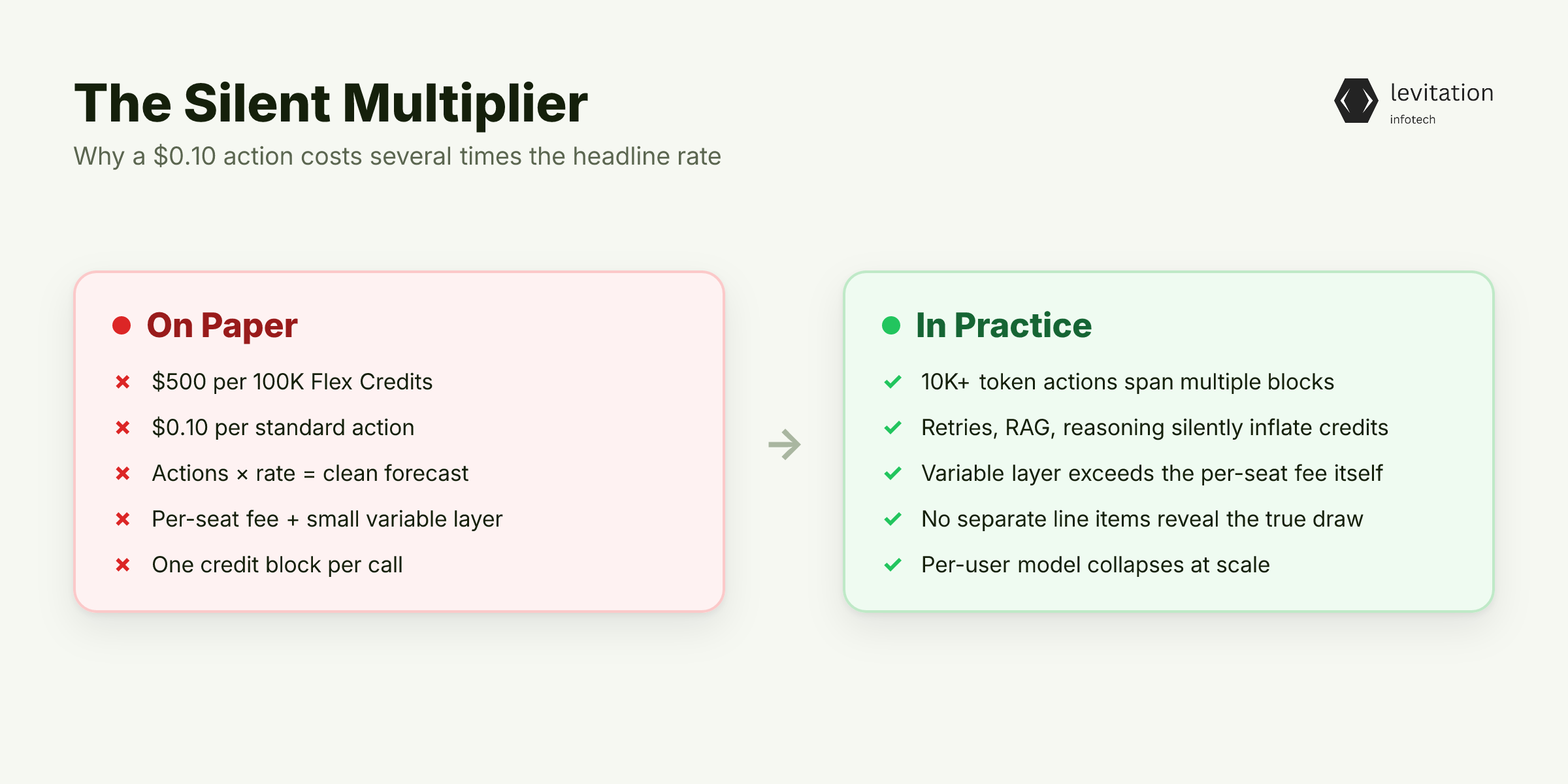
Salesforce's Flex Credit pool prices at $500 per 100,000 credits, with a standard action consuming 20 credits (about $0.10). On paper, that looks linear. Multiply actions by cost per action, and you get a clean forecast. Procurement loves it.
The silent multiplier: any action that processes more than 10,000 tokens consumes multiple credit blocks. A single complex action can cost several times the standard rate, depending on how many credit blocks the token count crosses, with no change in your contract.
The contract is the same. The rate is the same. The cost is not.
Add agent retries, multi-step reasoning chains, and RAG lookups, and a "standard" $0.10 action routinely costs several times the headline rate in practice.
A failed retrieval that triggers a retry. A reasoning step that pulls four documents instead of one. A summarization pass that re-reads the entire conversation history. None of these show up as separate line items. They all silently inflate the credit draw per action.
At 10K users running dozens of these per session, the math breaks the per-user model entirely. You are not paying the per-user fee with a small variable layer on top. You are paying the per-user fee, plus a variable layer that exceeds the per-seat fee itself.
The pattern matches what we see in tracked LLM cost curves from 100K to 100M tokens: the cost per token does not stay linear as workloads grow, because complexity, not volume, drives the multiplier.
Salesforce is just one vendor. When you map this across the market, a shared design pattern emerges.
The Multi-Vendor Pattern: What Every AI Contract Shares
Across enterprise AI vendors reviewed for cost behavior at scale, the same architecture appears. A per-seat anchor fee designed to look like SaaS. Plus one or more consumption meters priced in tokens, credits, or requests. The branding differs. The unit economics do not.
Major enterprise AI platforms, including Salesforce, use some variant of this structure. Consumption units go by different names across vendors: tokens on one platform, credits on another, requests on a third. The underlying math is the same.
Three structural drivers explain why the pattern is universal: - Model inference cost is variable by query. A short completion costs less than a long one. Vendors cannot price that variability into a flat per-seat fee, so they meter it separately. - Vendors want upside if usage grows. A flat per-seat fee caps their revenue at headcount. Consumption metering lets them earn more when customers succeed, which is also when the customer's bill grows. - Consumption pricing is harder for procurement to benchmark than flat per-user fees. Tokens, credits, and requests resist apples-to-apples comparison, which preserves pricing power.
Knowing the pattern is necessary. Fixing it requires a diagnostic you can run this quarter.
The CTO's AI Bill Diagnostic: Six Questions
You do not need a six-month audit. You need six questions, answered from production data, not vendor quotes. - For each AI feature in production, how many distinct meters bill it? If the answer is more than two, you have a four-bill exposure. Most enterprise AI stacks have three or four. - What is the 95th-percentile token count per action, not the average? The silent multiplier only fires on the long tail. Averages hide it. P95 surfaces it. - How many retries and multi-step chains does a typical user session trigger? Model each as a separate billable event. A session that looks like one action may be several. - What is your effective cost per successful task, not per action? An action that succeeds is cheap. One that retries multiple times before succeeding is not. - Are consumption credits committed or pay-as-you-go? Committed credits often have hidden tiers at scale, where renewal rates change and overage penalties kick in. - Can you re-derive last month's bill from logs alone? If not, the vendor's invoice is your only source of truth, and that is a negotiation disadvantage.
Teams that run this diagnostic against production telemetry, not vendor dashboards, surface the 3x problem as a set of actionable line items, not an aggregate mystery.
Production fixes move fastest when scoped around real telemetry rather than rebuilt from scratch by teams without a reference architecture.
Run that diagnostic and the fix becomes architectural, not contractual.
What Changes When You Build for the 10K Reality
CTOs who architect for consumption from day one hold cost per user well below the 3x curve. They batch retrievals, cap token windows, cache intermediate steps, and route simple queries to cheaper models. The architecture is the lever. Renegotiating the contract is the wrong end of the rope.
Three patterns separate the teams that hold cost from the teams that get blindsided: - Batch and cache aggressively. Most enterprise AI workloads re-fetch the same context many times per session. A semantic cache at the retrieval layer cuts token volume without changing the user experience. - Route by complexity. Not every query needs the flagship model. A router that sends simple lookups to a smaller, cheaper model and reserves the large model for genuine reasoning eliminates the cost of running expensive models on trivial tasks. - Cap the context window. An oversized context window does not improve answer quality when the actual question is small. Capping context to what the task actually needs is the most effective cost control most teams never build.
The bigger shift: AI cost stops being a finance surprise and becomes a unit-economic lever. One you can forecast, model, and improve the same way you treat cloud infrastructure. For engineering teams building production AI for Fortune 500, a flatter cost curve means a renewal. A 3x cost curve means a replacement.
The 3x cliff is not a pricing problem. It is an architecture problem. And architecture is something you control.
Frequently Asked Questions
What is the average AI cost per user at enterprise scale?
Pilot deployments run at a modest per-user cost. At 10K users, the same workload on the same contract lands at several times that once consumption layers and silent multipliers are counted. The variance comes less from per-seat fees and more from token-heavy actions and agent retries.
What is a Flex Credit and why does it matter at scale?
A Flex Credit is Salesforce's consumption unit. It prices at roughly $500 per 100,000 credits, with a standard action costing 20 credits (about $0.10). It matters at scale because any action processing more than 10,000 tokens consumes multiple credit blocks. A single complex action can cost several times the standard rate without any contract change.
How do AI vendors price consumption-based features?
Most enterprise AI vendors combine a per-user or per-seat anchor fee with one or more consumption meters. The meters are priced in tokens, credits, requests, or actions. The per-seat fee makes the quote look like traditional SaaS. The consumption meters are where the actual cost accrues once usage scales.
How can CTOs reduce AI cost per user at 10K users?
Run a six-question bill diagnostic to map every meter touching each AI feature. Model 95th-percentile token usage rather than averages. Batch retrievals, cap context windows, cache intermediate steps, and route simple queries to cheaper models. Teams that do this typically hold cost growth well below the 3x curve.
Is consumption-based AI pricing worse than per-user pricing?
Neither is inherently worse, but mixing the two is where the 3x problem originates. Pure per-user pricing caps your exposure but discourages usage. Pure consumption pricing aligns cost with value but is hard to forecast. The risk appears when vendors layer consumption charges on top of a per-user base without disclosing the interaction.
About the author
Mayank Singh is a software developer at Levitation Infotech, where he builds web and AI-powered applications across the company’s fintech, healthcare, and enterprise projects.