


TL;DR: A recent study found that only 3 of 14 clinical AI vendors met their SLAs. The window covered 90 days. The cause was not model accuracy. It was operational integration. CTOs who evaluate vendors on benchmark accuracy alone will join the 11 who failed. The fix is a framework. It tests for drift, bias, workflow friction, and post-sale discipline. Run it before the contract is signed.
Key Takeaways: - SLA failure in clinical AI correlates with integration debt, not model quality. Benchmark-driven vendor selection predicts the 11-of-14 failure pattern. - Physician trust is the load-bearing variable. A disabled tool scores zero on every SLA metric, no matter how accurate it is. - Four SLA categories predict survival: diagnostic accuracy with re-validation, workflow-tied latency, subgroup sensitivity, and retraining cadences with hard dates.
3 of 14 Clinical AI Vendors Met Their SLAs. That's a Crisis.
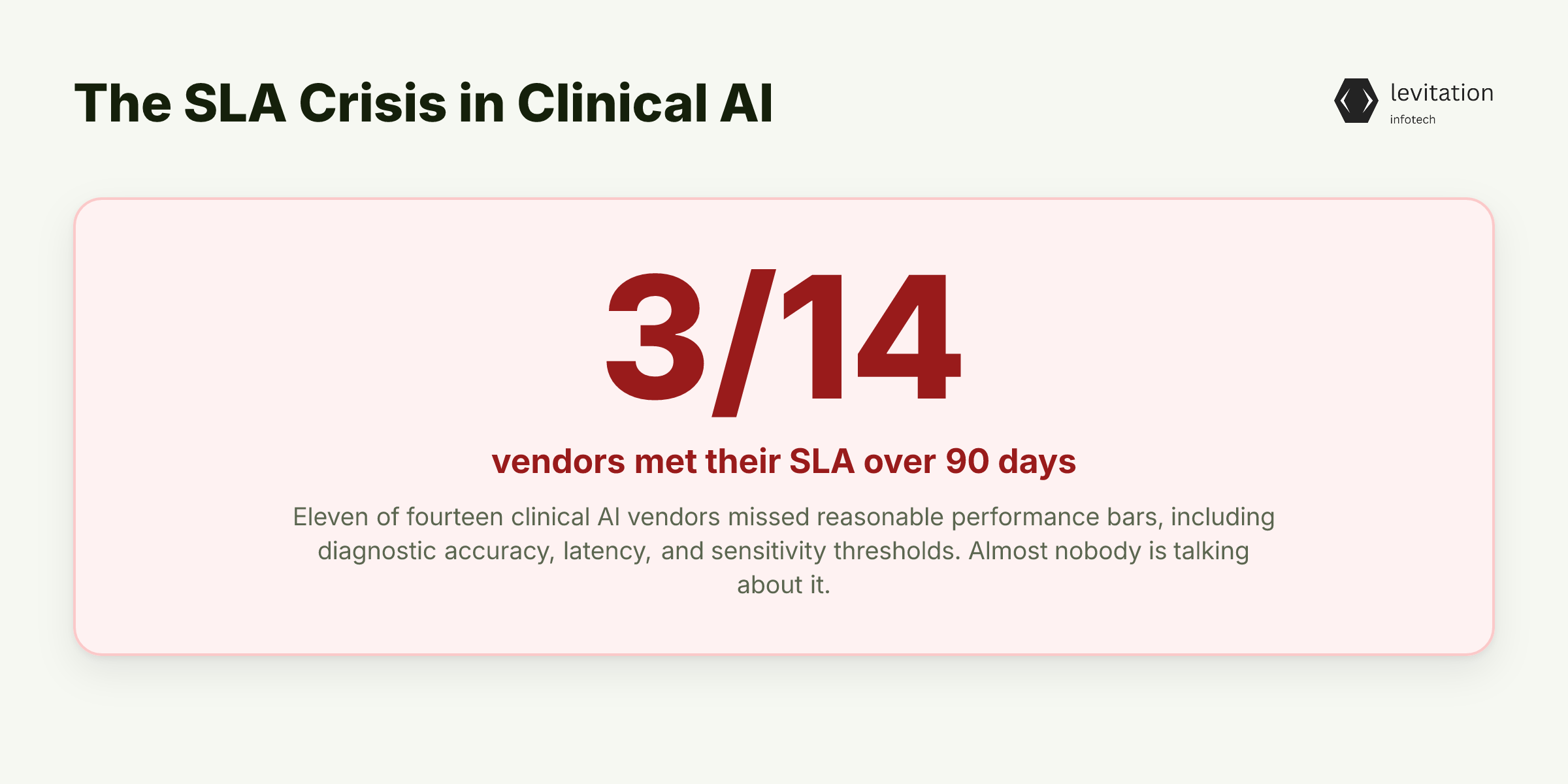
A recent study found that only 3 out of 14 clinical AI vendors met their SLAs. The window covered 90 days. The other 11 missed. For a CTO about to sign a multi-year contract, this is a critical signal. Almost nobody is talking about it.
The SLA metrics in the study were not the usual uptime promises. They included diagnostic accuracy rates, maximum acceptable latency, and sensitivity thresholds. The bar was reasonable. The miss rate was not.
The liability blind spot is worse than the failure rate. When clinical AI fails, the liability lands on the clinician and the institution. It does not land on the vendor. Terms of service disclaimers protect the vendor.
They can actually worsen your legal position. They confirm in writing that clinical judgment was the institution's alone. Medical board reviews focus on what the physician knew. They also focus on what was documented. They also focus on what a reasonably prudent physician would have done. Nobody asks what the software's terms of service said.
The instinctive reaction is to blame the technology. That's exactly backwards. The study points to integration, not model sophistication. So if better models weren't the answer, what was?
Why Better Models Didn't Fix the Problem
The obvious fix, swapping in a more accurate model, did not separate the winners from the losers. Vendors with the highest benchmark scores landed in the failing 11. Vendors with middling benchmark scores landed in the winning 3.
Something other than model quality was driving outcomes. CTOs over-index on benchmark accuracy because it is measurable. Vendors also optimize for what gets measured. Production reliability depends on dozens of factors that benchmarks never capture: - EHR connectivity and API stability across vendor versions - PACS latency during peak imaging hours - Alert fatigue thresholds that determine whether clinicians trust the output - Downtime protocols that fire when inference endpoints fail
These are not academic concerns. A tool that works at 2 AM in a trauma bay beats a leaderboard winner. The leaderboard tool might score 99%. It might still get disabled by week six. Procurement teams that anchor on accuracy invite the 11-of-14 outcome.
If the model isn't the bottleneck, what is?
The Real Failure Mode Isn't Technical, It's Operational
The study points to three operational failure modes that drove the SLA misses. None of them are about model architecture.
First, model drift without a retraining cadence. Diagnostic accuracy degrades silently over months. Patient populations, imaging equipment, and clinical protocols all shift. The vendor's pilot data grows stale as those conditions evolve.
Without active monitoring and a scheduled retraining pipeline, the tool falls below its contracted threshold. Nobody notices until the next quarterly review.
Second, bias accumulation across demographic subgroups. A model with strong aggregate accuracy can score much lower on a specific age or sex cohort. Aggregate reporting hides the gap. Bias grows with drift. It only shows up when you break the numbers down by subgroup.
Third, workflow friction that causes clinicians to bypass the tool. A diagnostic aid that adds three clicks to a workflow gets disabled. A documentation tool that generates text the physician has to rewrite gets abandoned.
A disabled or abandoned tool scores zero on every SLA metric. This is true regardless of the model's quality. The load-bearing variable is physician trust. Tools that increase cognitive load get muted, overridden, or quietly turned off. Once that happens, the SLA discussion is over.
This is why the winners focused on reducing documentation burden. They also earned trust. They did not chase benchmark deltas. It is also why healthcare technology procurement has shifted. It moved from model selection to workflow design.
If integration and trust are the real levers, what did the three vendors who met their SLAs actually do?
What Separated the 3 Vendors Who Made It
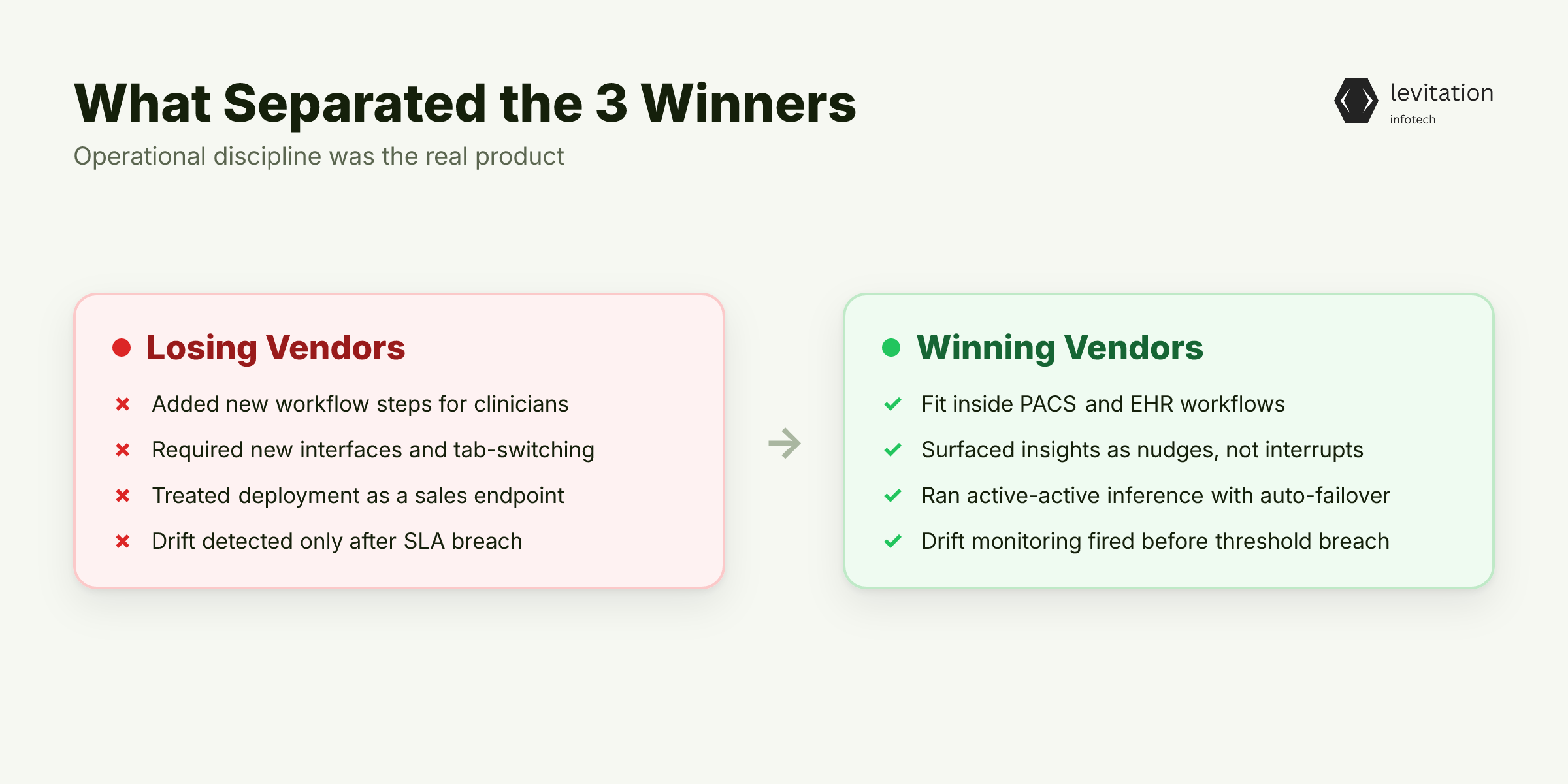
The winning vendors simplified clinical workflows. They did not add steps. Their tools fit into existing decision paths instead of creating new ones. A radiologist did not need to learn a new interface. The tool surfaced insights inside the PACS viewer they already used.
A hospitalist did not need to switch tabs. The documentation assistance appeared inside the EHR. The winners invested in physician trust-building. Real-time AI transcriptions reduced documentation burden rather than increasing it.
Clinical decision support arrived as a nudge at the right moment, not as an interrupt. Clinicians who feel the tool is on their side keep using it. Clinicians who feel the tool is adding work find ways to route around it.
The winners maintained infrastructure hard. Secure telehealth pipelines stayed redundant. Inference endpoints ran on active-active deployments with automatic failover. Drift monitoring fired before metrics breached the SLA threshold, not after.
The winners treated deployment as an ongoing operational commitment. The losers treated deployment as a sales endpoint. Many losers had equivalent or superior model architectures. They shipped the model, collected the license, and waited for the renewal conversation.
The pattern is the same one we see in top AI companies for healthcare in India. They sustain long-term deployments. Operational discipline is the product.
That pattern is now clear enough to act on. Here's the framework.
The CTO's Evaluation Framework: SLA Metrics That Actually Predict Survival
A 90-day pilot with real clinical data is the minimum. Anything shorter misses the drift, bias accumulation, and workflow friction that surface under real conditions. Synthetic test sets will not surface them.
Demand four SLA metric categories in the contract: - Diagnostic accuracy with quarterly re-validation. Not a one-time benchmark, but a hard schedule for re-measurement against current production data. - Latency budgets tied to clinical workflow. Not abstract 99th percentile targets, but budgets matched to the actual time a clinician has in a given decision moment. A 3-second budget means something different for a triage alert than for an end-of-day report. - Sensitivity and specificity thresholds with demographic subgroup breakdowns. Aggregate accuracy is not enough. Insist on subgroup reporting and reject any vendor that cannot produce it. - Retraining and update schedules with hard dates. If the contract says "as needed," you have no SLA. If the contract says "quarterly," you can measure breach.
Demand real-time dashboards and raw audit trail access. Vendor-reported numbers without independent verification predict the 11-of-14 failure pattern. Build independent monitoring of latency, uptime, and accuracy into your own infrastructure.
Third-party audit rights are appropriate for critical deployments. Set realistic baselines. Marketing claims of near-perfect resolution rates from POC data are fiction. Pilot conditions never match production complexity.
The vendors who quote realistic numbers from the start are the ones whose operational discipline survives the post-sale period.
Insist on bias audit clauses with specific, contractually binding thresholds. Disparities across race, ethnicity, sex, and age should be measured at every re-validation cycle. Breach consequences should be defined upfront.
Vendors who resist subgroup-specific thresholds signal exactly the kind of operational gap. That gap produces the 11-of-14 failure pattern.
These compliance expectations are standard practice in healthcare technology procurement.
Evaluate deployment speed as a reliability proxy. Vendors who can move from contract to production faster than the industry norm tend to have tighter operational discipline. The same engineering practices that compress timelines also prevent SLA breaches.
The vendors behind the 3-of-14 winners tend to share this trait.
This same discipline shows up in top AI companies for healthcare in India. They have survived multiple renewal cycles.
Deployment velocity predicts post-sale reliability.
Selecting on this framework changes the outcome. Here's what that looks like in practice.
What Changes When You Pick the Right Vendor
The outcome shows up in production metrics most CTOs never measure directly. Vendors whose systems remain in production years after initial deployment signal operational discipline. Strong client retention is another signal. That discipline survives the post-sale period.
The 3-of-14 winners share this profile. The 11 who failed do not. The cost of getting it wrong is not just wasted procurement. It includes clinical liability exposure when the tool misses a case.
It also includes migration costs when the contract is unwound. It also includes a loss of physician trust that takes years to rebuild. A clinician burned by a failed SLA resists the next AI deployment, no matter how good the new vendor is.
The strategic reframe is this: in clinical AI, reliability is the product. Accuracy is a prerequisite, not a differentiator. Every vendor on the short list can quote an accuracy number.
The question is which one will still be meeting their SLA when you call them in year three. The top AI companies for healthcare in India that have survived that long built operational muscle. The failed 11 never developed that muscle.
Frequently Asked Questions
Q: What SLA metrics should a CTO require from a clinical AI vendor?
A: At minimum, require diagnostic accuracy with quarterly re-validation. Also require latency budgets tied to clinical workflow. Add sensitivity and specificity thresholds with subgroup breakdowns. Add retraining schedules. Add real-time dashboards with raw audit trail access. Avoid vendors who report only aggregate accuracy without subgroup data.
Q: How long should you evaluate a clinical AI vendor's SLA performance before signing a long-term contract?
A: Minimum 90 days of production pilot with real clinical data, not synthetic test sets. The 3-of-14 study measured SLA performance over exactly this window. Shorter evaluations consistently miss drift, bias accumulation, and workflow friction. These only surface under real conditions.
Q: Who is liable when a clinical AI tool fails or produces a wrong result?
A: The liability lands on the clinician and institution, not the vendor. Terms of service disclaimers protect the vendor. They can actually worsen your legal position. They confirm in writing that clinical judgment was your sole responsibility. Treat vendor contracts as clinical workflow documentation, not just legal documents.
Q: What is model drift and how should SLAs address it?
A: Model drift is the decline in AI performance over time. Patient populations, imaging equipment, and clinical protocols all shift. SLAs should mandate retraining cadences with hard dates. They should also require performance reports that compare current metrics against pilot baselines. Specify maximum allowable degradation before the vendor is in breach.
Q: How do you verify a clinical AI vendor's SLA claims independently?
A: Require raw audit trail access to performance logs. Insist on third-party audit rights for critical deployments. Build independent monitoring of latency, uptime, and accuracy metrics into your own infrastructure. Vendor self-reporting without verification rights is a red flag. That flag correlates with the 11-of-14 failure pattern.
Run the next vendor shortlist through these four SLA categories before the demo. The 11-of-14 pattern starts to look like a choice rather than luck.
Sources
Research and references cited in this article:
- The Ultimate AI Vendor Checklist for Healthcare Leaders — Innovaccer
- Automated SLA Breach Alerts for Healthcare Vendors 2026
- Monitoring performance of clinical artificial intelligence in health care: a scoping review
- How to Measure AI Model Performance in Healthcare | Censinet
- AI Service Level Agreement (SLA)
- Healthcare AI's next challenge isn't adoption. It's reliability - SmartBrief
- Why Most Healthcare AI Fails After the Pilot Phase - MedCity News
- As AI adoption surges, AI uptime remains a big problem
- Why 96% of Healthcare Data Goes Unused — and How AI Finally Changes That | Context 2026
- Healthcare is Historically Slow to Adapt to Change: Why Clinical Trials Can’t Afford it with AI - ACRP
- Healthcare AI In 2026: Which Top Medical AI Companies ...
- Top 7 industries with stringent AI compliance needs in 2026
About the author
Mayank Singh is a software developer at Levitation Infotech, where he builds web and AI-powered applications across the company’s fintech, healthcare, and enterprise projects.