


TL;DR: Audit-grade explainability is not a model feature. It is an architecture outcome. Teams that treat XAI as a model-output problem ship self-reports that auditors reject. Teams that treat it as a system design discipline build immutable, contextual records. These records pass review on the first attempt.
Key Takeaways: - An auditor evaluates system behavior against policy, not model internals against theory. - The model's own explanation can never serve as the primary record of what it did. - Audit-grade XAI needs four governance pillars. These pillars must be designed in before deployment, not bolted on after.
Your Model's Self-Report Is Not an Audit Trail
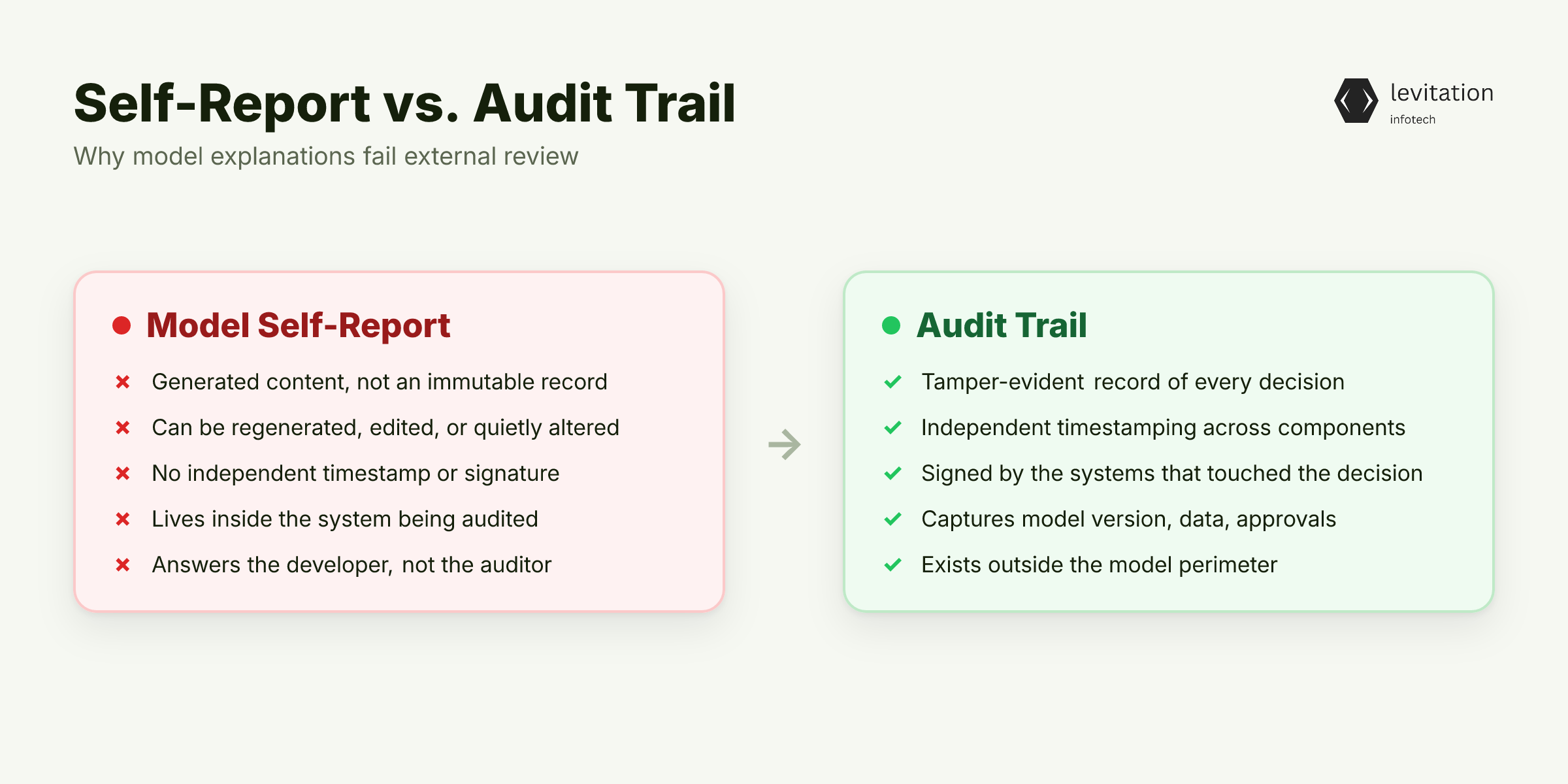
Your model can explain every decision it makes. Your auditor does not care.
The explanation your model generates is not the explanation your auditor will accept. That gap is why most XAI deployments fail their first external review.
Most teams start explainability by asking the model to explain itself. They collect chain-of-thought traces, tool call logs, and reasoning summaries. These outputs read like transparency. They feel like compliance.
In reality, they are debugging artifacts, not compliance evidence.
A debugging artifact answers a developer's question: "What did the model just do?" An audit trail answers an auditor's question: "Can you prove what the system did, in context, with no possibility of after-the-fact rewriting?"
The two are not the same thing. Treating them as interchangeable is the root cause of most first-audit failures.
The trap is subtle. Teams ship a model that "explains well" and assume the audit will follow. The model's self-report looks articulate. Stakeholders nod. Compliance signs off in principle.
Then the first external audit opens an evidence request, and the gap surfaces.
What auditors find is this: the model's explanation is generated content, not an immutable record. It can be regenerated, edited, or quietly altered. It carries no independent timestamp. It has no signature from the system components that touched the decision. It exists inside the perimeter of the very system being audited.
That is the structural problem. The thing the model writes about itself cannot serve as the primary record of what it did. It is testimony, not evidence. No auditor will treat testimony as evidence in their own proceeding.
Consider a practical example. An AML system flags a transaction. The model explains: "This pattern resembles layering." That is useful for the analyst reviewing the alert. It is useless for an auditor.
An auditor wants to know which version of the model ran. They want to know which data it saw and who approved the deployment. They want to know whether the rule set was current at the time of the decision. The model's one-line explanation covers none of this.
That gap is the gap that fails audits. Organizations that have built their regulatory compliance discipline around the model's voice rather than the system's voice discover this on audit day. Every first external audit exposes this gap, and the exposure is rarely gentle.
The fix is not a better self-report. The fix is a different architecture.
But why does a perfectly articulate self-explanation fail the moment an auditor opens the evidence package? The answer lies in what auditors actually ask. It is not the question the field has spent five years debating.
What Auditors Actually Ask (Hint: Not About Attention Weights)
The field spent five years debating how models compute. LIME. SHAP. Saliency maps. Mechanistic interpretability. Attention weight visualizations.
These are rich, interesting techniques for understanding model internals. They are also irrelevant in most enterprise audits.
An auditor asks a different question. They want to know: "How did the system behave? Who approved it? What data did it touch? Can you prove it all?" That question sits one level above the model. It treats the model as a component inside a larger system. The auditor evaluates the system against policy, regulation, and contract.
Consider the standard evidence package an auditor expects to receive: - A versioned model card with the date, owner, approver, and intended use. - A data lineage record showing which dataset, snapshot, and transformation pipeline produced the training input. - An approval log showing who signed off, when, and against which policy version. - A behavioral capture of every production decision: inputs, outputs, model version, policy version, and any human override. - A monitoring history showing drift, bias, and performance metrics over time.
None of these artifacts come from the model. They come from the system around the model. They are produced by governance workflows, data pipelines, approval systems, and logging infrastructure. The model itself generates none of them.
This is the structural distinction auditors enforce. The model sits inside the perimeter. The audit trail sits outside it. The audit trail records what the system did to the model. It also records what the model did with the data. It also records what happened to the output.
Nothing the model writes, reports, or generates can be the primary record of what it did.
The implications are uncomfortable for teams that have invested heavily in model-level XAI. Saliency maps tell you which input features drove a prediction. They do not tell you who approved that model version. They do not tell you whether the training data was compliant at training time. They do not tell you whether a human overrode the decision and why. Those are system-level questions. They need system-level answers. The ai compliance conversation has to move from the model layer to the system layer before any of this is solvable.
Auditors know this. They are not impressed by elegant explanations of model behavior. They are looking for a defensible, reconstructable, tamper-evident record of the entire decision flow. If you cannot produce it, no amount of model introspection will save you.
If the model's own words are not enough evidence, what does audit-grade XAI actually look like? It looks like a different kind of system entirely.
Explainability Is an Architecture Problem, Not a Model Problem
The reframe is simple and uncomfortable. XAI compliance is a system design discipline. It produces immutable, contextual records outside the model.
The model is one component. The audit trail wraps around it.
Concretely, an audit-grade XAI architecture has four governance pillars doing the heavy lifting: - Governance structures and roles. Model owners, approvers, escalation paths, and review boards. Codified in workflow, not in a doc that lives in a shared drive. - Risk assessment methods. Pre-deployment bias checks, drift baselines, impact tiering, and documented thresholds for re-approval. - Compliance alignment with regulations. Every model output mapped to the specific regulation it touches. GDPR explainability. AML decisioning. Sector-specific mandates. The mapping is explicit, versioned, and enforced. - Continuous monitoring and audit. Live streaming of predictions, feature distributions, and override rates. This data flows with the policy version into an immutable log the auditor can replay.
Notice what is missing. Not a single one of these pillars is a model-output artifact.
None of them is a chain-of-thought trace. None of them is a saliency map. They are all system-level constructs that the model does not produce and cannot produce.
The pattern shows up clearly in regulated industries. In AML, organizations that run audit-grade XAI architectures do not pass reviews because their models explain themselves well. They pass because they can show, end to end, which rule version fired. They can also show which model version scored the alert. They can show which analyst acted on it. They can also show what the disposition was. All of this comes with timestamps and approvals preserved. The detailed mechanics of explainable AI in AML compliance only matter in one case. That is when the surrounding system can reproduce them.
In healthcare claim approvals, the same pattern holds. Every decision is reconstructable from data lineage, model lineage, and human action lineage, all held outside the model.
The lesson is consistent. XAI succeeds only when the four governance pillars are put into practice before deployment. When they are bolted on after the model ships, the evidence gaps are too wide and too distributed to close. The full regulatory ai stack has to be designed in from day one, not papered over after.
This is also why retrofitting explanations onto an existing system is so expensive. You are not adding a feature. You are rebuilding the perimeter around a model that was deployed without one.
So which common failure patterns cause teams to walk into audit week with the wrong architecture entirely? The shortlist is shorter than most teams expect, and every item is preventable.
Why Your First Audit Fails Before the Auditor Arrives
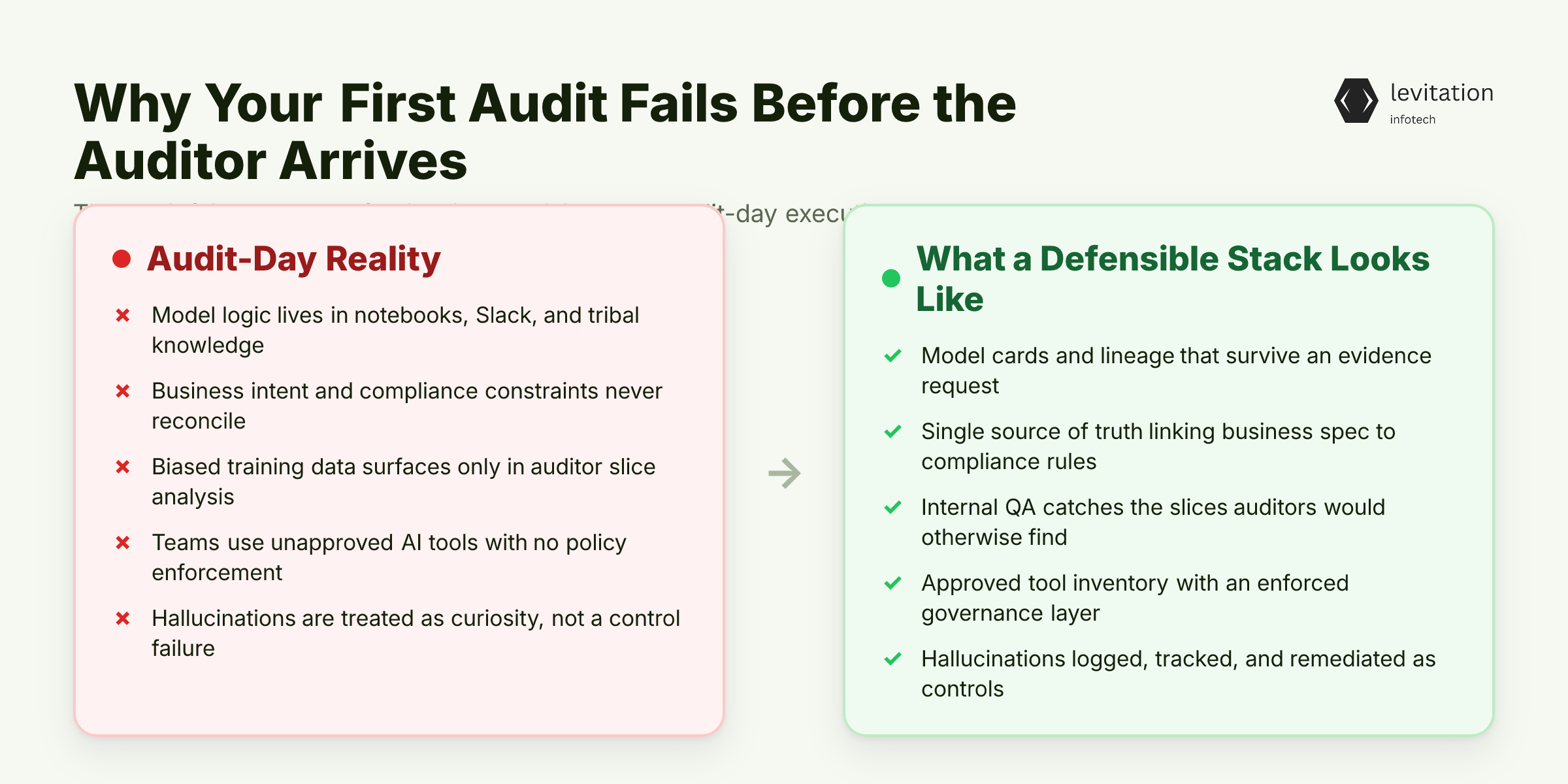
Most first-audit failures are not caused by the audit. They are caused by decisions made months earlier. Those decisions, made during build, left no audit trail.
The patterns repeat across industries. Each one is detectable in your system today, if you know where to look. - Weak documentation. Model logic lives in notebooks, Slack threads, and tribal knowledge. None of it survives an evidence request. The auditor asks for the model card; you send a Confluence page last edited in 2024. - Poor collaboration between teams. Business teams define intent. Compliance teams define constraints. The two never reconcile into a single source of truth. The model ships against the business spec, and the compliance gap is discovered on audit day. A model registry that passes every internal test still fails external audit if it is not connected to the approval workflow. - Data quality failures. Biased or incomplete training data surfaces only when auditors run their own slice analysis. They will. And they will find what your internal QA missed. - Governance gaps. Teams use unapproved AI tools, ignore hallucinations as a business risk, and lack a policy enforcement layer. The model is a black box to the very organization that built it. - Unaddressed hallucinations. Teams treat LLM hallucinations as a research curiosity, not a business risk. Auditors treat them as a control failure.
Each of these is an architectural gap, not a model gap. A model can produce the right output and still fail an audit. This happens when the system around it cannot prove the output was appropriate, authorized, and governed. That is why compliance automation has to be wired into the deployment pipeline, not bolted on as a separate workflow.
Teams that fail their first audit do not fail because the model is wrong. They fail because the system cannot prove the model was right. That is a documentation, governance, and lineage problem, not a machine learning problem.
Knowing the failure modes is one thing. Rebuilding the stack to get rid of them is the actual work. A small set of architectural choices, made deliberately, gets rid of the evidence gap before auditors open it.
The Audit-Grade XAI Stack: 4 Pillars You Can Build
Pillar one is governance structures. Assign model owners, approvers, and escalation paths. Codify them in your regulatory compliance workflow, not in a doc.
A doc is a suggestion. A workflow is an enforcement mechanism. The difference is what shows up in your evidence package on audit day.
Pillar two is risk assessment. Tier models by impact. Run pre-deployment bias and drift checks. Capture results in a versioned registry.
The registry is the single source of truth. It answers the auditor's first question: "What is this model, and who said it was safe to run?" When the registry is disconnected from the deployment pipeline, the same gaps that sink model cards will sink your audit. This happens regardless of how well the HIPAA audit failure pattern is understood in theory.
Pillar three is compliance alignment. Map every model output to the specific regulation it touches. GDPR explainability. AML decisioning. Sector-specific mandates. The mapping is not a wiki page.
It is a field in your model card, linked to a policy version, with an approval chain. Auditors do not accept "we believe we are compliant." They accept evidence.
Pillar four is continuous monitoring. Stream predictions, feature distributions, and override rates into an immutable log the auditor can replay.
"Immutable" is the operative word. Append-only. Timestamped. Signed. The auditor can prove no one edited history. Mutable logs are not logs; they are databases. The distinction is the difference between an evidence package and a draft.
The cost difference is structural. Organizations that build evidence capture into deployment avoid the reconstruction work entirely. Teams that retrofit explanations after the model ships must reconstruct the decision history from whatever partial records exist. That process grows harder with every quarter the system ran without an audit trail.
The choice is not technical. It is sequencing. Audit-grade work is cheaper before deployment than after.
A useful framing: the four pillars are not a checklist. They are a system. Drop one, and the others compensate briefly, then fail.
This is why half-built governance is worse than no governance. It gives leadership false confidence, then collapses under auditor scrutiny.
What does the operational reality look like once this stack is in production for years, not weeks? The answer is unglamorous, and that is the point.
What Changes When Audit-Grade XAI Becomes the Default
First-time audit passes replace firefighting cycles. Teams stop rebuilding evidence packages every quarter and start iterating on model quality.
The engineering capacity that used to go into audit prep gets redirected into model improvement, feature work, and customer outcomes. That capacity compounds.
Systems built on this architecture remain defensible across regulatory cycles. The data lineage, approval chain, and behavioral log are versioned against the policy they enforced, not the calendar they ran on. That is the test of an architecture, not a feature.
Enterprise credibility compounds. Organizations with this discipline earn sustained trust because their XAI is provable, repeatable, and regulator-ready on day one.
The differentiator is no longer "we use XAI." It is "our XAI produces an audit trail the auditor can replay." That is a category of one in most procurement processes. It is the reason buyers stop asking whether you can pass audit. They start asking how fast you can ship instead.
This is the work that separates AI programs that scale from AI programs that stall. The teams that win regulated workloads do not have better models. They have better systems around the models. That distinction is invisible to the model team and obvious to the auditor.
The lesson is consistent: the cost of doing it right is a fraction of the cost of doing it twice. The systems you build that way tend to outlast every regulatory regime they were first designed against.
Most teams underestimate how quickly this discipline pays for itself. The math gets more favorable the longer the system runs.
Frequently Asked Questions
Q: What is explainable AI compliance?
A: Explainable AI compliance is the practice of building AI systems. Their decisions must be reconstructed, justified, and verified against regulatory standards by an independent auditor.
Sources
Research and references cited in this article:
- Top 10 AI Governance Mistakes and How to Avoid Them - Cyber Security Services & Payment Security Services Company
- AI Compliance Failure Explained: Legal, Financial & Security Risks
- The most common AI policy failures in organizations | Upsun
- AI Audit Failures in Financial Services: Why Generic AI Falls Short
- AI Compliance in 2026: Top 6 challenges & Real-life failures
- AI Governance Solutions for Regulated Industries: Top 10 Tools for 2026
- AI governance for risk, audit, and regulatory readiness
- AI Governance Framework: 2026 Enterprise Guide
- AI Governance & Compliance: Enterprise Guide to Responsible AI
- Data Governance Frameworks for AI Compliance | 2026 - Dataversity
- Real-Life Explainable AI (XAI) Examples | 2026
- Is explainable AI the missing link in regulatory compliance?
About the author
Mayank Singh is a software developer at Levitation Infotech, where he builds web and AI-powered applications across the company’s fintech, healthcare, and enterprise projects.