


TL;DR: Open-source vector databases look cheap until the compliance audit arrives. They lack auditable lineage, fine-grained access controls, and retention hooks. This forces you to spend on retrofits, fines, and legal risk. Build a compliant, managed vector layer from the start and the audit becomes a non-issue.
Key Takeaways - Open-source stacks omit the compliance scaffolding regulators demand. - Adding perimeter security after the fact inflates complexity without closing the data-access gap. - A risk-first, policy-as-code approach lets you ship AI features while staying audit-ready.
The Hidden Compliance Drain in Open-Source Vector Databases
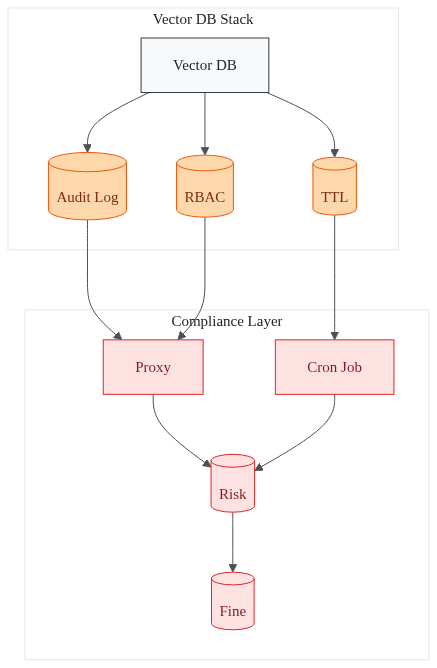
Fintech teams love the “free” badge on GitHub. They assume the open-source licence means lower total cost of ownership. Auditors ask for immutable data lineage. Most community-driven vector engines expose only CRUD APIs. They do not record who queried what, when, or why. Without that audit trail, regulators cannot verify that KYC or AML checks were applied at query time.
Regulators also demand access-control matrices that tie every read or write to a role. However, they also require an attribute and a purpose. Open-source projects rarely ship with role-based access control (RBAC) built into the query planner. You end up bolting a proxy or an API gateway that only masks the problem. The proxy becomes a single point of failure, and every additional hop adds latency.
Retention policies are a must for financial data. Laws require you to keep transaction-related embeddings for a defined period and then purge them securely. Most vector databases store embeddings in flat files or object stores without native TTL support. Teams resort to cron jobs that delete blobs. Those jobs are hard to prove in an audit because the delete operation leaves no immutable record. - Open-source vector stacks skip audit logging, RBAC, and TTL out of the box. - Fintech teams must build those capabilities themselves, often in an ad-hoc way. - The hidden spend shows up as engineering hours, third-party tools, and eventually fines.
The problem isn’t just missing paperwork; it’s how the architecture amplifies risk. What happens when that risk materializes?
Why Throwing More Money at Security Doesn't Fix the Leak
Most leaders reach for a next-gen firewall or a cloud-native WAF and think the compliance gap is sealed. Those perimeter tools encrypt traffic and block obvious attacks. They do nothing for the data-access gap inside the vector layer. When a user with read-only credentials can still query vectors that contain personally identifiable information, the breach is already inside your system. As a result, the data is exposed.
Open-source projects rarely ship with audit-trail hooks that integrate with a SIEM. You can attach a sidecar that watches write streams, but the sidecar runs outside the database’s transaction boundary. If the sidecar crashes, you lose the guarantee that every write was logged. The result is a fragile compliance chain that collapses under load.
Scaling those ad-hoc security tools also creates vendor lock-in. You might start with an open-source vector DB. Then you add a proprietary policy engine. Then a managed logging service follows. Each addition forces you to rewrite deployment pipelines, extending time-to-market for new AI features. The “more money = more security” equation breaks because you’re paying for complexity, not for the missing controls. - Perimeter security does not enforce who can see which embedding. - DIY audit sidecars sit outside the database transaction, risking gaps. - Layered add-ons increase vendor lock-in and slow product cycles.
The real solution lies not in patching symptoms but in rethinking the data layer from a risk perspective. Can a better design actually close the gap?
Insight: Structured Risk Management Beats Open-Source Blindness
A three-pillared risk strategy turns compliance from an afterthought into a design principle.
- Avoidance - Keep the most sensitive data out of the vector store. Store only hashed identifiers and let a downstream service enrich the result with protected fields after access checks.
- Transfer - Insure against regulatory penalties, but recognize that insurance does not replace technical controls.
- Mitigation - Enforce policies at query time, log every decision, and make the logs immutable.
Embedding policy-as-code lets you codify KYC, AML, and retention rules directly in the query engine. Tools like Open Policy Agent (OPA) can evaluate a request against a JSON policy. Then the vector index is touched. The result is a single source of truth that lives alongside your codebase.
1# terraform example: RBAC for a managed vector service2resource "aws_iam_role" "vector_reader" {3 name = "vector-reader"4 assume_role_policy = jsonencode({5 Version = "2012-10-17"6 Statement = [{7 Effect = "Allow"8 Principal = { Service = "ecs-tasks.amazonaws.com" }9 Action = "sts:AssumeRole"10 }]11 })12}1314resource "aws_iam_policy" "vector_read_policy" {15 name = "VectorReadPolicy"16 policy = jsonencode({17 Version = "2012-10-17"18 Statement = [{19 Effect = "Allow"20 Action = ["vectordb:Search"]21 Resource = "*"22 Condition = {23 StringEquals = {24 "aws:RequestedRegion" = "us-east-1"25 }26 }27 }]28 })29}3031resource "aws_iam_role_policy_attachment" "attach" {32 role = aws_iam_role.vector_reader.name33 policy_arn = aws_iam_policy.vector_read_policy.arn34}
Automated audit logs become immutable when you ship them to a write-once bucket (e.g., AWS S3 Object Lock). Then you forward them to a SIEM. The log entry includes the user ID, the policy decision, the vector ID. It also contains a cryptographic hash of the query payload. Because the bucket is write-once, the log cannot be altered without detection. - Policy-as-code enforces compliance at the query layer. - Immutable logs give auditors a tamper-evident trail. - Risk pillars keep the most sensitive data out of the vector store.
How can you enforce that without breaking performance?
Implementation Playbook: Building a Compliant Vector Stack in 3-6 Months
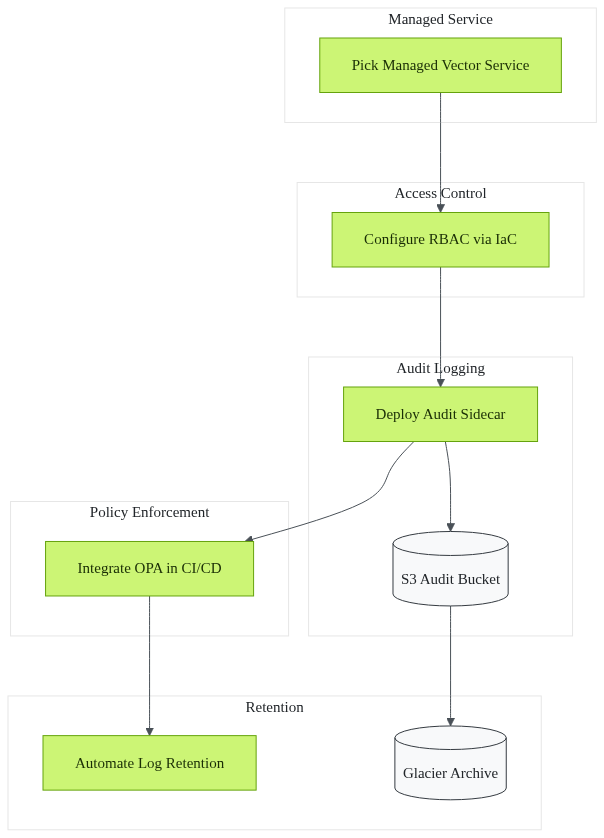
- Pick a managed vector service that already holds SOC 2, ISO 27001, and GDPR certifications. The managed offering adds a compliance veneer that open-source alone cannot provide.
- Configure RBAC and attribute-based policies via IaC. The Terraform snippet above shows how a single role can be scoped to a region. Then it can be scoped to a specific operation. Extend it with tags like `department=payments` to enforce departmental boundaries.
- Add immutable audit logging. Deploy a sidecar container that intercepts all write calls:
1apiVersion: v12kind: Pod3metadata:4 name: vector-db-with-logging5spec:6 containers: - name: vector-db7 image: myorg/vector-db:latest8 ports: [{containerPort: 8080}] - name: audit-sidecar9 image: myorg/audit-sidecar:1.210 env: - name: LOG_BUCKET11 value: "s3://my-audit-logs" - name: LOG_MODE12 value: "write-once"13 volumeMounts: - name: shared-socket14 mountPath: /var/run/vector15 volumes: - name: shared-socket16 emptyDir: {}
The sidecar writes JSON logs to the S3 bucket with Object Lock enabled. Your SIEM (e.g., Splunk or Elastic) pulls from that bucket via an event bridge, giving you real-time visibility.
- Integrate OPA into CI/CD. Add a policy test step that fails the pipeline if a new query bypasses a required check:
1steps: - name: "OPA policy test"2 image: openpolicyagent/opa:latest3 script: |4 opa test ./policies --data ./config
- Automate retention. Use a lifecycle rule on the S3 bucket to transition logs older than the mandated period to Glacier. Then delete after the legal hold expires. The rule is declarative and audited by the cloud provider. - Managed service gives you certifications out of the box. - IaC-driven RBAC makes role changes auditable and repeatable. - Sidecar + write-once bucket provides tamper-evident logs. - OPA in CI ensures policy drift never reaches production.
What does that look like in practice?
Payoff: Lower Costs, Faster Innovation, and Regulatory Confidence
With compliance baked in, you stop spending on emergency retrofits. Engineering time shifts from firefighting to feature development, shrinking the time-to-market for AI-driven products. Regulators see a single, auditable control point at the vector layer and reduce the
Sources
Research and references cited in this article:
- Vector Database Guide 2026 Options Features and Benefits
- What's Changing in Vector Databases in 2026
- Top Vector Databases for Enterprise AI: 2026 Comparison
- Top Vector Databases in 2026 - Slashdot
- How to Evaluate Vector Databases in 2026 - Actian Corporation
- Fintech's Open Source Conundrum: Risks, Rewards, and Mitigation ...
- Why open source matters in fintech AI — The Financial Revolutionist
- Fintech's Role in Shaping Open Source AI - Today's General Counsel
- Building Trust in Fintech: An Analysis of Ethical and Privacy ... - MDPI
- Artificial Intelligence and Open Source Data and Software: Contrasting Perspectives, Legal Risks, and Observations | Crowell & Moring LLP
- Cyber Risk Management for FinTechs in the 21st Century
- (PDF) Mitigating Cyber Risk in Financial Institutions: Leveraging AI ...
About the author
Mayank Singh is a software developer at Levitation Infotech, where he builds web and AI-powered applications across the company’s fintech, healthcare, and enterprise projects.