


TL;DR: Roughly 78% of workloads still authenticate with static API keys and shared secrets, despite workload identity being widely available and well understood. The gap is execution, not awareness. Traditional credential management creates rotation debt and migration friction that most teams underestimate. Workload identity replaces long-lived secrets with short-lived tokens tied to runtime context. Platform teams who pilot it roll it out faster than the multi-year timeline an in-house build takes.
Key Takeaways: - Static credentials compound with service count. The rotation cost is silent, but it is the real reason adoption stalls. - Workload identity issues short-lived tokens at runtime via attestation, collapsing the credential lifecycle into one control plane. - A five-step pilot playbook compresses adoption from years to months: inventory, one service, an issuer, one dependency, and a default for new builds.
The 78% Adoption Gap Isn't a Knowledge Problem
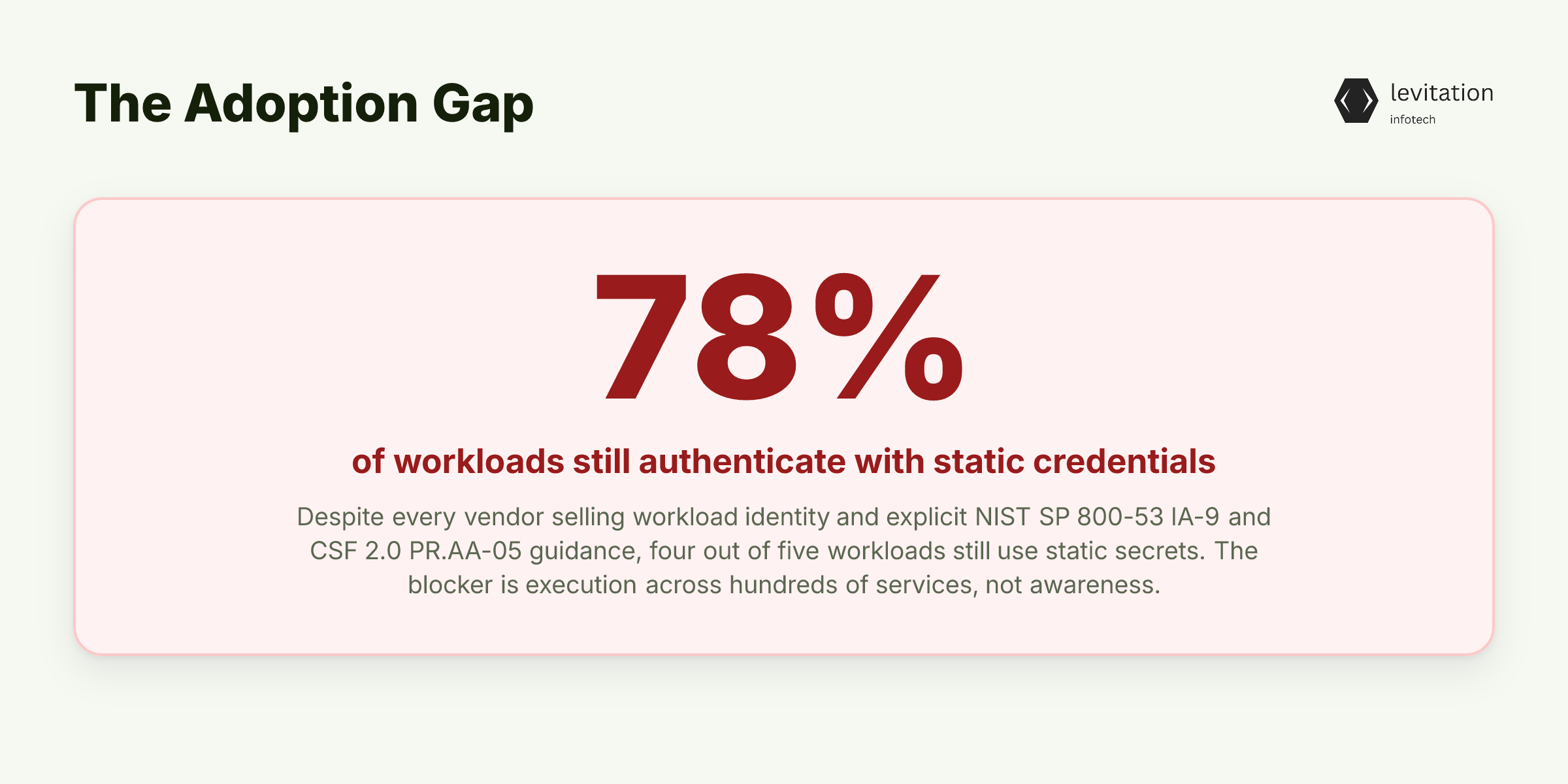
Every vendor in the cloud security space now sells workload identity. Adoption surveys still show roughly four out of five workloads authenticating with static secrets.
The gap isn't awareness. It's execution.
That stat should bother every CISO reading it. Workload identity is not a new idea. The concept is simple. Give every container, VM, and Kubernetes pod a unique, short-lived cryptographic identity instead of a shared API key. Vendors are loud. Frameworks are explicit.
NIST SP 800-53 IA-9 (Service Identification and Authentication) and CSF 2.0 PR.AA-05 both address machine-to-machine authentication and least-privilege access for non-human entities. And yet 78% of workloads still authenticate with static credentials.
The lag is structural, not intellectual. Most teams run hundreds of services written by dozens of teams, each with its own credential lifecycle.
The compliance language in NIST and CSF describes what should exist at runtime, but it rarely translates to operational control. A control that says "use managed identities" is a policy statement. A workload that still has an API key in its environment variable is the reality.
This is why cloud security posture for kubernetes and service mesh environments rarely moves from assessment to enforcement. Posture tools flag the gap. Ownership of the fix stays scattered.
So if awareness isn't the blocker, what is? The answer is sitting in every team's secrets manager.
Why Static Secrets and Manual Rotation Keep Winning
Static credentials feel safe because they are familiar. They also feel cheap because the cost of managing them is hidden inside operations budgets.
That hidden cost is rotation. Every certificate, every key, every API token needs lifecycle handling. The operational load compounds with service count. Teams that run 20 services feel it. Teams that run 200 drown in it.
Three forces keep the static-secrets model entrenched. - Configuration complexity. Standing up identity providers, trust bundles, and SPIFFE-style attestation means wiring each cluster individually. Heterogeneous environments multiply the work. The barrier is not the technology. It is the operational lift to standardize it. - Migration friction. Teams fear breaking existing IAM policies. They roll back to long-lived keys because they are familiar. Even when those keys are a known credential exposure vector, the visible cost of breakage outweighs the invisible cost of doing nothing. - Scattered ownership. A NIST IA-5 control failure shows up as bespoke secret handling scattered across repos. Every per-application auth path is a vulnerability waiting to age out. Zero trust and mTLS for cloud infrastructure only works if the control plane is consistent. Static secrets break that consistency one service at a time.
A single engineer often owns dozens of machine identities across cloud accounts, CI systems, and service meshes. The team rarely knows the full inventory. The same pattern shows up wherever model serving and data pipelines run at scale. The credential sprawl underneath is what most teams underestimate.
Teams don't avoid workload identity because the concept is weak. They avoid it because the cost of getting it wrong is visible. The cost of doing nothing is invisible, until something breaks.
The Hidden Cost of the 78%: What Skipped Adoption Actually Costs You
A leaked API key from one workload can pivot into IAM, S3, or database access. The blast radius is the entire identity attached to that key, not just the workload. That is the first cost nobody budgets for.
The second cost shows up at audit. NIST AC-6 (Least Privilege) assumes credentials are scoped to the smallest possible role. Static credentials almost always violate this assumption because rotation is painful. Engineers over-grant to avoid outages.
Every audit report that flags "excessive permissions" traces back to a static secret scoped too broadly. Nobody wanted to handle the rotation cost.
The third cost is incident response. When a forensic team needs to know which workload originated a request, they need a workload-scoped identity in the logs. Without it, they correlate timestamps across services and guess. That guesswork extends mean time to resolution.
Workload identity puts the answer directly in the log.
The fourth cost is persistence. Every static secret is a permanent credential. It cannot be revoked instantly. It cannot be scoped to a single execution context.
Static secrets persist in logs, environment variables, and container images long after the workload that owned them is gone. They age into vulnerabilities.
These costs compound. The 78% adoption rate is not a neutral statistic. It is ongoing exposure that accrues interest. It is exactly the kind of exposure that secure cloud migration with identity-first controls is designed to eliminate.
In regulated environments, the cost is concrete. When systems handle PHI, static secrets are an audit-grade liability. Workload identity is what makes least-privilege provable rather than aspirational.
Once you frame the cost as ongoing exposure, the question flips. It stops being "should we adopt?" and becomes "what does real adoption look like?"
What Workload Identity Actually Does (Beyond the Marketing)
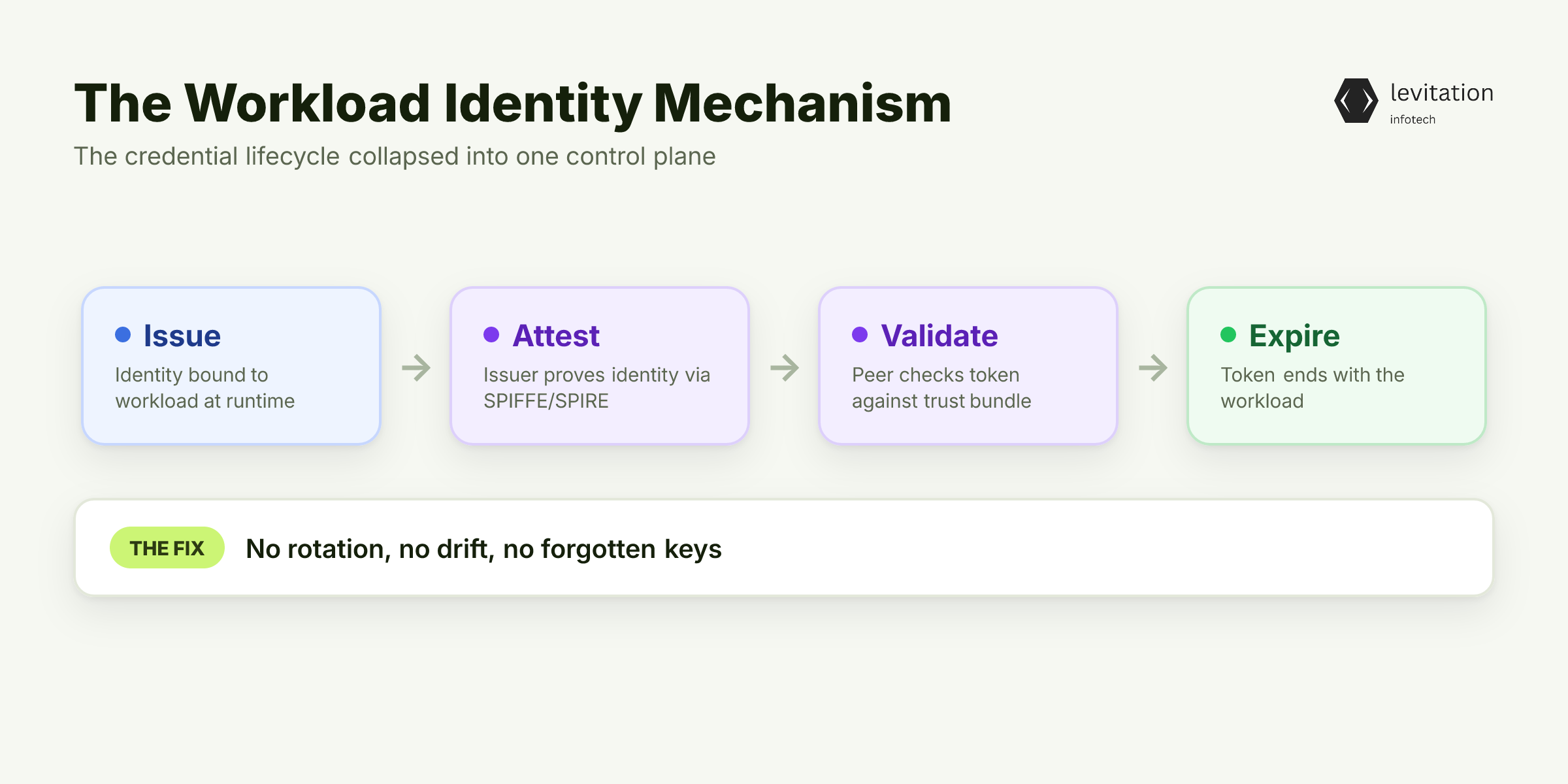
The marketing version of workload identity is vague. The mechanism is specific.
Identity is issued at runtime, tied to the workload's execution context. A Kubernetes pod, a VM, a process. Whatever the unit of work is, the identity is bound to that unit, not to a human or a config file. When the workload starts, an issuer attests to its identity. When the workload stops, the identity stops.
Tokens are short-lived. The standard window is measured in minutes rather than months, so revocation happens automatically at expiry. There is no manual rotation project, no scheduled cron job, no Slack reminder to rotate that key by Friday.
Trust is cryptographically verifiable. Each workload proves its identity via attestation, typically using SPIFFE and SPIRE as the issuance framework. Peer services validate the token against a trust bundle.
There is no shared secret to leak, no vault to query, no API key to pass through headers. This is also why mTLS alone is not enough. The mechanism replaces shared secrets with per-call authentication.
Every service-to-service call is a fresh authentication event with a fresh, scoped token. That collapses the entire credential lifecycle problem into a single control plane: issue, attest, validate, expire. No rotation. No drift. No forgotten keys in old Git history.
This is why kubernetes-native workload identity and IAM is increasingly the default for greenfield platforms and the target state for brownfield migrations. The control plane is uniform. The blast radius of any compromise is bounded by token lifetime. Every request leaves a verifiable trail.
That mechanism is clean in theory. The question platform engineers actually face is how to roll it out without breaking the services already in production.
A Platform Engineer's Adoption Playbook
A pilot that fails usually fails because the team tried to migrate everything at once. The playbook below avoids that failure mode by sequencing work to keep risk visible and progress measurable.
Step 1: Inventory where static secrets actually live. Secrets managers, environment variables, CI/CD vaults, container registries, and source control history are the obvious locations. The not-obvious locations are worse: hardcoded in Helm charts, baked into base images, committed to feature branches and forgotten. Teams consistently underestimate the count.
Step 2: Pick a starting cluster and a non-critical service. The failure mode where adoption is "too hard" almost always traces to teams trying to migrate everything simultaneously. A pilot service with no compliance dependency and no production SLA gives you room to learn the issuance model without the blast radius.
Step 3: Stand up an identity issuer. SPIRE is the reference open-source implementation. Cloud-native and managed alternatives exist for teams that don't want to operate the control plane themselves. Issue identities to the pilot service. Verify that peer services can validate the short-lived tokens. This step usually takes longer than expected because trust bootstrap and certificate distribution have edge cases.
Step 4: Replace one credential dependency at a time. Start with the database password. Then a service-to-service API key. Then a cross-cloud IAM role. Each replacement is a measurable reduction in static secret count and a smaller blast radius if something goes wrong.
Step 5: Make workload identity the default for new services. Existing static secrets get migrated on a maintenance schedule, not a panic-driven rewrite. New services inherit identity from the platform instead of requesting credentials from each downstream system. Observability and IAM for devops teams adopting zero trust becomes a dashboard question, not a fire drill.
Platform teams who run this playbook deploy faster than the in-house approach. The in-house approach has to build identity issuance, trust bootstrap, and rotation automation from scratch. It often stretches across multiple years, with many projects never reaching completion. The hard parts are platform concerns, not per-service work.
The playbook is straightforward. The harder question is what "done" looks like in operational terms.
What "Done" Looks Like: The Operational Difference
"Done" is not a certification. It is a set of operational properties that change how the platform feels day to day.
Secret rotation stops being a project. Tokens expire in minutes. There is nothing to rotate manually. The on-call rotation no longer carries a "rotate the prod database password" ticket that everyone defers until the next audit. Rotation is a property of the system, not a task for humans.
Incident response gets faster. Every request carries a verifiable workload identity, so the question "which service made this call?" is answerable from logs alone. Forensic timelines compress because the correlation effort collapses to a direct query against the identity-tagged log stream.
The blast radius of a compromise is bounded by token scope and lifetime, not by the breadth of an API key's IAM role.
NIST PR.AA-05 moves from policy to evidence. Access paths are uniform, scoped, and short-lived. Least-privilege reviews become mechanical. Query the issuance log, see which workloads requested which tokens, flag anything that does not match the expected pattern.
Reviews that previously consumed days of cross-team coordination compress to a single session of running queries against the issuance log.
New services onboard without negotiating credentials with every downstream system. They inherit identity from the platform. This eliminates the standing-IAM, secret-distribution, and validation-wiring friction that used to slow every greenfield project.
This is the operational payoff of cloud infrastructure and service mesh security built on workload identity. The audit story is provable. The on-call burden is lower.
If you are building AI systems, payment infrastructure, or any platform that runs hundreds of services, this is the floor. Workload identity is the baseline, not the differentiator. Teams that treat it as table stakes ship faster and audit cleaner.
Frequently Asked Questions
What is workload identity in cloud security?
Workload identity assigns a unique, short-lived cryptographic identity to each application, container, or service. It authenticates to other workloads and cloud APIs without using static API keys or shared secrets. It is the machine-to-machine equivalent of single sign-on, built for ephemeral cloud-native execution.
What percentage of workloads actually use workload identity today?
Industry surveys consistently put adoption at roughly one in five workloads. About 78% still rely on static credentials. The gap is widest in organizations running hundreds of services across multiple Kubernetes clusters and cloud accounts.
How does SPIFFE help with workload identity adoption?
SPIFFE defines a standard format for workload identities and a process for issuing them based on runtime attestation. SPIRE is the reference implementation. Together they replace per-service secrets with a uniform identity layer that any workload can verify cryptographically. This is what makes cross-cluster, cross-cloud authentication tractable.
Is workload identity the same as a service mesh?
No. A service mesh can use workload identity to enable mTLS between services. The mesh is the communication layer and identity is the trust layer. You can have workload identity without a service mesh, and you can have a service mesh without real workload identity. Many use shared certs that defeat the purpose.
What is the biggest barrier to workload identity adoption?
Configuration complexity and migration risk. Teams have to wire identity issuance, trust bootstrapping, and token validation across heterogeneous environments. They fear breaking production IAM. The pattern that works is piloting on one non-critical service, then making workload identity the default for everything new.
A workload identity assessment surfaces the gaps worth closing first.
About the author
Mayank Singh is a software developer at Levitation Infotech, where he builds web and AI-powered applications across the company’s fintech, healthcare, and enterprise projects.