


Most CTOs are now on the hook for AI systems they cannot name, locate, or shut down. The gap between accountability and visibility is the most expensive liability hiding in your stack.
TL;DR: AI governance fails before it starts because CTOs cannot see the AI already running in their organizations. Traditional IT inventories miss LLM APIs, embedded SaaS AI features, and shadow tools that bypass procurement. The fix is a three-layer visibility model, enforced through API proxies, observability tagging, contract audits, and a model registry. Together, these collapse governance from a quarterly scramble into a continuous, queryable posture.
Key Takeaways: - Shadow AI is the default state in most enterprises, not an edge case. IT asset management was never designed to find it. - AI exists in three visibility layers: built, sanctioned-vendor, and shadow. Most CTOs can only see the first. - Visibility is built in four steps: proxy traffic, tag observability data, audit SaaS contracts, stand up a model registry. - Governance without runtime visibility is policy theater. With it, you can answer "where is our data flowing right now?" in minutes.
The CTO's Blind Spot Is Wider Than You Think
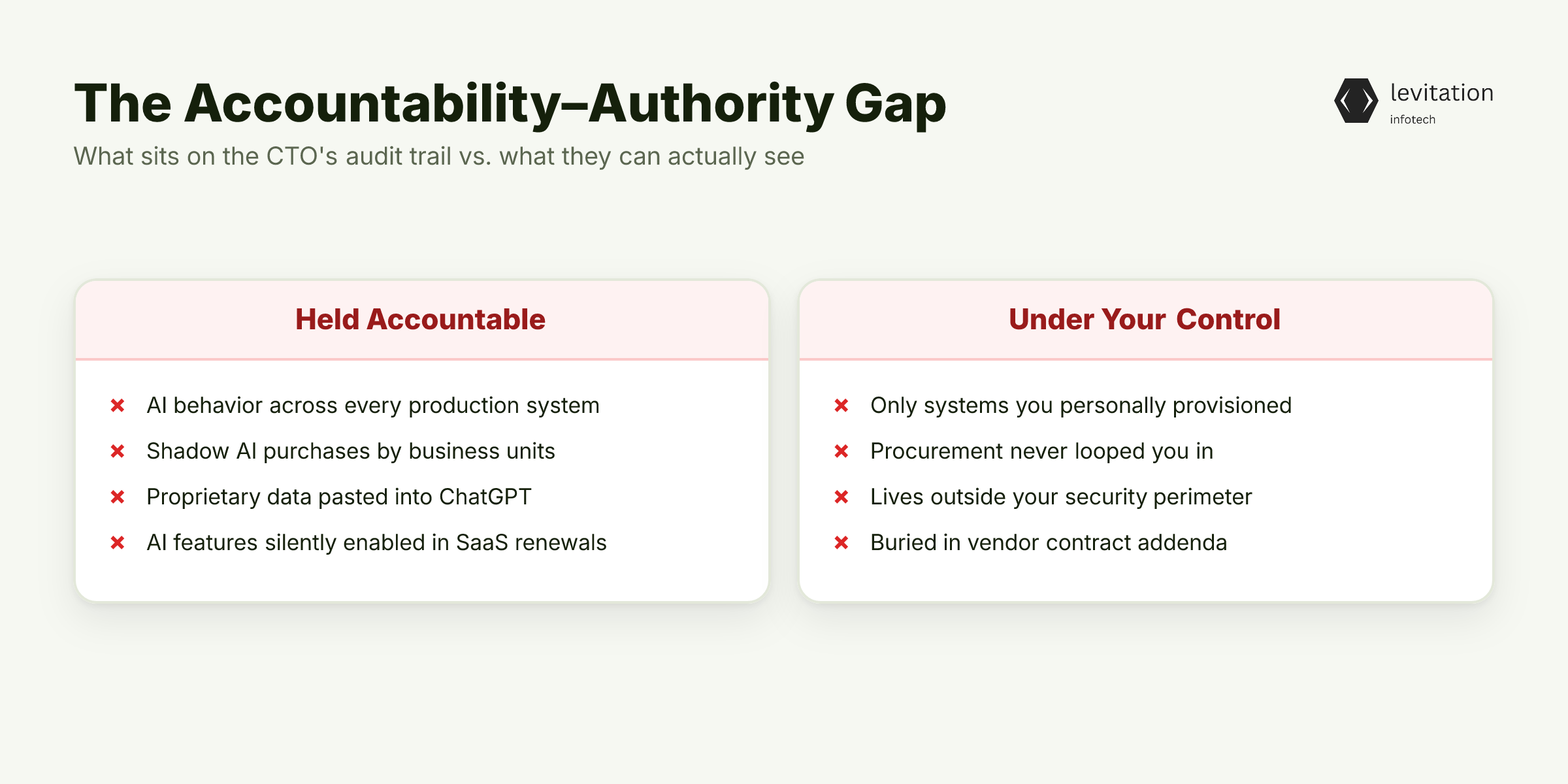
Most CIOs and CTOs are now accountable for AI systems they do not fully control. That sentence deserves a second read.
The people whose names sit on the audit trail are the same people who cannot answer a basic question. What AI is running in production right now? AI you cannot see is a liability sitting in your org chart, disguised as productivity tools.
Every business unit now buys its own AI point solutions. Every team pastes proprietary data into ChatGPT to "save time." Every SaaS renewal quietly activates an AI feature the procurement team never read about.
This is the accountability-without-authority asymmetry, and it is the structural risk facing CTOs in 2026. The board holds you responsible for AI behavior, but you hold no instrument to observe, audit, or stop it. The gap widens faster than any policy can close it.
If the problem is visibility, the obvious answer is an inventory. So why has the obvious answer failed?
Why Traditional Asset Inventories Cannot See AI
IT asset management was built for a different era. Licensed software running on managed endpoints, scanned by agents, tracked by license keys. AI workloads break every assumption in that model.
LLM API calls leave no installed binary. There is no agent footprint, no executable to discover, no license file to fingerprint. A developer pastes a customer record into a browser-based tool. The call happens over HTTPS like any other web request. Your endpoint scanner sees a browser. It does not see a model.
SaaS AI features make the problem worse. Your CRM ships an AI summary feature that activates with a settings toggle. Your helpdesk embeds an LLM into ticket routing. Your IDE adds a coding assistant that reads every file the developer opens.
None of these require procurement. None appear in your asset database. All of them touch your data.
Vendor sprawl compounds the gap. Each business unit procures its own AI point solutions through P-cards, departmental budgets, and annual renewals that IT never reviews. The result is an inventory that tells you what servers you own, but nothing about what models are reasoning over your data.
You can list every laptop on the network. You cannot list the models reading your source code. So what mental model actually fits how AI lives inside a modern company?
The Three Layers of AI You Cannot See (Yet)
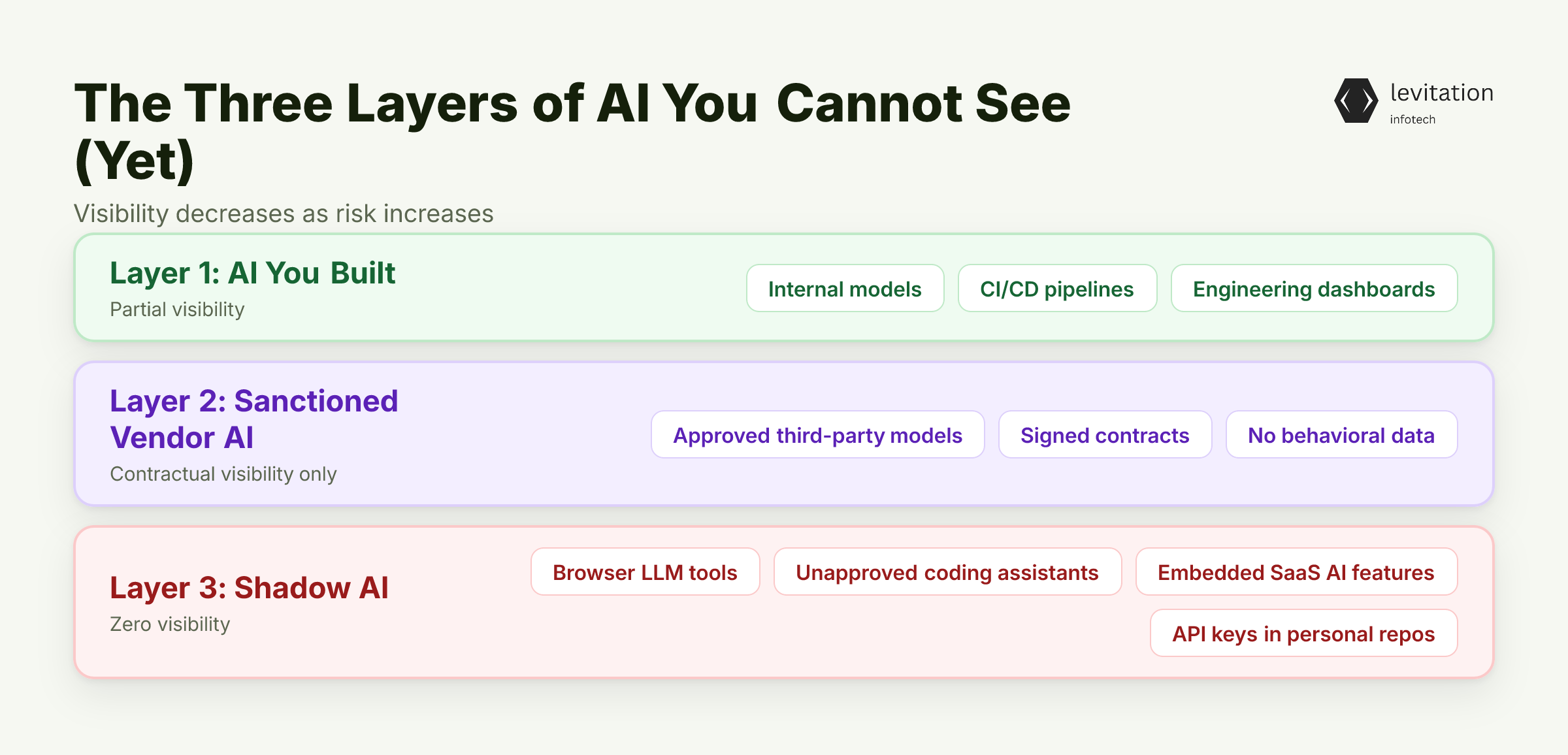
Layer 1 is AI you built. These are models your team developed, deployed, and monitors. They sit in your infrastructure, pass through your CI/CD pipelines, and show up in your dashboards. You have partial visibility here. The instrumentation gap is usually engineering, not governance.
Layer 2 is sanctioned vendor AI. These are third-party models and platforms procured through official channels. You signed the contract. You approved the spend. But did anyone read what the model does with your prompts?
Most CTOs have contractual visibility into Layer 2, not behavioral visibility. The contract says the vendor will not train on your data. The contract does not tell you what the model actually did at 3 a.m. on a Tuesday.
Layer 3 is shadow AI. This includes browser-based LLM tools, coding assistants installed without IT approval, embedded AI features inside SaaS platforms IT never reviewed, and API keys checked into personal repos. This is where the control gap concentrates. This is where customer data leaves the building.
Most CTOs have partial visibility into Layer 1, contractual visibility into Layer 2, and zero visibility into Layer 3. The control gap is not a single failure. It is a gradient across all three layers, with the most risk in the layer you cannot see at all.
The first question is not what governance framework to adopt. It is whether you can see everything you need to govern. Related reading on the AI governance blind spot problem confirms the answer starts at the network layer, not the policy layer.
Building the AI Control Map: Four Steps That Actually Work
Step one is to intercept at the API gateway. Route all outbound LLM traffic through a proxy that logs model identity, prompt metadata, token volume, and destination. This single move makes Layer 3 visible within weeks.
You will discover shadow usage you did not know existed: personal ChatGPT accounts, unsanctioned Claude subscriptions, and coding assistants reading your private repos. The proxy does not need to block traffic on day one. It needs to log it.
Step two is to tag AI workloads in your observability stack. Extend your existing APM and infrastructure tags to include model ID, prompt template version, and data classification. If your observability platform cannot see it, neither can you.
Most teams skip this step. They later discover they cannot answer "which model served that wrong answer?" during an incident.
Step three is to audit vendor AI contracts. Pull every SaaS agreement. Flag which platforms embed AI features, what data those features process, and what your audit rights actually cover. Most contracts will not survive a five-minute read.
Many contain clauses that grant vendors training rights over your inputs. Many embed AI features that activated automatically after a terms-of-service update nobody noticed.
Step four is to stand up a model registry. Even a lightweight registry, with model name, owner, use case, data sources, and retirement date, collapses Layer 1 and Layer 2 into a single queryable surface. The question "what models are in production?" becomes answerable in one query instead of a cross-team scavenger hunt.
This pattern can compress the visibility layer from a multi-year build into a matter of months. You are adopting a proven control map rather than designing one from a blank whiteboard. For a related read on what auditors find first when visibility is missing, see Your API Gateway Is Sabotaging AI Productivity.
Visibility is the means. The end is governance that holds up under audit, under regulator scrutiny, and under the next model your team adopts without asking.
What Governance Looks Like When You Can Finally See
With the control map in place, governance stops being policy theater and becomes runtime decision-making. You can answer "where is our customer data flowing right now?" in minutes, not weeks. You can revoke a vendor's data access the day a contract lapses, because you know which models are calling their endpoints.
Audit readiness shifts from a quarterly scramble to a continuous posture. That is what regulators will eventually require. Enterprises that already have the visibility layer will pass while competitors scramble. Vendor accountability becomes enforceable because you can prove what each provider is doing with your data, not just what their contract claims.
Visibility-first governance is what separates platforms that endure from those that get replaced after a year or two. The pattern that keeps systems in production is the pattern that made them observable from day one.
Teams that operationalize this shift from policy to runtime visibility often lean on enterprise AI solutions that treat observability as a prerequisite, not an add-on. For a complementary view on the model registry step, Your Model Registry Passes Tests. It Will Still Fail Audit. goes deeper on what most teams miss.
The accountability gap does not close with a principles document. It closes when every model touching your data shows up in a system you control, with a query you can run, on demand.
Frequently Asked Questions
What is the AI control gap?
The AI control gap is the distance between a CTO's accountability for AI-driven outcomes and their actual visibility into which models are running, what data they touch, and who governs their behavior. It widens with every unsanctioned LLM subscription and every AI feature that ships inside a SaaS contract IT never reviewed.
How do you discover shadow AI in an organization?
You discover shadow AI at the network layer, not the inventory layer. Routing outbound traffic through an LLM-aware proxy reveals endpoints, token volumes, and data classes that endpoint scans and SaaS audits miss. Pair this with a prompt-level audit of browser extensions and embedded AI features to close the loop.
What is an AI model registry and do we need one?
An AI model registry is a structured catalog of every model in use, with its owner, version, training data, intended use, and retirement date. You need one because without it, "what models are in production?" is unanswerable in most enterprises. That single question is the foundation of every governance framework regulators are now drafting.
How long does it take to close the AI control gap?
For most enterprises, the visibility layer can be stood up within a few quarters using API proxies, observability tagging, and contract audits. The full governance program, which includes policy, controls, enforcement, and continuous monitoring, runs longer. It starts producing audit-ready artifacts within the first quarter once the control map exists.
What should a CTO do first about AI governance?
Skip the framework. Start by answering one question: can you list every AI system touching your data right now, without asking a single team? If you cannot, the first deliverable is an inventory. Not a policy. Not a committee. Not a principles document. Visibility is the prerequisite every other governance activity assumes.
Run that one query today and see what surfaces.
About the author
Mayank Singh is a software developer at Levitation Infotech, where he builds web and AI-powered applications across the company’s fintech, healthcare, and enterprise projects.