


TL;DR: Zero trust was designed for human users and devices, not machine-speed AI agents that authenticate legitimately but operate at volumes and patterns that defeat per-request policy evaluation. The fix is not more zero trust, but zero trust re-applied to non-human identity with identity-per-agent, just-in-time access, action-class gating, and behavioral baselines enforced at the tool-invocation layer.
Key Takeaways: - Traditional zero trust catches human anomalies but misses agents that authenticate correctly and operate at machine speed - The four core principles still apply, but weight shifts to continuous validation and least privilege over initial authentication - Agent identity must be first-class in your IAM, with ephemeral tokens, scoped credentials, and action-class policies - Behavioral baselines and human-in-the-loop verification are required for destructive agent actions - An agent-native control plane makes agent deployment faster, not slower, by turning security review into design
Your Zero Trust Catches Engineers. It Misses Every Agent.

Your zero trust policy fires correctly when an engineer tries to reach a production database at 2 AM from an unrecognized device. It blocks them, pages the SOC, and demands MFA.
Now consider the AI agent that authenticated at 9 AM with a valid service token. It has been making API calls at a rate no per-request policy was built to review. It just initiated a bulk data export. Your policy sees nothing wrong.
The engineer hit a tripwire. The agent didn't. Both were anomalous in different ways, but only one was built into the threat model.
Zero trust was designed for human actors. One identity, one session, a measurable behavioral baseline. The model assumes a human at a keyboard making decisions. Unusual means off-hours, unfamiliar device, or unexpected resource.
Engineers are loud failures. They trip alerts, trigger MFA, and leave evidence.
Agents are silent successes. They authenticate legitimately, hold valid tokens, and operate at a volume no human session ever produces.
The failure is invisible. No alert. No block. No page. Just an authenticated agent doing what it was told, faster than any policy can review.
This isn't a misconfiguration on your team. It's a design assumption baked into zero trust from day one, and patching around it won't close the gap.
Agents Don't Break Your Policy. They Were Never Its Target.
The four zero trust principles, codified in NIST 800-207, were built for users and devices. They are: verify explicitly, apply least privilege, assume breach, continuously validate. Every principle still holds. None of them were designed for actors that make thousands of tool calls per minute while chaining delegated permissions across services.
The speed mismatch breaks the model first. A human session generates API calls at a rate that allows per-request evaluation. An autonomous AI agent generates calls at a rate that exhausts per-request evaluation entirely.
Any policy engine that evaluates per request gets exhausted, throttles, or starts returning cached approvals. The control plane becomes the bottleneck, and bottlenecks get worked around with standing permissions.
Then there's delegation inheritance. Agents often act on behalf of a user or service principal. They inherit broader scopes than a least-privilege check would grant a direct actor.
The agent's effective permissions look like a superset of the delegator's, because at the moment of evaluation, that's what they are.
This is the same pattern that makes zero trust leaks in fintech hard to catch. The credential looks valid. The action looks authorized. The audit trail shows nothing wrong.
The most dangerous blind spot is the "helpful agent" pattern. An agent that authenticated correctly, is executing a legitimate task, and has every token in order can still initiate a destructive action. No human would approve this in isolation.
Deleting a volume. Modifying a security policy. Exporting customer records. Your IAM system sees a valid caller with valid scopes.
The damage happens in the gap between valid and appropriate.
In production, the pattern repeats. Agents operate inside the trust boundary, not outside it.
They pass every check. They cause every incident.
If zero trust wasn't built for agents, what does an agent-native control plane actually look like?
Stop Asking Who the Agent Is. Start Asking What It Should Do Right Now.
The conceptual shift is from static identity verification to continuous, contextual authorization evaluated at the moment of each action. Traditional zero trust asks, "Is this caller who they claim to be?" Agent-native control asks, "Should this caller do this thing right now?"
Three changes make this real.
Identity per agent, not per session. Each autonomous agentic actor gets its own first-class identity with scoped, short-lived credentials. No shared service accounts. No inherited tokens.
The identity is auditable and revocable independently of any user.
Just-in-time access. Permissions are granted for the duration of a specific task and revoked immediately after. The window of standing privilege collapses from months to minutes. A compromised agent identity has a blast radius bounded by the token's remaining lifetime.
Policy at the tool-invocation layer. The decision point must live where the agent actually executes actions. Not just at the network edge or API gateway. Every tool call gets evaluated: identity, scope, action class, behavioral baseline, risk context. The same policy engine, applied at the right layer.
The four zero trust principles still apply, but the weight shifts. Continuous validation and least privilege become more critical than initial authentication. An agent's risk profile changes with every tool call. An agent that just queried a read endpoint is not the same risk as one about to invoke a delete.
What does this look like wired into your stack?
Give Every Agent an Identity Your IAM Can Actually Count
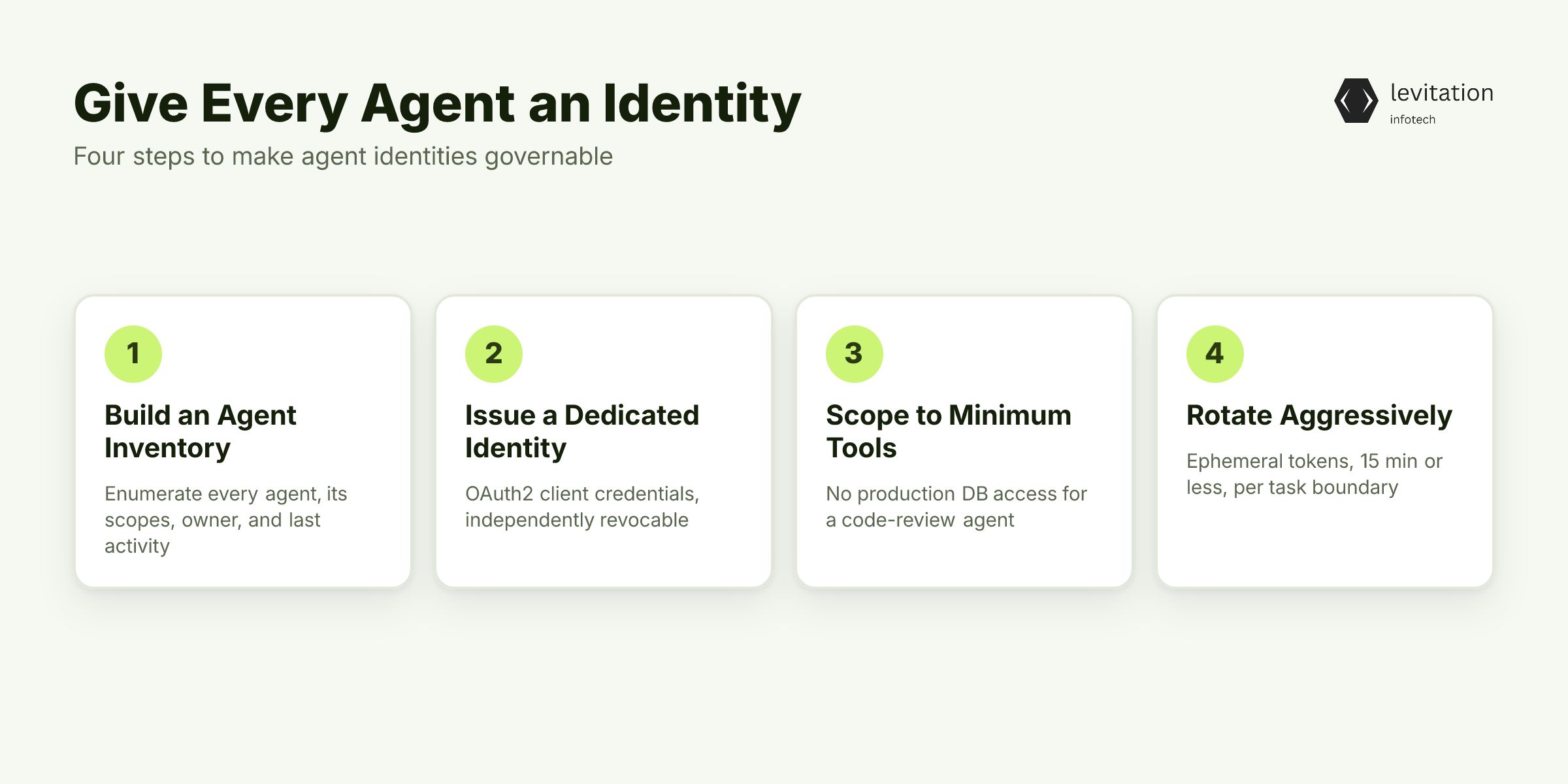
Step 1: Build an agent inventory. You can't govern what you can't enumerate. This is the first gap in any IAM maturity for non-human identities.
Most organizations can't list their own agents, let alone their scopes, owners, or last activity. When attackers map machine identities faster than your IAM team does, you've already lost the governance battle.
Step 2: Issue a dedicated identity per agent. OAuth2 client credentials or workload identity tokens work. The requirement: the identity is auditable and revocable independently of any user. Here's a minimal OAuth2 client credentials setup for an agent:
1# agent_identity.yaml - registered as an OAuth2 client2client_id: agent.code-reviewer-prod3client_secret: ${VAULT_SECRET_REF}4grant_types: - client_credentials5scope: - repo:read - pr:comment - ci:trigger6token_lifetime_seconds: 9007audience: https://api.internal/agent-actions
Step 3: Scope credentials to the minimum tools and data the agent needs. A code-review agent has no business holding credentials to your production database. A data-export agent has no business calling infrastructure APIs. Scope is the only thing standing between a compromised agent and a full environment takeover.
Step 4: Rotate aggressively. Ephemeral tokens with lifetimes of 15 minutes or less limit the blast radius of a compromised agent identity. Rotate at every task boundary, not on a calendar schedule.
This matters more when your agent holds more IAM roles than your senior engineer. Every extra role is an extra attack surface.
The reference architecture is straightforward. Agent identity is issued by your IdP. Tokens are validated at each tool invocation.
Scopes are enforced at the service mesh or API gateway. Audit logs stream to your observability stack.
Every layer does one thing. None of them trust the others blindly.
Identity is the foundation. But an agent that authenticates correctly with minimal scopes can still cause damage, which is why authentication alone is the wrong line of defense. What catches the rest?
Add Behavioral Baselines and Human-in-the-Loop for High-Impact Actions
Behavioral validation has to work at agent speed. Baseline what normal tool-call patterns look like for each agent: frequency, data volume, time-of-day, resource types, action sequences.
Then flag deviations at machine speed, not after the fact. A code-review agent that suddenly starts exporting bulk data is the agent equivalent of an engineer logging in from an unfamiliar device. It happens at 2 AM, without warning.
Action-class policies make this enforceable. Tag every action an agent can take into classes: - Read - lowest risk, broadest allowance - Write - moderate risk, requires identity validation - Delete - high risk, requires scope check plus behavior check - Export - high risk, requires scope check plus volume threshold - Modify policy - highest risk, requires human-in-the-loop
For destructive operations, human-in-the-loop is non-negotiable. MFA plus multi-admin verification (MAV) for actions like deleting volumes or modifying security policies. This applies even if the agent's identity and scope check out. An agent performing a bulk delete operation should be paused for a human to confirm, not waved through because its token is valid.
Observability ties it together. Every agent action must be logged with agent identity, user delegator, tool called, data accessed, and decision rationale. Without this, post-incident forensics on agent-caused damage is guesswork.
You can't answer "what did the AI do?" from a log query if the logs don't exist. Your devops team gets a single integration point at the service mesh or API gateway layer.
Policy stays consistent across all tool calls without modifying each agent.
In healthcare environments handling PHI, this action-class gating is what allows agent deployment to proceed at all. Without it, compliance review stalls every agent rollout. With it, the security team can sign off because the controls match the risk.
When these layers work together, the result isn't just better security posture. It's a faster path from agent prototype to production, and the audit trail to prove it.
What Changes When Your Zero Trust Sees Agents Too
Auditability replaces guesswork. Every agent action is attributable, scoped, and reviewable. Tracing agent behavior becomes a log query, not an investigation.
Agent deployment accelerates. When security teams can see and govern AI agents, they stop blocking rollouts. The bottleneck shifts from review to design, and design is faster than review.
Blast radius shrinks. Compromised agent identities, token leaks, and prompt-injection-driven rogue actions all have shorter windows of standing privilege and faster detection. Ephemeral tokens and behavioral baselines catch what static policies miss.
Compliance readiness improves. Regulators are asking about AI governance. An agent-native secure cloud posture gives you evidence, not assurances. Your architecture speaks the same language your auditor speaks.
The shift in posture is the real payoff: from "agents are too risky to deploy" to "agents are deployed with measurable, bounded, auditable risk." That posture change is what unblocks every downstream agent initiative in your roadmap.
Frequently Asked Questions
Do AI agents fall under existing zero trust policies?
Technically yes; zero trust is supposed to apply to every entity. In practice, most zero trust deployments were designed around human users and devices.
Agents authenticate correctly but operate at a volume and speed that defeats per-request policy evaluation. Agents need zero trust principles re-applied specifically to non-human identity patterns.
How do I inventory AI agents in my environment?
Start by querying your IdP and cloud IAM for non-human identities. Then correlate API gateway logs and service mesh telemetry. Find which credentials are used by agent frameworks.
Industry guidance treats this agent inventory as the first step in any zero trust for AI initiative. Effective governance starts with knowing what exists in your environment.
What is non-human identity policy?
Non-human identity policy governs the lifecycle, scoping, rotation, and revocation of credentials. These credentials are issued to machines, services, and AI agents.
It is distinct from human user identity governance. It enforces least privilege and ephemeral access for automated actors that may not have a human in the loop at the moment of action.
Can AI agents bypass zero trust?
They don't bypass it technically; they pass through it legitimately. An agent with valid credentials, appropriate scopes, and a legitimate task will satisfy every check a zero trust policy was designed to perform. The gap is that traditional zero trust doesn't evaluate the blast radius, frequency, or contextual risk of agent actions at machine speed.
What governance frameworks exist for agent trust?
Several industry efforts apply zero trust principles to AI agents. They use progressive trust models that establish credentials, scoping, behavioral baselines, and revocation as core elements. Organizations build these patterns using existing identity, observability, and policy enforcement tools rather than adopting a single product.
Map your agent inventory this week, and the rest of the architecture follows from there.
About the author
Mayank Singh is a software developer at Levitation Infotech, where he builds web and AI-powered applications across the company’s fintech, healthcare, and enterprise projects.