


TL;DR: Zero-trust frameworks give you granular policies, but they don’t erase static credentials that sit in IAM. Those tokens survive every check and keep leaking. Replacing them with short-lived, federated workload identities seals the gap and restores true zero-trust protection.
Key Takeaways - Static workload keys bypass continuous verification, so they remain a secret-leak vector even under zero-trust. - Runtime tokens issued by a federation layer give each request fresh proof of identity, eliminating the leak path. - A four-phase migration - audit, federation enable, token swap, automation - lets you move without downtime and shows measurable risk reduction.
Zero-Trust Is Not a Silver Bullet for Cloud IAM Secrets
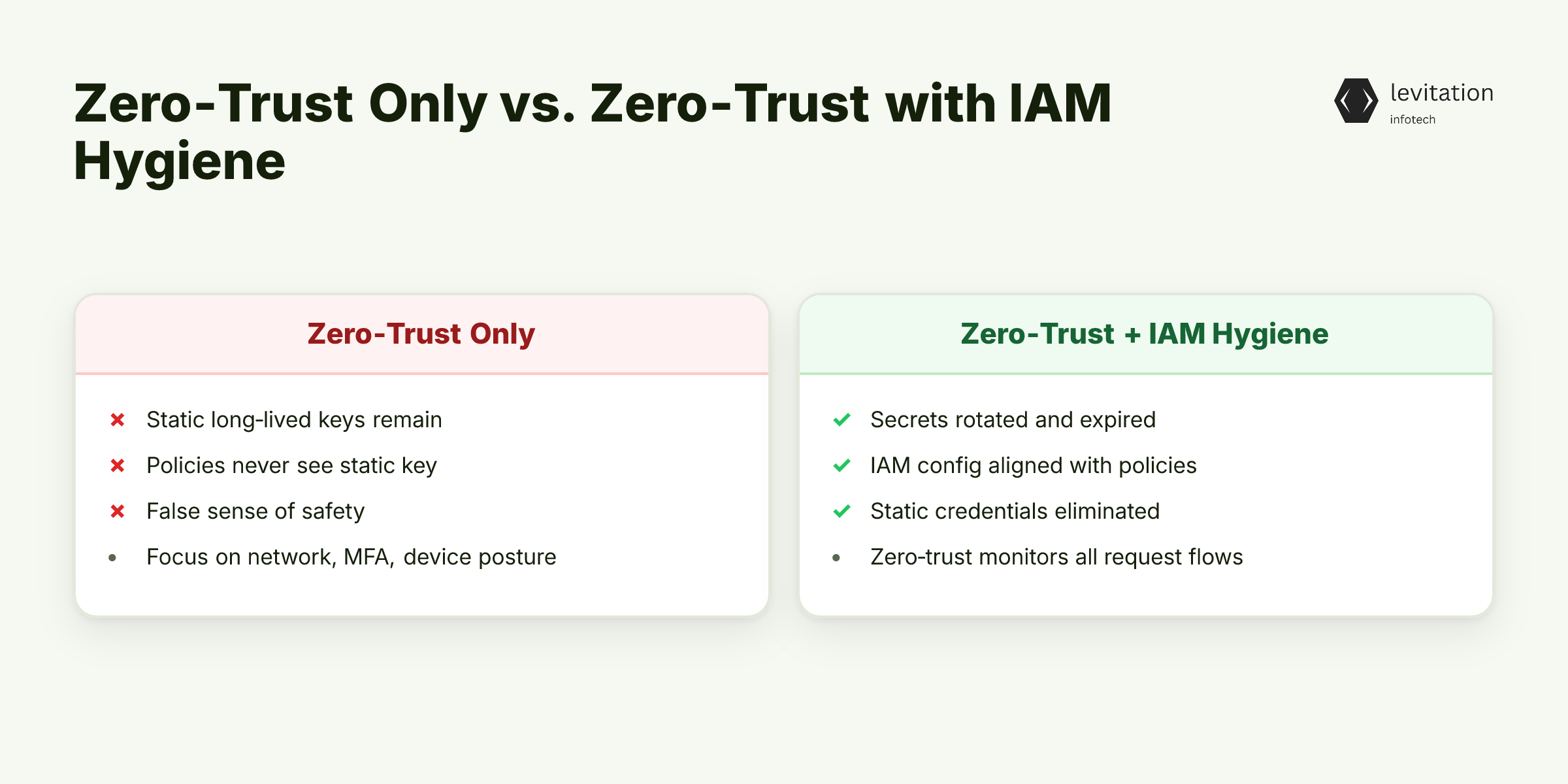
Teams often celebrate a zero-trust rollout like they’ve installed a vault on the perimeter. The press release is ready, the badge says “secure,” yet long-lived access keys still sit in environment variables, secret managers, and container images.
When a breach occurs, investigators trace the leak back to a static key that never expired. Zero-trust policies never saw it because the key never entered the request flow they monitor.
Why does this happen? - Teams treat zero-trust as a product launch, not an architectural shift. - The rollout focuses on network micro-segmentation, MFA, and device posture, while IAM configuration stays untouched.
The result is a false sense of safety. Policies may block an unauthorized IP, but a compromised static credential still opens the door from inside.
“Zero-trust without IAM hygiene is like locking the front door while leaving the back door wide open.”
If you think merely ticking the zero-trust box is enough, the next section shows how that approach collapses under real-world pressure.
Why Static Tokens Survive Zero-Trust Audits and Leak Secrets
Static tokens are the quiet culprits. They are generated once, stored, and then used until someone remembers to rotate them - if ever. Because they never change, they bypass the “verify every request” mantra that zero-trust champions.
How they slip past audits
- Credential scope is too broad. A single key may grant `:` on a whole account.
- Verification points ignore IAM metadata. Most zero-trust agents inspect the network layer, not the token’s age or origin.
- Tool silos. One solution enforces MFA, another enforces micro-segmentation; none see the static key sitting in a Kubernetes secret.
1# Example of a static key hidden in a Helm chart values file2aws_access_key_id: AKIAEXAMPLE3aws_secret_access_key: wJalrXUtnFEMI/K7MDENG/bPxRfiCYEXAMPLEKEY
The snippet lives in source control, gets baked into a Docker image, and is never touched by any zero-trust policy engine.
What makes them dangerous - Long lifetime - they survive weeks, months, or years. - Unlimited reuse - any compromised service can replay them endlessly. - No revocation path - you must delete the key manually, which often lags behind detection.
Typical fallout includes unauthorized data export, privilege escalation across cloud accounts, and lateral movement that bypasses network segmentation.
The fix is counterintuitive: stop trusting anything that never changes. The next insight explains how runtime tokens prove identity at the moment of request.
Dynamic Workload Identity Federation: The Missing Piece
Imagine each workload carrying a passport that expires after a short period. The passport is signed by a federation service that knows the workload’s true identity, its role, and its current security posture. Every request presents this passport, and the zero-trust engine finally sees who is calling what and when.
Runtime tokens in action - Issuance - An OIDC provider on AWS, GCP, or Azure issues a JWT after the workload authenticates with its cloud-native identity (e.g., an IAM role). - Verification - The zero-trust policy engine validates the JWT’s signature, expiration, and claims. - Revocation - Tokens expire quickly; compromised workloads lose access within minutes.
1{2 "iss": "https://sts.example.com/",3 "sub": "arn:aws:sts::123456789012:assumed-role/my-app-role/instance-id",4 "aud": "my-service",5 "exp": "<expiration timestamp>",6 "nbf": "<not-before timestamp>",7 "scope": "read:data write:logs"8}
That JSON Web Token (JWT) is the “runtime token.” It contains the exact role that generated it, the intended audience, and a short expiration.
Unifying zero-trust policies
When every workload presents such a token, the zero-trust engine can apply a single policy set across clouds: - Least-privilege - Grants are scoped to the token’s `scope` claim. - Context-aware - Policies can check the workload’s region, compliance label, or device posture at issuance time. - Auditability - Every token issuance is logged, giving a complete chain of custody.
By federating identities, you eliminate the single overlooked activity that drives IAM leaks. The next section shows how to migrate safely.
Step-by-Step Migration to Runtime Tokens in Your Cloud Stack
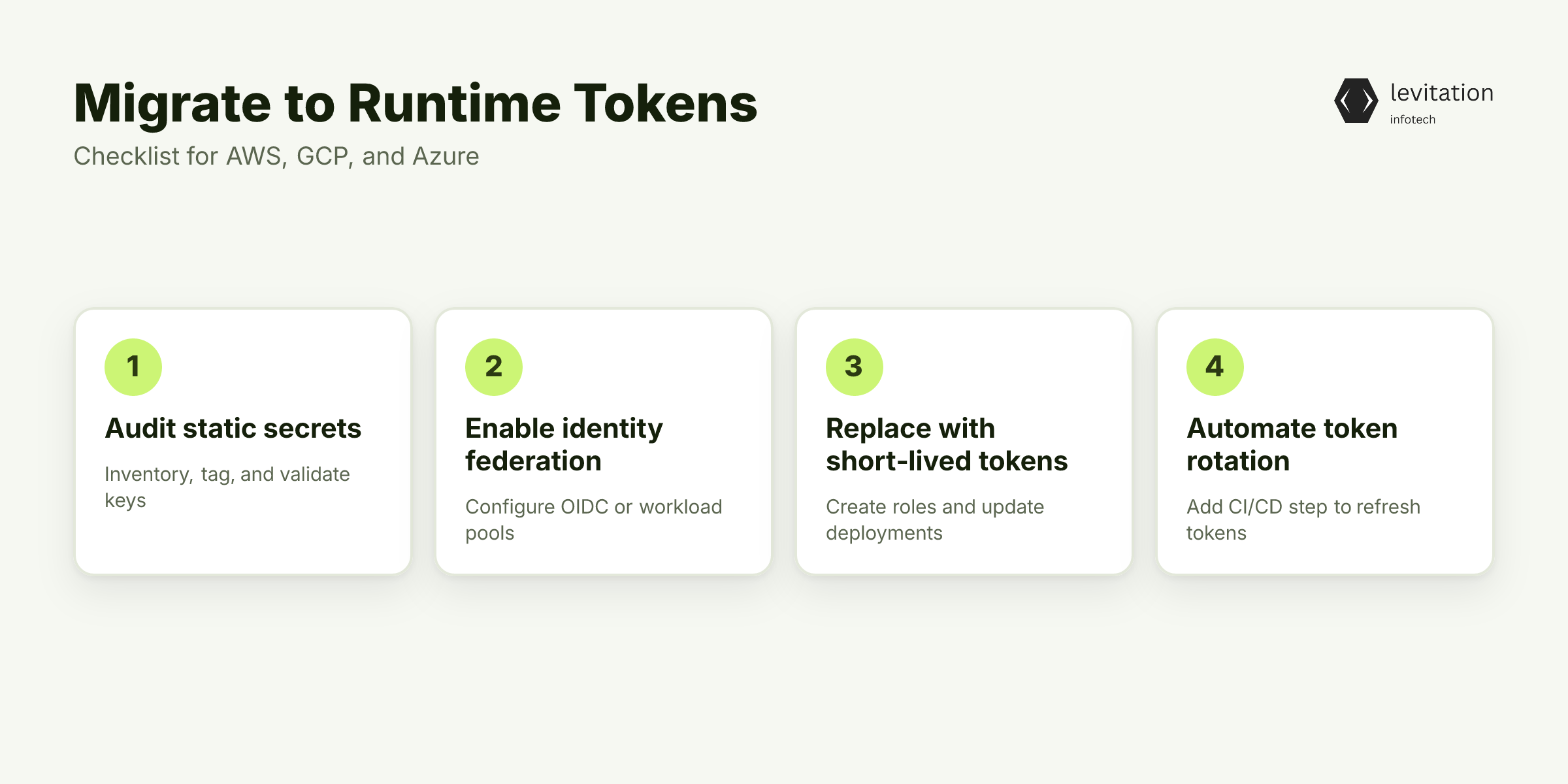
A migration feels scary until you break it into repeatable steps. Below is a checklist that works on AWS, GCP, and Azure. Each step can be automated in CI/CD, so you never have to pause production.
1. Audit static secrets against a zero-trust baseline - Inventory - Use `aws iam list-access-keys`, `gcloud iam service-accounts list`, `az ad sp list`. - Tag - Mark every key that exceeds a reasonable age with a `needs-rotation` tag. - Validate - Run a script that checks each key’s policy for over-broad permissions.
1#!/usr/bin/env bash2# Example audit script for AWS access keys3aws iam list-users --query 'Users[*].UserName' --output text | while read user; do4 aws iam list-access-keys --user-name "$user" \5 --query 'AccessKeyMetadata[*].AccessKeyId' \6 --output text | while read key; do7 echo "User $user has key $key"8 done9done
2. Enable workload identity federation - AWS - Create an IAM OIDC identity provider that trusts your EKS cluster. - GCP - Configure Workload Identity Pools and bind them to GKE service accounts. - Azure - Set up Azure AD workload federation with Managed Identities.
1# Terraform snippet for AWS OIDC provider2resource "aws_iam_openid_connect_provider" "eks" {3 url = "https://oidc.eks.${var.region}.amazonaws.com/id/${var.cluster_id}"4 client_id_list = ["sts.amazonaws.com"]5 thumbprint_list = ["9e99a48a9960b14926bb7f3b02e22da0c8c1a0e5"]6}
3. Replace static keys with short-lived tokens - Create IAM roles that map one-to-one with existing service accounts. - Update deployments to use the cloud provider’s SDK to fetch tokens at startup.
1# Kubernetes pod spec using AWS SDK to assume role2apiVersion: v13kind: Pod4metadata:5 name: my-app6spec:7 serviceAccountName: my-app-sa8 containers: - name: app9 image: my-app:latest10 env: - name: AWS_ROLE_ARN11 value: arn:aws:iam::123456789012:role/my-app-role - name: AWS_WEB_IDENTITY_TOKEN_FILE12 value: /var/run/secrets/eks.amazonaws.com/serviceaccount/token
4. Automate token rotation via CI/CD - Pipeline step - After each successful build, trigger a job that updates the OIDC trust relationship if the role changes. - Cache tokens - Store them in a sidecar container for the lifetime of the pod to avoid excessive STS calls.
1# GitHub Actions step to refresh GCP workload identity token - name: Refresh GCP token2 run: |3 gcloud auth print-identity-token --impersonate-service-account=my-app@gcp-project.iam.gserviceaccount.com > token.txt4 echo "TOKEN=$(cat token.txt)" >> $GITHUB_ENV
5. Validate longevity and compliance - Run smoke tests that simulate token expiry and verify graceful fallback. - Check audit logs for token issuance events; confirm they align with policy expectations.
Systems that follow this roadmap stay in production with a strong security posture and no reported credential-theft incidents. The next section quantifies the impact.
What Happens When Secrets Stop Leaking: Metrics and Business Impact
When static keys disappear, the security landscape shifts dramatically. - Incident response time shrinks. Without a key to chase, investigations focus on the actual breach vector, cutting analysis from days to hours. - Breach cost drops. The absence of credential misuse eliminates the need for costly forensic services and legal exposure. - Compliance posture improves. Auditors see continuous token rotation and clear audit trails, satisfying HIPAA, PCI-DSS, and other frameworks.
Organizations report smoother regulator interactions because every access request is provably legitimate. Many also note fewer false-positive alerts in data pipelines, freeing engineering time for feature work.
With secrets sealed, teams finally reap the promised benefits of zero-trust - real risk reduction, not just a marketing badge. Curious how to keep this momentum going?
Frequently Asked Questions
Why does zero-trust still allow secret leakage in cloud IAM?
Zero-trust verifies each request, but static credentials never change, so they slip past verification and stay valid indefinitely.
What is workload identity federation and how does it differ from static keys?
It issues short-lived, cloud-native tokens that prove a workload’s identity at runtime, removing the need for long-standing static secrets.
How can I start migrating existing services to dynamic tokens?
Begin with an inventory of static secrets, enable OIDC providers on each cloud, map IAM roles to token-based policies, and automate rotation through your CI/CD pipeline.
Will moving to dynamic tokens impact performance?
Token issuance adds minimal latency - typically a very short delay - and can be cached per request, while the security gains far outweigh the overhead.
Is this approach compliant with regulations like HIPAA or PCI-DSS?
Yes - dynamic tokens provide stronger audit trails and enforce least-privilege access, helping meet the strict access-control requirements of those frameworks.
Ready to close the leak and let zero-trust work as intended?
Sources
Research and references cited in this article:
- Zero Trust in 2026: Principles, Technologies & Best Practices
- Zero Trust: The Absolute Solution To Cloud Security Challenges
- Zero Trust Deployment Vulnerability: IAM Setting Impact - LinkedIn
- The Role of Zero Trust Architecture in Next-Generation IAM | Optimal IdM
- Zero Trust Cloud Security in Multi-Cloud Architecture
- Zero Trust in 2026: Why Traditional Security Models Are Failing | BTA | BTA
- Zero Trust model explained: Why “never trust, always verify” matters more than ever
- Zero Trust in 2026: Why Many Implementations Are Failing Quietly?
- What Is Zero Trust? | IBM
- Myths in Zero Trust Architecture: 11 Misconceptions Debunked | E-SPIN Group
- Workload Identity Federation for Cloud Security - LinkedIn
- Federated identity across the hybrid cloud using zero trust workload ...
About the author
Mayank Singh is a software developer at Levitation Infotech, where he builds web and AI-powered applications across the company’s fintech, healthcare, and enterprise projects.