

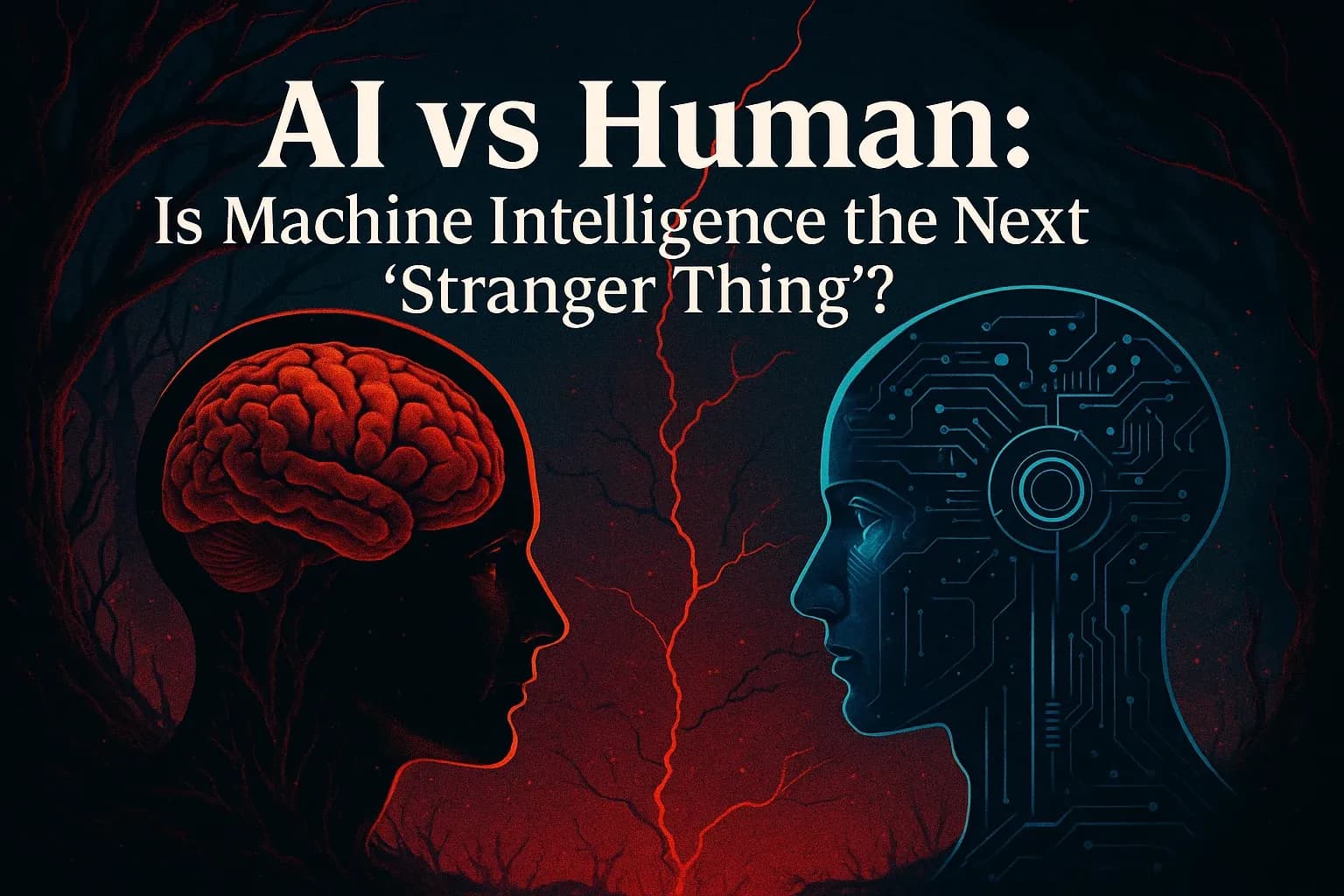
In Hawkins, strange things crawl out of the Upside Down. In our world, they come coded in algorithms. While Eleven battles Demogorgons, we’re wrestling with something equally powerful ,machines that think. But do they really? The debate of AI vs human intelligence is more than a sci-fi plot; it’s a real-world question shaping our future. Where does smart stop, and strange begin?
This blog explores the clash of artificial intelligence vs human intelligence, diving into what makes us human, where machines excel, and why trust in AI-generated decisions isn’t a given. From the emotional superpower that keeps humans ahead to the “Demogorgon” of AI missteps, we’ll unpack the AI vs human brain dynamic with real-world examples, stats, and a nod to Stranger Things-inspired curiosity.
The Upside Down of Intelligence: Human vs. AI
What defines intelligence? Human intelligence weaves together logic, emotion, intuition, and moral reasoning. It’s the spark behind a parent’s comforting words or a leader’s ethical stand in a crisis. Artificial intelligence vs human intelligence reveals a stark contrast: AI is a master of data crunching, pattern recognition, and automation, but it lacks consciousness, feelings, or self-awareness.
- Human Intelligence: Fueled by empathy, creativity, and experience. A 2023 study from MIT showed humans outperform AI in tasks requiring emotional intelligence, like conflict resolution, with 78% greater accuracy.
- Artificial Intelligence: Excels at processing vast datasets like predicting stock trends or analyzing medical scans but can’t “feel” the weight of its decisions.
The difference between human intelligence and machine intelligence lies in depth. AI can calculate probabilities; humans weigh values, emotions, and context. This gap is why HI vs AI isn’t a simple win-lose battle but a question of complementary strengths.
In the AI vs human brain race, humans bring the soul -emotions, ethics, and intuition that machines can’t touch.
Trust Issues: Can
Trust in AI-generated decisions is a hot topic in the AI vs human decision-making debate. Can machines handle high-stakes choices like hiring or healthcare? Let’s look at real-world cases.
- Hiring Decisions: AI tools like resume screeners streamline recruitment. A 2022 LinkedIn report found 67% of recruiters using AI saw faster hiring processes. But flaws exist. In 2018, Amazon scrapped an AI tool that downgraded resumes with female-associated terms, as it was trained on male-dominated data, showing how bias can creep into human artificial intelligence systems.
- Healthcare: AI shines in diagnostics. A 2024 The Lancet study reported AI detecting breast cancer in mammograms with 94% accuracy, outpacing human radiologists in controlled tests. Yet, doctors remain essential, blending AI’s insights with patient history and empathy ,elements no algorithm can replicate.
A 2023 Pew Research survey revealed 60% of Americans distrust AI in critical decisions without human oversight. AI and human collaboration works best when machines handle data and humans add context, ensuring AI vs human decision-making isn’t a solo act.
AI processes numbers; humans process lives. Trust hinges on transparency and human review.
Emotions Are the Superpower: Why We’re Still Eleven
Like Eleven’s powers in Stranger Things, fueled by raw emotion, human intelligence thrives on empathy, gut instinct, and lived experience. These traits set us apart in the HI vs AI showdown.
- Empathy: A nurse comforting a scared patient or a teacher inspiring a struggling student relies on emotional depth AI can’t mimic. A 2024 Stanford study found 85% of workplace decisions involve emotional intelligence, from team dynamics to crisis management.
- Intuition: Humans make gut calls based on experience like a firefighter sensing danger beyond what sensors detect. This role of emotions in decision-making is uniquely human.
- Moral Reasoning: Ethical dilemmas, like prioritizing patients in a hospital, demand weighing values, not just data. AI can suggest options but can’t grapple with “right” or “wrong.”
The human artificial intelligence gap is clear: machines lack the emotional spark that drives human judgment. Can AI replace human intelligence? Not when empathy and ethics are the heart of decision-making.
The Demogorgon of Misjudgment: AI’s Limitations
AI’s power isn’t flawless. The AI limitations vs human judgment conversation reveals its “Demogorgon” moments ,errors that highlight why humans remain essential.
- Facial Recognition Bias: A 2020 ACLU study found facial recognition systems misidentified Black and Brown faces at rates up to 35% higher than white ones, leading to real-world harm, like wrongful arrests in Detroit.
- Hallucinations: AI models can generate false but plausible outputs. A 2024 Google Research report noted 15% of complex AI responses contained inaccuracies, requiring human verification.
- Context Blindness: AI struggles with nuance, like mistaking sarcasm for hate speech in content moderation, lacking the human knack for subtle cues.
These missteps don’t doom AI—they underscore the need for human oversight. AI and human teamwork catches errors and adds ethical clarity, ensuring machines don’t run amok.
AI’s “Demogorgons” remind us: machines are tools, not masters. Human judgment keeps them in check.
Is the Future a Sci-Fi Nightmare or a Human-AI Team-Up?
The AI vs human narrative isn’t about winners or losers ,it’s about partnership. AI’s strengths speed, scale, precision complement human qualities like empathy and ethics. A 2024 McKinsey report predicts that 70% of businesses will integrate AI by 2030, but 80% of executives surveyed said human oversight remains critical for ethical outcomes.
- Healthcare: AI flags anomalies; doctors provide care.
- Business: AI optimizes logistics; humans set strategic vision.
- Creativity: AI generates drafts; humans infuse soul.
The future isn’t a sci-fi dystopia where machines replace us. It’s a collaboration where AI and human intelligence amplify each other. Can AI replace human intelligence? Not likely ,it’s more like a trusty sidekick than a solo hero.
Stranger things may happen, but for now the smartest machine still needs a human heartbeat behind it.
FAQ: AI vs Human Intelligence
Q: What’s the main difference between human intelligence and machine intelligence?
A: Human intelligence includes emotions, intuition, and moral reasoning, while machine intelligence excels at data processing and pattern recognition but lacks consciousness or empathy.
Q: Can AI replace human intelligence in decision-making?
A: AI can enhance AI vs human decision-making by handling data-heavy tasks, but human oversight is crucial for ethical and emotional contexts machines can’t grasp.
Q: Why is trust in AI-generated decisions challenging?
A: Trust issues arise from AI’s potential for bias, errors, and lack of transparency. Human review ensures AI and human decisions align with real-world needs.
Q: How do emotions impact human vs. AI decisions?
A: The role of emotions in decision-making gives humans an edge in empathy-driven choices, like caregiving or ethical dilemmas, where AI falls short.
.webp&w=2048&q=75)
.webp&w=2048&q=75)
.webp&w=2048&q=75)