


TL;DR: A 1,000-run evaluation can still approve an unreliable agent, so approval needs more than an average pass rate. A useful protocol traces each outcome across consistency, robustness, predictability, and safety, then applies risk-tiered release gates. Treat 1,000 as a transparent starting design; approval requires repeatable outcomes and explained divergence.
Key Takeaways: - An average can hide divergent tool paths, material decision variance, and rare high-impact failures. - Reproducibility evidence must link each outcome to an observable decision trace. - Release gates should reflect business risk and invalidate stale evidence after system changes.
A Passing Score Is Not a Repeatable Outcome
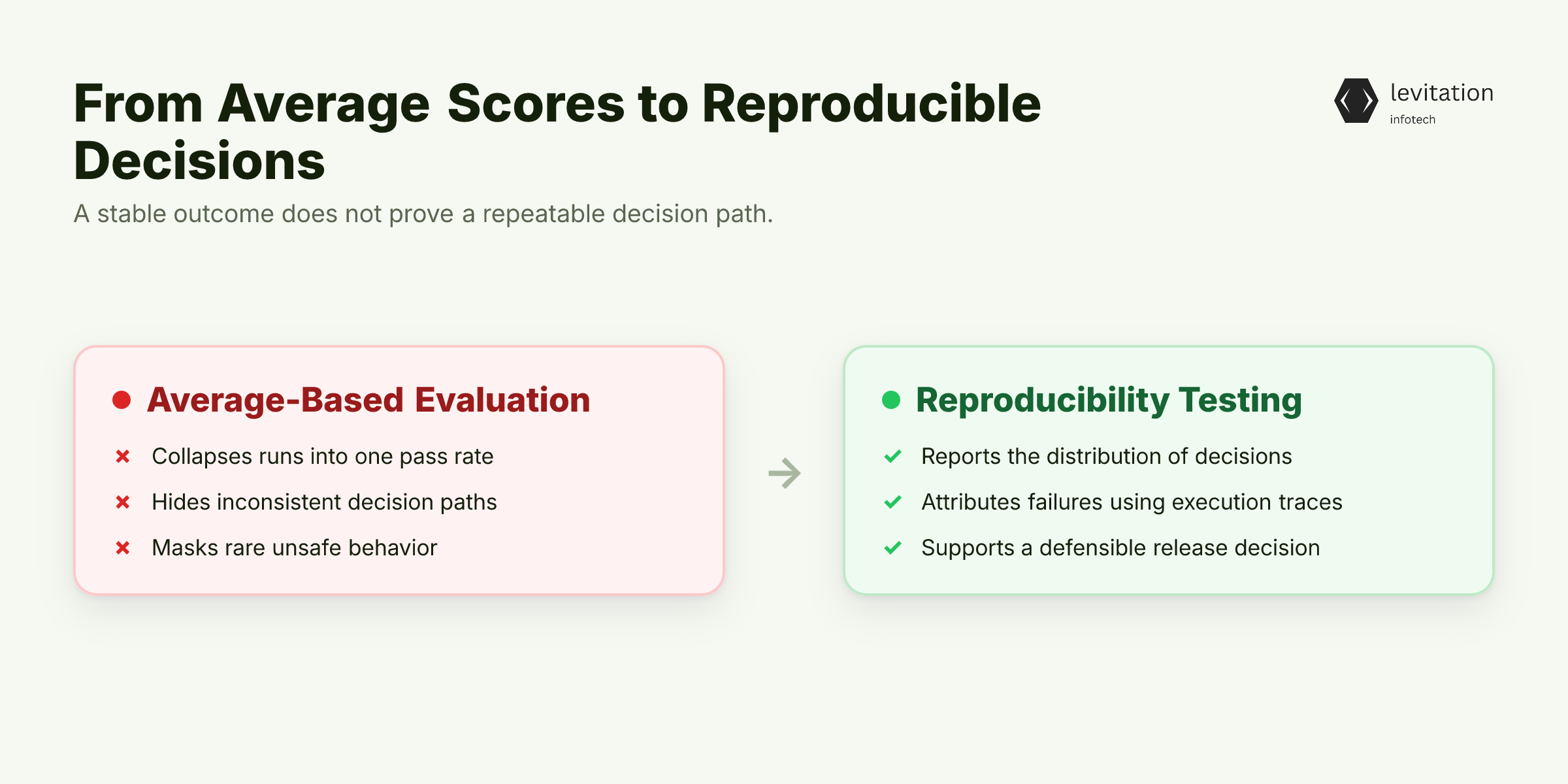
Even 1,000 agent runs can hide a reproducibility failure when teams collapse them into one average pass rate. The missing evidence is the decision path, not another run-count chart.
A passing score can coexist with inconsistent paths to the right answer. Rare unsafe behavior can hide inside a flattering average. Material decision variance then disappears from the report.
Imagine an agent that reaches the right claim decision through different tools each time. A customer sees the same result, so the average looks stable. The operating risk sits in the hidden path.
For CTOs, reproducibility has a specific meaning. Given a versioned task, context, tool environment, and bounded changes, can the team recreate an outcome and explain material divergence?
That is a stronger promise than benchmark accuracy. The 1,000-run protocol proposed here is a stress-test design, not a proprietary experiment or unpublished result. The evidence cited below comes from public research.
Delivery credibility and reproducibility answer different questions. For enterprise AI solutions, delivery experience does not prove that one agent repeats one decision path.
A CTO needs three things: - A distribution of decisions, not one combined score. - Failure attribution backed by traces, not a list of symptoms. - A defensible release decision, not a benchmark headline.
That reframing exposes the deeper flaw. Most agent evaluations score an outcome without proving that it can be repeated. The next step is to see what a single run leaves unseen.
Why One-Run Benchmarks Hide the Variances That Matter
Repeat the same support task after a policy update. One run can use a cached answer, while another calls a current API. Both can look correct.
The paths are not equivalent, though. Variance enters through several channels: - Task selection and evaluator interpretation. - Model sampling and generated reasoning. - Retrieved-data freshness and index changes. - Tool state, external APIs, and timeouts. - Session memory and retained context.
Each source can turn an apparently fixed task into a moving target. A one-run result cannot reveal which source changed.
REPRO-Bench shows why benchmark validity is itself difficult. A useful reproduction benchmark must make available evidence explicit, including the paper, code, data, documentation, and reported findings. It must also define what qualifies as reproduction.
Benchmark gains do not establish practical reliability. Agents tested on research-paper reproduction do not run enterprise workflows, so their percentages cannot become production targets. The transferable lesson is methodological: benchmark validity, output validity, and operational reliability make different claims.
Reproduction tasks also expose a boundary problem. Cases with clear artifacts or missing inputs are easier to judge than borderline cases. A binary judgment can hide that nuance.
This is an AI governance problem before it is a model problem. As Why Your LLM Evals Approve Models That Fail shows, an evaluation can approve a weak system because the test measures the wrong thing.
CTOs should repeat trials on fixed fixtures, pair them with controlled perturbations, and measure evaluator agreement. Then they should test whether the agent can perform the real workflow.
Another single benchmark will not settle that question. The evidence must define reliable behavior across several dimensions. Which dimensions matter most?
Reliability Has Four Surfaces, Not One Metric
Reliability has four surfaces. A system can repeat wrong behavior, react badly to a harmless change, or fail dangerously. It can also act without calibrated confidence. One score erases those differences.
Four Dimensions: Separate the Failure From Its Symptom
A useful framework from Towards a Science of AI Agent Reliability separates reliability into four dimensions. Measure each dimension independently so distinct failure modes remain visible.
Consistency measures repeatable behavior under fixed conditions. It shows whether the agent follows the same path when its task, context, tools, and environment remain unchanged.
Robustness measures stable behavior under input or environmental perturbations. It shows whether a paraphrased request, stale document, or failed tool changes the outcome.
Predictability measures calibrated confidence and the ability to distinguish correct from incorrect actions. It shows when the agent is likely right and when its confidence lacks basis.
Safety measures the bounded severity of failures. It defines the maximum harm the system can cause when its decisions go wrong.
ClaroAI-Bench shows why root-cause data must sit beside these scores. It examines NIH-funded computational papers and separates source-data findability from the ability to rebuild the original result.
Finding the data is only the first step. Rebuildability also depends on tool access and a reconstructable environment.
Full-capability agents reproduced 60.6% of NIH-funded computational papers when given rich tool access. The remaining gap shows that access alone is not enough when artifacts or environment state cannot be reconstructed.
Paper reproduction differs from enterprise agent operation, but both expose the same attribution problem. A model should not bear blame for an environment the evaluation failed to freeze.
For AI governance, use a two-label incident record. The first label names the reliability dimension affected, and the second names the root cause. The root cause could be agent variance, context drift, tool nondeterminism, environment change, missing artifacts, or an ambiguous evaluator.
A reliability scorecard can show that two runs diverged. Only a decision trace can reveal where the divergence began. The trace must therefore do more than log final answers.
Trace Decisions, Not Just Final Answers
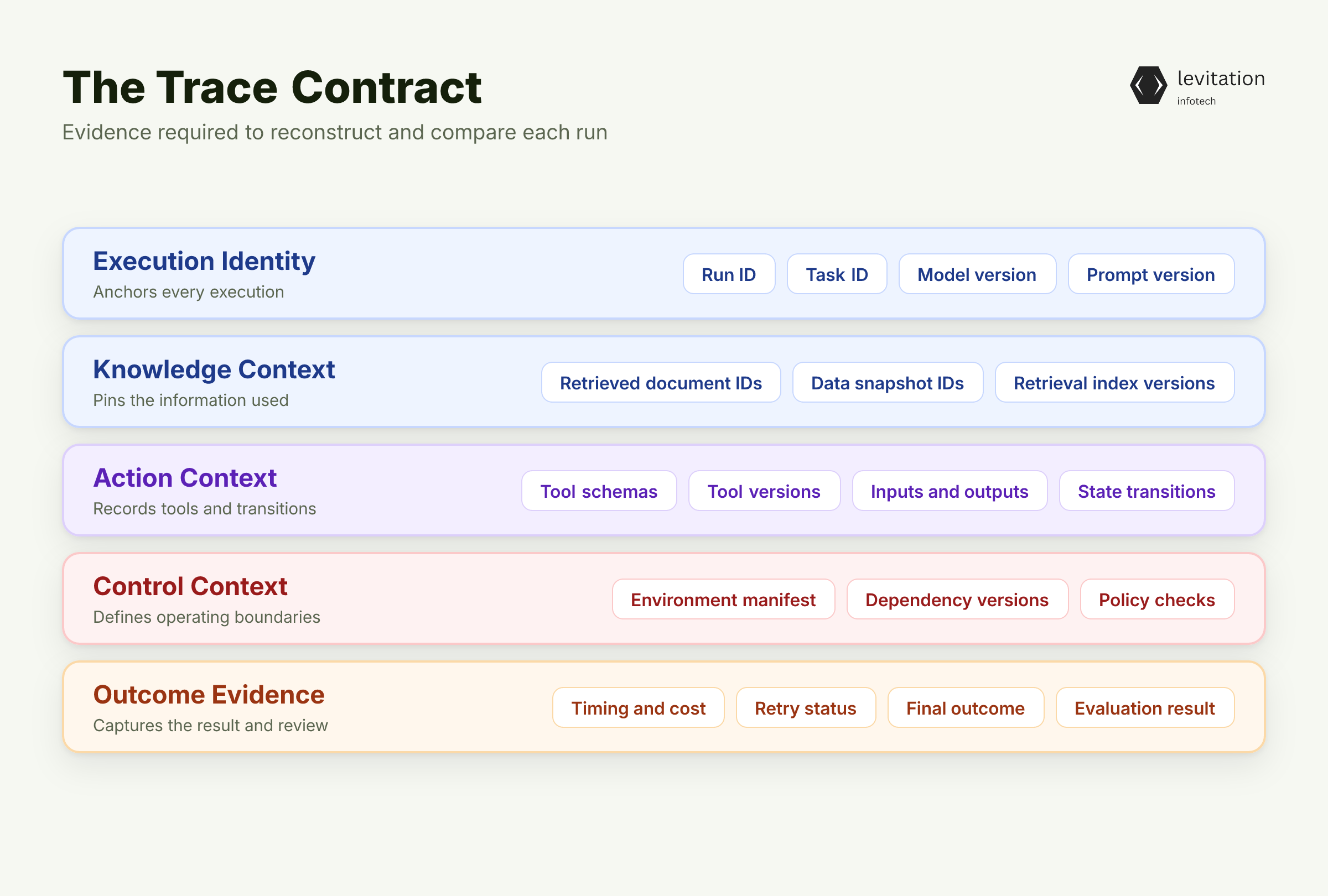
With a scorecard showing divergence, the trace must explain why.
Trace Contract: Bind Each Outcome to Its Evidence
Assign every execution a run identifier, then record the evidence needed to reconstruct it. The contract should capture: - Execution identity: Run ID, task ID, model version, and prompt version. - Knowledge context: Retrieved-document identifiers, data snapshot identifiers, and retrieval index versions. - Action context: Tool schemas, tool versions, inputs, outputs, and state transitions. - Control context: Environment manifest, dependency versions, and policy checks. - Outcome evidence: Timing, cost, retry status, final outcome, and evaluation result.
This contract turns a final answer into an accountable sequence of events. It lets teams compare two runs without relying on vague recollections. What must each event expose for that comparison to be decisive?
Observable Evidence: Trace Actions, Not Hidden Thoughts
Capture decisions and external actions. Do not treat hidden chain-of-thought as an audit artifact. It is neither a stable interface nor an appropriate control record.
A useful event includes the observed action, relevant input, tool response, and resulting state change. If the agent skips a tool, record that decision and the policy or context behind it.
Traditional monitoring reports service health, latency, and errors. Agent observability shows which context, tool result, or state transition produced a decision. A service can stay healthy while producing very different answers.
Durable Context: Make Operating Assumptions Reviewable
The context-engineering principle from Reproducibility in the Age of Agentic AI is straightforward. Externalize tacit operating context in durable, clear artifacts.
Those artifacts should include policies, fixtures, prompt contracts, tool descriptions, expected outcomes, and regression tests. They give engineers a shared source of truth and give agents executable boundaries.
Tests then serve two purposes. They verify intended behavior for humans and let agents check their own work. Agents can draft candidate tests, but humans must review them before they become release gates.
Store the resulting traces with the same controls used for cloud security solutions. Apply encryption, role-based access, tenant isolation, retention controls, and sensitive-input redaction. Observability without governance creates another data risk.
Once the trace can reconstruct each decision, the 1,000-run exercise becomes a controlled experiment. The next design choice is how to remove accidental variation without hiding real risk.
Build a 1,000-Run Reproducibility Protocol
A controlled experiment starts by removing accidental variation. The run count matters, but the experimental controls matter more.
Freeze the Baseline
Version the model, system prompt, context templates, tool contracts, dependencies, data snapshots, retrieval indexes, and environment configuration. Reset memory and external state between independent runs.
If a run inherits an old session, a live database, and a changed policy, it isn't a repetition. It's another experiment without a declared variable.
Allocate the Runs
As one transparent starting design, use 100 representative task-condition cells with 10 independent repetitions each. This is not a universal sufficiency claim. Adjust the allocation to task variance, autonomy, and business impact.
Build the evaluation matrix from three task families: common workflows, high-impact actions, and known boundary cases.
Hold one condition fixed for consistency trials. Then run controlled perturbations for robustness trials. Include paraphrased requests, stale data, unavailable tools, tool errors, and changed environmental state.
Execute Cleanly
Use independent workspaces for each attempt. Record retries, resource consumption, and every trace.
Use deterministic seeds only when the underlying model or tool supports them. A seed that appears deterministic but changes nothing creates false confidence.
Measure the Distribution
Report consistency, robustness, predictability, and safety separately. Add uncertainty intervals, decision-step variance, cost variance, and the severity of tail failures.
Never let averages conceal high-impact outliers. A release can look stable while its worst failures remain unacceptable.
Diagnose and Package
Classify each divergence, then archive the complete reproducibility package. Include: - Task fixtures and evaluator logic. - Prompt and tool manifests. - The environment lockfile. - Expected outcomes and unresolved exceptions. - Full traces and machine-readable results.
Define a minimal trace event that can join a final outcome to the model, tool call, policy result, and state change. A richer format has little value if that relationship is missing.
Your CI system should rerun the affected trial slice whenever a model, prompt, tool, retrieval source, policy, or dependency changes. For routine commits, keep that slice as narrow as possible. Stale evidence must never authorize a release.
Reusable evaluation infrastructure also changes the build-versus-buy decision. Enterprise AI solutions can supply the trace, policy, and release machinery without making every team rebuild it. The same controls belong in cloud security solutions, because sensitive decision evidence needs governance from the start.
The protocol creates evidence. Governance must decide what that evidence permits the business to do. That decision needs explicit release rules.
Turn Variance Into a Production Release Decision
Evidence without a decision rule is an expensive report. The release gate must translate distributions into permitted behavior.
Set Risk-Tiered Gates
Require evidence for all four reliability dimensions. Set thresholds from business impact and failure severity. Do not invent a universal industry number.
Lower-risk, reversible actions need defined consistency and safety boundaries. High-impact or hard-to-reverse actions need explicit exception handling, tested rollback, independent approval, and clear stop conditions.
Attach Evidence to Approval
Every approval should include a release record. The record must name the release owner, tested versions, and test corpus. It must also include measured distributions, unresolved exceptions, the rollback procedure, and conditions that trigger re-evaluation.
This package becomes the release record, not an attachment that disappears after approval.
Make Changes Visible
Any model upgrade, prompt modification, tool-schema change, retrieval-source change, policy revision, or dependency update should invalidate the affected prior result. Run the relevant slice before restoring approval.
The operational payoff extends beyond the approval meeting. Teams can compare traces after an incident, replay a disputed decision, and quantify upgrade risk. These tools also allow forecasting cost and latency variance, giving auditors evidence instead of an unstructured activity log.
That is enterprise AI governance in practice. Reproducibility permits more agentic action because the organization can detect divergence, bound harm, and stop or reverse a release.
Any broader durability claim needs the same discipline. System longevity and client retention are useful signals, but they are not causal proof that this protocol created either outcome. The unanswered question is practical: what run counts, trace fields, observability levels, and ownership rules should a release policy require?
Frequently Asked Questions
What is AI agent reproducibility?
AI agent reproducibility means recreating an agent's material outcome under a defined, versioned context and environment. It also means explaining why the outcome changed. The evidence covers consistency, robustness, predictability, and safety rather than one average pass rate.
How many AI agent runs are needed for a reliable evaluation?
There is no universal number because task risk, variance, and failure severity determine the required evidence. Treat 1,000 runs as a transparent starting protocol. One design uses 100 task-condition cells with 10 repetitions each. Adjust the allocation to the agent's autonomy and business impact.
What should an AI agent decision trace contain?
A trace should link the final outcome to its evidence. It must cover model and prompt versions, retrieved context, tool calls and responses, state transitions, policy results, and evaluation results. Use those fields to define the first release gate. The next question is what threshold that first gate should require.
About the author
Mayank Singh is a software developer at Levitation Infotech, where he builds web and AI-powered applications across the company’s fintech, healthcare, and enterprise projects.