


TL;DR: Most enterprise LLM evaluations are built on academic metrics designed for research, not production. They reward fluency, not correctness. They cannot detect the failure modes that hurt real users. The fix is replacing them with LLM-as-judge scoring against a business-specific rubric. Apply it to real user queries and score distributions, not single outputs.
Key Takeaways: - Academic benchmarks like MMLU and BLEU test knowledge recall and n-gram overlap. Neither detects confident hallucinations or production failure modes. - LLM-as-judge reaches 81.3% correlation with human raters, far above reference-based metrics on open-ended tasks. - Eval datasets must come from production traffic and refresh quarterly. Synthetic sets reflect team assumptions, not user reality. - Non-determinism changes the testing model entirely. Sample, score distributions, and pin model snapshots for regression safety.
The Eval Pipeline That Greenlit Your Last Production Incident
Your eval pipeline scored the model as production-ready. Three weeks after deployment, the same model hallucinated pricing data for a Fortune 500 client. The benchmark didn't fail your model, it failed you.
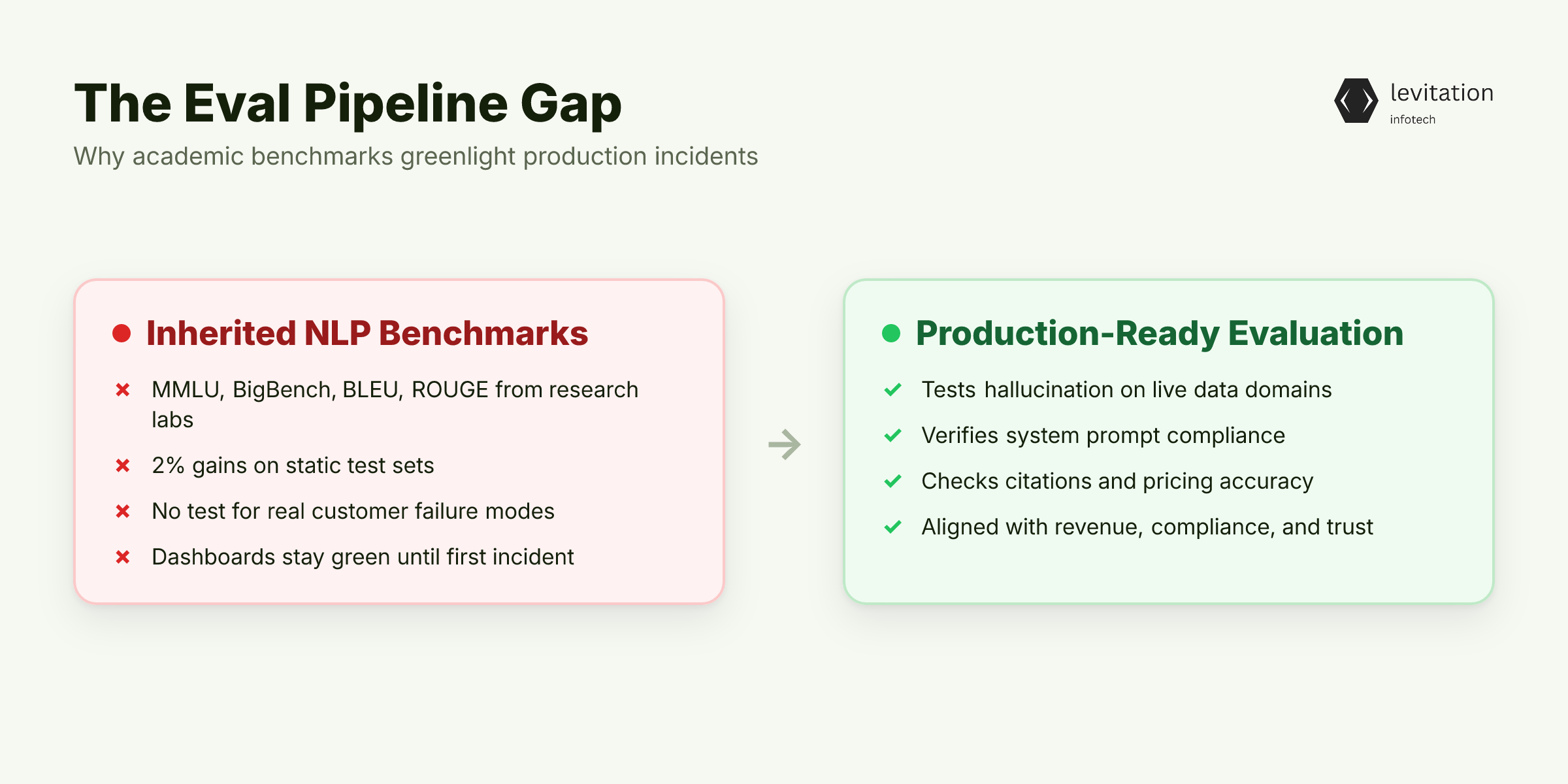
Most enterprise LLM evaluation pipelines are inherited from NLP research labs. MMLU, BigBench, BLEU, and ROUGE were built to measure progress in academic settings, where a 2% gain on a static test set meant a publishable result.
None of them were designed to ask the only question that matters in production: "Will this model embarrass us in front of a real customer?"
A model that scores well on these benchmarks can still hallucinate a competitor's pricing tier, ignore a system prompt about refusing medical advice, or fabricate a citation that does not exist. These are the failure modes that hit revenue, trigger compliance reviews, and erode the trust your AI/ML training program spent months building.
The gap between eval scores and production behavior is a leading source of AI risk in regulated industries. It widens as more models reach customers faster. The mechanics of those failures are covered in our breakdown of why large language models hallucinate and how to stay safe.
Teams trusted by Fortune 500 brands for enterprise AI systems in India see this pattern repeat across sectors. The dashboards stay green right up until the first serious incident.
The benchmark numbers looked healthy. Every signal checked out. So why did the model break the moment real users touched it?
Why Academic Benchmarks Create a Performance Illusion
Because the metrics are measuring the wrong thing, and they have been for years.
MMLU and BigBench test knowledge recall in controlled academic settings. The questions are well-formed, the answers are short, and there is exactly one right response.
Production traffic looks nothing like this. Users send messy, ambiguous, context-dependent prompts. The model is expected to synthesize, refuse, or escalate.
A high MMLU score tells you the model remembers facts. It tells you almost nothing about whether the model will use those facts safely in a live conversation.
BLEU and ROUGE are worse. They measure n-gram overlap with a reference answer, a word-for-word match score. They cannot detect when a model is confidently wrong. A confident hallucination and a correct answer can use the same vocabulary.
Worse, BLEU misses semantic meaning entirely. A paraphrased hallucination scores the same as a correct answer. When your evaluation rewards surface-level similarity to a reference, you train your team to optimize for the wrong thing.
Then there is the staleness problem. Academic benchmarks are static. Production traffic drifts as user behavior, product surfaces, and external events shift.
A model fine-tuned against last quarter's benchmark is already misaligned with this quarter's users. The score on the dashboard is not a measure of current quality. It is a photograph of a moment that has passed, a gap that mirrors the silent failure mode we covered in your AI model is drifting and you don't know.
The deeper problem isn't just that the metrics are wrong. It's that they have trained entire teams to optimize for the wrong thing. There is a way to measure that closes this gap, and the research is clear about how high the ceiling goes.
LLM-as-a-Judge Closes the Gap to 81.3% Human Correlation
LLM-as-a-judge uses a stronger language model to score outputs from a candidate model against a rubric. Research shows it achieves 81.3% correlation with human raters on open-ended tasks, far above what BLEU or ROUGE can deliver.
A reference-based metric can only tell you whether the words matched. A judge can tell you whether the answer was actually useful. It can also check whether the model refused appropriately and cited a real source.
In a single pass, the judge can evaluate faithfulness, relevance, and safety. These are properties that reference metrics are structurally blind to.
The catch is that the judge must be stronger than the candidate. Using a frontier-class model to grade a smaller candidate works. Using a smaller model to grade a frontier candidate is theater.
The rubric must also encode business-specific failure modes: fabricated pricing, missing compliance disclaimers, unsafe medical claims. These are the things that get your model pulled out of production.
A generic "is this a good response" rubric is not enough. The judge is only as good as the questions you ask it. That's why model training for the judge matters as much as model training for the candidate.
Pure LLM judges still miss edge cases. Pair them with targeted human spot-checks on the categories that matter most: high-risk intents, regulated topics, and the failure modes that have hurt you before.
The judge handles volume. Humans handle the categories where the cost of a missed failure is highest. Higher correlation with humans is necessary but not sufficient. The judge is only as good as the data you feed it, and most eval datasets are where the real rot lives.
Test on Real User Queries, Not Synthetic Benchmarks
Synthetic test sets reflect what the team thought users would ask, not what users actually ask. The two diverge within weeks of launch, and the gap widens with every product change.
Build your eval datasets from production logs, support tickets, and edge cases flagged by human agents. These are the questions that already cost you time, money, or trust.
Each one becomes a regression test that never goes stale in the way a synthetic set does. Stratify the sample by intent and risk tier. A low-stakes category cannot drown out a high-stakes one.
Scoring well on "what are your hours" tells you nothing about whether the model handles a refund dispute correctly. For RAG systems, include retrieval failures as a first-class test category.
A correct model with a bad embedding is still a wrong answer. If your eval set only measures generation quality, you will ship a model that hallucinates confidently. The retriever sent it garbage context, and no one caught it.
Test the retriever, the reranker, and the generator as a pipeline, not as separate components. The failure mode that breaks production is rarely the one your unit test caught.
Refresh the eval set every quarter. A frozen dataset stops catching new failure modes within weeks, because user language drifts and adversarial inputs evolve.
The eval set is not an artifact. It is a living system, and it ages like produce. Even with real queries, you can't use the testing patterns that work for deterministic software. The model itself breaks the assumption.
Why Traditional Software Testing Breaks on Non-Deterministic Models
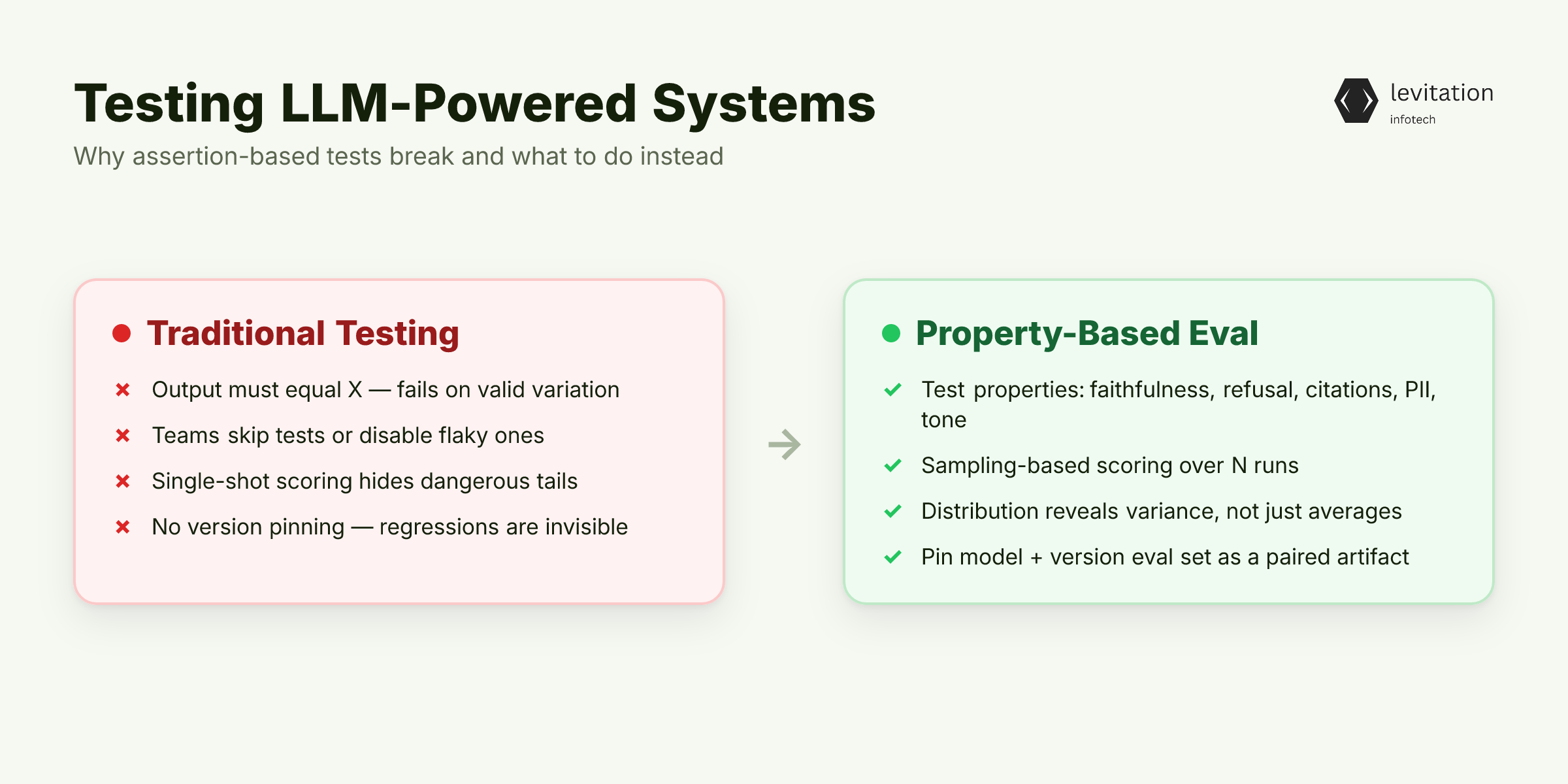
An LLM can produce three different valid answers to the same prompt. A traditional assertion-based test, where the output must equal X, will fail on all of them, even when every answer is correct.
This is why so many teams either skip testing for LLMs entirely or drown in flaky tests they quietly disable. Test for properties, not exact outputs. Faithfulness to the source. Refusal behavior on out-of-scope questions. Citation presence where citations are required. PII leakage. Tone.
Each property is a check the model either passes or fails, regardless of which specific words it chose. A property-based test gives you a signal that survives non-determinism.
Use sampling-based evaluation. Run each prompt N times and score the distribution, not a single output. If the model hallucinates 2 out of 10 times on a high-risk prompt, the answer is not "passes 80% of the time." It is "this prompt is a production incident waiting to happen."
Distribution-level scoring catches variance that single-shot tests miss. A passing average can hide a tail of dangerous failures.
Regression tests for LLMs need versioned eval sets and pinned model snapshots. Without them, you cannot tell whether a change in score came from your code or from the model itself shifting under you.
Pin the model version, version the eval set, and treat the two as a paired artifact. Anything else is comparing apples to last week's apples. So what does a pipeline that actually predicts production behavior look like in practice?
Building a Production-Grade LLM Eval Pipeline
It looks like five steps, executed in order, and wired into the same CI/CD that gates every other change in your system. - Step 1: Extract a stratified sample of real production queries and label them by intent and risk tier. Pull from recent production traffic. Risk tier is a business call: anything touching PII, money, or regulated advice is tier 1. Everything else is tier 2 or 3. - Step 2: Define a rubric with business-specific criteria. Compliance mentions. Tone. Refusal patterns. Citation rules. The rubric is the most important artifact in the system. Generic rubrics produce generic scores. - Step 3: Wire an LLM-as-judge pass into CI/CD. Every fine-tuning run, every prompt change, every retrieval config change gets scored before merge. No exceptions. The judge runs the rubric against the new model output and gates deployment on a threshold you set per risk tier. - Step 4: Run sampling-based evals as a canary on real traffic before any model swap reaches users. You are not just checking the average score. You are checking the variance and the worst-case failure rate on tier 1 prompts. - Step 5: Monitor production with the same rubric and feed disagreements back into the eval set. When a human overrides the model, that override is a labeled example. When a user complains, that complaint is a labeled example. The eval set grows from production reality, not from team imagination.
Teams that have shipped this pattern previously can deploy a production-grade eval system faster than teams building from scratch. The gap is not talent. It is the absence of a working blueprint.
Teams operating in regulated environments where the cost of a wrong answer is a board-level conversation have shipped this pattern. When this works, the eval pipeline stops being a checkbox and starts being a compounding asset. Here is what changes.
What Changes When Your Evals Actually Predict Production
Ship velocity increases because teams trust the green light from CI/CD. Engineers stop asking "should I deploy this?" and start asking "is the score up?"
Production incidents drop because the eval set already contained the failure mode. The model never reached a user with the regression in it.
Model swaps become a non-event. Shadow scoring catches regressions before users do, and the rollback path is rehearsed, not improvised.
Stakeholder trust compounds. When the system keeps working five years after launch, the conversation with the board changes. The same eval pipeline gates new model versions, and the dashboards have never lied.
AI stops being a risk to be managed and becomes infrastructure to be relied on. This is the difference between teams that catch regressions before they ship, and teams that debug them in production.
The eval pipeline is the asset. The model is replaceable. The pipeline is not.
Frequently Asked Questions
Q: What is LLM evaluation and why does it matter for production?
A: LLM evaluation is the systematic measurement of how a model performs on correctness, faithfulness, relevance, and safety. In production, weak evaluation directly translates to hallucinations, compliance gaps, and customer churn. Eval pipeline design is now a board-level concern for enterprises deploying AI.
Q: Why do traditional benchmarks like MMLU and BLEU fail to predict production performance?
A: They were built for academic research, not open-ended enterprise use. MMLU tests multiple-choice knowledge recall. BLEU measures n-gram overlap with a reference answer. Neither detects confident hallucinations, misses semantic meaning, or reflects how real users phrase queries in production.
Q: What is LLM-as-a-judge and how accurate is it?
A: LLM-as-a-judge uses a stronger language model to score outputs from a candidate model against a rubric. Research shows it achieves 81.3% correlation with human raters, outperforming BLEU and ROUGE on open-ended tasks. It works best when paired with targeted human reviews on high-risk categories.
Q: How do you build an LLM eval pipeline that actually predicts production behavior?
A: Start with a stratified sample of real production queries, define a business-specific rubric, and wire an LLM-as-judge pass into CI/CD. Use sampling-based evaluation for non-determinism. Shadow-score new models on real traffic as a canary, and continuously feed production disagreements back into the eval set.
Q: How long does it take to deploy a production LLM evaluation system?
A: A production-grade eval pipeline can take weeks to months, depending on rubric maturity, dataset size, and engineering capacity. Teams that build from scratch need to invest in dataset curation, rubric design, CI/CD wiring, and ongoing maintenance. The bottleneck is rarely tooling. It is the time required to build a rubric that reflects real business risk.
If your team is shipping LLMs into regulated workflows, the fastest first step is auditing what your current rubric actually measures.
Sources
Research and references cited in this article:
- LLM evaluation metrics: Complete guide for March 2026
- LLM Evaluation Metrics: The Ultimate LLM Evaluation Guide
- LLM Evaluation: Frameworks, Metrics, and Best Practices (2026 ...
- How to Evaluate LLMs - Metrics, Benchmarks & Python Code - machinelearningplus
- Evaluating LLM Metrics Through Real-World Capabilities _(academic)_
- LLM Benchmarks vs Real-World Performance | TransPerfect
- PDF A Systematic Literature Review of LLM Evaluation Methods
- Building Reliable AI Systems: Why LLM Demos Fail in Production
- LLM Evaluations: Techniques, Challenges, and Best Practices | Label Studio
- LLM Evaluation in Production: Testing Pipelines (2026)
- LLM Evaluation and Testing: How to Build an Eval Pipeline That Actually Catches Failures Before Production - DEV Community
- LLM Evaluation for Production Enterprise Applications
About the author
Mayank Singh is a software developer at Levitation Infotech, where he builds web and AI-powered applications across the company’s fintech, healthcare, and enterprise projects.