


TL;DR: A composable AI stack typically spans more than a dozen vendors. Auditors only validate three boundary questions across the entire chain: lineage, governance, and observability. Whether your stack creates 12 audit boundaries or 3 depends on one thing: whether the seams between vendors are provable. The contract count is irrelevant. Build for the three questions, and the rest of the audit becomes architecture, not archaeology.
Key Takeaways: - Audit scope is determined by unprovable boundaries, not vendor count. Cutting vendors rarely shrinks what auditors must test. - The three auditor questions (lineage, governance posture, observability) cascade across the stack and expose every open seam. - A unified metadata layer, source-level policy enforcement, and a single observability dashboard are the structural fixes that collapse 12 boundaries into 3.
Your 12 Vendors Just Became a Compliance Liability
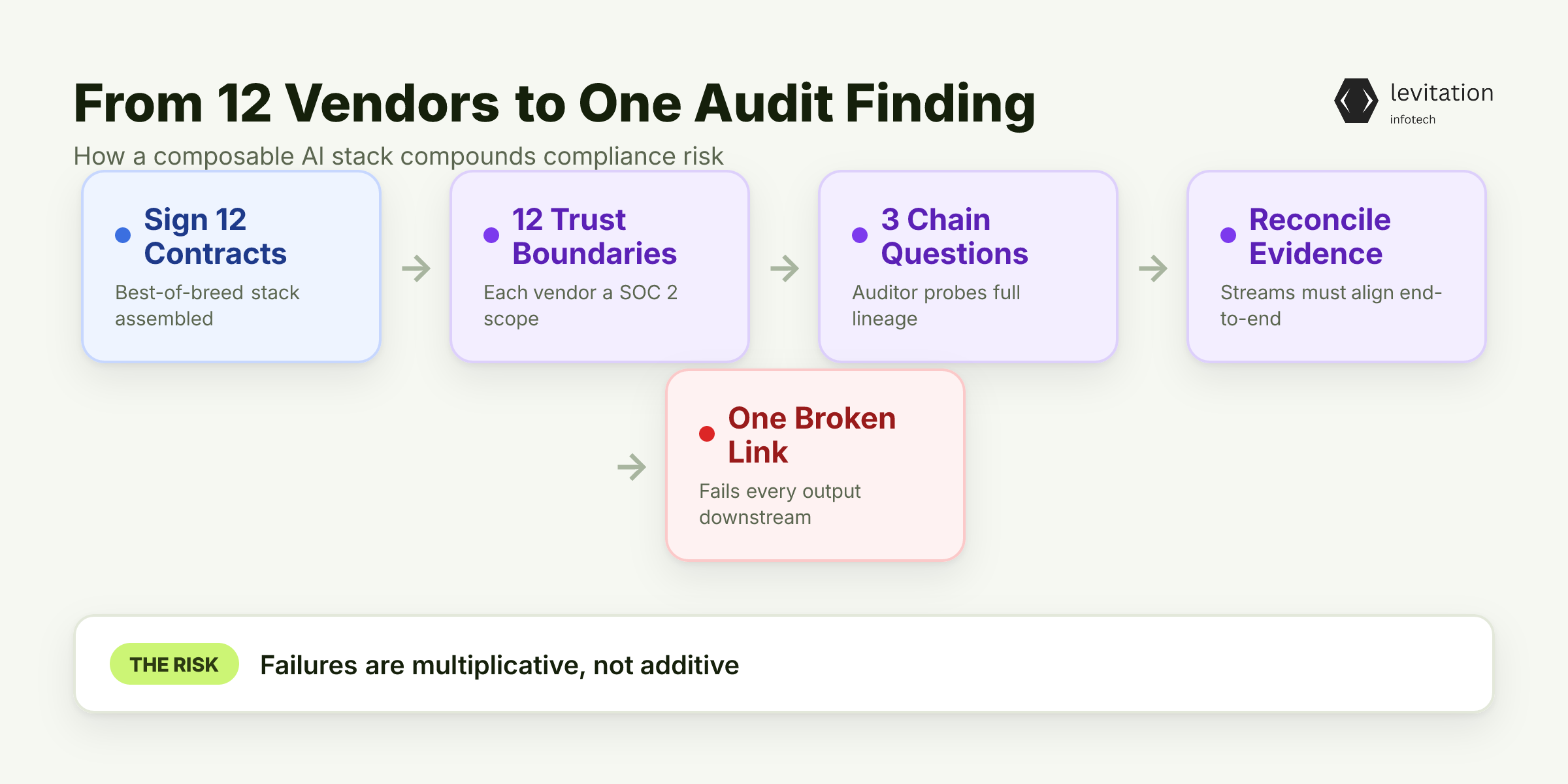
You signed 12 contracts to build a composable AI stack. Your auditor will validate exactly 3 questions across the entire chain. Most of your vendors will operate outside the audit boundary. You will not know which until the report lands.
A modern AI stack does not live in one product. It lives across a vector database, a feature store, a model server. An observability layer, an orchestrator, a governance tool. A retrieval layer, a prompt registry, and a handful of supporting services. Each one has its own contract, its own access controls, its own logs, and its own interpretation of what "compliant" means. That is the cost of best-of-breed. It is real.
The problem is not the architecture. The problem is how auditors see it. Every vendor contract is a SOC 2 trust boundary. Each boundary requires evidence collection, control mapping, and sign-off. Twelve vendors does not mean twelve times the work.
It means twelve different evidence streams that must reconcile with each other. Auditors must verify the chain between them. The work compounds non-linearly. The failures are multiplicative: one missing lineage link anywhere in the chain breaks the trail for every output that flows downstream.
Most CTOs discover this during fieldwork, not during scoping. The audit begins with a clean inventory of twelve vendors. By week three, the auditor is asking how a feature computed in vendor two ends up inside a prompt served by vendor nine.
Nobody has that answer. The control gap gets logged, the finding gets escalated, and the remediation clock starts. All of this happens while the business is still running.
The instinct at that moment is to cut vendors, reduce the surface, simplify the picture. That instinct is wrong. Here is why.
If your stack is built this way, you are not alone. Teams running regulatory compliance programs for enterprise AI have watched this exact failure pattern repeat. It plays out across deployments of every shape and size. The shape of the failure stays consistent even when the vendors do not.
Why Cutting Vendors Doesn't Shrink Audit Scope
Consolidation feels like the safe move. Fewer contracts, fewer vendors, smaller audit surface. The math is simple. The math is wrong.
The reason composable stacks sprawl is that different tools do different things well. One vector database excels at hybrid search. Another handles metadata-heavy filtered queries with lower latency.
A third integrates cleanly with your orchestration layer. Picking one is a trade. In regulated workloads, you cannot afford to trade away retrieval quality for audit convenience. The model that drives a credit decision cannot run on a weaker vector store just to make the auditor's evidence collection easier.
What auditors actually care about is whether the chain between vendors is provable. They do not count contracts. They do not score you on vendor count. They ask whether you can take any output, any feature, any prediction, and trace it back to its source. They want policy enforced at every step, under live conditions. A four-vendor stack where each vendor runs its own isolated governance model fails this test just as badly as a twelve-vendor one.
The real cost driver is evidence fragmentation. When each vendor emits its own logs, its own access policies, and its own lineage graph, the auditor must reconcile all of it. That reconciliation happens by hand. That is where audit prep time explodes.
Consolidation reduces it only marginally. Even a smaller stack produces fragmented evidence if the vendors were not designed to work together.
If the vendor count is not the problem, what is? It is the specific questions auditors ask. Most composable stacks cannot answer them without custom integration work. Teams that try to fix the wrong variable (cutting vendors instead of fixing seams) end up with a smaller stack. That smaller stack still fails the same three questions. The pattern holds across verticals. The cost driver is not the contracts you signed. It is the boundaries you cannot prove.
The Three Questions Every Auditor Asks Your Composable AI Stack
Auditors do not read twelve vendors. They read three questions, and they read them against the chain.
Question one: how does end-to-end lineage work in real time? Not a Confluence page. Not an Excel export someone updated last quarter. Auditors want a live, queryable path from source system to transformation to model output to consumer.
The auditor will pick a random output column, ask where it came from, and expect a working answer in minutes. If your tool responds with documentation, you have already lost this question. As one practitioner put it plainly: lineage that exists only in a Confluence page is not lineage at all.
Question two: what is your governance posture? Who owns this data domain? Where is access policy enforced: at the source, in transit, or only at the dashboard?
This is where most stacks collapse. Policy applied at the model serving layer does not travel upstream. If your vector database retrieves documents the requesting user cannot see, the policy is decorative. The auditor wants to see policy attached to data, not bolted to a UI.
Question three: show me observability. Data drift, schema change, distribution shift, and embedding staleness must be visible through a real dashboard, not retrofitted after an incident. The auditor will ask for a recent alert, triggered by a real event, from a production environment. If your observability layer cannot produce that artifact, the entire stack downstream of it is operating blind.
Here is the part most CTOs miss. If any vendor in your composable chain cannot answer one of these three questions, the entire chain downstream fails too. Not just that vendor. Everything that consumes its output. The seam is not where the failure lives. The failure cascades.
This is why auditors "read three" even when you have twelve vendors. The three questions cascade across the stack and reveal which boundaries are sealed and which are open. Every open boundary becomes a finding.
Every sealed boundary is invisible to the auditor because it produces no evidence of a problem. Building compliance automation into the architecture itself is what turns open boundaries into sealed ones. The third vendor in your pipeline just failed Question one. Here is what that failure actually looks like inside most stacks.
Why Most Lineage Dies in a Confluence Page
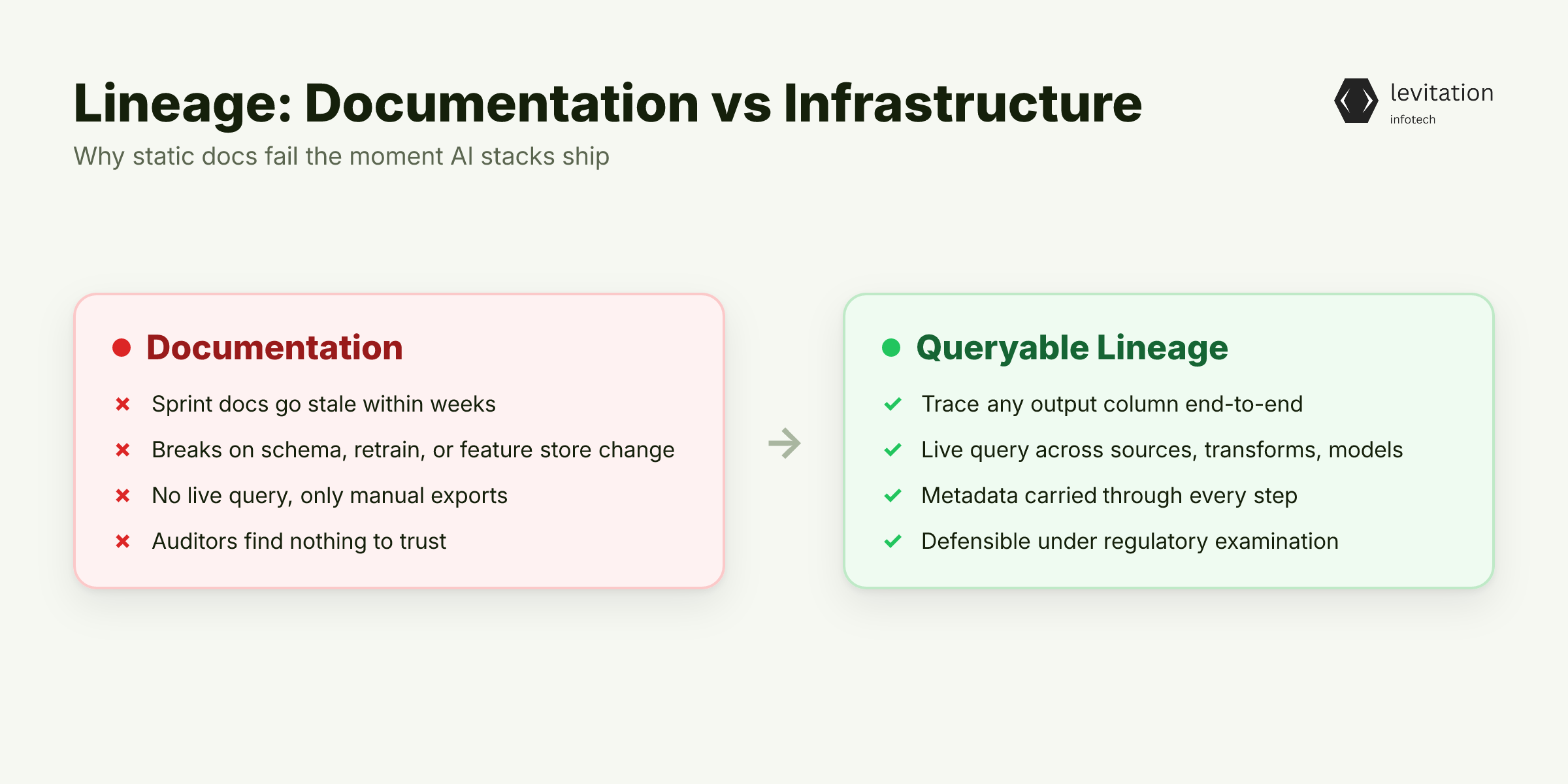
Manual lineage documentation becomes stale within weeks of any schema change, model retrain, or feature store update. This is not a theoretical risk. It is the default state of most AI stacks the moment they ship.
Practitioners have personally reviewed stacks where lineage lived only in a Confluence page from a sprint three months earlier. The diagrams looked plausible, and the tables mapped columns to source systems. The problem was that nothing in the page was true anymore.
Two schema changes, one feature store migration, and a model retrain had invalidated every row. Nobody had updated the document. Nobody trusted it to be the source of truth.
Queryable lineage means something different. You can select any column in any output table. You can trace it back to the source system, the transformation, and the model version. All through a live query.
No diagrams. No exports. No guesswork. If you cannot run that query, the lineage is documentation, and documentation is not defensible. Without queryable lineage, no model is defensible to a regulator, and no analyst will trust the output.
This is the line that separates "we have lineage" from "our lineage holds up under examination." Most teams discover the difference only when an auditor asks for a specific trace. Then the team spends two weeks reconstructing it by hand.
Vector embeddings make this harder. The transformation from raw text to chunk to vector to retrieved chunk to prompt context is a lineage chain most tools cannot trace.
Each step changes the artifact. Each step risks losing the link back to source. If your embedding index does not carry lineage metadata forward, your RAG pipeline is an untraceable black box. Auditors see right through it. Mature regulatory AI programs treat embeddings as a transformation step, not a boundary. That distinction is what keeps the chain queryable.
This is why the systems that survive in production are the ones built with lineage as infrastructure, not documentation. The audit boundary is structural, and the structure outlives every team turnover and schema migration. Building that structure starts with one decision: where the metadata actually lives.
Building Audit-Ready Lineage Across 12 Vendors
The fix is not more documentation. The fix is a metadata layer every vendor writes to, not twelve separate lineage graphs that nobody can reconcile.
Start with a unified metadata layer. OpenLineage, DataHub, or Unity Catalog work, with a single schema that all twelve vendors emit to. Every transformation, every read, every model inference becomes an event.
The lineage graph is not something you build. It is something your stack produces as a byproduct of running. When the auditor asks for a trace, you query the metadata layer, not your memory.
Enforce access policy at the source system, not at the model serving layer. Policy that lives in the application can be bypassed by any vendor downstream. Policy attached to the data travels with it.
Use signed claims or token-based propagation. Policy should reach the vector database, the retrieval step, and the prompt assembly layer, not just the model endpoint. The auditor is testing whether your policy survives a vendor swap or a new integration. If the answer is no, the boundary is open.
Wire drift detection to a single observability dashboard that ingests signals from feature stores, vector databases, and model servers. Treat schema change as a first-class event, not a log line someone notices three weeks later.
When embedding distributions shift, when a feature goes null, when retrieval quality drops, the alert fires once. It fires in one place. The team that owns the model sees it.
Tag every artifact with a stable identifier that survives vendor swaps. Features, embeddings, model versions, prompt templates, and output columns all need a consistent ID scheme. When you replace a vector database next year, the lineage must remain queryable because the IDs did not change.
This is the difference between a swap measured in weeks and one measured in quarters. The lineage graph has to be rebuilt from scratch in the slow version.
Test the chain quarterly. Select a random output column. Trace it to source without manual reconstruction. If you cannot, the boundary is open, and you have until the next audit cycle to close it. This is not a hypothetical test. It is the operational discipline that separates audit-ready stacks from the ones that scramble every spring.
Stacks built this way ship faster, because the architecture enforces the audit boundary from day one. Stacks built the other way take much longer. Documentation stands in for structure, so evidence has to be retrofitted after every change. The AI compliance model that ships fastest is the one where compliance is architecture, not overhead.
That chain has to survive your next vendor addition. Here is the test that decides whether a new vendor is allowed in.
The Vendor Pre-Signing Test
Most vendor evaluations focus on features, latency, and price. Auditors care about something else. Before signing any vendor contract, run the pre-signing test.
Require a live demo of all three auditor questions answered against a sample of your actual data. Not their sandbox. Your data, your schema, your access patterns. If the vendor cannot show lineage propagation, policy enforcement, and drift detection against your environment, they will not do it in production. They never do.
Ask: can your tool emit OpenLineage events? If not, it will become a lineage dead zone in your audit graph. Every output that flows through it will be untraceable, and the chain downstream will inherit the gap.
The vendor may have great retrieval quality and beautiful dashboards. None of that matters if the tool cannot speak the lineage protocol your stack runs on.
Ask: where is access policy enforced, and can it propagate to downstream vendors via signed claims, not API calls? API calls are brittle. They break when a vendor rotates an endpoint. Signed claims travel with the data. The vendor must demonstrate policy propagation in a live scenario, not a slide.
Ask: show me your drift dashboard with a real alert triggered by a schema change in a production environment. Not a synthetic demo. A real alert, from a real event, in a real production environment. If the vendor's drift detection is theoretical, your observability boundary will be theoretical too.
Reject vendors whose demonstration drags past your evaluation window. Audit season will not wait for them. The longer the vendor takes to prove the three questions, the more drag they introduce. They become the unprovable boundary that fails the audit. Teams that treat compliance automation as a vendor selection criterion, not a post-signing project, ship faster and audit cleaner. The difference becomes visible the first time an auditor asks the right question and your stack answers it in minutes.
What an Audit-Ready Composable Stack Actually Buys You
The payoff is structural, not procedural. Audit scope collapses from per-vendor reviews to three boundary checks. Audit prep time drops. Evidence collection cost drops.
The auditor stops asking how vendor seven connects to vendor nine. They start asking whether the unified metadata layer is producing the events it should. The conversation shifts from archaeology to verification.
Vendor swaps become safe. Because lineage is queryable through the metadata layer, replacing a vector database does not invalidate the chain. The new vendor emits events to the same schema, the lineage graph continues, and the audit boundary stays sealed. The migration that nobody wanted becomes a project measured in weeks because the structure absorbs the change.
Systems built this way stay in production because the audit boundary is structural, not documentation-dependent. The team turns over. The schema evolves. The vendors change.
The boundary holds because the architecture, not the people, enforces it. Run the pre-signing test on your next vendor, and watch the audit conversation change before fieldwork even starts.
About the author
Mayank Singh is a software developer at Levitation Infotech, where he builds web and AI-powered applications across the company’s fintech, healthcare, and enterprise projects.