


TL;DR: SOC 2 scope is a boundary you define around an in-scope service and its material dependencies, not a count of every endpoint an agent can reach. Endpoint-counting is the wrong fix. It inflates scope, drives audit costs up, and pushes the real problem into the background. The real problem is CC6 logical access for delegated authority chains. The fix is a five-step access chain map that ties each tool invocation to CC6.1, CC6.2, and CC6.3 evidence.
Key Takeaways: - SOC 2 scope is a contract about the in-scope service, not a technical inventory of reachable endpoints. - The real friction for agentic systems lives in CC6 logical access, not in the scope section. - A chain of delegated authority (user to agent to service identity to tool to resource) must be reviewable link by link. - Endpoint-counting inflates audit costs. Every new system in scope multiplies the control families the auditor tests and the evidence the team produces. - A defensible scope uses boundary controls, subservice carve-outs, and material dependency classification to exclude what does not belong in scope.
Your Agent's Reach Exceeds Your SOC 2 Scope
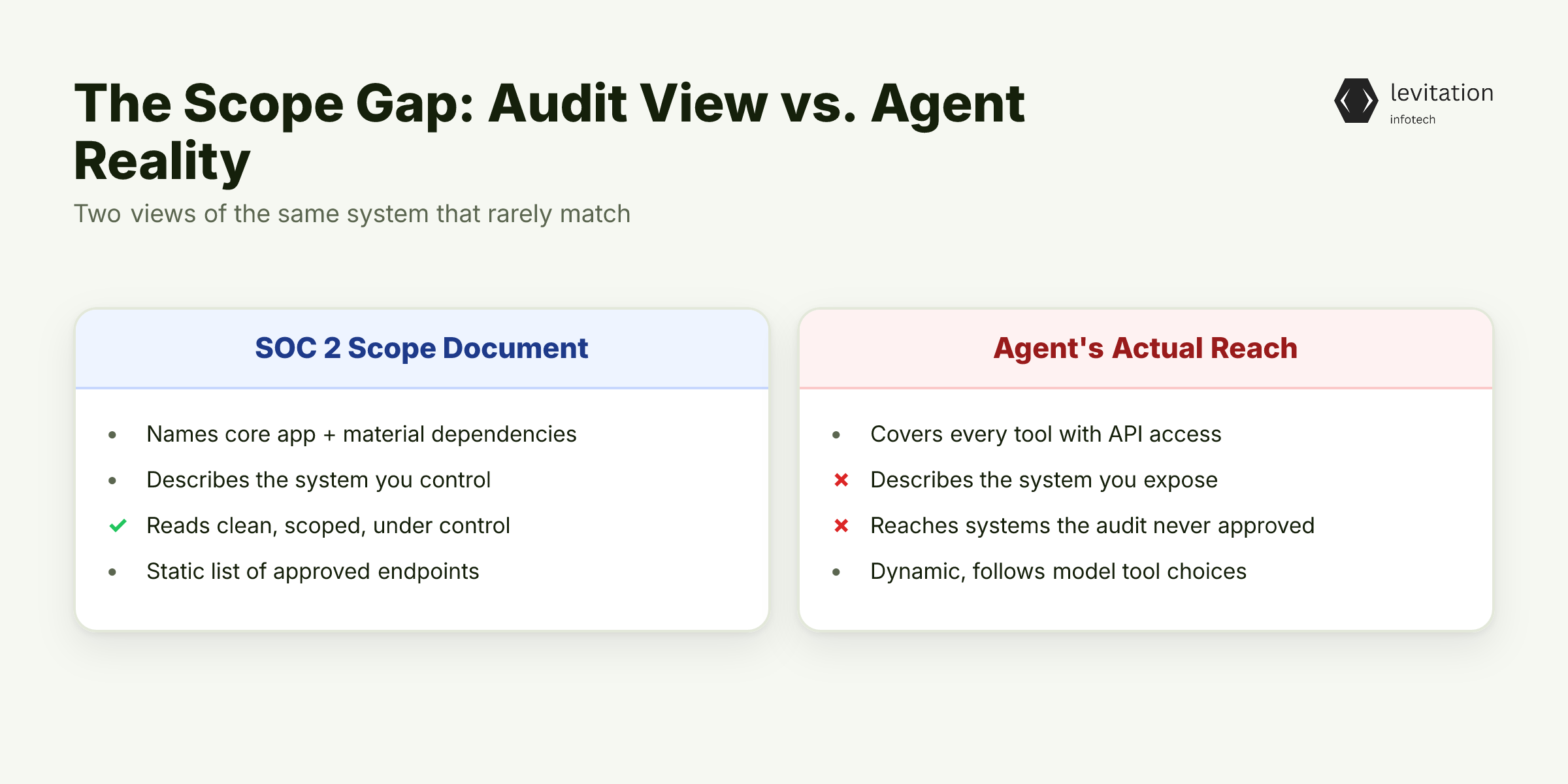
Your agent can call every API it has tool access to. Your SOC 2 report names only the in-scope service and its material dependencies. The gap between those views is where your next audit finding lives.
Consider a customer ops agent with tool-use across a CRM, an ERP, a billing system, a support knowledge base, and three internal microservices. Each tool exposes its own API surface, reachable from inside the agent's execution context.
The SOC 2 scope section names the core application and a handful of supporting systems. A typical report reads clean, scoped, and under control. An auditor reading both artifacts side by side will see the mismatch immediately.
This gap is not a documentation oversight. It is a structural mismatch between how agentic systems work and how SOC 2 scope is defined.
The agent does not care about your scope document. The model picks a tool, fires a request, and the request lands at whatever endpoint the tool targets. AI agents reach systems the audit never explicitly approved.
The auditor is reasonable to ask why reachable systems are not reflected in the report.
Compliance leaders inside large enterprises already feel this tension. The audit conversation shifts from "what is in scope" to "what can the agent actually touch" the moment tool-use enters the picture.
The scope document describes the system you control. The agent's reach describes the system you expose. Those two views rarely match.
The instinct is to close the gap by adding the rest to the scope document. That is exactly what makes the problem worse.
Why Adding Endpoints to Scope Doesn't Solve the Problem
SOC 2 scope is not a flat list of systems. It is a boundary around the in-scope service and its material dependencies. The auditor's job is to evaluate your controls against that boundary.
The moment you start listing every endpoint an agent can touch, you are no longer defining a service boundary. You are declaring a perimeter around every integration in your stack.
If you list every reachable endpoint, you take on logical access, change management, vendor management, logging, and monitoring evidence for each. That list grows fast with agentic systems.
Most teams do not own the controls for the systems the agent touches. The CRM, the billing vendor, the payment processor, the support tool each sits behind someone else's security program. Listing them in your scope does not make their controls yours. It makes the absence of your controls visible to the auditor.
The cost mechanism is direct. Every system added to scope multiplies the control families the auditor has to test and the evidence the team has to produce.
Narrow-scope services need a small fraction of the audit effort that broad-scope agentic platforms need. Scope creep drives that gap fast, because every new system in scope adds control families, evidence requirements, and coordination work with the auditor.
This is the wrong layer to fix the problem on. The right layer sits inside AI governance frameworks that treat scope as a boundary you defend, not a list you expand.
Engineering teams that build custom software for regulated workloads run into the same pattern. They try to absorb the agent's reach into the audit, but the audit was never designed to absorb it in the first place.
The endpoint-counting approach fails because it solves the wrong layer. The real friction lives in CC6, where the auditor is evaluating something your agent's architecture does not natively provide.
CC6 Logical Access Was Designed for One Human, One Identity
CC6 in a traditional SaaS model is simple. A named human authenticates against a policy. The policy grants or denies access to a resource. The auditor reviews user provisioning, role assignments, and deprovisioning. One identity, one decision, one audit trail.
Agentic systems break that model completely. The chain is longer. A user triggers an agent. The agent assumes a service identity, usually a service account, a workload identity, or a token minted by an identity provider. That service calls a tool. The tool acts on a resource. Each link in the chain carries its own identity, its own scope, and its own audit trail. The SOC 2 auditor reasonably expects every link to be reviewable.
The AI governance translation of CC6 has to account for that chain. The controls that worked for human-to-resource access do not transfer to user-to-agent-to-service paths. This is the highest-friction control family for agentic systems, ahead of CC7 monitoring and CC8 change management. We have covered why most observability stacks miss agent-specific audit gaps before.
CC6 compounds the problem because the auditor will ask for evidence at every link, not just at the resource boundary. Teams that solve this with shared credentials, ambient authority, or implicit inheritance from the invoking user get caught fast. The auditor looks for those patterns in the first walkthrough.
The auditor's question is consistent. Who authorized this access, under what policy, and can you show me the evidence? If the answer requires a developer to manually reconstruct the chain from logs, the control does not exist in a defensible form.
For most AI agents in production today, that is exactly the situation auditors walk into. The same pattern shows up in workload identity programs. Zero Trust stops at the perimeter and agents walk past it because the trust decision was made for the human, not the delegation. CC6 surfaces this gap faster than any other control family.
Understanding the chain problem is necessary but not sufficient. The resolution requires reframing what SOC 2 scope actually means.
SOC 2 Scope Is a Boundary, Not a Technical Inventory
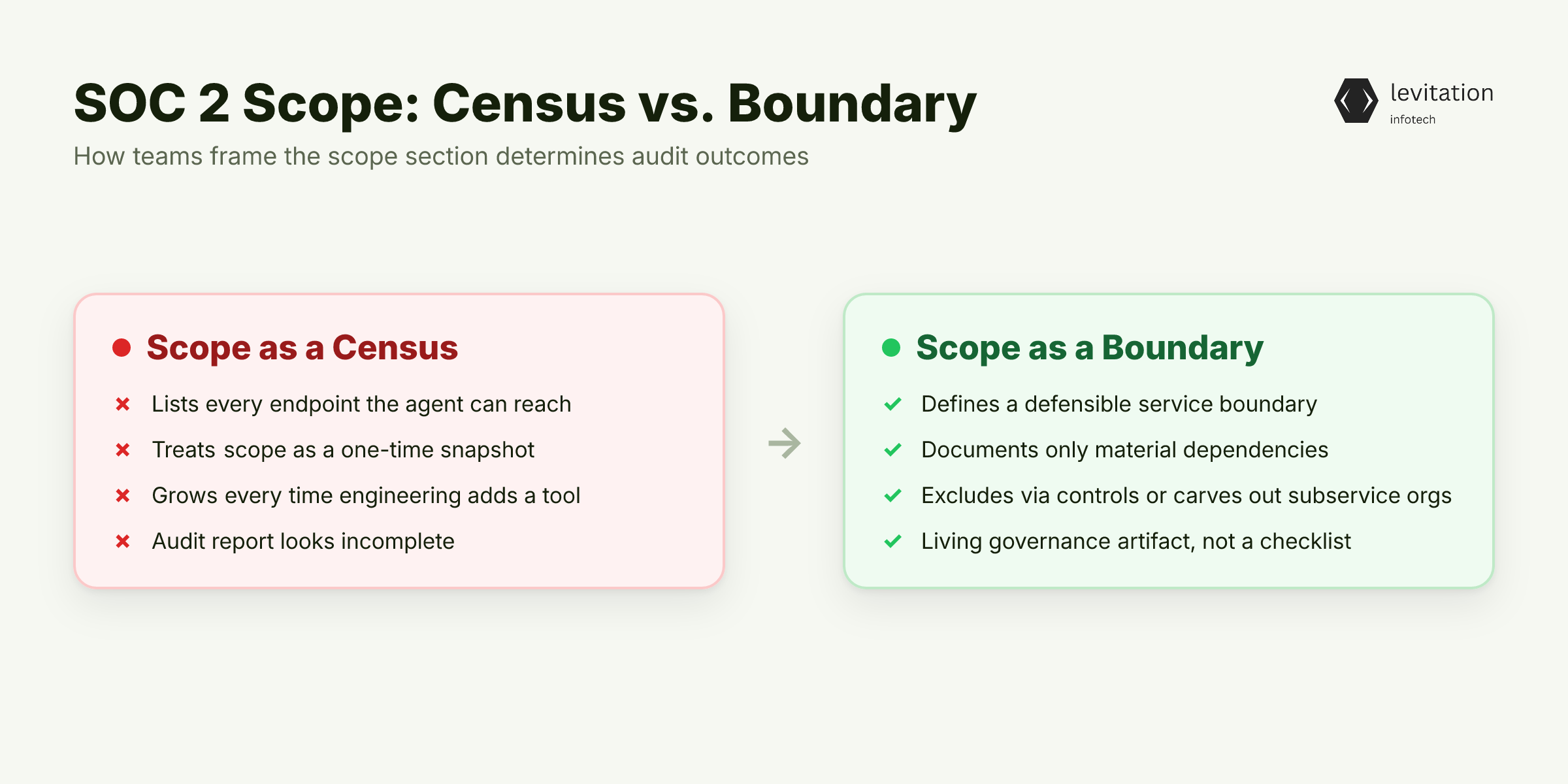
SOC 2 scope is defined by the in-scope service and the people, processes, technology, data, and material dependencies that support it. It is not defined by every system an agent can reach.
The auditor evaluates whether your controls cover the access chain. They do not care whether you listed every endpoint the agent could touch.
Your job is to define a defensible boundary, document material dependencies, and let the auditor evaluate controls against that boundary. Every reachable endpoint is not the scope. The scope is the subset that materially supports the in-scope service. For the rest, you either exclude them with boundary controls or carve them out as subservice organizations with documented evidence.
This is where most teams go wrong. They treat the scope section as a census of integrations, then wonder why the audit report looks incomplete.
The scope section is a contract. It tells the auditor which systems your controls apply to and which are covered by another vendor's controls. It also names which systems are out of bounds for the agent.
The right AI compliance posture treats the scope document as a governance artifact with teeth. It is not a checklist that grows every time the engineering team adds a tool.
Teams that run AI governance programs understand this distinction. The pattern is consistent. The teams that pass audits cleanly define a tight boundary. They defend it with technical controls. They treat the scope section as a living artifact that reflects how the access chain works.
The teams that fail treat the scope section as a snapshot. They discover too late that the agent reached new systems since the diagram was drawn.
With the right mental model, the implementation becomes mechanical. Here is the five-step process to make agent access defensible.
Building the Agent Access Chain Map: Five Concrete Steps
Step 1: Enumerate every tool the agent can invoke. Classify each tool by data sensitivity. Read-only PII carries different exposure than write access to a production database. External systems (third-party APIs) carry different exposure than internal-only microservices. The classification drives every downstream control.
Step 2: Assign a distinct service identity to each tool invocation chain. No shared credentials. No ambient authority. No implicit inheritance from the invoking user. The agent does not act as the user. It acts as a delegated principal with its own identity, its own scope, and its own audit trail. Teams that skip this step end up with agents carrying more IAM roles than senior engineers, with no clear way to separate human access from delegated access.
Step 3: Log every link in the chain. Every tool call should produce a record with timestamp, invoking agent, tool called, resource touched, and policy decision. The auditor should be able to reconstruct any access from the logs alone, without interviewing a developer. If the reconstruction requires tribal knowledge, the control does not exist in a form the auditor can test.
Step 4: Map each chain link to the relevant CC6 sub-criteria. CC6.1 covers logical access provisioning. CC6.2 covers modification of access. CC6.3 covers removal of access. Each link in the agent's chain must produce evidence for the appropriate sub-criterion. This is the translation that most teams skip, and the gap that most audits expose.
Step 5: Define the agent's access policy as code. The controls must be testable, reproducible, and version-controlled. Narrative policy documents fail SOC 2 Type 2 because the auditor cannot observe them operating. Policy-as-code turns the control into something the auditor can sample, test, and verify against historical evidence. Engineering teams that build custom software for regulated workloads use this pattern. Agent deployments are no different.
The access chain is only half the problem. The other half is figuring out which dependencies are material, and which ones you can carve out.
Material Dependencies, Subservice Organizations, and Carve-Outs
A material dependency is any system whose failure or compromise would impair the in-scope service. Not every reachable endpoint qualifies. The agent can call every endpoint it has tool access to, but only a subset of those endpoints support the in-scope service directly. The rest are either peripheral, redundant, or out of bounds for the agent's intended behavior.
For dependencies you do not control, the SOC 2 approach is the complementary subservice organization carve-out. This covers third-party APIs and SaaS platforms the agent can invoke. You review the vendor's own SOC 2 report, document the dependency, and describe the controls you apply at the integration boundary. The auditor evaluates your boundary controls, not the vendor's internal controls. This is standard AI compliance practice for any agent that calls external APIs.
For dependencies you do control but want to exclude from scope, you need a documented boundary control. A network policy, an API gateway rule, or an agent-level restriction that physically prevents the agent from reaching the excluded system. The boundary control is not a policy statement. It is a technical mechanism the auditor can test. If the agent can reach a system, that system is in your chain, whether you listed it in scope or not.
The classification matters because it drives the evidence requirement. Material dependencies need full CC6 coverage. Subservice organizations need documented vendor reports plus boundary controls. Excluded systems need boundary controls that prove the agent cannot reach them. The AI governance framework that ties this together treats the classification as the first decision the auditor will validate.
Once the chain is mapped and dependencies are classified, the scope becomes defensible. Here is what that looks like in practice.
What a Defensible Agent Scope Looks Like in Practice
Audit findings drop because the chain is reviewable end-to-end. The auditor does not have to take your word that the agent cannot reach excluded systems. The boundary controls produce evidence. The access chain produces evidence. The classification produces evidence. The auditor samples, tests, and finds the controls operating as designed.
Agent deployment velocity increases because new tools can be added with a documented policy change rather than a full scope amendment. The access chain map updates. The sub-criteria evidence matrix updates. The policy-as-code repository commits the change. The AI agents ship faster because the governance work is integrated into the deployment pipeline, not bolted on after the fact.
The scope document becomes a living governance artifact rather than a stale snapshot. It reflects the current state of the access chain, generated from the same source of truth that enforces the controls. The auditor sees a scope document that matches the running system, which is the only configuration that survives SOC 2 Type 2.
This posture separates teams that ship custom software for regulated workloads from teams that treat compliance as an annual event. The difference shows up in audit outcomes, deployment velocity, and buyer trust. The SOC 2 Type 2 report tells the rest of the story to anyone who reads past the opinion page.
The shift from endpoint-counting to boundary-defending is the work, and Levitation helps engineering teams build that posture into the agent stack itself so governance runs with the system instead of arriving after the auditor.
Frequently Asked Questions
How many API endpoints should be in SOC 2 scope for an AI agent? There is no fixed number. SOC 2 scope is defined by the in-scope service and its material dependencies, not by every endpoint the agent can reach. The auditor evaluates whether your controls cover the access chain, not whether you listed every endpoint.
Does an AI agent's tool use count as a new endpoint for SOC 2?
About the author
Mayank Singh is a software developer at Levitation Infotech, where he builds web and AI-powered applications across the company’s fintech, healthcare, and enterprise projects.