


TL;DR: Event streaming can speed up failover orchestration, but it doesn't make payment state safe. The right recovery unit is readiness at cutover. Can the standby region authorize, capture, replay, and reconcile without duplicate or conflicting money movements?
Key Takeaways: - A 47-second data switch isn't recovery until payment acceptance and capture are safe. - Event replication isn't consumer readiness, and stream-level exactly-once doesn't span external side effects. - Model failover as a gated state machine, then measure safe acceptance, safe capture, and reconciliation separately.
A 47-Second Data Move Was Not a 47-Second Recovery
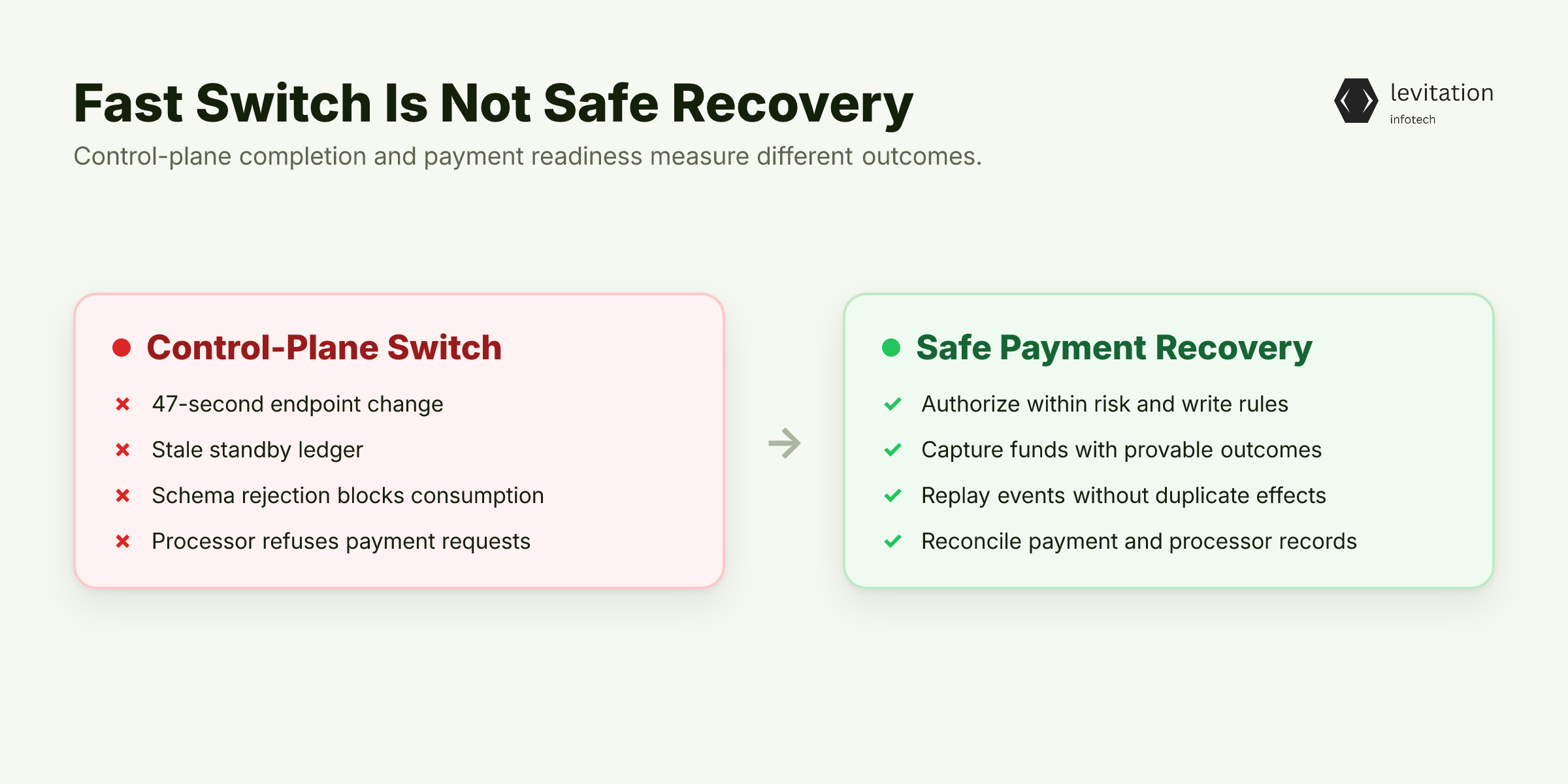
A DynamoDB region switch completed in 47 seconds. The payment application still died.
That split is uncomfortable because the switch looked like success. Across 12 payment failover simulations, a fast control-plane decision was not the same as safe payment recovery. The system must accept, capture, and reconcile money before recovery is complete.
Three clocks, not one
Most incident dashboards collapse recovery into one stopwatch. That stopwatch often measures control-plane execution, not whether money can move safely. - Detection time: From the first payment impact until the system recognizes it. - Movement time: From the decision until traffic and write authority shift. - Safe-acceptance time: Until the standby can accept a payment without creating an unsafe state.
Recovery remains incomplete until safe acceptance reaches its target.
In the cited simulation, a database endpoint changed in 47 seconds. The standby ledger can still be stale. Its consumer can reject the current schema, and the processor can refuse requests.
None of those failures makes the switch slower. They make the application unusable.
Which clock exposes the real outage when control-plane timing looks clean?
Streaming helps orchestration, not judgment
Payment event streaming can speed up orchestration and keep event records available during a regional failure. That's its real contribution.
Streaming doesn't automatically make the receiving application, ledger, or downstream dependencies ready to act. A replicated event can still be unreadable, unauthorized, or unsafe to apply.
For teams in data engineering services, the design question is sharper: what is ready at cutover?
Teams should track four business outcomes from the first failure signal: - Authorize: Accept a payment without violating risk or write rules. - Capture: Move funds through a processor that can prove the request's outcome. - Replay: Process repeated, delayed, or reordered events without repeating a side effect. - Reconcile: Match processor, ledger, and webhook records.
Route 53 weights and database endpoint changes belong in the timeline. They don't belong in the recovery verdict.
The reported results do not provide a definitive streaming win-loss count for the 12 simulations. They do show that a fast component switch did not guarantee that the payment application would survive. Readiness at the cutover boundary matters more than the speed of the trigger.
If the slowest clock isn't the problem, which failures can actually be automated without moving risk from one region to another?
Traffic Moved, but Payment State Did Not
Traffic moved. Payment state didn't.
The control plane isn't the recovery outcome
Amazon's documented pattern starts with API Gateway invoking Lambda. Lambda then updates Route 53 weights and DynamoDB records.
This automates a control-plane sequence. It doesn't prove that a payment application can safely process the resulting traffic.
Routing can complete before clients have learned the new endpoint. It can also finish before workers hold current leases and the standby can own writes.
That last problem is the silent one described in leader election as a hidden high-availability failure.
How can a team prove that routing finished before money became unsafe?
Replication is availability, not readiness
EventBridge global endpoints can replicate an event into log groups in both regions. That improves event availability. It says nothing by itself about a consumer's ability to apply the event safely. - The consumer can decode the current schema. - Its checkpoint points to compatible state. - Its replay procedure preserves ordering and ownership. - Only one region has valid side-effect authority.
A replicated event is useful only if its consumer can read it safely. For teams in data engineering services, replication is the transport, not the readiness proof.
So what changes when the event arrives safely but the money movement cannot be?
Stateful payments break the shortcut
Duplicate captures, stale ledger writes, out-of-order events, replayed webhooks, and unresolved reconciliation work are ordinary failure modes. They appear when traffic changes while work is already in flight.
Exactly-once stream processing usually protects events and their state store together. It doesn't make external captures, ledger writes, and webhooks unique together.
This boundary is easy to miss in Kafka-Flink designs, as exactly-once processing with Kafka transactions shows. Idempotency and reconciliation remain separate controls.
Idempotency prevents repeats where possible. Reconciliation finds and resolves what crossed the boundary.
Manual recovery is slow, error-prone, and inconsistent under pressure. Event automation can shorten the response. The mistake is treating automated console steps as end-to-end recovery.
That distinction leads to a better unit of analysis than streaming versus replication: readiness at the exact moment traffic changes. So what must be true at that instant?
Failover Readiness Is a Four-Part Contract
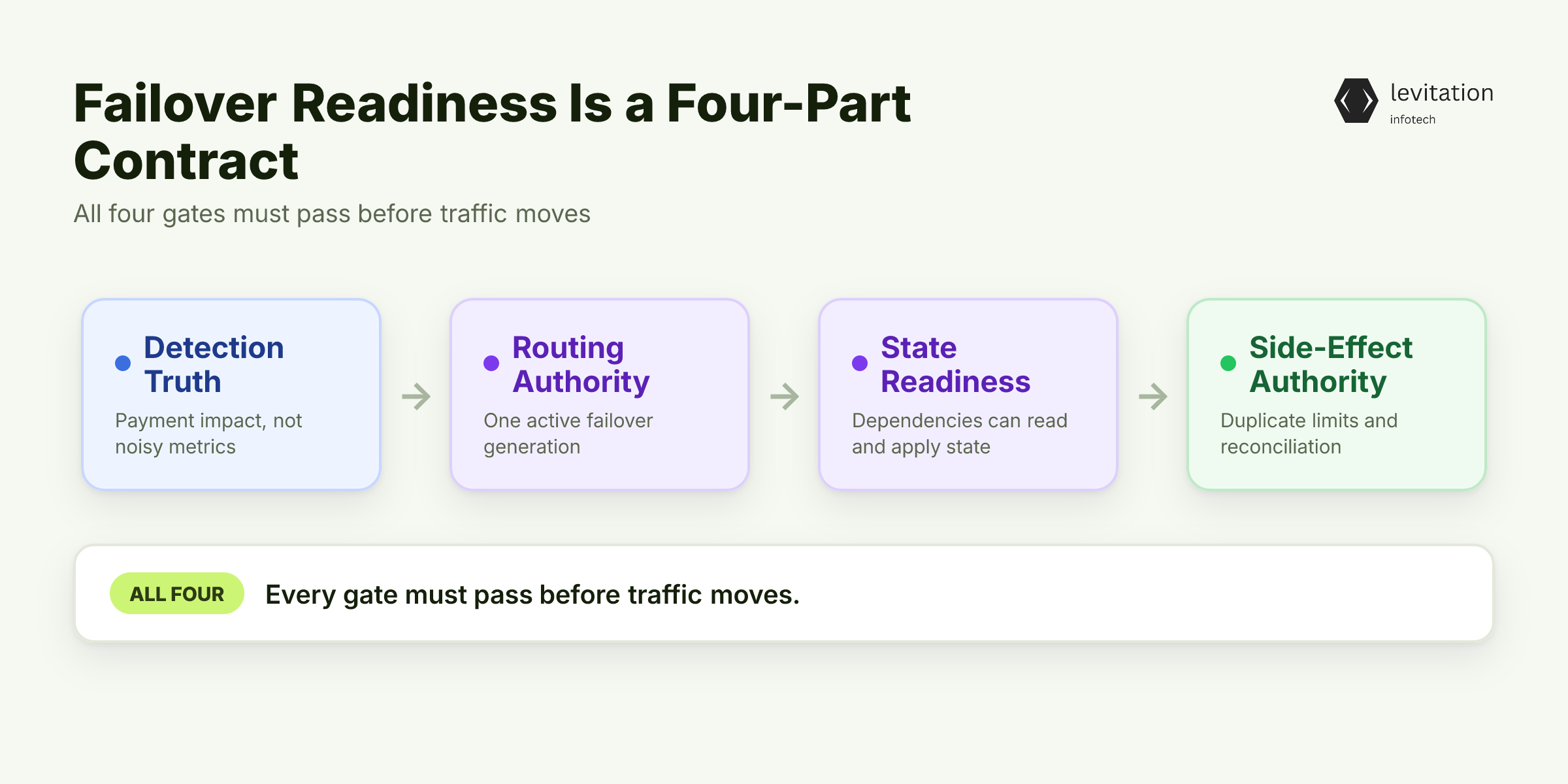
Most teams write failover as one gate: route or don't route. A payment system needs four gates.
Gate one: detection truth
Detection must reflect payment impact, not merely a noisy metric. The signal should fire within the required window without causing flapping or contradictory decisions. - Business health confirms customers cannot authorize or capture. - Component health explains why the payment path failed. - One authority records the detection and any reversal.
A load balancer can be healthy while every capture path fails. That's a payment-impacting outage with healthy components.
Which system owns the decision when the component signals disagree?
Gate two: routing authority
Establish one active failover generation so clients, APIs, workers, and event producers agree on the write owner.
Route 53 weight changes are one action inside this gate. They don't prove clients reached the target or workers abandoned the old leader.
A plan for data engineering services should record that generation across every producer and consumer. A mismatched generation can send two regions into the same transition.
How can the standby prove it owns writes before production traffic arrives?
Gate three: state readiness
Before admitting traffic, verify the payment store, ledger, consumers, schemas, checkpoints, credentials, and replay path. - The standby reads current payment state. - Consumer code accepts the event schema. - Checkpoints and replay procedures remain compatible. - Credentials and write authority are valid.
Replication helps only when the receiving consumer can read and apply the event safely. Active-active designs make this harder, not easier, as active-active high availability can break stateful systems shows.
What evidence confirms that every dependency can read and write current state?
Gate four: side-effect authority
Capture, refund, ledger mutation, and webhook retry need limits on duplicate risk and a known reconciliation path.
Suppose a capture request times out after the processor accepts it. The standby sees no response and cannot infer whether the capture succeeded.
An idempotency key lets the processor recognize the same request and return its earlier outcome. Without that check and an outcome lookup, a retry can charge twice.
High-impact actions should stay gated even when detection and routing are automated. A gate can become automatic only when tests prove its limits.
Which side effects can run unattended without moving risk to the standby?
When streaming earns its place
Payment event streaming earns its place when the backbone remains available, consumers are pre-warmed, and state is compatible. It also assumes that semantic conflicts can be resolved without human judgment. It doesn't win merely because the trigger arrived first.
Netflix's Project Nimble aimed to complete regional failovers in under 10 minutes without operator workload. Use that as a reference for reducing human work, not a universal payment target.
The 47-second DynamoDB switch remains the warning. Component speed can conceal application failure.
The metrics that resolve the tension are time to safe payment acceptance and time to safe capture. Measure each independently from time to route.
Once readiness becomes explicit, the failover runbook can be engineered like a controlled state transition instead of console clicks. What should that state machine refuse to do without a human?
Run the 12-Simulation Drill as a State Machine
A drill shouldn't begin with a dashboard. It should begin with a failure matrix.
Build the 12-run matrix
Use the same scorecard for every run, including runs by data engineering services teams. Otherwise, one fast recovery can hide the causes of slower ones.
Each run should record: - The injected fault and expected signal. - The control-plane action. - The state-readiness result. - The event-continuity result. - The safe-capture decision. - Operator interventions. - The root-cause classification. - Timestamps and supporting evidence.
Compare results by failure class, not one average. An average can make replay failure look like routing delay.
Include aborted drills and failed gates. Hiding them makes recovery evidence less credible.
Which failure class should the first rerun isolate?
Automate the reversible plane
The AWS pattern maps API Gateway to Lambda, then Route 53 and DynamoDB. EventBridge, Step Functions, or SNS can express that sequence with explicit gates.
Every step needs idempotency. A retried command must not repeat a route change, trigger another promotion, or replay a write event.
Which commands are safe to reverse, and which need a fresh promotion generation?
Make regions repeatable
Use CloudFormation, CDK, Terraform, or similar infrastructure as code. Deploy matching regional configurations to reduce drift. This makes recovery environments more predictable.
How will you detect when one region's configuration no longer matches the other?
Make readiness a state machine
`DETECTED -> QUARANTINED -> STATE_READY -> STREAM_READY -> ROUTED -> SAFE_TO_ACCEPT -> SAFE_TO_CAPTURE -> RECONCILING -> RECOVERED`
Here, QUARANTINED stops new money movement until ownership is clear. ROUTED means a controlled route change, not unrestricted production admission.
Each transition carries evidence and the expected failover generation. A retried transition can't skip a gate. Traffic movement cannot advance until the expected generation and state checks pass.
In plain terms, the workflow refuses to route until the state and stream gates pass.
Which gate should fail first when a standby is stale?
Break event continuity on purpose
Inject duplicate, delayed, reordered, and replayed events. Verify idempotency keys, sequence handling, consumer checkpoint recovery, schema compatibility, and ledger-to-processor reconciliation. - A duplicate can't create a second capture. - A delayed event can't overwrite newer state. - A replayed event can't repeat a webhook. - Every ledger entry maps to one processor outcome.
Regional log replication is availability evidence. It isn't proof that side effects were unique.
Can the drill prove that a duplicate capture never leaves the processor?
Separate automation from authorization
Automate detection, evidence capture, reversible traffic changes, and replay preparation. Keep explicit approval gates for ledger repair, bulk replay, and other steps that can move money incorrectly.
The goal isn't zero humans. It's repeatable execution with human judgment only where semantic conflict appears.
Which conflicts deserve a human decision, and which can use a tested rule?
Measure and repeat
Record detection time, routing time, time to safe acceptance, time to safe capture, event-backlog age, reconciliation lag, duplicate indicators, and manual actions.
Run the drill again whenever routing, schemas, dependencies, logic, or regional infrastructure changes. The same matrix then compares runs over time instead of celebrating one good morning.
Company-level delivery claims associated with Levitation should not be presented as results from these 12 simulations.
A rigorous drill produces a different recovery metric. It measures how quickly payment risk returns to an approved, reconciled state, not how quickly infrastructure changes labels. What should that metric show at the next board review?
Measure Safe Recovery, Not Motion
A CTO should receive a readiness dashboard, not one impressive failover duration.
Four clocks on one dashboard
Keep each outcome separate: - Time to route: Did the control plane change? - Time to safe acceptance: Can the standby authorize a payment? - Time to safe capture: Can it capture funds without unsafe duplicates? - Time to reconcile: Do processor, ledger, and webhook records agree?
Put event-backlog age, reconciliation lag, duplicate indicators, and manual actions beside those clocks.
Suppose routing completes quickly while safe acceptance waits for a stale consumer. One duration would hide where recovery stalled.
Which clock should trigger escalation when the route is ready but capture isn't?
Turn findings into policy
Event-driven failover and payment event streaming are strongest when failure isolation, consumer readiness, and write authority already exist. They're insufficient when the application, event state, or downstream dependencies still need to catch up.
Before approving automated traffic movement, require: - A failover generation shared by every producer and consumer. - Idempotent side effects with tested outcome lookups. - Explicit readiness gates for acceptance and capture. - Replay procedures and named reconciliation ownership.
Teams gain repeatable execution, clearer ownership, auditable evidence, and fewer manual decisions. The business gains a lower operational burden without mistaking a switch for restored payment service.
Similarly, firm-level delivery indicators are not failover measurements.
The remaining CTO questions are operating limits, not architecture slogans. Which payments can move automatically? Which need human authority? What evidence proves the answer?
Frequently Asked Questions
Before reviewing an architecture, check five boundaries: - Detection and routing authority - Safe acceptance and capture - Event replay - Ledger reconciliation - Human approval for money movement
Is event-driven failover always faster than a manual runbook?
No. It can shorten detection and control-plane execution. Application and data readiness still govern recovery.
Compare time to safe payment acceptance or capture, not just routing time. What if the route is ready but the processor is not?
Does event streaming guarantee exactly-once payment processing?
No. Exactly-once processing is usually scoped to a stream-processing boundary. External captures, ledger writes, and webhooks still require idempotency and reconciliation.
Replication into both regional log groups improves event availability but doesn't prove unique side effects. Which external side effect needs the strongest idempotency key?
What RTO should we use for payment failover?
Use the stricter of the approved safe-acceptance and safe-capture targets. A routing target cannot replace either one.
Measure from the first payment-impact signal, and track reconciliation as a separate recovery objective. Which limit should the team test first?
About the author
Mayank Singh is a software developer at Levitation Infotech, where he builds web and AI-powered applications across the company’s fintech, healthcare, and enterprise projects.