


TL;DR: A Noida plant manager chose a ₹14 lakh custom ERP over a ₹1.1 crore SAP deployment. The system beat the commercial alternative on cost-efficiency. The cost gap is real. The capability gap is not. The math favors custom builds for most mid-sized single-plant operations.
Key Takeaways: - A focused custom ERP at about one-eighth SAP's price beats commercial deployments when built for one plant's workflow - Most of SAP's cost hides in unused modules, consultant days, and recurring license fees, not the software itself - Mid-sized plants (50-500 employees) sit in the worst-cost zone: too big for SMB tools, too small to absorb SAP's overhead - Five-year TCO flips the decision firmly toward custom builds for single-plant operations - Pre-built Indian workflows compress deployment from 9-12 months to 2-4 months when scoped and modular from day one
The ₹1 Crore SAP Lie Mid-Sized Plants Buy Every Year
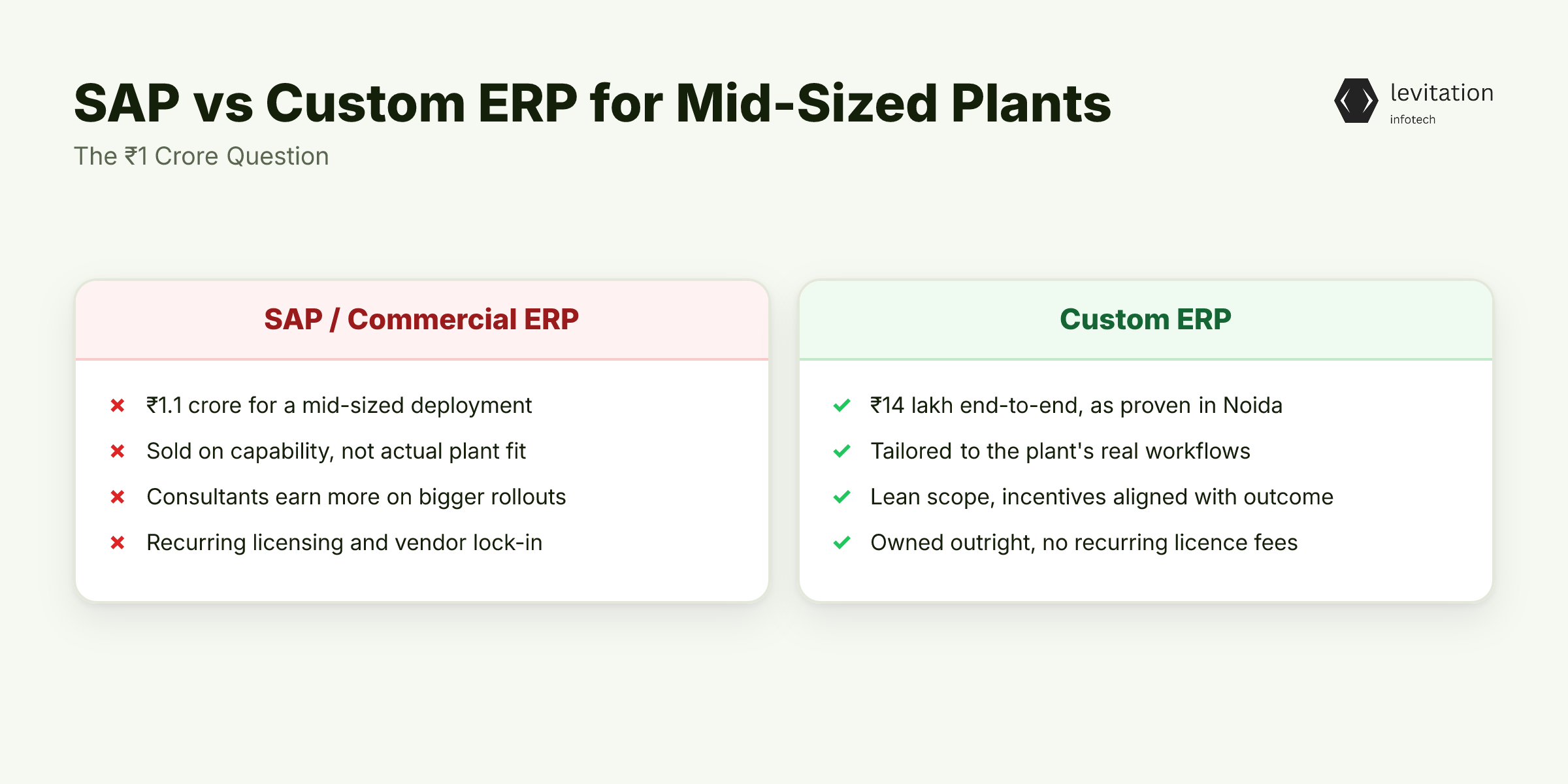
A Noida plant manager just proved that SAP's ₹1.1 crore price tag is a choice, not a necessity. Here is the math his plant ran. Here is why mid-sized manufacturers across India keep overpaying for software they never fully use.
Most plant heads inherit a default assumption: serious manufacturing runs on SAP. The belief gets reinforced by consultants, sales decks, and peer pressure from larger competitors. The procurement pattern that follows looks more like groupthink than software selection.
One Noida-based plant did the opposite. It commissioned a custom ERP for ₹14 lakh. It watched the system beat a comparable SAP deployment that would have cost ₹1.1 crore.
The research is clear: tailored solutions for mid-sized Indian plants beat commercial ERPs on cost-efficiency. The gap often reaches nearly an order of magnitude.
Indian implementation costs for commercial ERPs run from ₹60,000 at the low end to ₹20 lakh at the high end. The documented Noida case hit ₹1.1 crore for a full mid-sized deployment.
The reason mid-sized plants land closer to the top is structural. SAP and similar platforms sell on capability, not fit. Consultants also earn more from bigger deployments than smaller ones.
Plant heads who skip the comparison step end up paying for a brand rather than a system. For a deeper breakdown of where Indian ERP budgets actually go, see our ERP implementation cost in India analysis.
But if the cost gap is this obvious, why do plant managers keep signing the cheque?
Where the ₹96 Lakh Difference Actually Disappears
The answer sits inside the cost structure of a commercial ERP sale. Five line items eat the budget. Most of them stay invisible until the contract is signed.
First, per-user licensing. SAP charges by named user or professional user. The price scales with headcount rather than usage.
A 200-person plant can burn lakhs on licenses alone before any module is configured.
Second, consultant days. SAP implementation partners bill thousands per consultant-day depending on seniority. A nine-month rollout with multiple consultants costs more than the software license itself.
Third, integration with legacy shop-floor systems. MES platforms, SCADA, PLCs, and weighing systems rarely speak SAP's language. Middleware and custom connectors add months of effort and lakhs in fees.
Fourth, training. SAP's UI is famously unintuitive for floor staff. A typical mid-sized plant spends weeks training operators. Most operators then revert to Excel and WhatsApp within a quarter.
Fifth, scope creep. Consultants sell "growth modules" you will never use. Plant heads pay for most of the capabilities they will never touch because the pitch is framed as future-proofing.
The implementation timeline compounds the cost. Pre-built Indian manufacturing workflows compress rollouts from 9-12 months to 2-4 months, but only when the vendor is honest about scope. The plant must also be honest about what it needs.
Most SAP engagements run the full nine to twelve months. The discovery phase keeps uncovering "essential" modules.
Mid-sized manufacturers (50-500 employee plants) are the worst-hit segment. They are too big for SMB tools like Tally's manufacturing module or Zoho Inventory. They are too small to absorb SAP's overhead.
Vendors that target this segment solve the licensing problem but create a different one: limited manufacturing depth. Our post on why Noida founders are replacing Odoo with custom ERP documents this pattern. Many plants have already outgrown Zoho. For a fuller picture of where Indian ERP budgets actually go, revisit the ERP implementation cost in India breakdown.
So what does that ₹14 lakh custom ERP actually include that makes it competitive with SAP's production-grade features?
What a ₹14 Lakh Custom ERP Actually Delivers
The deliverable list is not a stripped-down version of SAP. It is a focused system built for one plant's actual process flow.
A well-scoped custom build covers MRP (material requirements planning), production scheduling, BOM and routing management, and shop-floor data capture. It also covers inventory and warehouse control, purchase and supplier workflows, and quality management with batch traceability for regulated plants.
PLM and supply chain modules round out the manufacturing stack.
The India-compliance edge is where the cost math shifts hardest. Built-in GST, TDS, e-invoicing, and sector-specific regulations save ₹5-15 lakh versus retrofitting SAP's global templates to Indian requirements. Global tools need India-specific modifications. A custom build starts India-ready.
Customization is not a feature here. It is the point. A custom ERP molds to your plant's process flow instead of forcing your team to follow SAP's logic.
Operators stop working around the system and start working inside it. The plant manager's clipboard becomes a tablet. The daily report stops being typed twice.
Dashboards come configured to your plant's KPIs: OEE, downtime per line, scrap rate, dispatch SLA. Generic SAP templates force every plant into the same reporting framework regardless of what actually drives margin.
A custom system puts the data the plant head actually needs on the home screen, not buried three menus deep.
The custom-build advantage shows up clearly when a new regulatory requirement lands. SAP plants wait for the next release and pay for the upgrade. Custom plants ship the change themselves in days. The deliverable list looks strong on paper, but the real question every plant CFO asks next is the total cost of ownership over five years. For a closer look at how custom builds are scoped and delivered, see our guide on ERP software development.
The TCO Comparison Plant CFOs Should Run First
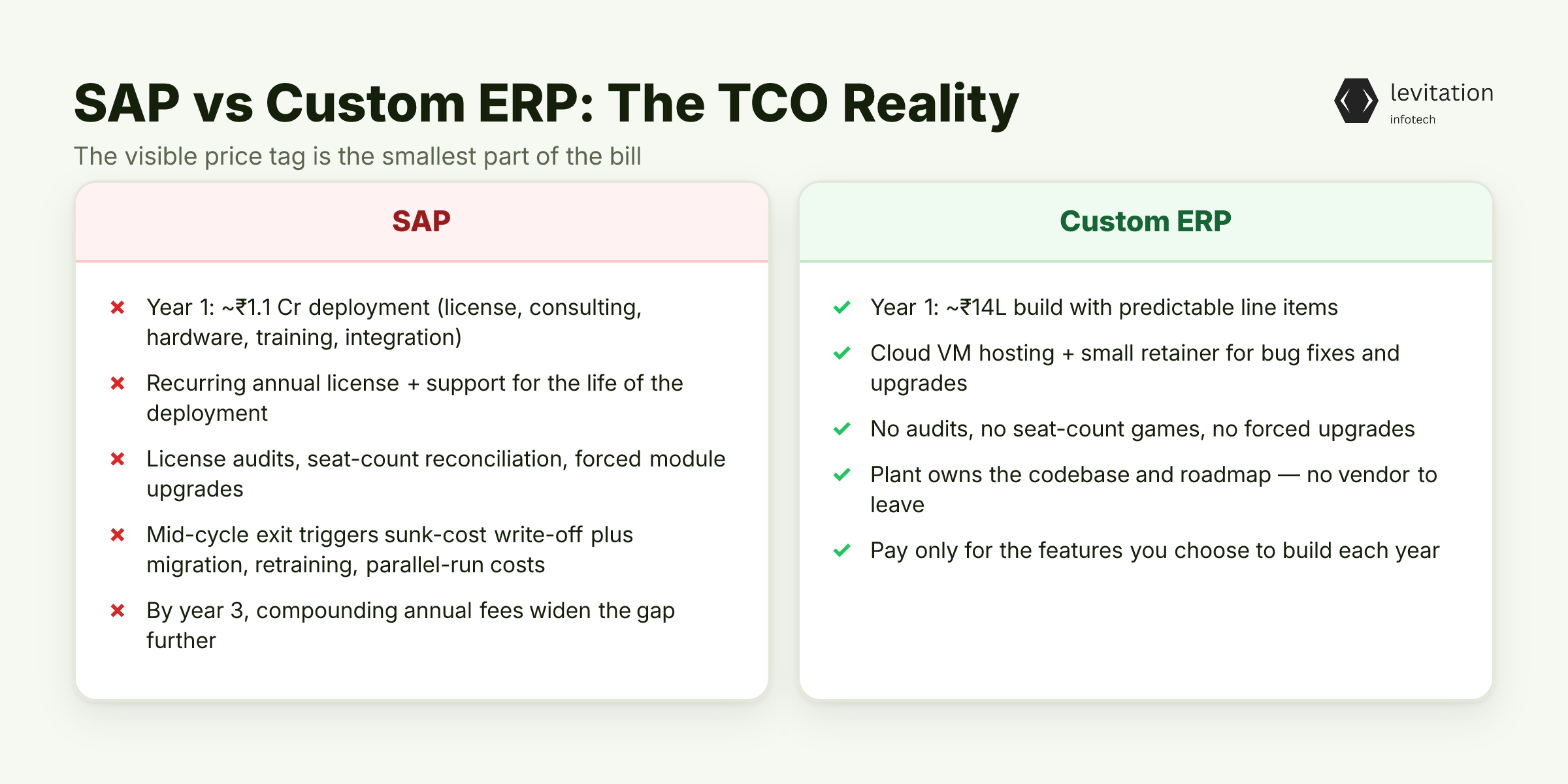
Year one is where SAP's sticker shock lives. Licensing, consulting, hardware, training, and integration add up fast. A ₹1.1 crore deployment is the visible number. The hidden cost is the recurring bill that starts in year two.
SAP's annual license and support model recurs every year for the life of the deployment. That is not a one-time setup fee. It is a structural drain on plant margins, baked into the commercial model.
The ₹14 lakh custom build, by contrast, has predictable costs. Hosting on a cloud VM, a small retainer for bug fixes, and an upgrade budget for year two or three cover most of the predictable expenses. Workflows need refreshing periodically, and the budget covers that.
No license audits. No seat-count reconciliation. No forced module upgrades.
By year three, the gap widens. SAP plants pay recurring license and support fees on top of any new feature work. Custom plants pay only what they choose to build. The compounding effect of even a modest annual percentage adds up to a large sum over five years.
The switching cost trap is real. Plants that leave SAP mid-cycle write off a large share of their sunk cost. They discover the data migration, retraining, and parallel-run expenses they underestimated.
Custom ERP avoids this trap because the plant owns the codebase and the roadmap. There is no vendor to leave.
For plant heads weighing this decision, the math is the math. The remaining question is execution. Can a plant head actually deliver a custom build without the SAP partner ecosystem collapsing the timeline? Our deeper guide on ERP software development walks through what to look for.
Building Custom ERP Without the SAP-Sized Headaches
The custom build breaks into four phases. Plant heads who understand the structure can hold vendors accountable instead of getting steamrolled by scope creep.
Phase one: process mapping (two weeks). Walk the shop floor, document every handoff, and capture the spreadsheets operators actually use. Map the real workflow, not the official one.
This is the most underestimated phase. Skip it and every later phase bleeds.
Phase two: module development (six to eight weeks). Build MRP, production planning, inventory, and quality modules against the process map. A typical stack here is Node.js or Python on the backend, PostgreSQL for the data layer, and React for the operator-facing UI. REST APIs handle equipment integration.
Phase three: integration with MES and shop-floor IoT (two to three weeks). Pull data from PLCs, SCADA, weighing systems, and existing MES platforms via standard industrial protocols.
This is where customization actually wins: integrations are designed for your specific equipment stack instead of requiring expensive middleware.
Phase four: UAT and rollout (two to four weeks). Phased go-live by line or shift, with rollback plans for each cutover. Avoid the big-bang launch that has killed more ERP projects than bad code ever has.
The make-or-buy hybrid matters more than most vendors admit. Many plants use ERPNext or Odoo as a base and customize the manufacturing layer. This can cut the ₹14 lakh figure further for plants with straightforward workflows.
The trade-off is vendor lock-in to the base platform's upgrade cycle. That is why the modular extension principle matters so much. Plant managers who skip this lesson end up running frozen versions of their base platform out of upgrade fear. Our ERP software development guide unpacks this pattern in detail.
One principle saves years of pain: never hack the core. Always build modular extensions. When the upstream platform releases an update, your customizations stay intact instead of breaking every integration you depend on.
So what actually changes on the plant floor when the ERP finally fits the operation instead of the other way around?
Five Years Later: What Changes When the ERP Finally Fits
The operational outcomes show up in the first quarter, not the fifth year.
Manual reconciliation drops. The plant stops running two systems (ERP plus spreadsheets) when the ERP speaks the language operators already use. Month-end close compresses because data is captured at the source instead of re-entered three times.
Real-time production visibility replaces the daily report lag. The plant head sees OEE, downtime, and dispatch status on a single dashboard, not in a WhatsApp group at 7 PM. Floor staff stop being the bottleneck for information the system should surface automatically.
The strategic shift matters more than the operational one. A system the plant owns means the roadmap answers to operations, not to a vendor's quarterly earnings call. When a new line goes in, the ERP extends. When regulations change, the ERP adapts.
No change order. No licensing renegotiation. No waiting for SAP's next release window.
The structural advantage applies to any single-plant operation weighing the same switch, since the economics that drove the Noida decision generalize across similar plants. Software should fit the plant. The plant should not contort itself to fit software that was designed for a different scale.
Teams with production experience delivering custom manufacturing platforms can hit the timelines described here.
Frequently Asked Questions
Q: Is a custom ERP really cheaper than SAP for a mid-sized Indian manufacturing plant?
For plants with 50-500 employees and a focused product line, yes. The documented Noida case shows a custom build at ₹14 lakh outperforming a comparable SAP deployment at ₹1.1 crore once licensing, consulting, and customization were tallied.
The gap widens every year. SAP's recurring license and support fees compound, while custom systems have predictable hosting and support costs.
Q: What manufacturing modules should a custom ERP include?
At minimum: MRP (material requirements planning), production scheduling, quality management, BOM and routing, shop-floor data capture, inventory and warehouse control, purchase and supplier management, and GST-compliant finance.
Plants in regulated sectors (pharma, chemicals, food) should also add batch traceability and e-signature workflows.
Q: How long does it take to build and deploy a custom ERP for a plant?
For a focused mid-sized plant, expect 2-4 months from kickoff to go-live. The pre-built Indian manufacturing workflow timeline breaks down as: two weeks for process mapping, six to eight weeks for module development, two to three weeks for MES and equipment integration, and two to four weeks for UAT and phased rollout.
Q: When does SAP actually make sense over a custom ERP?
SAP is the right call for multi-plant enterprises (5+ facilities), companies preparing for IPO or acquisition where SAP's brand carries audit weight, and businesses with deep in-house SAP talent.
For a single plant with stable processes and a clear roadmap, custom ERP delivers better ROI with less organizational drag.
Q: Can a custom ERP integrate with existing shop-floor equipment and MES?
Yes. A well-built custom ERP uses REST APIs and standard industrial protocols like OPC-UA to pull data from PLCs, SCADA systems, and existing MES platforms.
This is where customization actually wins over SAP: integrations are designed for your specific equipment stack instead of requiring expensive middleware. For more on how Indian plants are sizing these costs, see our ERP implementation cost in India analysis.
Sources
Research and references cited in this article:
- Manufacturing ERP 2026 — Best for Production & Inventory
- Best ERP Software for Manufacturing in 2026 (Top 5 Compared)
- ERP for Manufacturing Systems - Complete 2026 Guide - MIE Solutions
- Why These are the Top 10 Manufacturing ERP Systems for 2026
- Best ERP Software for Small & Medium Manufacturers in India
- Oracle vs SAP for Manufacturing | ERP Research
- ERP Systems: A Comprehensive Cost Breakdown and Analysis | Houseblend
- ERP Implementation Cost Calculator | 2026 Pricing Guide
- ERP Software Comparison | 2026 Pricing, Features & More
- Manufacturers Can Budget For ERP Costs | Rea Business Advisors
- 8 Real-life Examples of How Manufacturing ERP Helped Businesses - ERP Cloud Blog
- Companies Using ERP: Case Studies | QAD Blog
About the author
Mayank Singh is a software developer at Levitation Infotech, where he builds web and AI-powered applications across the company’s fintech, healthcare, and enterprise projects.