


Every ISO 27001 vendor quotes you the audit fee. Almost none quote you the readiness bill, which lands 4x higher and far earlier. The ₹6 lakh figure is the line item founders budget for. The ₹25 lakh figure is the line item that kills the budget.
TL;DR: ISO 27001 audit fees in India run ₹6-15 lakh, but the audit is the cheapest part of certification. The real cost is the readiness work, which typically runs several times the audit fee. Founders who understand this gap, scope ruthlessly, and externalize program ownership can compress certification timelines and land at a predictable cost instead of a budget-breaking DIY build.
Key Takeaways: - The audit is a brief verification event. Readiness is the longer program that comes before it. - True all-in cost ranges from ₹4-12 lakh for small startups to ₹41-82 lakh for multi-site enterprises. - Focused deployments with external ownership compress certification timelines versus in-house builds. - Scope discipline, template-first design, and a vCISO are the levers that compress both bill and timeline.
The ₹6 Lakh Audit Is a Distraction
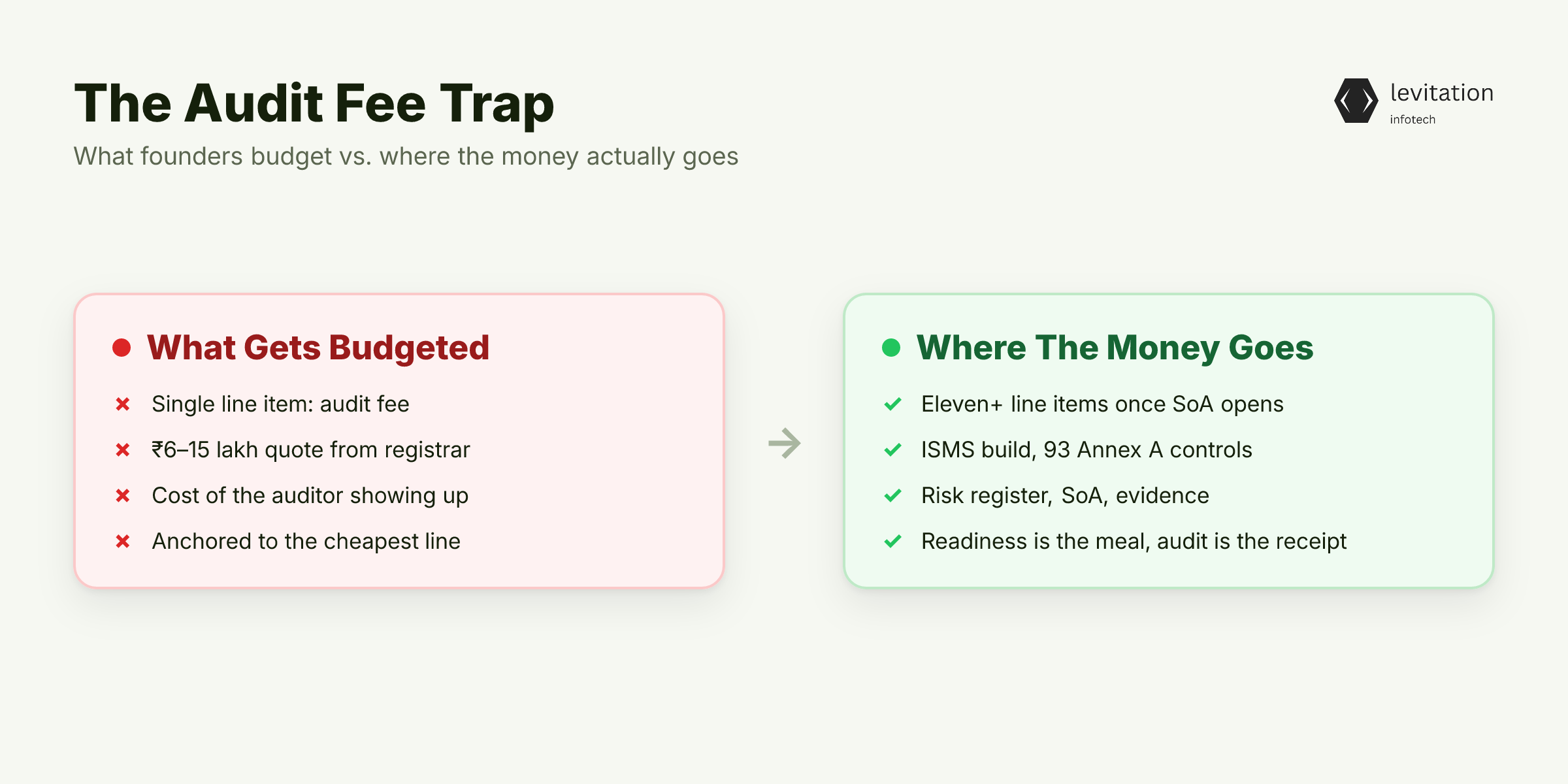
Certification bodies quote audit fees in the ₹6-15 lakh band because that's their revenue line, not yours. When a founder calls a registrar for a quote, they get a number tied to audit days. That number is the cost of the auditor showing up. It is not the cost of being ready for the auditor.
Here's the part that surprises founders. The audit is a short verification at the end of a much longer readiness project. The bulk of the timeline is readiness. That's the work of building your Information Security Management System. Document 93 Annex A controls, run a risk register, write a Statement of Applicability, and collect evidence. The audit is the receipt. Readiness is the meal.
Founder budgeting starts and stops at the audit number. The spreadsheet has one line. Then a consultant opens a SoA template and the spreadsheet gets eleven more lines. The day that happens, the budget collapses.
The cheapest line on the quote is the one every founder anchors to. That's the trap. For a complete breakdown of the numbers in the Indian market, see our iso 27001 implementation cost india guide. So if the audit is the cheap part, where does the other nineteen lakh actually go?
Why Readiness Eats Four Times the Audit Budget
Readiness is a long program of work disguised as a one-time project. The deliverable list reads like a small company's annual operating plan. Risk register, SoA, 93 Annex A controls, evidence collection, internal audits, management review, a full staff awareness cycle. Each item has dependencies. Most have to be redone after the first internal audit finds gaps.
The DIY path fails for a specific reason. No founder has forty hours a week to write a risk treatment methodology while running the company. ISMS work competes with every sprint planning meeting. It loses every time. Long before the audit window, the founder is staring at a half-built risk register and a sales call that needs the certificate yesterday.
Cheap consultants fail differently. They hand you a template set and disappear. The templates are fine, but putting them to work so an auditor's sample tests pass sits with your team.
Most founders don't know what "evidence" means until the auditor asks for it and the file is empty. A proper iso 27001 readiness assessment covers this gap, but only if someone actually runs it.
The structural fact is simple: readiness is a long program, the audit is a short one. That explains the cost gap. The invoice itself needs its own breakdown.
Where the ₹25 Lakh Actually Goes
Four line items make up nearly every readiness bill. The categories don't change by company, even if the balance does. - Consultancy and gap analysis: Human hours are still the dominant cost. Someone has to map your systems to the standard, run risk workshops, and translate auditor findings into a fix list. This is the line founders try to compress and regret. - Tooling: GRC platforms, SIEM, endpoint, DLP, and access reviews. Most founders cut this line first. The cut usually comes back during the certification audit, when the auditor asks for access review logs and you don't have any. Tooling is what makes evidence collection cheap. Without it, you pay in consultant hours. - Training: Lead auditor courses run ₹15,000 to ₹45,000 per person in India. Staff awareness training is rarely itemised but always required. If your engineers don't know what a phishing simulation is, the auditor will notice. - Internal labour cost: The line item nobody quotes you. Once you add founder and engineering hours diverted from product work, this is often the largest line on the real bill. Most founder-led ISMS projects underestimate how much product engineering time gets consumed.
Those ratios shift depending on whether you have fifty employees or five hundred. The real driver is scope, not headcount.
Sizing Your Real Budget by Team Size
Band your budget by the number of distinct systems, vendors, and locations inside scope. Headcount is a rough proxy. Scope is the real driver. - Small firms (under 50 staff): ₹4-12 lakh all-in. The bill is dominated by consultancy hours and one GRC tool. If you stay disciplined, you can land here. - Mid-sized (50-500): ₹12-35 lakh. This is the band where most quoted ₹25 lakh readiness bills land. Multiple product lines, multiple customer environments, and a real access management problem. The audit fee is the smallest line on the invoice. - Large multi-site (500+): ₹41-82 lakh. Scope expansion across entities and geographies drives this. Every new site adds a separate physical security assessment, separate access control evidence, and a longer audit. Auditors charge by man-day, and multi-site audits burn days fast.
The cost is not linear with headcount. A fifty-person company with three cloud accounts, four vendors handling PII, and two office locations costs more to certify than a two-hundred-person company with one product and one location. For more on the mechanics, see isms implementation cost breakdowns by scenario.
Knowing your band does not cut the band. Here is what does.
How Founders Cut the Bill Without Buying a Cheap Audit
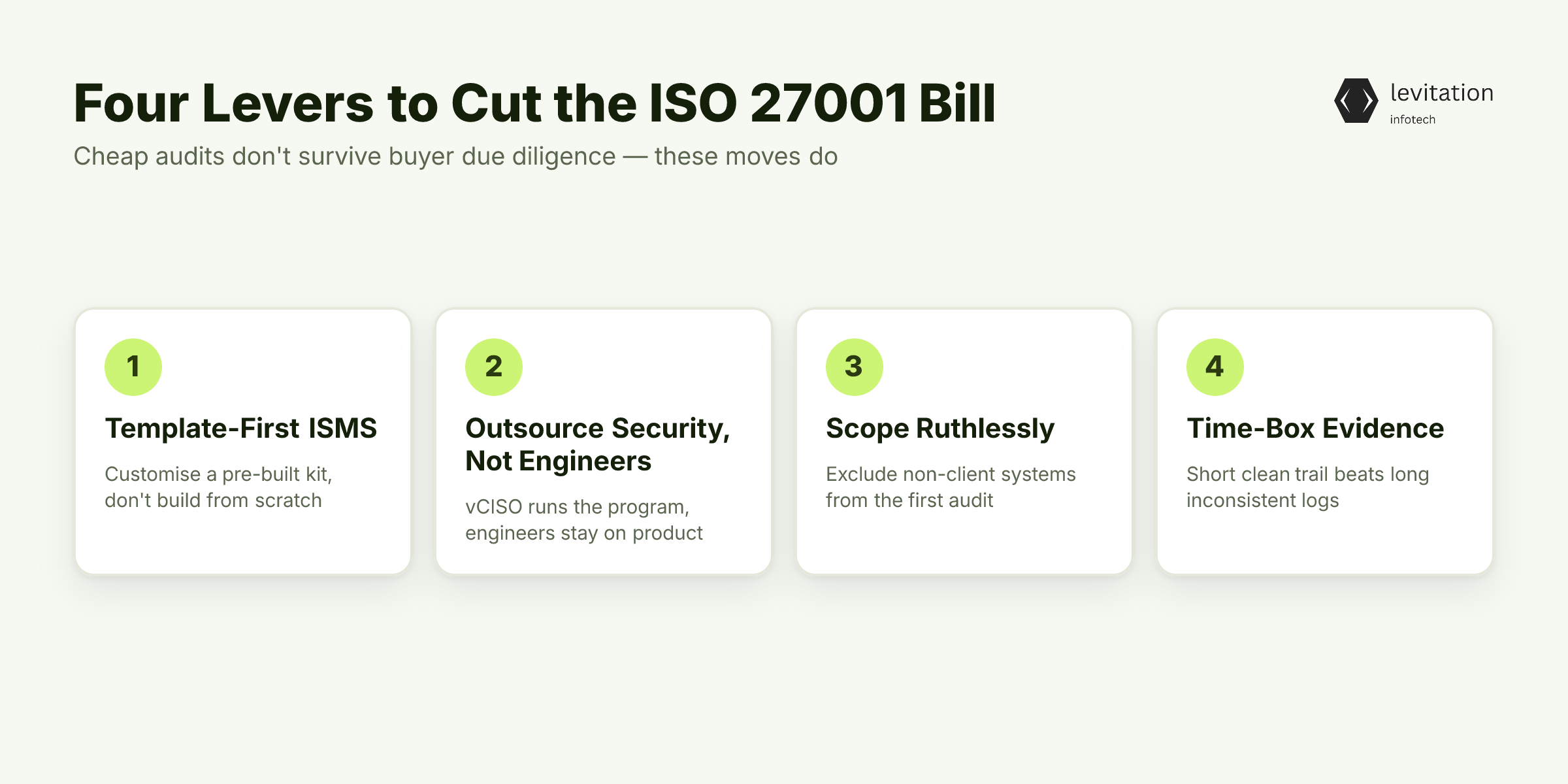
Four levers work. Buying a cheap audit is not one of them. A cheap audit gives you a certificate that doesn't survive a buyer's due diligence call. - Template-first: Start from a pre-built ISMS kit (policies, SoA, risk register) and pay consultants to customise, not create. Building from scratch is the single biggest reason readiness projects run far longer than they need to. Templates compress the initial setup into days rather than months. - Outsource the security function, not the project: Retain a vCISO who runs the program while your engineers stay on product. Your engineers should be reviewing access logs, not writing risk treatment plans. A vCISO costs a fraction of a full-time CISO and owns the timeline instead of competing with it. For related thinking on access control architecture, see why fintech AI needs granular access control. - Scope ruthlessly: Exclude production systems that hold no client data from the first audit. Expand scope at surveillance. Most founders include everything because they don't know what's auditable and what isn't. The auditor doesn't care about your internal wiki. They care about systems that touch customer data. - Time-box evidence collection: A short, clean trail of artefacts beats a long trail of inconsistent logs. Auditors sample. Consistency and completeness matter more than sheer volume of records.
These moves don't just cut the bill. They cut the timeline. Speed is the other lever, and it changes the cost model completely.
The Focused Path That Beats an In-House Build
An in-house build stretches because engineers are pulled back to feature work every sprint. ISMS work has no customer pulling for it, so it loses every planning meeting. By the time the audit window approaches, the risk register is stale. The SoA references systems that no longer exist, and the auditor is going to notice.
A focused deployment, where ownership sits outside the engineering team, compresses the timeline at a predictable fixed cost. The difference is accountability. Whoever owns the ISMS owns the timeline. When ownership is diffuse, the timeline drifts. When one person or one external team is accountable, the timeline holds.
The trade-off is not quality. A focused deployment produces a more consistent ISMS because it has fewer context switches. The trade-off is internal learning.
Your team will not become ISO 27001 experts. They will become operators of a system someone else built and documented. For most funded startups, that is the right trade.
For founders, predictable cost plus predictable date matters more than the theoretical saving of doing it yourself. The certificate has a sale attached to it.
Every month of delay is a month of deferred revenue. The remaining question is what the certificate actually buys you.
What ISO 27001 Certification Unlocks in India
BFSI and enterprise RFPs in India routinely disqualify vendors without an active ISO 27001 certificate. Certification is a gate, not a differentiator. Without the certificate, your proposal gets screened out before anyone reads the technical answer.
With it, you enter the shortlist.
For fintech founders, the certificate shortens bank partnership cycles. Partner banks can rely on your ISMS instead of running their own vendor assessment. The time saved on security questionnaires compresses each bank relationship, compounding across partnerships.
Global enterprise buyers treat the certificate as a baseline. Without it, you do not enter the procurement funnel at all. With it, you enter the same funnel as every other vendor.
The certificate does not win you the deal. It gets you to the deal. For a comparison with SOC 2 and why some Indian SaaS founders end up buying the wrong one, see why Indian SaaS founders buy SOC 2 when buyers want ISO 27001.
At Levitation, we've shipped security-critical systems for 39+ banks. ISO 27001 readiness is rarely the bottleneck once you commit to a real program. The bottleneck is the founder's belief that the audit is the work.
It is not. The work is everything before the audit.
Frequently Asked Questions
Q: How much does ISO 27001 certification actually cost in India for a small startup?
A: For a startup under 50 people with a single product, the all-in cost typically lands between ₹4 lakh and ₹12 lakh, including consultancy, a GRC tool, and the certification audit. The audit itself is usually the smallest line item, starting around ₹6 lakh.
Q: Why is ISO 27001 readiness more expensive than the audit?
A: Readiness covers the program of work to build the ISMS: risk register, Statement of Applicability, 93 Annex A controls, evidence, internal audits, and management review. The certification audit is a short verification event at the end. Readiness is the product. The audit is the receipt.
Q: Can we get ISO 27001 certified without hiring a consultant?
A: Yes, but it is rare for funded startups. A founder-led DIY path stretches across multiple budget cycles because feature work keeps pre-empting ISMS work. Most teams either hire a consultant for the heavy lifting or retain a virtual CISO to run the program part-time.
Q: How long does ISO 27001 implementation take in practice?
A: A focused deployment with external ownership, template-first approach, and scoped audits compresses certification timelines. The gap is almost entirely about whose calendar owns the project and how the readiness work competes with product priorities.
Q: What is included in the ISO 27001 readiness cost?
A: Readiness cost covers gap analysis, ISMS design (policies, SoA, risk register), Annex A control implementation, evidence collection, internal audit, management review, and the staff awareness training cycle. The certification audit fee is billed separately by the certification body.
Sources
Research and references cited in this article:
- ISO 27001 Certification Cost 2026
- ISO 27001 Certification in India (2026): Cost, Process & Benefits Guide
- Top 12 ISO 27001 Certified Pentest Companies in India 2026
- ISO 27001 Audit Blueprint: Exact Costs & Timelines for 2026
- ISO 27001 Certification India: Cost & Process
- ISO 27001 Certification India 2026: Cost & Process | TCSA
- ISO 27001 Certification Cost in India: 2026 Guide Explained
- Understanding ISO 27001 Certification Cost in India for 2026
- Future of ISO and IT Compliance in India for Digital Businesses
- ISO 27001 for Small Businesses: Complete Implementation Guide for 2026
- ISO 27001 Cost Breakdown for Small to Medium-Sized Businesses
- The Challenges of Adopting ISO 27001 Controls: A Comprehensive Guide for CISOs and IT Administrators
About the author
Mayank Singh is a software developer at Levitation Infotech, where he builds web and AI-powered applications across the company’s fintech, healthcare, and enterprise projects.