


TL;DR: Chatbot quotes ranging from ₹30,000 to ₹8,00,000 both miss the real budget. Vendors price features, not outcomes. Almost nobody prices the data layer honestly. The fix is a 10-question framework that forces every line item onto the table. Training data, integrations, fallback, retraining, and usage-based fees all need a number before a single rupee changes hands.
Key Takeaways: - A ₹30K quote and an ₹8L quote are usually answering different questions. That is why comparing them is pointless. - Training data and conversation logs are most of the real build cost, yet they almost never appear in vendor quotes. - The right tier is set by conversation volume, integration depth, and whether the bot must learn, not by features on a wishlist.
The ₹30K and ₹8 Lakh Paradox: Why Both Numbers Miss
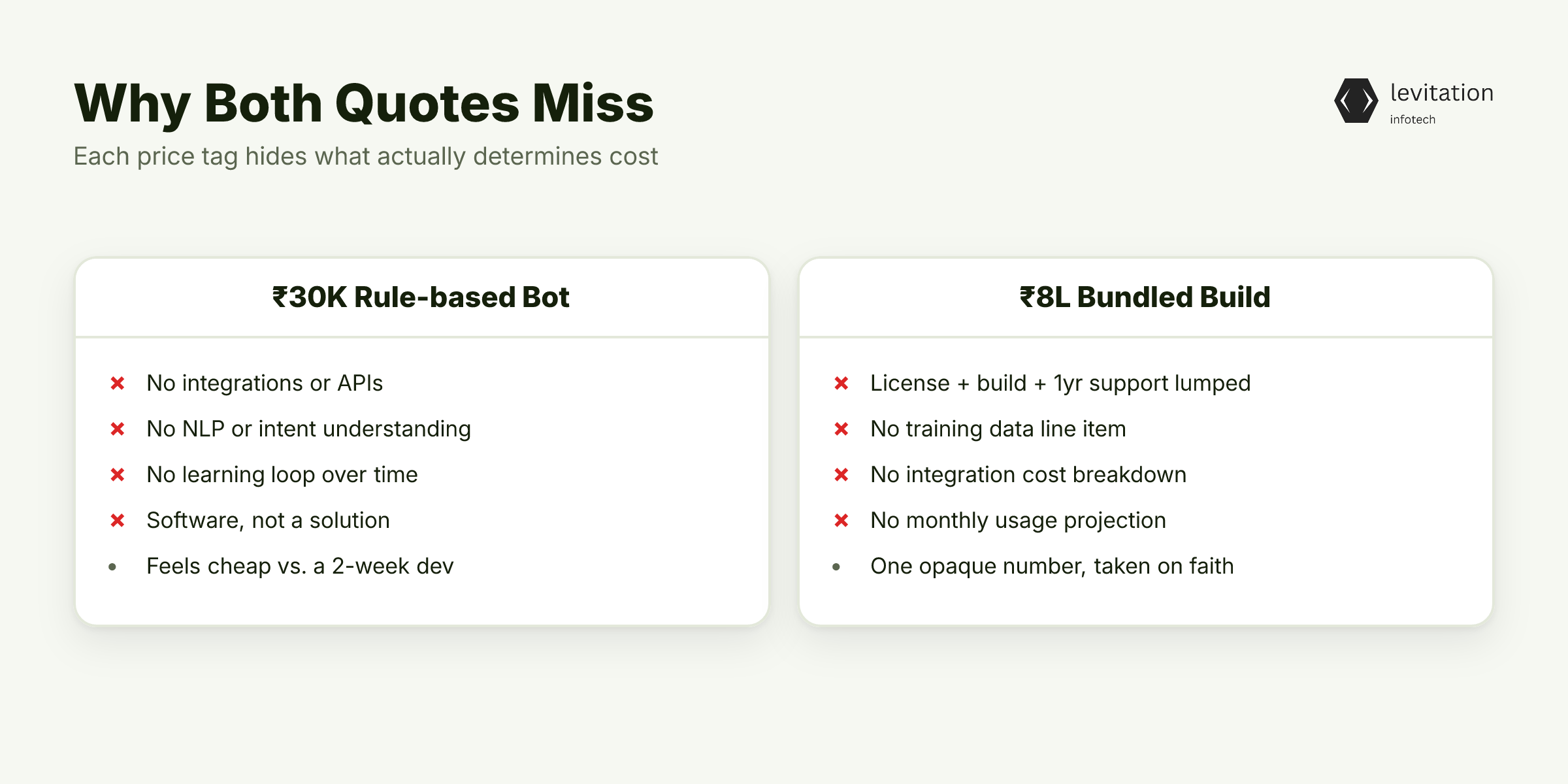
A ₹30K quote almost always means a rule-based FAQ bot. No integrations. No NLP. No learning loop. The vendor is quoting for software, not for a solution. The number feels like a deal because the founder compares it to a developer for two weeks. It wins.
An ₹8L quote bundles a license fee, a custom build, and one year of support into a single line item. It hides what actually costs what. There is no breakdown of training data work. No separate column for integrations. No monthly usage projection. The founder sees one number and has to take it on faith.
Both quotes share the same flaw. They price features, not outcomes, and leave out the variable that determines whether the project works. The founder has no way to compare them on equal terms. The data layer is what makes or breaks a bot. This is why ai chatbot development cost in India guides that quote features without asking about your data miss the point.
The market-wide confusion around chatbot development cost is a scoping problem. It starts before the founder ever speaks to a developer. What trap breaks the first realistic estimate?
The Training Data Trap That Breaks Every Initial Estimate
Most founders assume the bot costs money and the data is free. It is the reverse. The dataset drives the bulk of the real build cost. Curated conversation logs, intent taxonomies, edge-case examples, and domain vocabulary all need work. The model is a commodity. Your data is the moat.
A custom AI chatbot needs more than transcripts. It needs labelled examples of what users actually ask. The language and slang they use must map to the intents your business can act on. Without that, accuracy collapses no matter how good the model is. The bot hallucinates and hands off to a human too often. It quietly erodes the customer experience you were trying to fix.
Pre-built platforms can be 40-60% cheaper than custom builds. They shift the data burden to you and lock you into their taxonomy. You save on the build and pay for it in lost flexibility and per-seat fees.
The pattern repeats across deployments. Teams that scope data readiness before quoting a line of code ship bots that work. Teams that quote first discover the data problem at month three. By then the budget is already spent.
The full picture of conversational AI cost only makes sense once you treat data as a first-class deliverable, not a free input. What are the real budget tiers, and which one does your startup belong in? For a parallel look at agent systems, see the ₹5 lakh AI agent quote hiding a ₹9 lakh bill breakdown.
Three Real Budget Tiers (And What Actually Determines Yours)
Indian chatbot projects cluster into three honest budget tiers. Which one you belong to is not a function of features. It is set by conversation volume, integration depth, and whether the bot needs to learn.
Tier 1 - Rule-based FAQ deflection. ₹30K-₹1.5L first-year all-in. No NLP, no learning loop, no real analytics. Payback in 30-60 days if query volume is high and questions repeat. This is a ticket-shield, not a chatbot. The cost to build a chatbot at this tier is genuinely low, if the use case is genuinely simple.
Tier 2 - NLP plus CRM integration plus multilingual. ₹3-12L first-year all-in. This is where most Indian startups should budget. The bot understands intent, pulls customer context from your CRM, and hands off cleanly to a human when stuck. It improves month over month.
Tier 2 projects silently escalate into Tier 3 budgets when scope is left vague. "Learning" turns into unbounded retraining work.
Tier 3 - Multi-channel enterprise conversational AI. ₹15-60L first-year all-in. Justified only with sustained high conversation volume. Multi-language requirements, deep ERP or compliance integrations, or strict uptime SLAs also count. An experienced ai development company will tell you this tier is overkill for 90% of startups who think they need it.
The trap is treating Tier 1 as a starter kit. You cannot upgrade later for the price difference. Data architecture, integration design, and evaluation frameworks all change between tiers. What does the ₹30K quote actually leave out, and why does "cheap" end up costing more?
What's Hiding Inside a ₹30K Quote (And Why It Costs 5x More)
A ₹30K bot usually ships with a small number of conversation flows. No analytics dashboard. No fallback routing to human agents. No retraining loop. Every month you operate it, the cost compounds in ways the quote never mentioned. - Hourly rates in India run $20-60. A "cheap" bot that needs post-launch work quickly becomes a project whose true cost the ₹30K quote never named. - WhatsApp deployments look low at quote stage. The WhatsApp chatbot cost adds Meta-approved BSP fees, per-conversation charges that differ between user-initiated and business-initiated messages, and template message costs that scale with volume. - Hosting, LLM API calls, and storage for conversation logs are recurring costs. No one prices them in the headline number. - When the bot fails and customers churn to a competitor, the loss is silent. It never gets billed back to the vendor.
The ₹30K quote is not a discount. It is a down payment on a project whose total cost nobody is willing to name.
Scoped custom AI development work beats surprise upgrades every time. How do you force a vendor to expose those line items?
The 10-Question Budget Framework Founders Actually Need
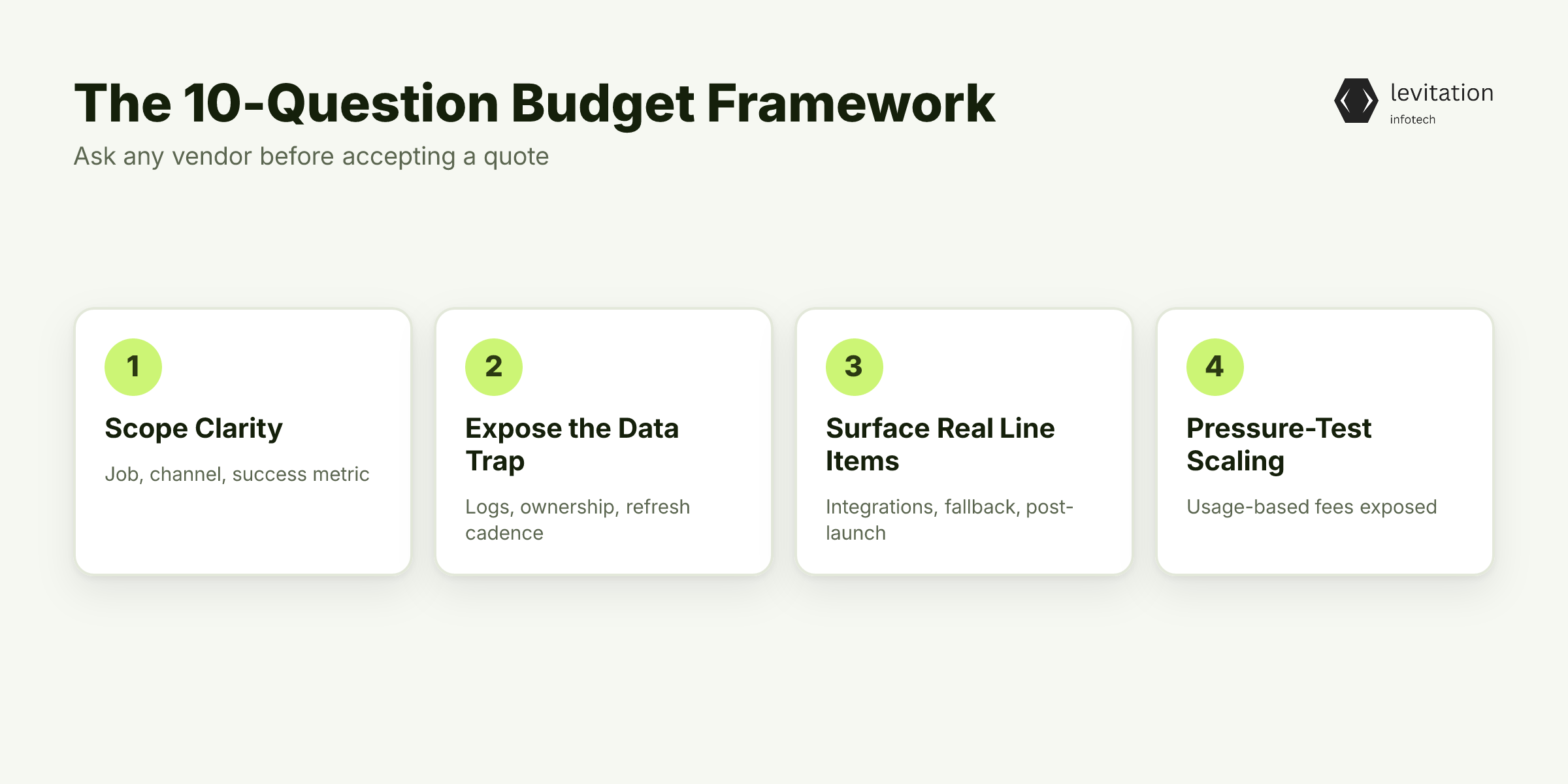
Use these ten questions before you accept any quote. Any vendor who cannot answer them on the spot is not quoting. They are guessing.
Questions 1-3 force scope clarity.
- What is the bot's single job? Pick one. "Handle support" is not an answer.
- Which channel does it live on? Web, WhatsApp, app, or voice. Each has different cost.
- What is the success metric at 90 days? Deflection rate, CSAT, or AHT. If they cannot name it, they cannot measure it.
Questions 4-6 expose the data trap.
- How many real conversation examples do you have from production?
- Who owns the conversation logs, and can the vendor use them for training?
- What is the refresh cadence: monthly, quarterly, or never?
Questions 7-9 surface the real line items.
- Which systems does the bot integrate with, and who owns that work?
- What happens when the bot does not know the answer? Fallback to human is not free.
- Who owns analytics, retraining, and model evaluation after launch, and at what cost?
Question 10 is the one vendors hate.
- What does the project cost if my monthly conversations triple in six months?
This last question forces the vendor to expose usage-based fees, scaling assumptions, and retraining triggers. The AI consulting work that goes into answering it well is where the real cost lives. A vendor who answers these ten questions is quoting a project. A vendor who rewrites the spec in their head while you ask them is selling you software.
For a complementary angle on the same trap in agent-based systems, see the AI agent cost guide. The mechanics are nearly identical. You can also sanity-check any chatbot price you receive against this framework before signing.
Red Flags in Any Chatbot Quote - Indian Market Edition
Three patterns predict a 3x budget overrun. None of them are subtle. - A quote that does not break out training data, integrations, and post-launch support into separate line items is hiding the real risk. Lump-sum quotes look professional. They also prevent you from negotiating the line that actually hurts. - Promises of "90% accuracy" without naming the dataset, the intents, or the evaluation set are marketing copy. Accuracy is meaningless without the test set it was measured against. - Vendor willingness to skip a discovery phase and quote in 48 hours is the strongest predictor of a blown budget. Discovery is not a sales tax. It is the only way to expose the data and integration work the quote depends on.
If you see all three, walk away. If you see one, ask for a revised quote. Honest ai solution development takes longer to scope and costs less to deliver. The inverse is also true.
The same lesson shows up in chatbot cost in India trends. The cheapest quotes consistently produce the most expensive projects. When does a real ₹8L quote actually pay back?
When ₹8 Lakh Is the Right Number (And What Changes)
Tier 2 deployments that genuinely cost ₹8L all-in pay back in 8 to 14 months in India. That assumes license, build, and first-year support are bundled honestly. It is faster than the 12-18 month Western benchmarks.
The math works when the scope is honest. The right quote forces a conversation about three things: - Conversation volume: the number the vendor assumes determines hosting, API cost, and retraining frequency. - Fallback rate: the percentage of conversations the bot cannot handle and must hand to a human. - Accuracy benchmarks: measured on a held-out test set, not on cherry-picked demos.
When you can defend those three numbers to a board or co-founder, the ₹8L is justified. When you cannot, the quote is fiction. Honest budgeting is not about finding the lowest number. It is about closing the gap between quote and reality so the project ships. The same drift shows up in ai chatbot cost tracking and enterprise AI development deployments.
If a quote clears every test above, the next step is asking the vendor to put the same line items in writing.
Frequently Asked Questions
How much does it actually cost to build a chatbot in India in 2026?
For a Tier 1 rule-based FAQ bot, budget ₹30K-₹1.5L all-in for the first year. For a Tier 2 NLP-enabled bot with CRM integration and multilingual support, the realistic range is ₹3-12L. Tier 3 enterprise conversational AI runs ₹15-60L first-year all-in. Hourly rates in India sit between $20-60. The final number depends on integration depth and data readiness more than on features.
Why do chatbot quotes vary so wildly between vendors?
Vendors price different things. One quotes a software license, another quotes a custom build, a third quotes a fully managed solution. Without a fixed scope covering channel, integrations, conversation volume, and data ownership, the same brief produces quotes that differ by roughly 25x. The variance is a scoping problem, not a market problem.
Is a ₹30K chatbot worth it for a startup?
Only if your use case is genuinely simple FAQ deflection. Low query complexity and no integration requirements. A ₹30K bot that needs post-launch work, retraining, or WhatsApp BSP fees on top will balloon into a much larger project within six months. Cheap quotes are a filter for simple problems. Using one for a complex problem is the most common reason Indian chatbot projects fail.
How long does it take for a chatbot to pay back in India?
Tier 1 FAQ deflection bots typically pay back in 30-60 days. They replace high-volume repetitive tickets. Tier 2 NLP-driven bots with CRM integration realistically pay back in 8-14 months in India. That is faster than the 12-18 month Western benchmarks, provided the deployment is scoped honestly and not padded with unused features.
What is the WhatsApp chatbot cost in India specifically?
Beyond the build cost, WhatsApp adds Meta-approved BSP fees. Per-conversation charges vary by user-initiated versus business-initiated messages. Template message costs add on top. A WhatsApp bot that looks like a low-five-figure project on quote day can carry heavy per-month usage fees once volume scales. Usage-based pricing needs to be part of the original conversation.
Sources
Research and references cited in this article:
- AI Chatbot Development Cost (2026): Pricing Guide & Factors
- AI Chatbot Development Cost Guide 2026 | Easycomm Innovations
- AI Development Cost 2026 | Chatbot, App & Agent Cost Breakdown
- How Much Does AI Chatbot Development Cost in 2026?
- Chatbot Pricing Based on Real Cases 2026
- AI Chatbot Development Cost: 2026 Price Guide
- AI Chatbot Cost in 2026: Real Numbers From 20+ Builds
- 17+ AI Chatbot Mistakes That Hurt Accuracy, CX & Revenue
- Chatbot Pricing Based on Real Cases 2026
- The In-Depth Chatbot Development Cost Guide for 2026
- AI Chatbot Development: Cost, Timeline & What to Build First
About the author
Mayank Singh is a software developer at Levitation Infotech, where he builds web and AI-powered applications across the company’s fintech, healthcare, and enterprise projects.