


TL;DR: AI agent quotes in India systematically undercount the integration, security, and compliance work. This work is needed to make an agent production-grade. A ₹5 Lakh quote typically covers only the agent core. The rest arrives as change orders once work begins. The fix is a line-item breakdown, a 12-month TCO projection, and fixed-price integration with defined API boundaries.
Key Takeaways: - A ₹5 Lakh quote covers the agent core, not the enterprise environment it must operate inside. - Compliance retrofit alone can add 20-30% to the budget. It is rarely included in initial SOWs. - Hidden costs can double the initial budget before any return is realized. As a result, this pushes the true Year Two cost well past the ₹9 Lakh integration ceiling.
The ₹5 Lakh Quote That Becomes ₹9 Lakh Before Lunch
You signed the SOW at ₹5 Lakh. Three weeks in, your Noida vendor sends a change order. It's for ₹4 Lakh for integration, security retrofit, and audit trails. You didn't know these weren't included. The agent hasn't even touched production data yet.
This isn't a story about dishonest vendors. It's a structural mismatch between what gets priced and what actually ships.
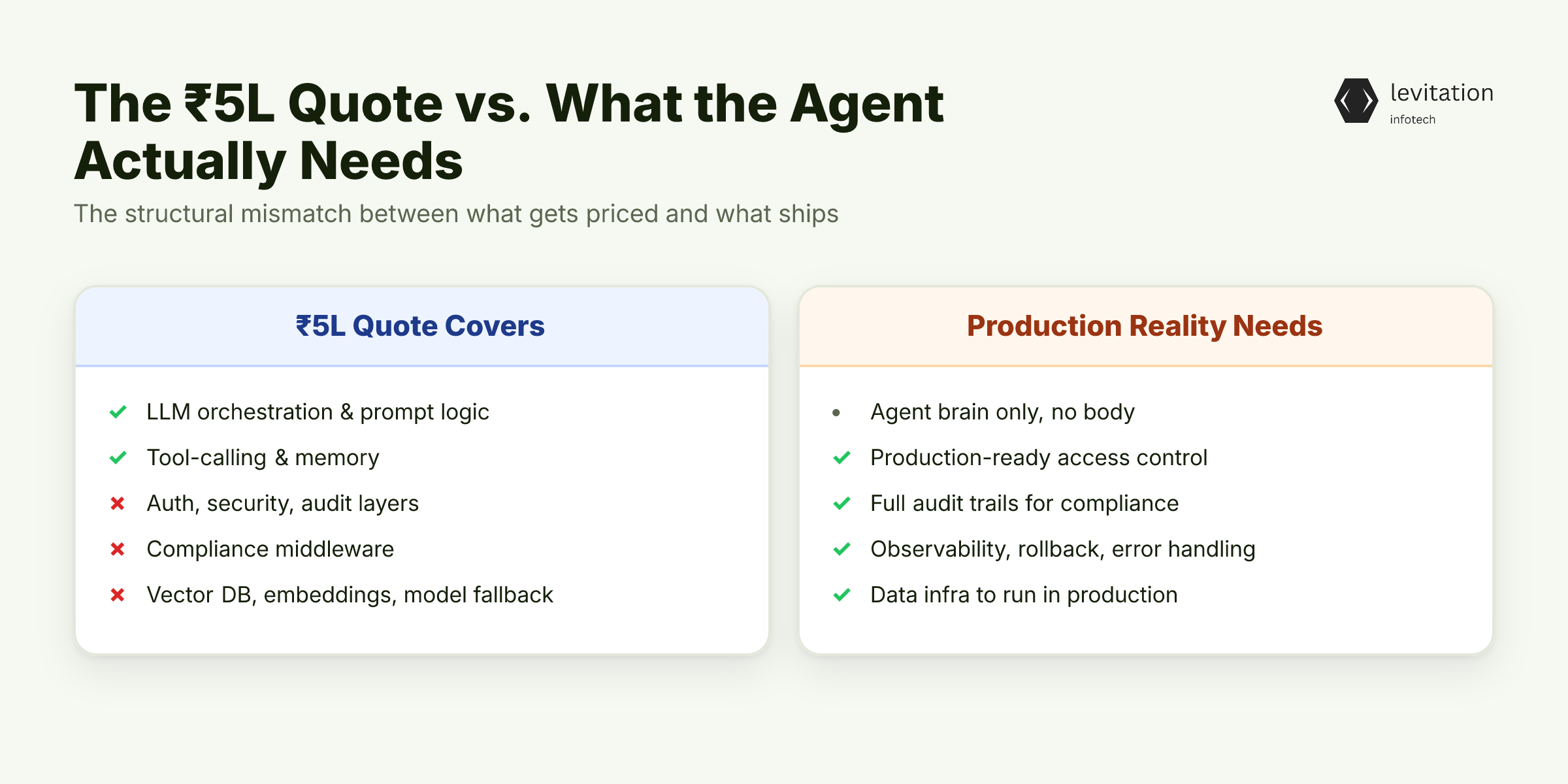
The ₹5 Lakh number you signed covers the agent core: LLM orchestration, prompt logic, and tool-calling. It does not cover the enterprise environment the agent must operate inside.
Most CTOs read "AI agent development" and assume the quote is for a working system. Vendors read it as the agent brain, not the body that holds it. That gap between quote and deployment is where margins live. It is also where budgets die. - The headline number buys you prompts, memory, and tool-calling logic. - It does not buy auth layers, audit trails, or compliance middleware. - It does not buy production observability, rollback paths, or error handling. - It rarely covers the vector DB, embedding pipelines, or model fallback systems.
Working with an experienced ai development company changes this dynamic. However, this only works if you ask the right questions before signing. The vendor's job is to win the deal. Your job is to know what the deal doesn't include.
Why Your Vendor's 'Integration' Line Item Is a Black Box
Integration, as written in most SOWs, is a single line item. In practice, it contains six to eight distinct workstreams. These are rarely broken out: - API gateways and connector development - Authentication and role-based access control layers - Data pipelines for context loading and retrieval - Error handling, retry logic, and circuit breakers - Observability: logging, metrics, traces across LLM calls - Rollback paths, feature flags, and deployment orchestration - Rate limiting and quota management - Data transformation between agent output and downstream systems
Vendors define "integration" narrowly. To them, it means the LLM hooks into one system.
To you, it means the agent works across the stack. These are not the same thing.
The mid-market AI vendor landscape in Noida prices against the agent. It does not price against the enterprise environment. They compete on the visible deliverable: the chatbot that answers questions. They don't compete on the invisible scaffolding that keeps it from leaking data or crashing under load.
When you compare top generative AI companies in India, look for those who break integration into named workstreams. Make sure they include effort estimates. Most won't.
We've seen how this same gap shows up elsewhere. The 5 Lakh AI pilot that won't reach production for 32 Lakh shows the same pattern. It shows up at a different scale. The "AI agent stack" quietly violating compliance rules is what happens when observability was never part of the original scope. This is documented in Your AI Agent Stack Is Secretly Violating Rules.
So where does the extra ₹4 Lakh actually go? It's not padding. It's work that was never specified in the first place.
The Real Cost Stack: What Actually Sits Inside an AI Agent
A production-grade agent has four cost layers. The ₹5 Lakh quote covers only one of them.
Core agent development (the largest single cost layer): - LLM orchestration and prompt engineering - Tool-calling logic and function definitions - Memory management and context windowing - Reasoning loops and decision trees
Integration layer (routinely under-scoped): - API connectors for each system the agent touches - Auth, RBAC, and session management - Rate limiting, retry logic, and circuit breakers - Error handling and graceful degradation
Security and compliance (20-30%, frequently quoted separately): - Audit trails with trace IDs across LLM calls - PII redaction at the prompt layer - Data residency controls - Output filtering and safety checks
Infrastructure (recurring, often absent from fixed-price quotes): - Vector database hosting and scaling - Embedding pipeline compute - Caching layers to control inference cost - Model fallback and failover systems
The core and integration layers together account for the majority of the build spend. The 20-30% compliance layer is where most projects derail. This is because it shows up as a change order after the SOW is signed.
Teams that engage with a custom ai development partner early can map these costs before signing. They can do this instead of after.
An ai agent development company trusted by Fortune 500 brands for enterprise AI in India will structure these as separate line items. They will do this from day one. The ones who don't are betting you won't ask.
That 20-30% compliance markup deserves its own breakdown. It's the line item most often presented as a "surprise."
The 20-30% Compliance Markup Nobody Warns You About
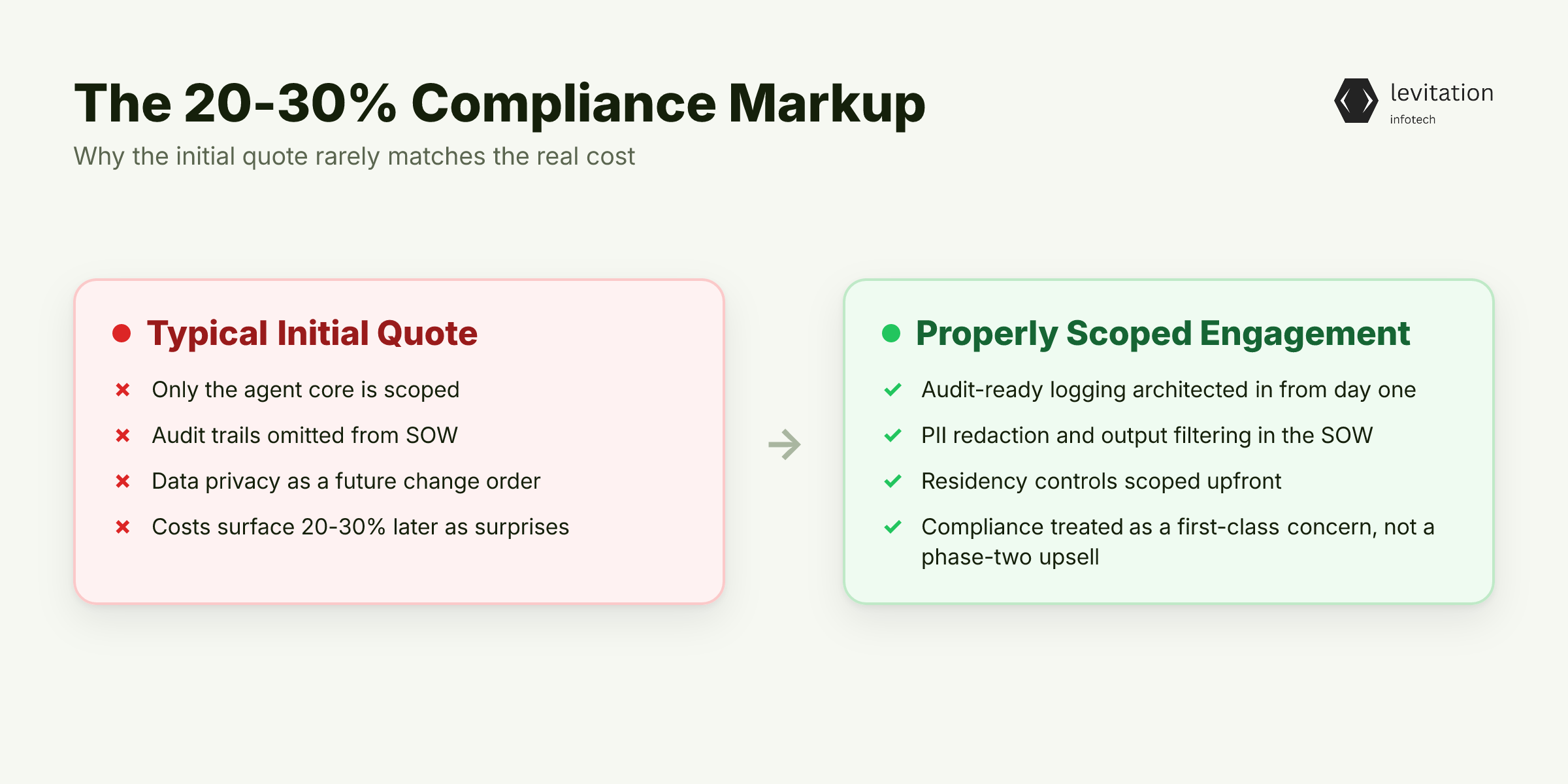
Retrofitting security controls, audit trail implementation, and data privacy compliance can increase the budget by 20-30%. This isn't vendor opportunism. It's a structural cost of building an agent that survives an enterprise audit.
Audit trails alone require: - Structured logging at every LLM call, with trace IDs that survive across retries - Replay capability so compliance officers can reconstruct any agent decision - Tamper-evident storage so logs can't be quietly edited post-hoc - Retention policies that match your industry's regulatory requirements
This is middleware. It's not part of the agent core. It sits between the agent and your logging infrastructure.
It takes weeks to build correctly. The initial quote never mentioned it. The reason is that the vendor scoped the agent, not the system around it.
Data privacy compliance adds three more workstreams: - Redaction at the prompt layer so PII never reaches the LLM - Output filtering so the agent can't echo sensitive data back to the user - Residency controls that keep certain data types within Indian borders
Each is a separate engineering effort. Combined, they represent 20-30% of the project cost. They are almost always quoted as a separate engagement after the SOW is signed.
We've watched this exact gap catch teams off guard. See The Blind Spot in Your AI Stack That Audits Always Find First for how compliance officers approach this in practice.
Working with an enterprise ai development partner who has shipped audit-ready agents before helps. It means these costs show up in the initial proposal. They show up there, not in a change order.
The right llm development company treats compliance as a first-class concern. It treats it as such, not a phase-two upsell.
If ₹5 Lakh is a trap and ₹9 Lakh is the floor, what does a properly scoped quote actually look like?
What a Properly Scoped Quote Should Look Like
A quote you can trust has four characteristics. If any are missing, the ₹5 Lakh will become ₹9 Lakh, and possibly more.
1. Line-item breakdown across five categories: - Agent core (LLM orchestration, prompts, tool-calling, memory) - Integration adapters (per system, with named effort) - Security and compliance layer (audit trails, redaction, residency) - Infrastructure (vector DB, embeddings, caching, model fallback) - Post-launch monitoring and on-call support
2. A 12-month TCO projection covering: - Inference costs at your expected request volume - Vector database hosting and scaling - Model upgrades and migration effort - On-call support and incident response
Recurring costs compound over time. Inference, vector DB hosting, model upgrades, and on-call support each carry their own annual run rate.
A system that costs ₹5 Lakh to build can compound toward a meaningful share of the initial build spend. This can happen within the first year. We've mapped how these inference costs behave at scale in Stop Bleeding Money on LLM Inference. Vendors who quote "₹5 Lakh, done" are ignoring this entirely.
3. Fixed-price integration with defined API boundaries: - Each connector is scoped with a specific system and data contract - "Integration" is not a single line item but a set of named deliverables - Change orders trigger only when you add new systems, not when the vendor discovers scope
4. A realistic deployment timeline: - Enterprise agent deployments run through several phases: scoping, integration build, compliance retrofit, and hardening before launch - The duration depends on the number of systems the agent must integrate with - It also depends on the maturity of existing data pipelines and the depth of audit and compliance requirements
The right ai consulting engagement starts with a scoping workshop. This workshop produces this breakdown before any code is written.
A partner offering rag development as part of the same engagement can fold retrieval architecture into the same cost structure. This avoids treating retrieval as an add-on.
Get the scoping right and the real payoff shows up not at signing. It shows up years later. It shows up when the system is still running and the cost curve has flattened.
Why a ₹5 Lakh Agent Can Double by Year Two
The initial bill is the easy part. Year Two is where most AI agent projects quietly bleed.
Hidden costs add up quickly. The ₹5 Lakh becomes ₹9 Lakh during build. The annual run rate can climb past twice the initial build once you add: - Maintenance, model upgrades, and drift monitoring - Infrastructure scaling as usage grows - Governance overhead as compliance requirements evolve - Opportunity cost from delays caused by mid-project scope renegotiation
TCO must include infrastructure, integration maintenance, governance overhead, and the opportunity cost of delays.
Teams that scope this way end up with systems that continue running in production. They continue running long after the initial build. The foundation wasn't negotiated under pressure.
The ₹5 Lakh agent exists. It's just not the one you think you're buying. A properly scoped ai solution development engagement costs more upfront. However, it costs less over the life of the system. It survives the audits that kill the cheaper alternatives.
Frequently Asked Questions
What is the actual cost of building an AI agent in India?
AI agent development in India ranges from $5,000 for a simple chatbot to $400,000+ for enterprise multi-agent systems. Per published estimates, the cost of an AI agent project can range from $20,000 to $300,000 depending on complexity. A mid-market production agent in India typically lands well above the ₹5 Lakh headline figure most vendors open with. This is true once integration, security, and compliance are properly scoped.
Why do AI agent quotes in Noida underestimate integration costs?
Vendors quote against the agent core (LLM orchestration and tool-calling) because that's the visible deliverable. Integration, including API connectors, auth, audit trails, compliance, and observability, gets bundled into a single vague line item. That line item expands once work begins. It's not dishonest, but it produces a consistent gap between quote and final bill.
What hidden costs should CTOs budget for in AI agent projects?
Beyond the quoted build cost, expect 20-30% more for security and compliance retrofitting. Add recurring infrastructure costs for vector databases and inference. Add ongoing maintenance for model upgrades and drift monitoring. Hidden costs can double the initial budget before any return is realized.
How long does AI agent development actually take in India?
Production-grade enterprise agent deployments run through several phases: scoping, integration build, compliance retrofit, and hardening before launch. The exact duration depends on integration complexity, existing infrastructure, and compliance requirements. It does not depend on a fixed vendor timeline.
How do I evaluate an AI agent vendor's quote before signing?
Demand a line-item breakdown separating agent core, integration, security/compliance, and infrastructure. Ask for a 12-month TCO projection including inference and hosting. Insist on fixed-price integration with defined API boundaries. If the vendor can't produce this breakdown, the ₹5 Lakh quote will become ₹9 Lakh, and possibly more.
Get the line-item breakdown before you sign anything.
Sources
Research and references cited in this article:
- AI Agent Development Cost: $8K–$400K Real Quotes (2026)
- AI Agent Development Cost $5K to $180K+ (2026)
- AI Agent Development Cost in 2026 - Pricing, MVP, ROI & Budget Guide
- AI Agent Development Cost 2026: Pricing & Budgeting Guide
- AI Agent Development Cost in 2026: Full Pricing Guide | Intellectyx
- AI Agent Development Cost 2026: The Hidden TCO Breakdown
- AI Agent Development Cost: Full Breakdown for 2026 - Riseup Labs
- Enterprise AI Agent Development Cost in 2026 | CT Labs
- The Hidden Cost of Agentic AI: Why Most Projects Still Die Before Production | Splunk
- True Cost of AI Calculator — model monthly TCO across 12 LLMs
- The Complete AI Agent Development Cost Guide for 2026
- AI Agent Development Cost for Manufacturing (2026 Guide)
About the author
Mayank Singh is a software developer at Levitation Infotech, where he builds web and AI-powered applications across the company’s fintech, healthcare, and enterprise projects.