


TL;DR: That ₹4 lakh Noida AI quote isn't an AI project. It's three API subscriptions stitched behind a login screen. The real cost shows up as perpetual inference fees that scale with traffic. It also shows up as data preparation the quote never mentions, and quarterly retraining cycles with their own compute and labor burden. A genuine custom AI development program demands a budget several times the integration quote. It builds the system you own, not the system three vendors rent you.
Key Takeaways: - The ₹4L quote prices the integration layer, not the model work, inference tax, or retraining cycle. - API inference spend scales with traffic volume. The monthly bill grows linearly with usage, a number the quote never shows. - A line-item audit with 8 specific items separates genuine AI programs from API-glue projects before you sign. - Production-critical systems in regulated industries need a different budget: several times the build quote, with ownership of prompts, embeddings, and data pipelines.
The ₹4 Lakh Quote Is an Integration Invoice, Not an AI Budget
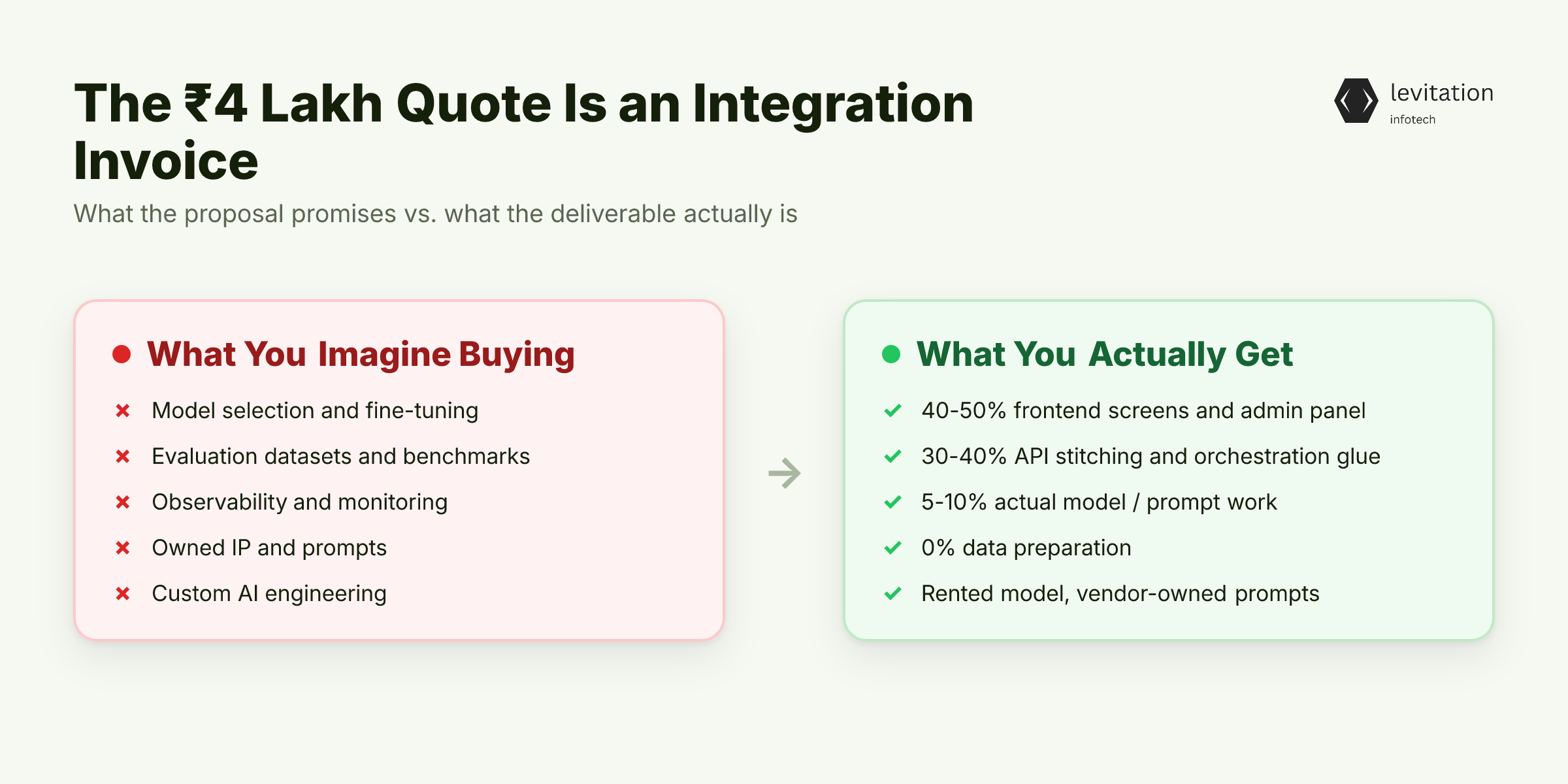
That quote on your desk doesn't say "AI development." It says three API keys, a login screen, and a monthly bill that never ends. The CTO who signs it usually discovers this six months after launch.
The ₹4 lakh Noida AI quote follows a familiar pattern. One hosted LLM endpoint. One vector database. One chat orchestration layer like LangChain. All wrapped in a custom React UI with an admin panel.
The vendor calls this "custom AI development services" because the proposal title says so. The deliverable is a chat window connected to three vendor APIs.
Here's the breakdown the proposal doesn't show: - Frontend screens and admin panel: 40-50% of effort - API stitching and orchestration glue: 30-40% - Actual model work (prompt design, evaluation): 5-10% - Data preparation: usually 0%
The "AI" in the proposal title creates a mental model the deliverable cannot match. You imagine model selection, fine-tuning, evaluation datasets, and observability. You get a frontend.
The model is rented, not built. The training data belongs to someone else. The prompts live in the vendor's head.
This is why AI development budgets balloon after launch. The build phase looks cheap. The runtime phase runs forever.
The sticker price is misleading, but it isn't the only number the quote is hiding from you.
The Three Cost Layers Your Quote Quietly Buries
A real AI development company knows AI systems have three cost layers. The build is layer one. Inference, data, and retraining are layers two and three.
The Noida quote prices layer one and stops reading.
Layer 1: Inference, the perpetual tax.
Current API pricing sits around $2.50 per unit of input for Claude- and GPT-class models. That cost compounds with every request, and the monthly bill grows with traffic volume.
The first month feels manageable. The twelfth month feels like a subscription you can't cancel because your product depends on it.
Layer 2: Data preparation, the work the quote never mentions.
Real AI software development requires clean, labeled, governed data. Months of work. ETL pipelines. Data quality audits. Annotation cycles.
None of this fits in a ₹4L line item, so it simply doesn't appear in the proposal.
Layer 3: Monitoring, retraining, and drift handling.
Production AI systems degrade. User behavior shifts. Model performance drifts.
Post-deployment AI costs run into thousands of dollars monthly once you include cloud, monitoring, inference, and updates. Budget for recurring retraining cycles that include compute, data labeling, and engineering time. Higher-frequency use cases cost more.
The quote optimizer knows none of this matters to the comparison phase. CTOs compare build quotes. They don't compare total cost of ownership.
So if the build isn't really the cost, what exactly is the ₹4L quote actually paying for?
Anatomy of an API-Glued AI System: What You're Actually Receiving
Open the proposal. Count the third-party services. You'll find three, almost always.
A typical Noida custom AI development project looks like this:
1stack:2 llm: OpenAI GPT-4o or Anthropic Claude (API)3 vector_store: Pinecone or Qdrant (managed)4 orchestration: LangChain or LlamaIndex5 frontend: Next.js or React6 backend: Node.js or Python7 hosting: AWS or GCP
This architecture is technically legitimate. It's also commercially fragile. Here's why: you own zero model IP.
There's no fine-tuning. Every capability is one vendor price-hike away from collapse. If OpenAI raises pricing, your entire system gets more expensive overnight with no recourse.
The lock-in math is worse. Switching off any one of the three APIs forces a rewrite of the orchestration layer.
You paid ₹4L to build the glue that holds the three vendors together. Replacing one vendor means replacing the glue.
When teams try to build AI systems this way, they discover the architecture has no migration path. The vendor selection in month one becomes the constraint in month twelve.
This isn't vendor malice. It's a structural pricing logic. Once you see it, every Noida AI quote reads the same way. The ₹4L anchor is no accident.
Why Noida Vendors Price AI This Way: The Margin Logic Behind the Markup
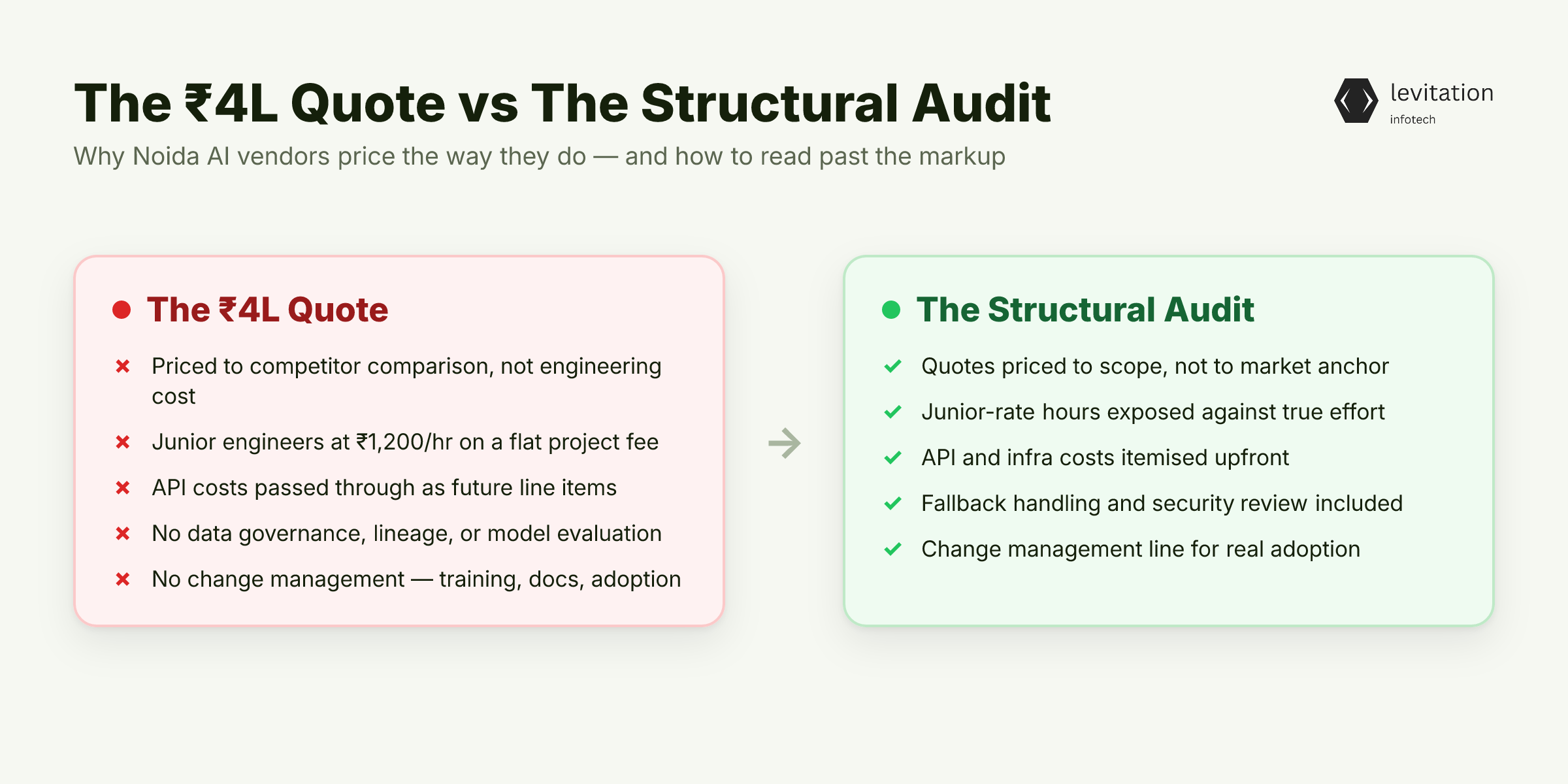
The ₹4L number isn't arbitrary. It's a market anchor.
AI chatbot development quotes in the NCR region cluster around ₹3-5 lakh because that's what buyers compare against. Vendors price to the comparison, not to the work.
If your competitor quotes ₹4.2L for the same scope, you quote ₹3.8L. The actual engineering cost becomes secondary.
The freelance-to-agency economics explain the rest. A Noida vendor quoting ₹4L for a three-API integration is typically running junior engineers at ₹1,200/hour against a flat project fee.
The agency margin is thin. The API costs are passed through to you as future line items, or simply excluded.
What the quote optimizer leaves out: - Data governance and lineage tracking - Model evaluation harnesses - Fallback handling when APIs timeout - Security review and penetration testing - Change management so the organization actually uses the system
Change management for AI systems requires meaningful investment in training, documentation, and adoption support. The ₹4L quote doesn't have a change management line. It never does.
This is why AI consulting engagements that focus on quote structure often catch what sales decks skip entirely. If the quote is structurally misleading, you need a structural way to read it. Here's the audit that catches what sales decks skip.
The 8-Line-Item AI Quote Audit: What Must Appear Before You Sign
A real AI development services proposal has eight line items. If yours has fewer, you're looking at an integration invoice, regardless of the proposal title.
Line items 1-3: Build scope
- Model selection rationale: which model, why, and what trade-offs
- Fine-tuning or RAG design: retrieval architecture, chunking strategy, embedding model choice
- Evaluation dataset definition: how you'll measure quality before launch
Line items 4-6: Operational scope
- Inference cost projection at 1x, 10x, and 100x current traffic, the perpetual tax in numbers
- Monitoring stack: latency tracking, hallucination detection, drift signals
- Retraining cadence and cost: quarterly, monthly, or event-driven, and what each cycle costs
Line items 7-8: Risk scope
- Data residency, PII handling, and vendor exit plan: who owns the prompts and embeddings when the contract ends
- Security review: threat model, pen test scope, incident response runbook
A line-item audit tells you whether ₹4L is the right number. The next question is whether ₹4L is the right answer for what you're actually trying to build.
For enterprise AI development, the answer is almost never the build quote. It's the TCO projection across three years, and whether ₹4L covers it depends on what you're building.
When ₹4 Lakh Is the Right Number, and When It Is a Trap
₹4L is the right number in two scenarios: - A tightly scoped internal chatbot over a known document corpus. Twenty users. Five hundred documents. Speed-to-learning matters more than durability. - A proof-of-concept where you need to validate a hypothesis before committing capital. The goal is learning, not production.
₹4L is a trap in three scenarios: - Regulated workflows in BFSI or healthcare, where audit trails, model governance, and data residency aren't optional - Customer-facing inference at scale, where every API outage is a customer experience failure - Any system where the vendor's three APIs are a single point of failure
The decision rule is simple. If the system touches money, patient data, or regulatory reporting, ₹4L is the deposit, not the budget.
Real AI solution development for these use cases demands a budget several times the build quote. The ownership question matters more than the build cost.
You can read more about this in our breakdown of how a ₹5 lakh AI pilot becomes a ₹32 lakh production deployment.
What Real Custom AI Development Looks Like: The Cost of Systems That Outlive Their Vendors
A custom AI development program shifts the cost structure from one-time build to a portfolio of decisions.
Architecture choices. Data ownership. Model selection. Observability. None of these fit on a ₹4L line.
The reference points matter. Teams running production-critical AI at scale don't start with three-API glue. They start with model selection criteria, evaluation harnesses, and data pipelines they control.
Owned AI systems have prompts, embeddings, and evaluation datasets belonging to the operator, not the vendor. They survive vendor pricing changes, regional shutdowns, and product roadmap pivots.
Systems still running in production years after deployment aren't lucky. They're owned.
The compounding return is the part most buyers miss. A custom AI system you own becomes a moat.
The data you generate improves the model. The workflows you build create switching costs in your favor.
A three-API integration becomes a liability the moment any vendor changes pricing, shuts down a region, or pivots their product roadmap.
The three hidden costs that triple AI development cost in India break down the math without marketing language. For a detailed AI development company comparison on what ownership costs over three years, start there.
The ₹4L quote isn't a discount. It's a deferred invoice with three vendor names on it.
Frequently Asked Questions
How much does AI development actually cost in India?
A three-API integration project in Noida typically lands at ₹3-5 lakh for the build. The real cost is the perpetual inference layer that scales with traffic, plus annual retraining and monitoring. A genuinely custom AI system for production-critical use cases typically costs several times the build quote once you include the inference tax, data pipelines, and ownership of prompts and embeddings.
Why do Noida AI vendors quote so cheaply?
The ₹4L Noida AI quote reflects a three-API integration priced against local market reference points. It is not priced against the full cost of running production AI.
Vendors optimize the build quote because that is the number CTOs compare. Inference, data prep, and monitoring get passed through as future line items, or simply excluded.
Is API integration the same as AI development?
No. AI development that uses APIs is legitimate, but it is integration work. You rent intelligence from three vendors instead of building your own.
Custom AI development involves model selection, fine-tuning, evaluation, data pipelines, and observability. That is why genuine custom projects cost multiple times more than a glue project.
What hidden costs should I expect after the AI build is delivered?
Plan for monthly inference costs that grow with traffic. Add recurring annual retraining expenses, which include compute and labeling.
Budget for real change management so the organization actually uses the system. Post-deployment AI costs run into thousands of dollars per month once you include cloud, monitoring, and updates.
How do I evaluate an AI development quote properly?
Demand line items for model selection, data preparation, evaluation, inference cost projection at scale, monitoring, retraining, and a vendor-exit plan.
If the quote only describes screens, APIs, and an admin panel, you are looking at an integration invoice, not an AI development project, regardless of what the proposal title says.
About the author
Mayank Singh is a software developer at Levitation Infotech, where he builds web and AI-powered applications across the company’s fintech, healthcare, and enterprise projects.