


TL;DR: Most Noida startup founders budget only for visible engineering labor. They miss three silent cost categories: data preparation, integration and compliance engineering, and post-deployment operations. Together, these can match or exceed your original AI quote. Budgeting around all four buckets from day one is the only way to keep your AI project from tripling in cost.
Key Takeaways: - Initial AI quotes in India cover only the model build, leaving most of the real cost unaccounted for. - Data prep, integration and compliance, and post-deployment operations are the three hidden categories. - A realistic production AI system budget is an order of magnitude larger than the early proposal number. - Forcing vendors to price all four buckets in writing prevents the most common scope explosions.
Your AI Quote Is Missing the Bulk of the Real Cost
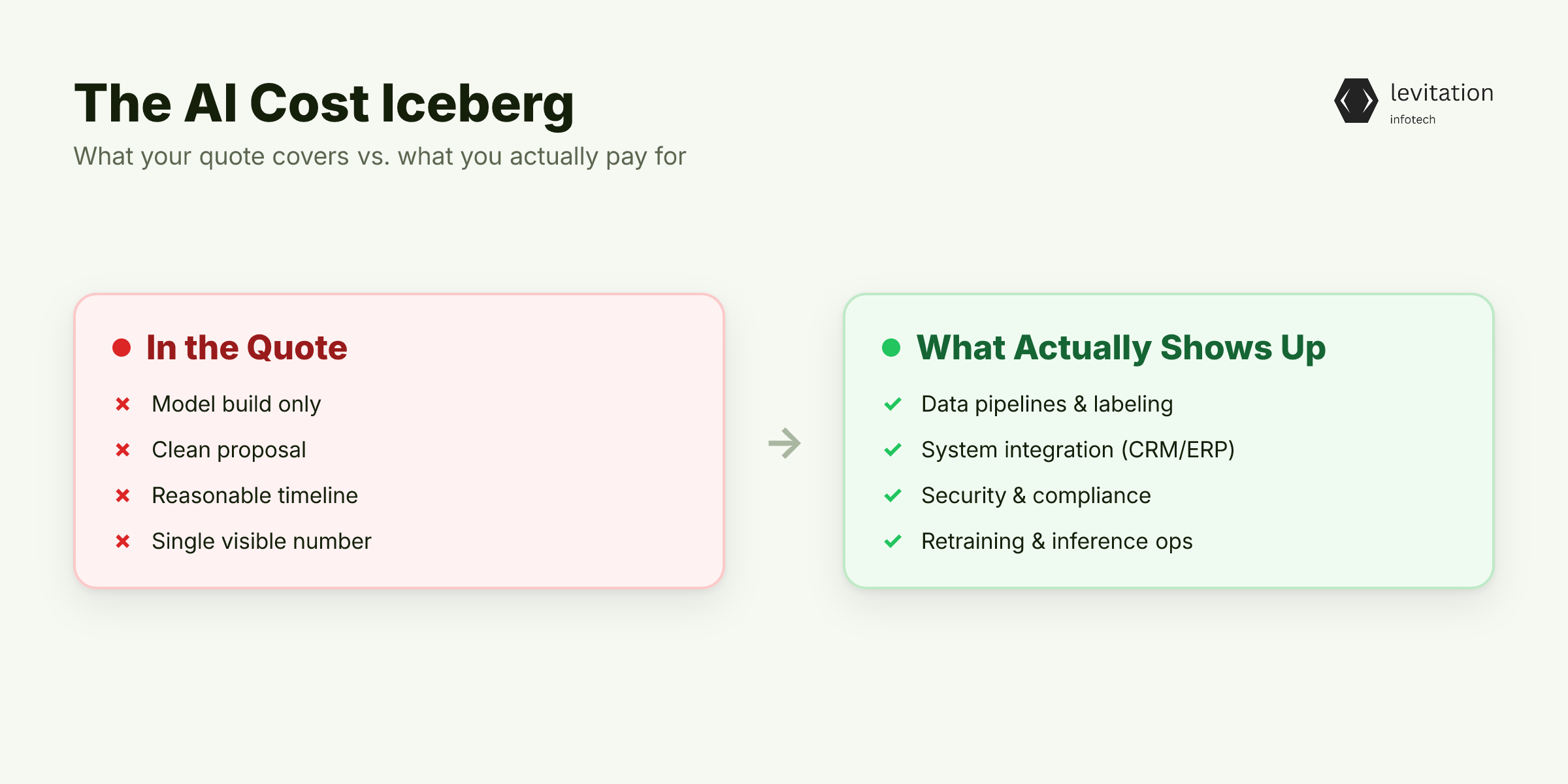
You budgeted for your AI product. The actual bill is much higher. And the model itself is not to blame.
The pattern repeats across India. A vendor submits a clean proposal. The team looks strong. The timeline feels reasonable. The founder approves based on a number that covers only the model build.
Months later, the product is still not in production. The original budget is gone. The vendor asks for more money to cover "data work, integration, and operations" that were never in the original scope. The founder ends up raising bridge capital just to keep the lights on.
This is the standard arc for AI projects in India. The trap is not that vendors are dishonest. The cost structure of AI differs from regular software. Most budget templates were built for the wrong shape of project.
Here is what almost never makes it into the first proposal: - Data pipelines, labeling, and storage - Integration with existing systems (CRMs, ERPs, payment rails) - Security hardening and compliance engineering - Ongoing retraining, monitoring, and inference costs
Each of these is a separate workstream. Together, they routinely add as much as the visible engineering number itself, sometimes more.
The founder who budgets only for the model ends up paying for the iceberg under the waterline. The iceberg has three specific shapes, and the next section shows you the first one.
Why Most Noida Startup Founders Budget Wrong
AI pricing in India is typically quoted around labor. The labor cost to hire an Indian AI team runs $25,000 to $150,000+, depending on scope. On the surface, that feels like a bargain. The problem is what surrounds that labor.
Competitors in the space are blunt about it: data, integration, and infrastructure dominate the bill. The model itself is rarely the most expensive part. But founders keep comparing AI to a SaaS build.
A SaaS project is predictable. You scope it. You build it. You ship it. The deliverable is fixed. An AI project behaves more like infrastructure. It is ongoing, variable, and usage-driven. The moment a real user starts hitting your endpoint, the cost shape changes.
The India-specific trap is sharper than most realize. The rupee-denominated hourly rate feels cheap. It masks a deeper problem. AI projects consume far more engineering hours per unit of output than traditional software. Data work, iteration, and integration cycles all add up before any user sees a result. The unit economics look good in a proposal. They fall apart in production, a pattern we have analyzed in detail in our review of Noida's software quote gap.
Founders who only budget for the ai software development labor line end up in the same place every time. They run out of runway. They scramble for fresh capital. They watch their AI roadmap slip. Once you see the shape of the iceberg, the three hidden cost categories become obvious. The first one is where most Noida startups bleed the most cash without realizing it.
Hidden Cost #1: The Data Preparation Black Hole
Data work is not one expense. It is three layered expenses stacked on top of each other, and it is the first place Noida founders bleed budget before a single inference runs.
First comes collection and labeling, which is often manual in India for any domain-specific dataset. Hindi-NLP corpora, regional healthcare records, agri-tech sensor data. None of it exists in clean public form. Someone has to build it.
Second comes cleaning and storage. Cloud bills for unstructured data quietly climb. Object storage, ETL pipelines, and versioning tools all add line items that were never in the original proposal.
Third comes augmentation and synthesis. When the real data is thin, teams generate synthetic samples or use foundation models to expand the set. Each of these is a separate workstream with its own iteration cost.
For Noida startups, this hits hardest on the first layer. Domain-specific data rarely exists in clean form, so every project starts with a data sprint that nobody priced in. Vendors will tell you "we'll handle the data" and put a single line item in the proposal. That line is where the budget dies.
Founders who plan for a real custom ai development effort plan differently. They include data audit, labeling, and storage from week one. They avoid the most common cause of AI project failure.
The ones who treat data as a footnote end up paying for it three times: once in delays, once in rework, and once in the change orders that arrive when the data turns out to be unusable.
Even after your data is clean, the model still has to talk to the rest of your stack. And that conversation is the second cost that quietly triples your budget.
Hidden Cost #2: Integration, Security, and Compliance Engineering
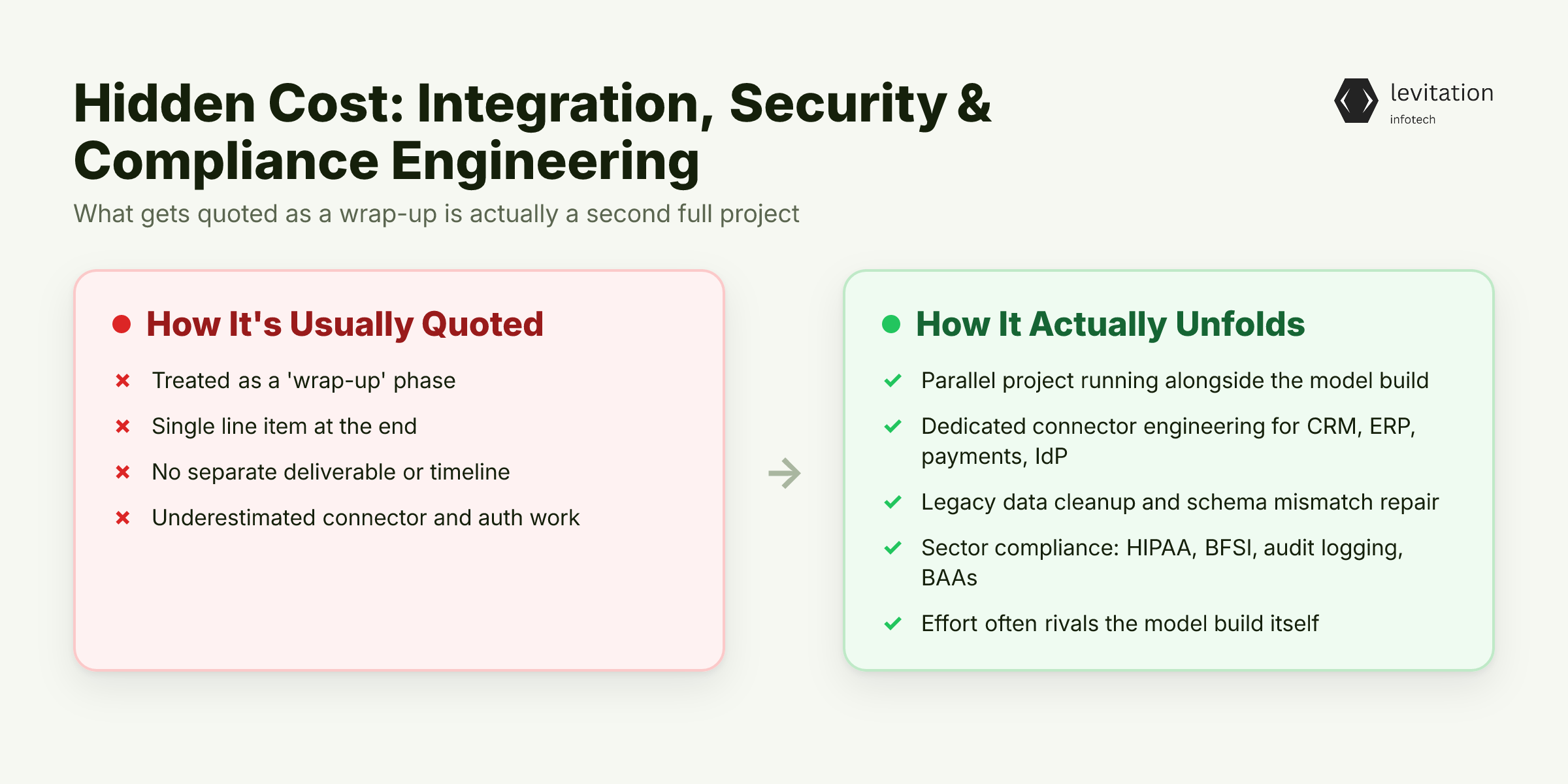
Security compliance, third-party API integration, and unexpected operational challenges are the most commonly underestimated line items in any AI project. Most proposals treat them as a "wrap-up" phase. In practice, they are a second full project running in parallel.
Every AI system has to plug into something. CRMs, ERPs, payment rails, identity providers, ticketing systems. Each connector is a mini-project with its own edge cases, auth flows, and failure modes.
A model that performs well in isolation often falls apart in production. It meets a legacy ERP with dirty data and inconsistent schemas. The cost of fixing those mismatches adds up fast.
Compliance adds another underappreciated layer. Data protection requirements, sector-specific rules for healthcare and BFSI, and the security hardening that enterprise buyers require before signing a contract. Each of these is a separate engineering workstream with its own deliverable.
Healthcare illustrates the pattern clearly. A HIPAA-compliant system for hospital chains requires audit logging, encryption at rest, role-based access, and signed business associate agreements. The compliance work is rarely a small wrap-up. Across regulated deployments, the integration and compliance workstream often rivals the model build itself in effort, a pattern documented in our HIPAA-compliant AI scribe deployments across Indian hospital chains.
A ai solution development partner who treats integration and compliance as a "sprint three" line item is the partner who will quote you low and renegotiate later. The honest quote breaks these out as their own buckets with their own timelines. If yours does not, ask why.
You survived data prep and integration. The model is in production. Congratulations. You have just unlocked the third hidden cost, the one that keeps charging you every month for the next five years.
Hidden Cost #3: The Post-Deployment Tax (Retraining, Monitoring, Scaling)
The model is live. The launch went fine. The bill starts arriving thirty days later.
Post-deployment costs cover cloud infrastructure, inference, monitoring, and updates. This is not a one-time charge. It is a permanent line item. It scales with your usage and grows with each new user, model iteration, and integration.
Annual operating costs compound on top of the initial build for most realistic projects. The number is easy to miss when you are celebrating the launch. It is the cost of running the system rather than building it, and it never stops.
Model retraining is its own budget line. Every retraining cycle means data refresh, evaluation, testing, and redeployment. None of it is free, and the same pattern that breaks LLM cost forecasts once usage is real shows up in nearly every production deployment.
Then there is the change management line item, which is the most invisible cost of all. Getting your organization to actually use the AI system you have built costs real money. Training, process redesign, and adoption work all add up. The cost grows with the size of the team and the breadth of the workflow.
The model works perfectly. Your sales team still emails spreadsheets to each other. Adoption is an engineering-adjacent problem that vendors will not price in unless you force them to.
A serious ai development company puts retraining, monitoring, and adoption work into the contract from day one. If yours treats operations as a "future conversation," that is the conversation you will have when the project is supposed to be compounding and is instead bleeding cash.
Knowing the three costs is step one. The founders who actually ship within budget are the ones who restructure their proposal and vendor choice around them.
The Budget Framework That Actually Works
The first move is to demand that every proposal breaks the work into four buckets: - Model build: a defined slice of the total - Data preparation: a major line item, not a footnote - Integration and compliance: their own workstream with its own timeline - Post-deployment reserve: an annualized allowance, not an afterthought
If any bucket is missing from the quote, the quote is incomplete. Most proposals skip the data and post-deployment buckets because they are the hardest to scope. That is exactly why they need to be in writing.
Second, insist on a fixed-scope data audit before signing. Pay a small fee for a real data readiness report. It forces honesty about what you have and what you do not.
It also prevents the most common scope explosion: discovering partway through that your training data is unusable. That single audit pays for itself many times over.
Third, use the speed advantage deliberately. Outsourced delivery in months rather than the year-plus an in-house team typically needs frees up a meaningful cost runway. That is not a soft benefit. For a Noida startup burning cash every month, it is a hard survival line.
Your build ai partner's delivery speed is part of the cost equation, not a separate metric. Treat it that way when you compare quotes.
Fourth, pick a partner who will put post-deployment SLAs and retraining costs in writing. Vendors who refuse to price operations are the ones who quote low and renegotiate later. The right partner sees operations as a predictable, scoped workstream, not an open tab.
When the budget reflects reality, the entire economics of the project shift. The outcome looks very different from the version most founders fear, and the next section breaks down exactly what changes.
What Changes When You Budget for All Three Costs
Your real AI project cost in India, when data prep, integration, and a full year of operations are included, runs far above the early proposal number. The gap is not a vendor trick. It is the cost of doing AI properly.
Three concrete shifts happen when you plan for all four buckets:
- You stop running out of runway before the product compounds.
- You can tell investors a defensible number that survives diligence.
- You avoid the long rebuild that follows a budget-busted MVP.
Enterprise buyers notice the difference. The same operating discipline that prevents cost overruns makes a system enterprise-ready. That is why enterprise AI development partners trusted by large enterprise buyers in India deploy at this level by default. It is not a premium tier. It is what production work costs.
The final ROI calculation only works when the post-deployment operating cost is planned for. When it is not, the project gets killed before it has a chance to compound. The math turns positive around year two, but only if the system survives long enough to get there.
The pattern is consistent across healthcare, fintech, and enterprise SaaS. Founders who budget for all three hidden costs ship on time and stay in business. The ones who do not are the case studies nobody writes about.
Frequently Asked Questions
How much does AI development cost in India in 2026?
For a production-grade custom AI system, AI development cost in India runs well above the early proposal number once data prep, integration, and 12 months of post-deployment operations are included. Basic chatbot or rule-based AI projects can start at a fraction of that, but those are not comparable to a real AI system.
What is a realistic Noida AI development budget for a startup?
A realistic Noida AI development budget for a startup building a production AI product needs to cover model build, data pipelines, integration, and a reserved slice for ongoing operations. Quoting below that number almost always means one of those four buckets has been silently dropped.
Why do AI development projects go over budget?
AI projects go over budget because the initial quote almost always covers only the model build labor. The three cost categories that get added later, including data preparation, integration and compliance engineering, and post-deployment retraining and monitoring, together can match or exceed the original number.
Is outsourcing AI development to India cheaper than hiring in-house?
Outsourced AI development services in India typically come at a fraction of equivalent US or EU in-house team cost for the same engineering output. The bigger advantage is speed. Deployment happens in months rather than the year-plus an in-house team typically needs, which frees up a full year of runway.
How can I reduce AI project pricing in India without cutting quality?
The most effective lever is reducing data preparation cost. Use transfer learning and pre-trained models, buy labeled datasets instead of building from scratch, and run a data readiness audit before signing the build contract. Each of these can meaningfully reduce total AI project pricing in India without changing the model or the team.
Ask each vendor to price all four buckets in writing, and the real cost gap shows up before you sign.
About the author
Mayank Singh is a software developer at Levitation Infotech, where he builds web and AI-powered applications across the company’s fintech, healthcare, and enterprise projects.