


TL;DR: Attackers can pivot across your cloud estate in roughly four minutes. They use valid credentials and legitimate API calls. Traditional SIEM architectures take up to four days to fire a single alert. The gap is architectural, not procedural. Closing it requires identity-centric behavioral detection, cloud-native telemetry, and a managed detection layer that turns raw logs into containment actions.
Key Takeaways: - The 4-minute-versus-4-day gap is a 1,440x asymmetry in decision windows, and that gap is where attackers live. - Traditional SIEMs miss cloud lateral movement because they were built for perimeter-era batch correlation, not real-time identity behavior. - Detection engineering that correlates identity, network, and compute telemetry can compress MTTD from days to minutes.
Your adversary doesn't need to outsmart your perimeter. They just need to wait four days while your SIEM processes yesterday's logs. By the time an alert fires, they've already pivoted three steps deeper into your cloud estate.
Your Attacker Has a 1,440x Speed Advantage
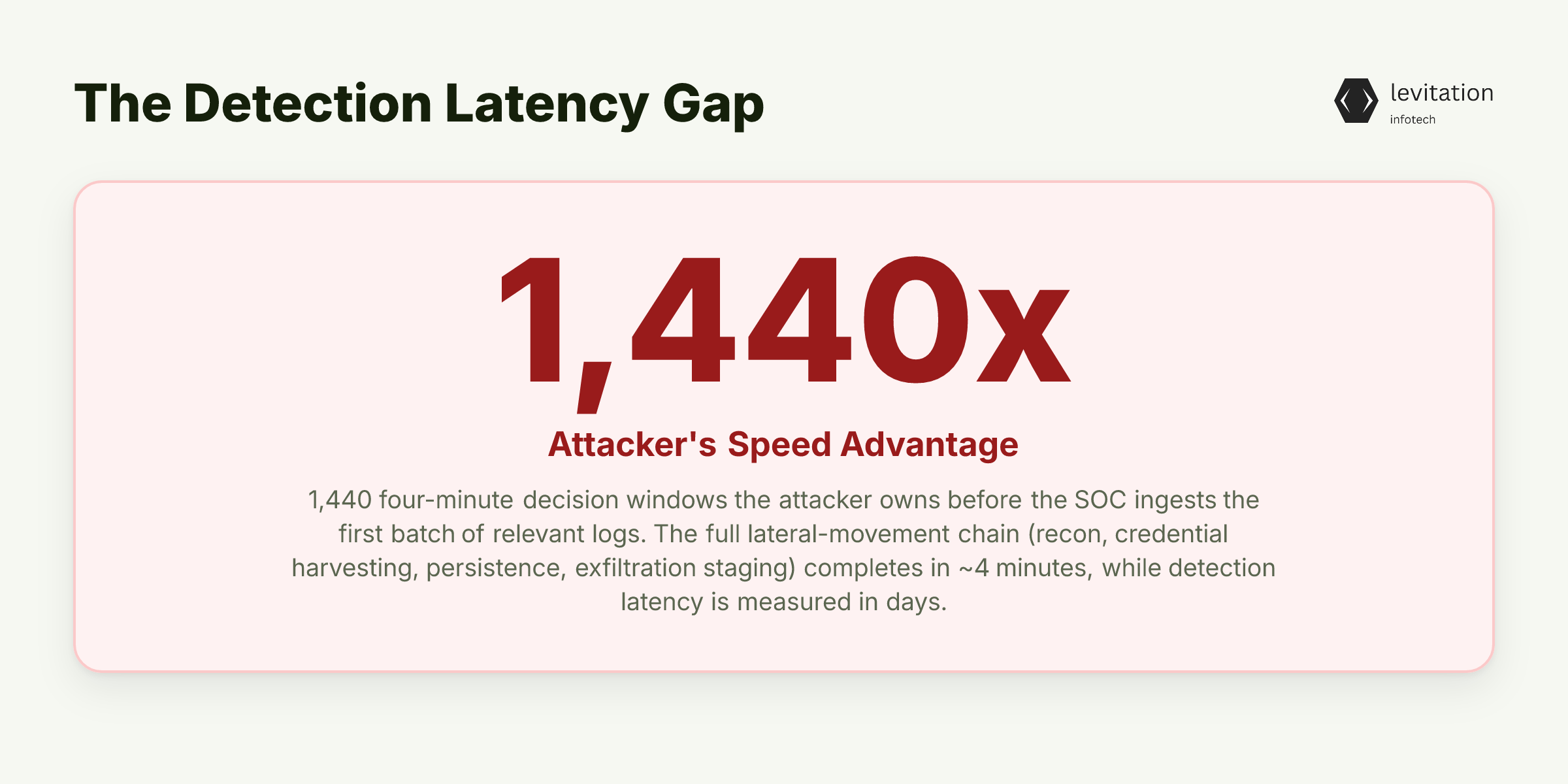
Four days. That is 1,440 four-minute decision windows the attacker owns before your SOC has even ingested the first batch of relevant logs. Meanwhile, the entire lateral movement chain (reconnaissance, credential harvesting, persistence, and staging for exfiltration) completes in roughly four minutes.
The numbers sound wrong until you walk through them. The attacker uses valid credentials. The API calls look like any other operator's day. The metadata service returns secrets exactly as it was designed to.
Nothing trips a static rule. Nothing crosses a network threshold. The compromise is complete before lunch.
What makes this terrifying is the patience behind it. Attackers can dwell for weeks inside a compromised environment, mapping the network, harvesting credentials, and identifying high-value targets before they act. Attackers don't need to win in four minutes every time. They need to win once, in four minutes, while defenders process alerts on a four-day delay.
The math favors the patient attacker every single time. The reason CISOs misjudge this risk is measurement bias. They track prevention metrics: firewalls blocked, MFA challenged, patches deployed. They rarely track detection latency.
The metric that should scare the board is the time between initial credential compromise and the first qualified SOC alert. That number is almost always measured in days.
The instinctive response is to push more logs into the SIEM and tune harder. That is exactly why the gap keeps widening.
Why Your SIEM Was Architected to Miss This
Traditional SIEMs were built for a different war. Perimeter firewalls, discrete endpoint events, bounded log volumes, and batch correlation windows measured in hours, not seconds. The architecture assumes a stable network boundary, predictable asset inventories, and an attacker's signature worth matching.
Cloud environments break every one of those assumptions. Compute is ephemeral: instances live for minutes, then vanish. The control plane is API-driven: every privilege change is an HTTP call to a regional endpoint, not a logon event on a domain controller.
Identity is the new perimeter, but identity events look like normal user behavior.
Log collection becomes the bottleneck. Agents on transient instances miss windows because the instance terminates before the forwarder flushes. API polling introduces lag measured in minutes per query.
Forwarders drop events under load because the SIEM was sized for yesterday's threat volume, not cloud-scale telemetry.
The result: the volume of logs drowns the signal the SOC actually needs. Analysts wade through millions of API calls to find the four that matter, and the search takes days.
The detection is not failing because of configuration error. It is failing because the architecture is wrong for the environment. As we covered in Why Half Your SIEM Detections Fail in the Cloud, most cloud SIEM deployments inherit detection content designed for on-prem estates.
Understanding the architecture explains why attackers succeed. It does not explain how they move without triggering a single alert along the way.
The Lateral Movement Playbook That Looks Like Normal Traffic
Attackers pivot using valid credentials harvested from the initial foothold. That foothold is rarely exotic: a phished laptop, a leaked service principal in a public repo, or a developer whose access token was committed to a CI pipeline.
The credentials work. The attacker logs in. Nothing fails.
Once inside, the attacker exploits cloud APIs directly. AssumeRole calls, IAM policy enumeration, and metadata service access are all legitimate operations performed daily by your platform team. A single AssumeRole into a higher-privilege role looks like a developer switching contexts.
The detection rule that should fire has a suppression list a mile long.
Compute instance access becomes the springboard. SSM Session Manager, SSH keys in instance metadata, and IMDS abuse for credential theft are all paths. They escalate from a single foothold to cross-account access.
Each step uses tools your engineers use every day.
Privilege escalation chains stitch these normal-looking actions together. The attacker chains AssumeRole, calls an API that returns a temporary credential, uses that credential to assume another role, and pivots again.
The full chain completes in minutes. No single step is anomalous. The pattern is.
The playbook is not novel. It is just faster than the detection system that is supposed to catch it.
If the techniques resemble normal activity, the detection strategy has to change too. Stop matching signatures. Start correlating behavior.
What Actually Detects Movement That Looks Legitimate
Behavioral baselining per identity, per service, and per resource is the only signal that holds up. Deviation from normal is the signal. A role that has never been assumed from this source IP is anomalous.
A service account that has never called this API is suspicious. A workload that has never reached this metadata endpoint is a candidate for investigation.
Identity-centric correlation is the connective tissue. Link an AssumeRole event to subsequent API calls across accounts and regions. Chain role assumptions together when they happen in quick succession from the same principal.
Treat identity as the spine of your detection graph, not the network.
Cloud-native telemetry is non-negotiable. CloudTrail data events, not just management events, are the raw material. So are VPC flow logs at the ENI level, Kubernetes audit logs, and workload identity logs. Without them, you are correlating on metadata stripped of context.
Detection content like this only works when the data is there in real time and the response path is automated. That requires more than rules. It requires engineering.
The Three Detection Layers That Matter
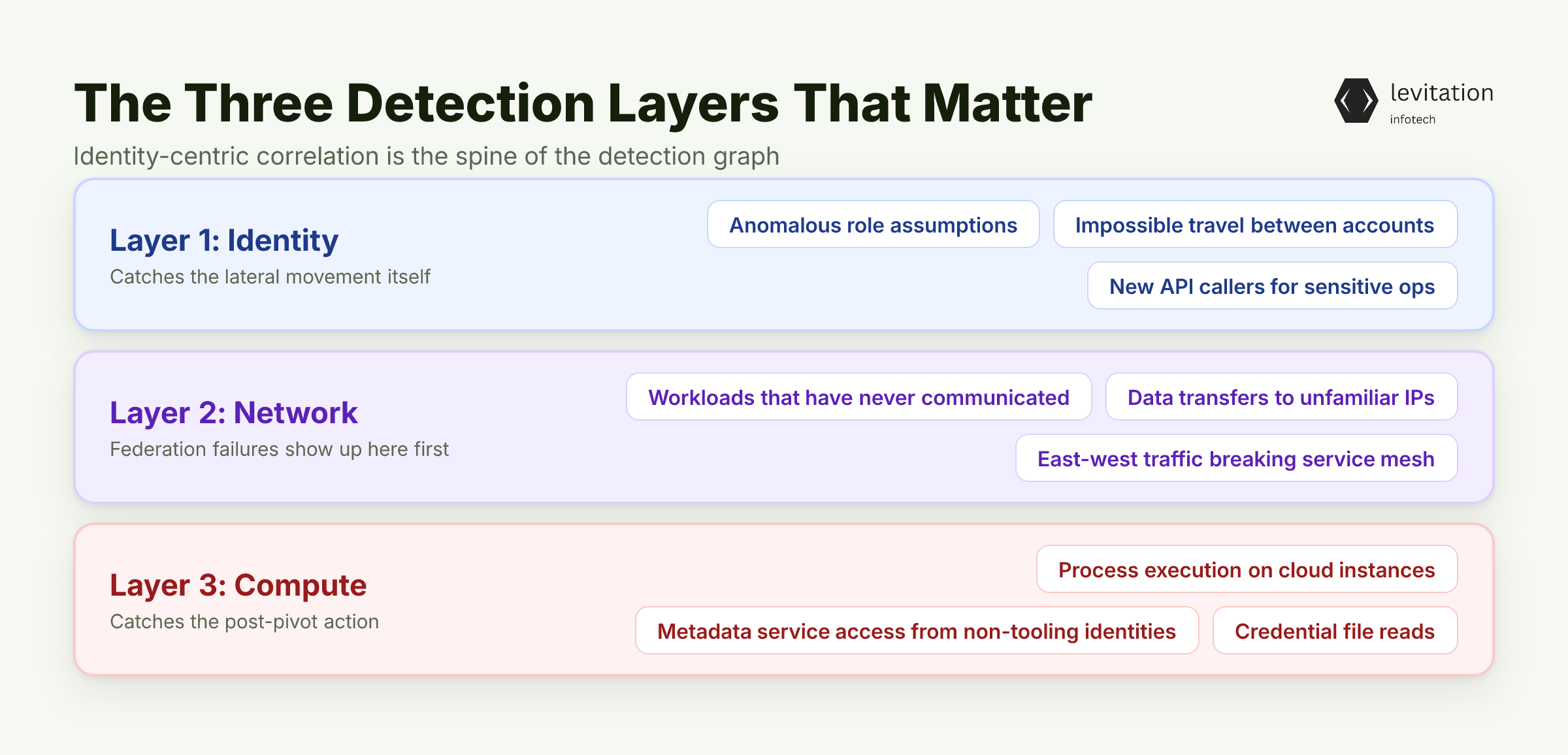
Layer 1: Identity. Anomalous role assumptions, impossible travel between accounts, and new API callers for sensitive operations. This layer catches the lateral movement itself.
Layer 2: Network. Lateral connections between workloads that have never communicated. Data transfers to unfamiliar IPs. East-west traffic that breaks the expected service mesh pattern. Workload identity federation failures often show up here first.
Layer 3: Compute. Process execution on cloud instances, metadata service access from non-tooling identities, and credential file reads. This layer catches the post-pivot action when the attacker is already running on your infrastructure.
Detection content without engineering discipline becomes shelfware. The next layer is the process that keeps it alive.
Engineer Detections, Don't Buy Alerts
Define use cases tied to attacker behavior, not vendor checkbox features. The detection should describe a specific adversary action. It should map to a MITRE ATT&CK technique. It should produce a triage path your analysts can run.
Prioritize log sources by detection value. Full CloudTrail data events outrank firewall logs for cloud lateral movement. Kubernetes audit logs outrank pod logs.
Order your pipeline by what catches the attack, not what is easy to ingest.
Establish measurable KPIs. MTTD for lateral movement, MTTR for containment, and coverage percentage of MITRE ATT&CK techniques. If you cannot measure it, you cannot improve it.
Knowing what to detect and how to engineer it is necessary. The harder question is how to operationalize it without burning out the SOC.
The Detection Engineering Stack That Closes the Gap
Tier your log sources by detection value: - Critical: CloudTrail data events, IAM activity, Kubernetes audit logs, workload identity logs. - High: VPC flow logs, EDR telemetry, DNS logs. - Contextual: Application logs, load balancer logs, CDN logs.
Build a managed detection layer for 24x7 coverage. Internal SOCs rarely staff the follow-the-sun coverage attackers exploit. A managed layer does not replace your team; it compresses the time between detection and triage.
Anchor the stack in zero trust and least-privilege IAM so detections have a clean baseline to compare against. If every workload has excessive permissions, behavioral baselining is noise. If every identity follows least privilege, the deviation signal is sharp.
Treat observability and security telemetry as the same pipeline. This approach reduces collection latency, eliminates tooling sprawl, and gives your SOC the context they need.
Operationalize through runbooks, not dashboards. Every detection should have a defined triage path, a containment action, and an escalation owner.
A detection platform is a long-running system, not a deploy-and-forget project. The teams that close the gap treat it as production infrastructure with SLOs, on-call coverage, and continuous tuning. That is the kind of operational durability a detection platform demands.
Architecture and process are necessary. But CISOs need to see what shifts in the metrics that matter to the board.
What Changes When 4 Days Becomes 4 Minutes
MTTD for lateral movement compresses from days to minutes. Not in vendor benchmarks, in real environments where detection content meets telemetry and runbooks meet on-call.
SOC alert fatigue drops. Detections are higher-fidelity because they are behaviorally contextualized. Analysts stop triaging noise and start triaging real movement.
Containment happens before exfiltration. The attack window shrinks from days to the duration of an automated response. The attacker does not get to complete their playbook.
Board-level reporting shifts. The conversation stops being "did we get breached" and becomes "how fast did we contain." That is a fundamentally different conversation, and it changes the security budget conversation too.
Detection latency is a board-level risk, not an operational footnote. The organizations that treat it that way understand the gap. Four minutes versus four days is the difference between contained incidents and front-page breaches.
Frequently Asked Questions
How long does it really take attackers to move laterally in a cloud environment?
Industry observations put cloud-to-cloud lateral movement at roughly four minutes from initial credential compromise to privilege escalation. Attackers chain legitimate API calls and valid credentials. The movement itself is fast even when the overall dwell time extends to weeks.
Why do traditional SIEM systems take days to detect lateral movement?
Traditional SIEMs were built for batch log collection, bounded event volumes, and perimeter-era correlation rules. In cloud environments, log collection introduces latency and query bottlenecks. Detection rules are tuned for signature-based threats, not identity-driven behavior.
What is the difference between cloud SIEM and traditional SIEM?
Cloud SIEM is built to ingest cloud-native telemetry at scale. That includes CloudTrail data events, VPC flow logs, Kubernetes audit logs, and identity provider logs. It correlates in real time and uses behavioral analytics, not static rules. Traditional SIEM treats cloud logs as another feed into a perimeter-era architecture.
What are the most effective detections for cloud lateral movement?
The highest-value detections focus on identity anomalies. These include AssumeRole events from unusual principals, new API callers for sensitive operations, cross-account role chaining, and metadata service access from workloads. Layer in network detections for workload-to-workload traffic that has never been observed before. Add compute detections for credential file access on cloud instances.
How do you reduce mean time to detect (MTTD) for lateral movement?
Prioritize identity-centric log sources. Engineer behavior-based detections rather than signature rules. Tier your log sources by detection value. Operationalize a managed detection layer for continuous coverage. MTTD compression from days to minutes is achievable when telemetry, detection content, and response runbooks are treated as one system.
Want to see what the four-minute-versus-four-day gap looks like in your environment? Get in touch.
Sources
Research and references cited in this article:
- Navigating the Cloud: Exploring Lateral Movement Techniques
- What Is Lateral Movement in Cybersecurity? | Orca Security
- What is Lateral Movement? Understanding Attacker Techniques | Wiz
- Lateral Movement: How to Solve the Cloud’s Biggest Risk - Illumio Cybersecurity Blog | Illumio
- Lateral Movement in Cybersecurity - Cast AI
- Understanding SIEM Detection Failures: Causes and Solutions for Effective Threat Detection - Secure Blog
- Stop Lateral Movement: Why Prevention Beats Detection Every Time - TerraZone
- The Evolution of SIEM: Leveraging New Solutions for Cloud Security
- Lateral Movement SIEM Usecases : r/cybersecurity - Reddit
- SIEM Cyber Security Capabilities, 4 Common Challenges & Solutions
- SIEM Implementation: Strategies and Best Practices
- Addressing SIEM Concerns in 2026 - Evolving Solutions
About the author
Mayank Singh is a software developer at Levitation Infotech, where he builds web and AI-powered applications across the company’s fintech, healthcare, and enterprise projects.