


TL;DR: Off-the-shelf SIEM correlation rules silently break in cloud-native environments because they're built for static hosts and stable IPs. The fix is rebuilding detection around identity, workload lifecycle, and schema-aware pipelines, not buying more detection content.
Key Takeaways: - Nearly 50% of SIEM detection failures trace to log collection problems, not analyst skill or rule quality - Cloud-native attacks exploit ephemeral workloads and IAM role chaining in ways traditional correlation cannot see - Detection content needs version-pinning, field-health checks, and identity-centric correlation to survive schema drift
Half of Your SIEM Rules Are Already Dead
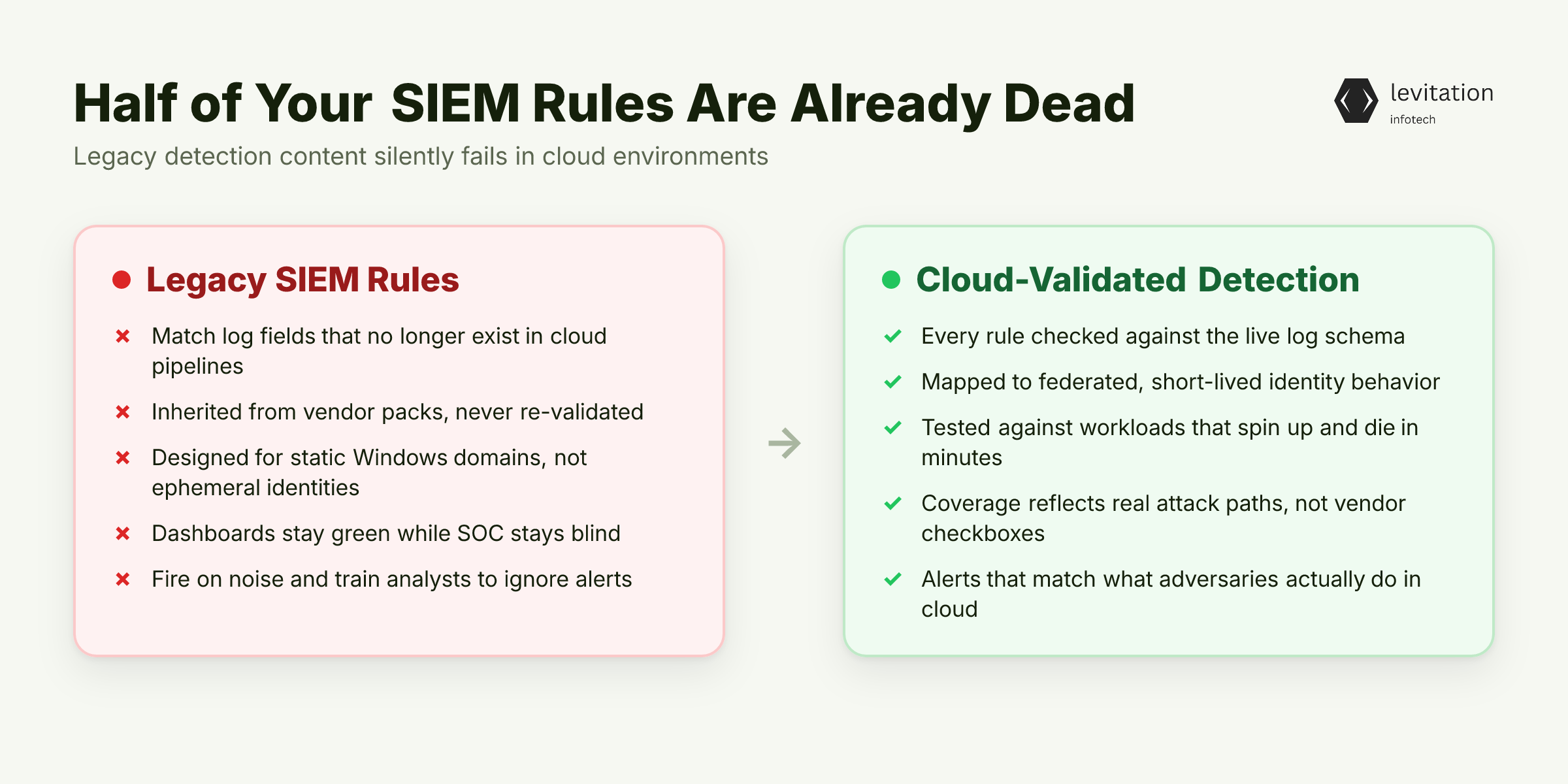
Nearly 50% of SIEM detection failures trace back to a single root cause that no vendor dashboard will show you. It's not what you think. It's not analyst skill. It's not budget. It's that many of the rules running in your SIEM right now match against log fields that no longer exist, in environments that no longer behave the way the rules assume.
Security teams inherit detection content from vendor packs, MITRE mappings, and open-source repos. The assumption is that more rules equal better coverage. The opposite is often true. A rule written for a Windows domain controller, shipped in 2019, and never re-validated against your CloudTrail pipeline is a rule that fires on nothing useful, or worse, fires on the wrong thing and trains your SOC to ignore alerts.
Most security architects inherit these rules and never question their cloud fit. The content came from a trusted vendor, mapped to a MITRE technique, and loads cleanly into the SIEM. The team rarely asks whether the schema it expects still exists. Field-population checks don't happen. The rule joins the thousands of others, ticking the coverage box, contributing nothing.
This is not a tuning problem. It is an architecture problem. Cloud security monitoring in 2026 is fundamentally different from perimeter defense in 2015. Workloads spin up and die in minutes. Identities are federated, ephemeral, and scoped to single API calls. The rules were not designed for this, and the failure mode is silent: the SIEM keeps ingesting, the dashboard shows green, and the SOC stays blind.
The real damage shows up in which attacks slip through, and which ones look nothing like what the old rules ever expected.
Cloud-Native Attacks Don't Match Old-School Playbooks
Traditional correlation assumes persistent hosts, stable IPs, and bounded sessions. Cloud-native attacks don't operate that way. An attacker who assumes an IAM role, pivots through a service account, and calls a Lambda function leaves a trail that looks like normal workload traffic. There are no failed logins. No port scans. No alertable brute-force patterns.
The attack surface is identity, not network. In a zero trust architecture, the network boundary is already dissolved. The trust boundary is the role assumption, the policy attachment, the API call. The log volume is a problem too: a single busy Kubernetes cluster can outpace correlation windows and storage budgets built for traditional data centers. The SIEM doesn't just need to store this data. It needs to find the one anomalous role assumption in ten million routine ones.
Vendor correlation rules look for signal in the wrong layer. They watch hostnames and source IPs that no longer point to stable assets, and authentication failures that don't happen. The attacker didn't fail to authenticate. They authenticated successfully with stolen or assumed credentials. The playbook never fires.
The problem is structural. Off-the-shelf rules correlate events within a single log source, within a fixed time window, against fields like `src_ip` and `dest_host`. Cloud attacks cross log sources. A role assumption in CloudTrail connects to a service-to-service mTLS handshake in your mesh, which connects to a `kubectl exec` call in Kubernetes audit logs. No single log source has the full picture. The correlation graph spans the entire control plane, and traditional SIEM engines don't model that. This is exactly why zero-trust IAM posture matters even for detection. The same identity relationships that attackers abuse are the only stable joins you have. Lose sight of identity, lose detection. But even when identity is the join key, a quieter failure mode still keeps the SOC blind.
The Schema Drift Problem Behind Silent Failures
Schema drift is the silent killer of cloud SIEM. Cloud providers update service APIs and log formats often. AWS adds new fields to CloudTrail events. Azure restructures its Activity Log schema. GCP changes resource type identifiers. Every change creates a moving target that vendor content packs cannot keep pace with.
The result: rules that worked last quarter match against fields that no longer exist. The SIEM ingests data normally. Dashboards show healthy ingestion rates. Alerts still fire, but on patterns that have shifted in meaning or on null values that always satisfy the condition. Detection coverage degrades week over week, with no visible signal in the SIEM's own health metrics.
This problem compounds in k8s environments. Audit log formats, RBAC events, and mtls-protected service-to-service calls each bring their own schema complexity. Infrastructure teams modify audit policies, change log forwarding, and consolidate log streams. Each change can silently break detection rules that were never re-validated. Your observability pipeline may also reshape the same fields in transit, adding to the drift downstream.
The mechanism is simple. A rule references `eventName=AssumeRole` and `userIdentity.sessionContext.sessionIssuer.type=Role`. The first field exists. The second was renamed in a provider API update. The rule now matches every event where the second field is empty, which is millions of records per day. The alert volume spikes, gets suppressed as noise, and the SOC moves on. The real attack, when it comes, looks identical to the noise the rule has been generating.
The fix is not a better SIEM. The fix is a detection pipeline that treats schemas as a first-class deployment artifact.
What Cloud-Aware Correlation Rules Actually Require
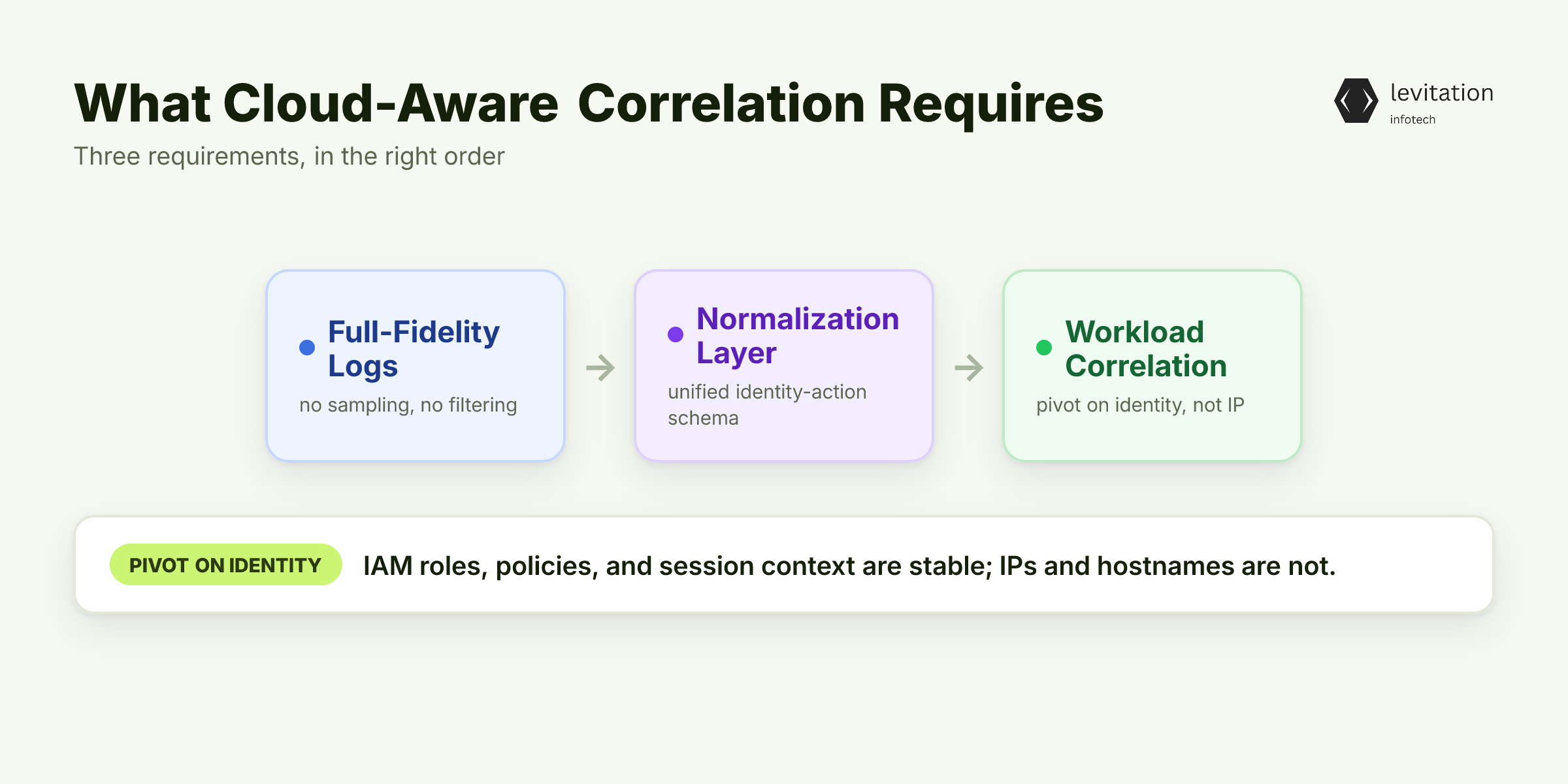
Three things. Full-fidelity log collection, not sampled or filtered. A normalization layer that maps provider-specific fields into a unified identity-and-action schema. And correlation against workload lifecycle events, not static host attributes.
Detection logic must pivot on identity, the role, service account, or workload identity, because that's the only stable signal in ephemeral environments. A pod's IP is meaningless when the pod lives for 90 seconds. A Lambda function's hostname is irrelevant when the function runs once and exits. But the IAM role it assumes, the policy attached at invocation time, and the session context from the calling service: those are stable. Those are correlatable. Those are what attackers actually exploit.
Event-level correlation, the kind most off-the-shelf rules do, joins individual log lines. Graph-based correlation joins IAM relationships, policy inheritance, and trust boundaries. To catch privilege escalation chains, you need the second. A role that assumes another role, which assumes a third with admin scope, is invisible to single-event rules. It's obvious when you graph the relationships.
1# Example: identity-centric correlation in a normalized schema2actor: arn:aws:iam::123:role/app-deploy3action: sts:AssumeRole4resource: arn:aws:iam::123:role/admin-tier5session_age_seconds: 46caller_chain: - arn:aws:iam::123:role/ci-runner - arn:aws:iam::123:role/app-deploy - arn:aws:iam::123:role/admin-tier7detection: privilege_escalation_chain
Observability signals become force multipliers here. Trace data, span IDs, and service-to-service latency patterns from your cloud infrastructure confirm or refute whether a suspicious API call was part of a legitimate workload chain. SIEM plus observability is a stronger detection stack than either alone.
Building that stack in the right order is where most teams get stuck, and the order matters more than the tools.
A Practical Framework for Rebuilding Cloud Detection
Here's a five-step sequence that teams can actually ship.
Step 1: Inventory and verify. List every cloud audit log source, CloudTrail, Azure Activity, GCP Audit, Kubernetes audit logs. For each, check not just that logs are flowing, but the schema version and field completeness. A CloudTrail log with global events disabled is missing the IAM data you need.
1# Verify CloudTrail configuration2aws cloudtrail describe-trails \3 --query 'trailList[].{Name:Name,S3BucketName:S3BucketName,IsMultiRegionTrail:IsMultiRegionTrail}'45# Check that management events include IAM6aws cloudtrail get-event-selectors \7 --trail-name prod-trail \8 --query 'EventSelectors[*].IncludeManagementEvents'
Step 2: Normalize to actor-action-resource. Build a mapping layer that transforms provider-specific fields (`eventName`, `operation`, `action`) into a single schema: who did what to which resource. This is the foundation every cloud-aware rule will sit on.
Step 3: Replace IP correlation with identity correlation. Rules join IAM events to workload lifecycle events from service mesh telemetry. A role assumption followed by a service mesh call to a sensitive service is the new "lateral movement" signal. Your service mesh mTLS posture shapes what telemetry is available for these joins, and gaps in that posture become gaps in detection.
Step 4: Build a detection rule health check. A script that runs daily and flags any rule whose referenced fields haven't appeared in ingested logs for N consecutive days. Silent failures become visible failures. Engineers fix them before attackers exploit the gap. The devops team treats detection content with the same CI/CD discipline as application code.
Step 5: Version-pin and deploy as code. Pin detection rules to specific cloud provider API versions. When AWS changes CloudTrail schema, your rules break in staging before they break in production. Treat rule updates as a Kubernetes deployment: tested, reviewed, rolled out with rollback.
Teams that ship this sequence stop depending on vendor content packs. They own their detection pipeline, they can audit it, and they can evolve it as the cloud evolves. The result is a detection posture that gets sharper as the environment changes, not noisier.
From Alert Fatigue to Actual Signal
The shift is visceral. Security teams stop chasing false positives from rules that no longer match reality. They start investigating alerts grounded in identity and workload context. Mean time to detect drops because correlation happens across the signals that actually matter in cloud attacks: role assumptions, policy changes, lateral API calls.
Detection coverage becomes measurable. A rule health check tells you which rules are firing and which are silent. A schema inventory tells you which fields are populated and which are stale. The "all green dashboard, blind SOC" failure mode becomes structurally impossible.
The cloud migration conversation changes once detection isn't the bottleneck it's been for the last decade. A few questions security architects ask once they start seeing the problem clearly.
Frequently Asked Questions
What are cloud-native attack patterns that off-the-shelf SIEM rules miss?
Cloud-native attacks center on identity abuse, IAM role chaining, service account compromise, and API-driven lateral movement. They exploit ephemeral workloads and short-lived credentials, producing log patterns that traditional correlation rules, built for persistent hosts and stable IPs, do not recognize as malicious.
Why do vendor SIEM content packs fail in cloud environments?
Vendor content packs are built against stable, on-prem log schemas. Cloud providers update their APIs and log formats often, and infrastructure teams routinely modify audit policies. When the underlying schema changes, rules keep running but match against fields that no longer exist, creating silent detection failures that dashboards do not surface.
How do you write SIEM correlation rules for cloud audit logs?
Effective cloud correlation rules pivot on identity (role, service account, workload identity) rather than IP or hostname. They correlate IAM events with workload lifecycle events and require normalized, full-fidelity cloud audit logs, not sampled or filtered streams. Detection logic should follow the actor-action-resource model consistently across providers.
What is schema drift in SIEM detection?
Schema drift occurs when the structure or meaning of log fields changes while SIEM rules still reference the original field names. The SIEM ingests data normally, alerts continue to fire, but the rules match against missing or renamed fields, leaving attack paths invisible. It is a leading cause of undetected SIEM failure in cloud environments.
How can security teams detect attacks in ephemeral cloud workloads?
Detection in ephemeral environments requires correlation across identity, API calls, and service-to-service communication, not host-based monitoring. Service mesh telemetry, Kubernetes audit logs, and cloud provider audit logs must be joined on workload identity and session context. Static indicators like IP or hostname are unreliable when workloads live for minutes.
Start with the schema audit: it surfaces the silent failures your dashboards have been hiding.
Sources
Research and references cited in this article:
- Cloud Security Threats in 2026: Top Risks & How to Defend
- 15 Must-Have SIEM Features for Modern Threat Defense in 2026
- Six Advanced Cloud-Native SIEM Use Cases for Enhanced Security | Exabeam
- What is Cloud SIEM?
- Top 25 Cloud Security Tips for 2026 - NetCom Learning
- Understanding SIEM Detection Failures: Causes and Solutions for ...
- Why SIEM Correlation Fails at Scale in Modern Environments
- Cloud SIEM and Modern Cybersecurity | CrowdStrike
- SIEM Correlation Rules: Fine-Tune Detection Logic at Scale
- SIEM Correlation Rules: Enhancing Your Threat Detection
- Best SIEM Tools for 2026: Compare 10 Leading Platforms
- What Is SIEM? The Cloud Native Security Evolution Guide | Wiz
About the author
Mayank Singh is a software developer at Levitation Infotech, where he builds web and AI-powered applications across the company’s fintech, healthcare, and enterprise projects.