


TL;DR: A 4-tool SaaS stack priced at ₹11.4 lakh/year looks cheaper than a ₹6 lakh custom build, until you add SSO fees, API overages, integration glue, and seat-based growth penalties. At roughly 70 active users, a single-codebase custom build crosses over and starts compounding in your favor every quarter. CEOs who run a 4-question filter on their workflow before signing a renewal save ₹20+ lakh over three years and gain a competitive moat their SaaS vendor will never prioritize.
Key Takeaways: - The 70-user mark is the break-even threshold where per-seat SaaS economics flip against you and a fixed-cost build starts compounding. - Hidden SaaS costs (SSO add-ons, API overages, integration glue) typically add 30-50% on top of the headline subscription quote. - A ₹6 Lakh build is realistic for an MVP, but plan for 30-40% contingency for the edge cases, compliance, and scale work. - The decision is not build vs buy. It is three paths: build, buy, or buy-and-extend with a custom layer.
The ₹11.4 Lakh Illusion: What 'Affordable' SaaS Actually Costs Per Year
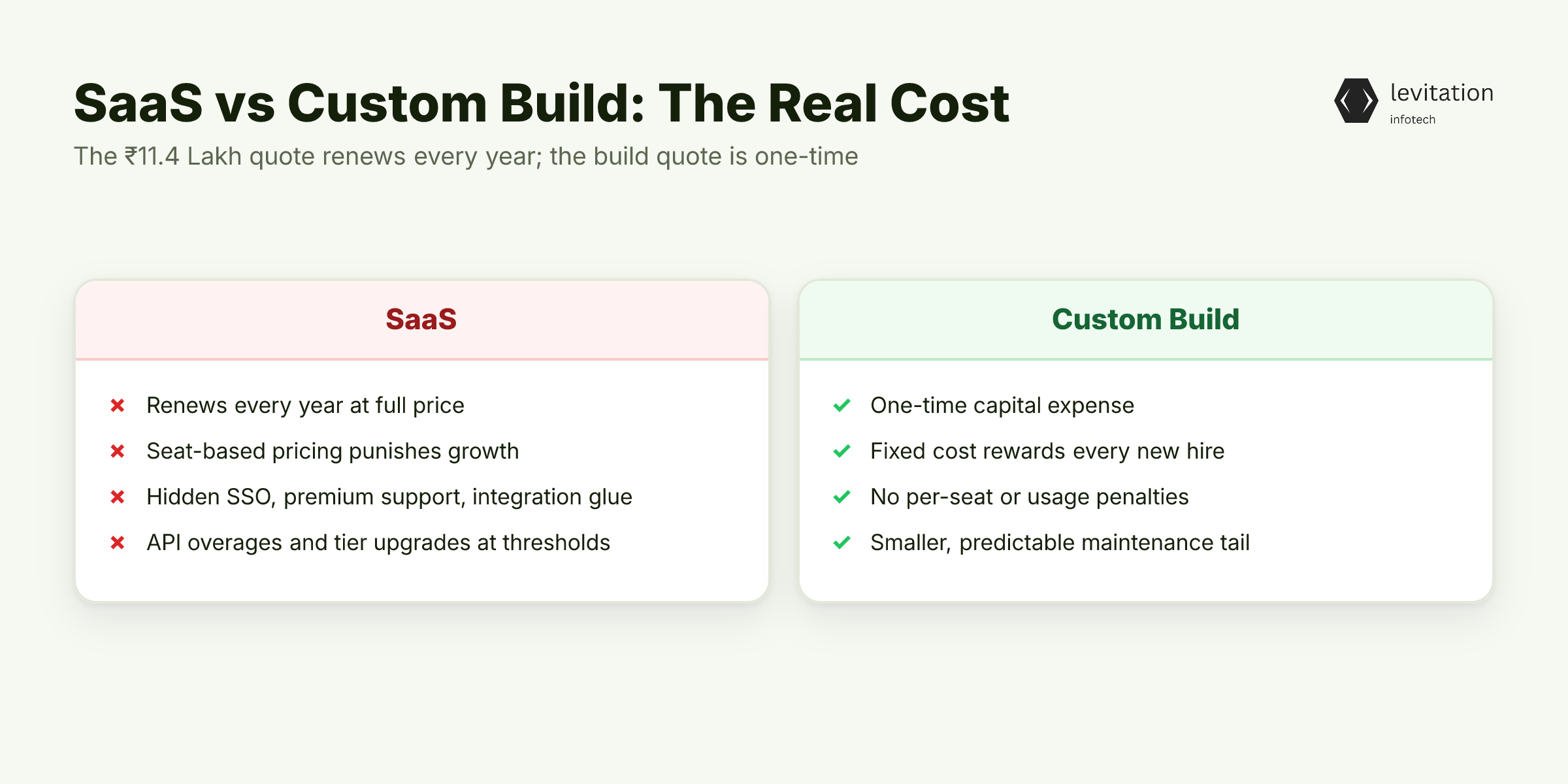
Four "affordable" SaaS tools start at one annual figure. By month 18, the bill has crept past ₹11.4 lakh. SSO add-ons, premium support tiers, and integration glue (Zapier, Make, custom middleware) push it higher.
The headline price renews every year. Tier upgrades trigger at user thresholds. API overages arrive monthly. Integration overhead grows with stack size.
The trap is the comparison itself. Finance teams anchor on the ₹6 Lakh custom software development cost in India quote. They see it as expensive next to ₹11.4 Lakh spread across four subscriptions. They aren't comparing the same thing.
The SaaS figure renews every year. The build figure is a one-time capital expense with a smaller maintenance tail.
Seat-based pricing punishes growth. Fixed-cost build pricing rewards it. Every new hire, every contractor, every new region adds to the subscription line item. The build doesn't care.
Industry data from build vs. buy surveys shows more enterprises replacing SaaS with custom software. That isn't a fringe movement. It's the new center of gravity. Companies still treating ₹11.4 Lakh as "affordable" are the ones falling behind. This pattern mirrors what we tracked in 78% of Indian SMEs Quit SaaS. The 22% Who Stayed Pay 3x More.
The subscription line item is the smallest part of the bill. The real damage shows up in the rows your finance team never flags.
Why Four Tools Became Seven (and Your Operations Team Stopped Talking)
The "best-of-breed" trap works like compound interest in reverse. You start with a CRM, a helpdesk, and an analytics tool. Three tools, clean boundaries.
Then a workflow tool arrives because someone read about it on LinkedIn. Then a chat platform gets added because support needs a shared inbox. Then contract management shows up because legal flagged the previous one.
The first year, you have four tools. By year three, you have seven. None of them were planned together.
The hidden cost categories are predictable: - Per-seat tier upgrades that activate the moment you cross a user threshold - API call or workflow execution overages billed monthly - SSO, audit log, and advanced security add-ons that unlock only at enterprise pricing - Integration glue (Zapier, Make, custom middleware) that grows with stack size
Each new tool adds 10-20% integration overhead. Not in the vendor's marketing. In your team's actual workflow.
When a process change touches 4 tools, it now touches 4 vendors. It touches 4 contracts, 4 support queues, and 4 renewal cycles.
Your operations team stops trying to align them. They start building spreadsheets to track the differences.
A single SaaS application development project flips this. Workflow logic lives in one codebase. One release cycle. One vendor relationship.
The cross-tool report that runs instantly in a unified stack queries a single database. No API handoffs. No vendor throttling.
The same blind spot that catches founders on the other side of the line shows up here too. We covered it in You Crossed the Build vs Buy Line. Build Costs Hide..
If SaaS gets expensive at scale, the obvious move is to build. That's where most CEOs miscalculate the second time.
The Build Cost Nobody Quotes You on the First Call
A ₹6 Lakh build quote is real. It's also incomplete.
The number that anchors most vendor pitches covers UI, backend API, and database design. It includes one or two core integrations, basic admin, and 3-4 months of engineering. The team is usually based in Noida or NCR.
It typically does not include SSO integration, advanced reporting, audit logs, or compliance documentation.
The real number to anchor on is the MVP cost plus 30-40% contingency. Build costs scale non-linearly.
The first 60% of features is fast. Edge cases, compliance, scale, and the integrations you didn't think about on day one are where budgets explode.
The vendor quoting ₹6 Lakh knows the project will land closer to ₹8-9 Lakh by month five. They just can't price the unknown yet.
This is the mirror of the SaaS trap. SaaS vendors hide fees in tier upgrades and overages. Build vendors hide maintenance in the post-launch conversation.
The pattern repeats across enterprise deployments in regulated industries. The ₹6 Lakh build becomes an ₹8 Lakh project. The year-two maintenance conversation catches founders off guard.
Set up the comparison fairly. The real decision is not ₹6 Lakh vs ₹11.4 Lakh. It's ₹8-9 Lakh build plus ₹2 Lakh/year maintenance vs ₹11.4 Lakh/year SaaS that scales with every headcount you add.
Once you strip the marketing off both numbers, a single variable decides the entire decision.
The 70-User Break-Even: When a ₹6 Lakh Build Wins on Pure Math
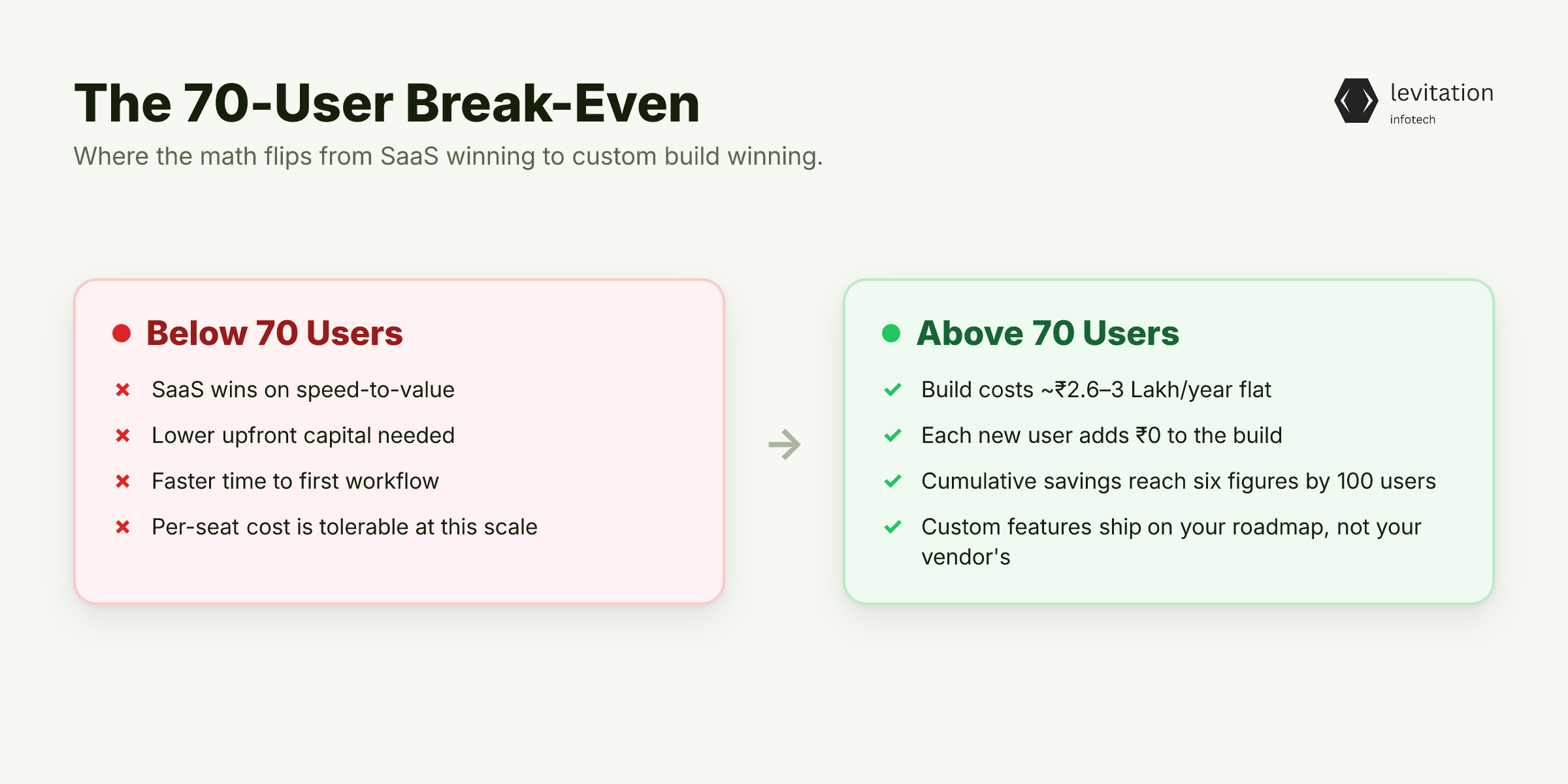
A realistic ₹8 Lakh build amortized over 3 years is roughly ₹2.6 Lakh/year. Add a ₹2 Lakh/year maintenance layer. That puts the build path at ₹2.6-3 Lakh per year.
The SaaS path holds at ₹11.4 Lakh per year. It rises with every new user you add.
The crossover lands at roughly 70 active users. Below that, SaaS wins on speed-to-value. Above it, every additional user costs you money on the SaaS side. On the build side, it costs nothing.
By the time you reach 100 users, the cumulative delta is already six figures. Custom software development becomes cheaper on pure math, and a competitive moat on strategic ground.
Why 70, not some other number? The threshold depends on three variables: per-seat price, integration depth, and feature utilization.
Most teams use 30-40% of what they pay for in any given SaaS tool. The unused 60-70% is the cost of the seat model itself.
The higher your per-seat price and the deeper your integrations, the lower your break-even user count gets. This mirrors the dynamic we documented in Why Founders Pick Custom Software at 10 Users. Regret It at 200, just inverted.
The same seat-based math that punishes early custom builds rewards later ones past the threshold.
Beyond the math, a custom build becomes a strategic asset at scale. You can ship features your SaaS vendor will never prioritize. Those features only matter to your workflow.
SaaS development done in-house lets you move at the speed of your roadmap, not your vendor's.
Build vs. buy survey data validates that the 70-user threshold is no longer the fringe case. It's the mainstream.
Knowing the break-even point is half the answer. The other half is knowing which of your tools is actually worth replacing.
A Build vs Buy Framework Your CFO Can Run This Quarter
Four questions, one decision. Run them honestly and you'll have your answer before the next budget review. - Is the workflow a competitive differentiator? If yes, build. If it's commodity, buy. - Will you have 70+ active users in 18 months? If yes, build or buy-and-extend. If no, buy. - Does any vendor cover 80%+ of your requirements out of the box? If yes, buy or buy-and-extend. If no, build. - Can you stomach 3-6 months of build time? If no, buy. If yes, consider build.
A SaaS MVP sits in the middle of the matrix. Ship a scoped custom build first. Validate the workflow, then expand if it sticks.
This avoids the all-or-nothing trap. Founders either over-build a prototype or under-buy a vendor they outgrow in 12 months.
The red-flag list for SaaS contracts is short and lethal: - Per-API-call pricing: the bill grows with your product's success, not its users - Per-GB storage or transfer fees: the data gravity you want becomes the cost you can't escape - Per-workflow execution charges: every automation you add is a new line item
Any vendor that charges on usage metrics instead of seats is pricing for their growth, not yours. Past 70 users, those cost curves always break against you.
Custom software development systems that survive 5+ years in production do so for one reason. The workflow fit the business closely enough to evolve with it instead of fighting it.
Run this filter once and you'll know your answer. Here's what the next 3-5 years look like when you get it right.
What Year 3 Looks Like When You Build Instead of Buy
The compounding math tells the story. Three years on the SaaS path: ₹11.4 Lakh × 3 = ₹34.2 Lakh in subscriptions. Three years on the build path: ₹8 Lakh build + ₹2 Lakh/year maintenance × 3 = ₹14 Lakh.
The delta is over ₹20 Lakh. That money stays in product, hiring, or growth. It doesn't disappear into a vendor's renewal cycle.
Operationally, the difference is sharper. One codebase. One release cycle. One vendor relationship: your own team.
That replaces 4-7 vendor relationships with staggered renewals, support escalations, and pricing negotiations. The hidden tax of multi-vendor SaaS is the meetings, not the line items.
The compliance and longevity upside matters more than the math for some industries. Engineering quality that survives 5+ years in production is what separates a real build from a prototype.
When the software touches regulated data, control over the full stack matters. It's the difference between passing an audit and rebuilding from scratch.
The team that gets this right doesn't look back at year three. They look forward to year five. By then, the build has compounded into a feature set the SaaS vendor still hasn't shipped.
Frequently Asked Questions
At what number of users does building custom software become cheaper than SaaS in India?
For most mid-market workflows priced at ₹11-12 Lakh/year across multiple SaaS tools, the break-even lands around 70 active users. Factor in per-seat growth, integration overhead, and 3-year amortization.
Below 70, SaaS usually wins on speed-to-value. Above 70, a custom build compounds in your favor every quarter.
What does a ₹6 Lakh custom build actually include in India?
A realistic ₹6 Lakh MVP covers UI, backend API, database, and basic admin. It includes one or two core integrations plus 3-4 months of development from a Noida or NCR team.
It does not typically include SSO, advanced reporting, or full compliance documentation. Plan an additional 30-40% for those layers.
What do build vs buy surveys say about enterprises replacing SaaS with custom software?
Recent industry surveys show a growing share of enterprises moving from SaaS to custom builds. The same seat-based economics apply in India 12-18 months behind US peers.
Dollar-denominated SaaS pricing is even more punishing when converted to INR. The direction of the trend is identical. Only the timeline shifts.
What are the hidden costs of SaaS that break the build vs buy math?
The four biggest are per-seat tier upgrades as you add users. Then API call or workflow execution overages. Then SSO, audit log, and security add-ons that unlock only at enterprise pricing. And integration glue tools like Zapier, Make, or custom middleware that grow with your stack.
When should a CEO choose buy-and-extend instead of a full custom build?
Buy-and-extend wins when a credible vendor covers 80%+ of your workflow out of the box. Your differentiator lives in the last 20%.
Typically a custom integration layer, a proprietary calculation, or a customer-facing portal bolted onto the core SaaS. Full custom builds only make sense when the workflow itself is the differentiator.
Map these four questions to your actual seat counts and tool list before your next renewal. The answer is rarely ambiguous once the numbers are honest.
About the author
Mayank Singh is a software developer at Levitation Infotech, where he builds web and AI-powered applications across the company’s fintech, healthcare, and enterprise projects.