


TL;DR: The SaaS invoice on your books is the honest number. The custom build quote is the lie. Build costs scatter across cloud bills, headcount allocations, compliance sprints, and abandoned features where no dashboard can catch them. FinOps gives CEOs the method to surface these hidden cost buckets. Once surfaced, they often show a custom build as more expensive than a five-year SaaS subscription, and far less controllable.
Key Takeaways: - SaaS bills live where finance can see and challenge them. Build costs hide where finance can't. - A five-year build vs buy comparison often converges at similar totals. Only one side has a line item you can cut. - Build only when the software is a differentiator. Buy when it is a commodity. Buy-and-extend for the 80% fit.
Your Build Quote Was the Cheap Part
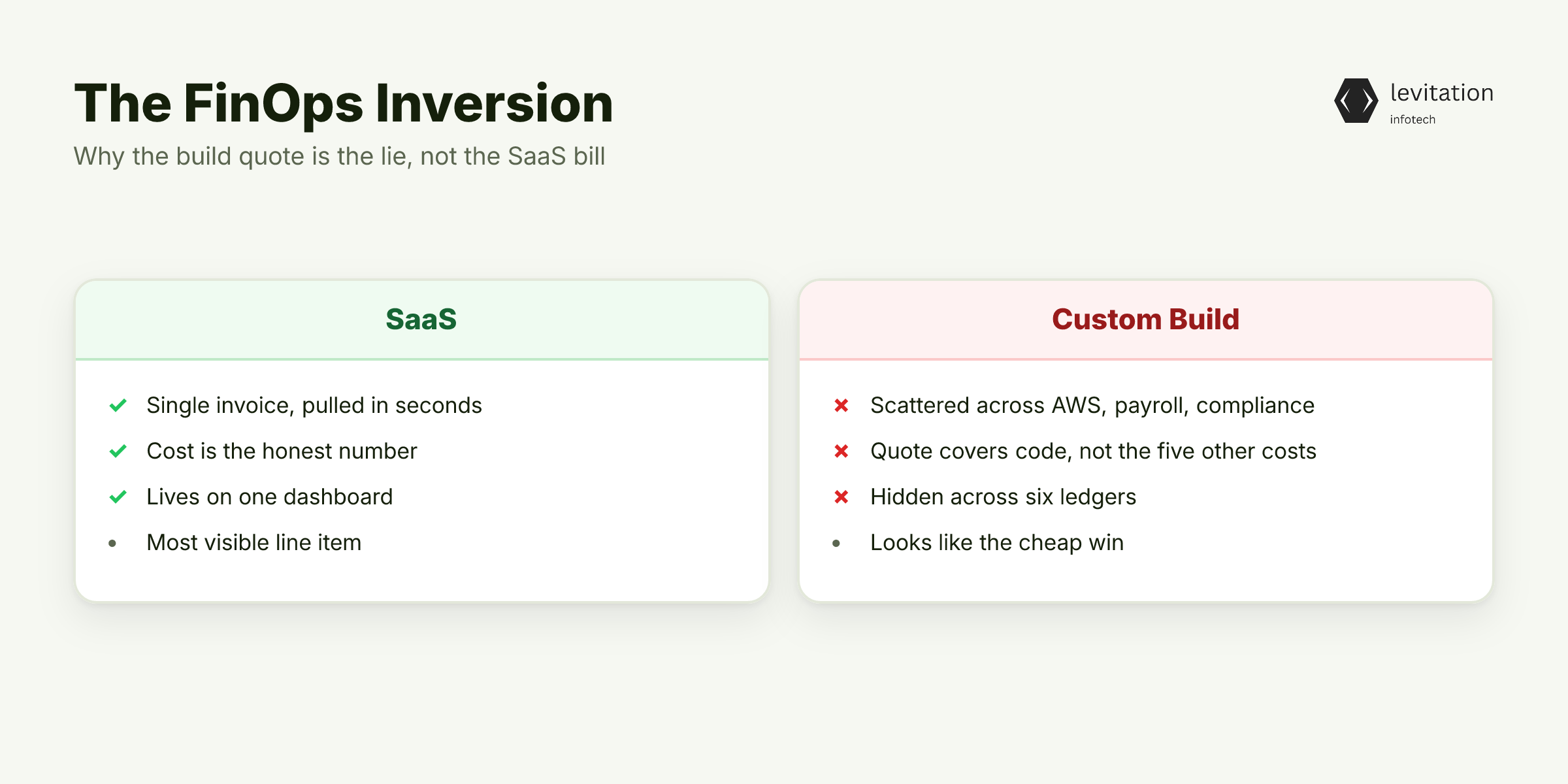
Your finance team can pull up every SaaS invoice you've paid this quarter in under a minute. Try doing the same for the custom software your team built last year. The real cost is scattered across AWS bills, payroll allocations, compliance sprints, and features no one uses.
The SaaS bill is the honest number. The build is the one hiding in plain sight.
CEOs instinctively compare a one-time build quote against an annual SaaS subscription. They assume the build is the long-term win. That instinct is wrong. The build quote covers the code. It does not cover the five other places that cost lives once the system goes live.
The FinOps inversion is this: SaaS is the most visible line item on your books. Build is the one that scatters.
A real comparison often lands at similar five-year totals. One published model shows a $700K build against a $700K SaaS path. But only one of those numbers can be pulled up on a dashboard. The other lives in six different ledgers. The visibility gap is not an edge case. It is the default state.
So why does every board see the build quote first, and treat it as the truth?
Why the Spreadsheet Comparison Always Favors Build
The reason is not bad logic. It is the accounting illusion.
A capitalised build asset looks smaller than five years of opex SaaS fees stacked together. Finance treats the build as a one-time hit, amortised across useful life. The SaaS subscription looks like a recurring bleed.
Boards prefer the visible certainty of a single line on a capex schedule. They avoid the recurring drain they have to renew every year. That framing ignores what the build actually costs once deployed.
The hidden costs the build quote misses: - Implementation and integration for enterprise SaaS still runs 6 to 18 months, even on the buy side. - Training and change management add another layer your vendor quote does not capture. - A half-time admin role to keep the system running costs about $40,000 a year in the published model. - The gap between quote and deploy swallows scope, time, and budget before production.
The buyer bias runs deeper. Built software feels like an asset on the balance sheet. So it gets treated as a sunk cost once deployed. Nobody questions a sunk cost the way they question a renewal.
Finance will renegotiate a SaaS contract line by line. They will not go back and audit the build that already shipped.
There is a deeper reason this keeps happening. It is not bad math. It is a visibility problem baked into how software spend is reported. SaaS projects get line-itemed, reviewed, challenged. The build does not.
If the math is not the problem, what is? And who catches it first in your org?
The FinOps Flip: Bought Software Has Better Cost Visibility Than Built
Here is the counterintuitive take: bought software is not cheaper than built software. It is more visible.
A SaaS bill lives in the expense feed, the renewal calendar, and procurement's spend reports. Anyone in the org can pull it up. Anyone can question it. Anyone can cut it.
The CEO can walk into a board meeting and answer "what did we spend on software last quarter" in thirty seconds.
A built tool's cost scatters across cloud infrastructure invoices, headcount allocations, regulatory-update sprints, and features that never shipped. There is no single line item to review. There is no single vendor to renegotiate. There is no single page to print for the audit committee.
The five-year math often converges at a similar total. The difference is governance. You can govern what you can see.
This leads to a clean decision rule: - Build only when the software is a competitive differentiator. - Buy when it is a commodity: CRM, HRMS, ticketing, dashboards. - Buy and extend when you need 80% of an existing product.
If the build side hides costs across multiple categories, what are those categories? And how do you price them? That is where most leadership teams stall. The cost-visibility problem is what finance teams escalate first. It is rarely the engineering team that flags it.
The Five Hidden Cost Buckets Your Build Quote Forgot
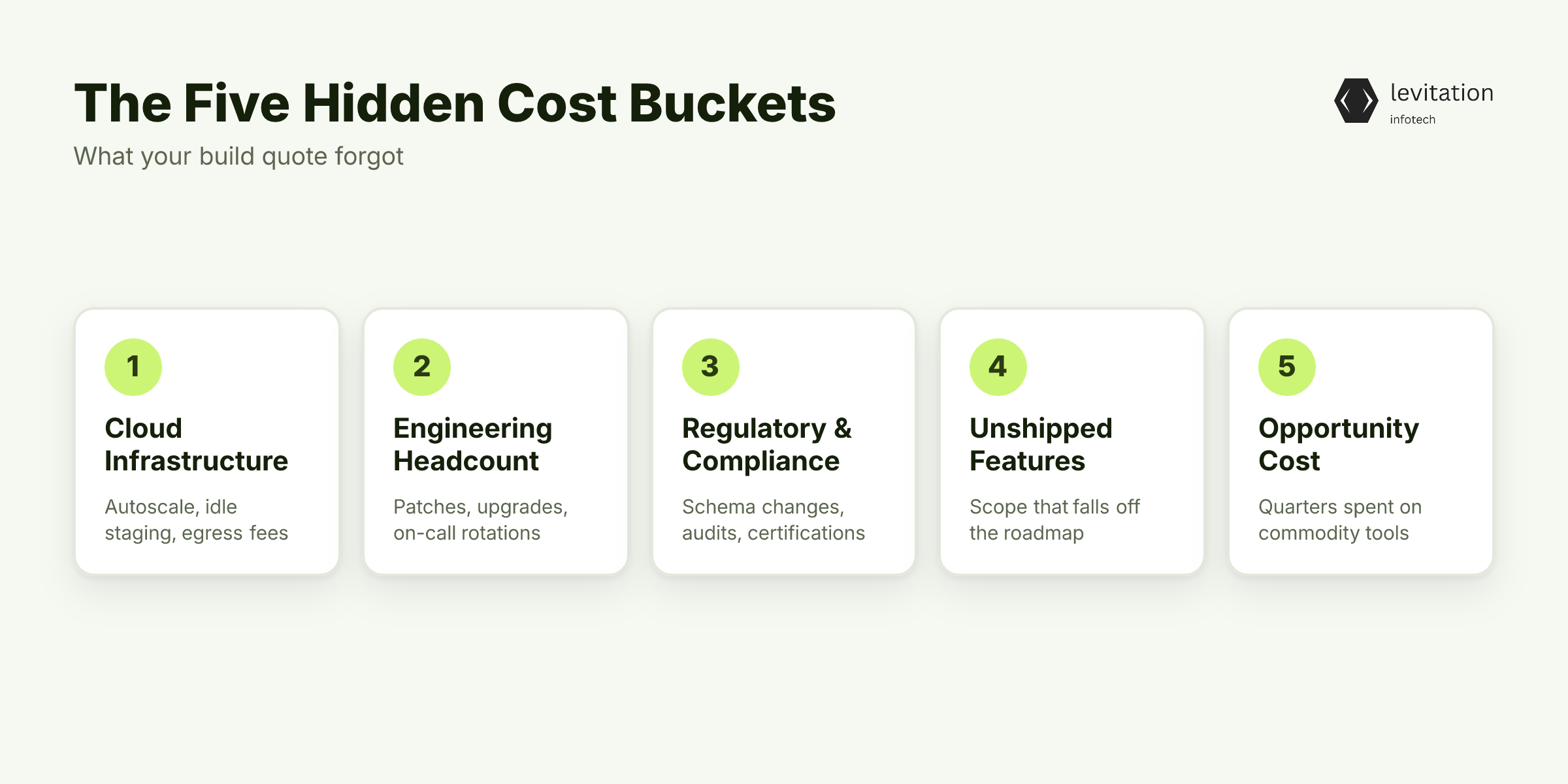
Every custom build absorbs cost in five places your quote did not price. Here is each one, and why it stays hidden.
Cloud Infrastructure. Autoscale events, idle staging environments, and egress fees compound after launch. Cloud spend that compounds over years rarely ties back to a specific project. Most of it shows up under a single cloud-provider line that nobody attributes back to the build. Cloud cost overruns hit FinOps dashboards late, after the spend is already in the books.
Engineering Headcount Allocation. Engineering hours get split across teams and projects. Maintenance time never appears in a single project ledger. Patches, dependency upgrades, and on-call rotations consume ongoing time from senior engineers whose salaries are paid centrally. Application development teams almost never track this in the project ledger, which is why it stays hidden.
Regulatory and Compliance Updates. In healthcare and finance, compliance updates can dominate year-two engineering effort. Schema changes, audit trail requirements, and certification renewals all need engineering hours the original scope did not include. The maintenance layer is where most builds bleed out, and it is rarely scoped up front.
Features That Never Shipped. Feature scope typically exceeds what actually ships. Items that fall off the roadmap still cost the full build and QA cycle. Someone wrote the code, reviewed it, tested it. Then it never went live. That cost lives nowhere. It is the most hidden bucket of all.
Opportunity Cost. Every quarter your engineering team maintains a commodity tool is a quarter they are not building core IP. The salary is the same. The output is not. Backend maintenance for a non-differentiator is the most expensive line on your books because it shows up as payroll, not as software spend.
Knowing the buckets is one thing. Pricing them in a real comparison is where most leadership teams stall.
How to Run the Real Build vs Buy Math (In Five Steps)
Here is the five-step method we run with CEOs who want the honest number.
Step 1: Price the SaaS Total at Five-Year TCO. Include license, implementation (the published model uses about $100,000 in year one for enterprise rollouts), and a half-time admin. This gives you a defensible number for the buy side.
Step 2: Add the Five Hidden Build Buckets. Cloud, headcount, compliance, abandoned features, opportunity cost. Price each separately. Do not blend them into the original quote. Blending hides them again, and that is the trap you are trying to escape.
Step 3: Apply a Maintenance Multiplier on Year One. Research shows a built tool's maintenance often runs several times its original cost. Apply a multiplier, then let it taper in years two through five.
Step 4: Assign an Abandonment Rate to Feature Scope. Internal builds typically see a portion of their scope fall off before launch. That abandoned scope takes the full build and QA cost with it. Cut that abandoned scope from the build quote before comparing. If the build still wins, it was genuinely the right call.
Step 5: Compare Like-for-Like at Year Three, Not Year One. That is when the hidden buckets start showing up on the P&L. Year-one comparisons always favour the build. Year-three comparisons reveal the truth. For SaaS product development and software development cost India decisions, the three-year mark is the honest comparison point. MVP cost projections almost never hold to year three for this reason.
When the build still wins after this exercise, it is a real signal. The teams that get this right run the math before the first line of code.
Once the math is honest, the decision almost makes itself. Here is what changes in practice.
What Changes When You Price Build at Total Cost of Ownership
Capital allocation gets sharper. You stop building commodity functions and start buying them, freeing engineering for differentiators.
Vendor management gets sharper too. You stop buying software for differentiators you should own. You stop renewing SaaS you should have built.
Finance gets a defensible audit trail. Every software spend now lives on one page of a FinOps report instead of across six ledgers. The CFO can answer the board's "what did we spend on software" question in one sentence.
The real outcome for the CEO is faster time-to-value on commodity work, and defensible moats on the 20% of software that drives margin. Cost of custom software decisions stop being gut calls. Software development price negotiations stop being vendor-led. Buying SaaS for HRMS becomes obvious.
This is how TCO-led decisions kept build budgets defensible at board review for the leadership teams we work with. The quote is not the conversation. The five-year P&L is.
Run the five-step math before your next build review.
Frequently Asked Questions
When should an Indian SME build instead of buy software?
Build only when the software is a competitive differentiator. Build when no mature vendor covers the requirement. Build when you have engineering capacity plus a multi-year commitment to maintain it. For everything else (CRM, HRMS, internal dashboards, ticketing), buying SaaS is almost always the lower-risk, lower-total-cost option once the five hidden cost buckets are priced in.
What is a realistic build vs buy cost threshold in India?
Most SMEs find the crossover point at year-one build spend well below the total of a multi-year SaaS subscription. Below that, a custom build can make sense for a narrow workflow. Above it, a multi-year SaaS subscription plus integration usually wins on total cost of ownership, especially once cloud, headcount, and compliance upkeep are added.
How do you account for hidden costs in a build vs buy analysis?
Add five buckets to the build quote: cloud infrastructure, engineering headcount allocation (which gets split across teams and projects), regulatory and compliance updates, features that never ship, and opportunity cost. Price each separately and apply a maintenance multiplier on year one that reflects how upkeep grows over time. That gives a number that can be compared honestly against a five-year SaaS TCO.
Is outsourcing custom software development to India cheaper than buying SaaS?
Outsourcing reduces the upfront build cost compared to in-house, but the ongoing maintenance, cloud, and compliance costs remain. The honest comparison is outsourced build TCO versus five-year SaaS TCO, not outsourced build quote versus annual license fee. For a full cost breakdown, the same five-bucket math applies to any outsourcing decision. Once you run that comparison, SaaS wins for most commodity functions.
How long does a custom software build actually take for an SME?
A focused MVP can ship in months. Production-grade systems with integrations, security review, and compliance scope run longer. Enterprise rollouts, even on the buy side, still run 6 to 18 months. That is why a like-for-like comparison should be made at the three-year mark, not the one-year mark.
About the author
Mayank Singh is a software developer at Levitation Infotech, where he builds web and AI-powered applications across the company’s fintech, healthcare, and enterprise projects.