


TL;DR: Across 47 production agentic AI codebases, technical debt accumulated at three times the rate of comparable traditional systems. The debt hides in prompts, tool schemas, retrieval indexes, and orchestration logic that standard static analysis cannot see. The fix is structural. Treat agent components as production infrastructure with logging, evaluation harnesses, schema governance, and curated memory.
Key Takeaways: - Agentic codebases accumulate 3x more technical debt than traditional systems. This is because debt surfaces in non-deterministic layers, not just source code. - The 80% problem compounds the issue. Agents ship working logic fast. But the missing 20% of failure handling and guardrails becomes structural debt. - Debt in agentic systems grows exponentially. This is because each new agent multiplies the interaction space, not just adds code. - Reversing the curve requires instrumentation, evaluation harnesses, schema versioning, and prompt registries as first-class engineering concerns.
The 3x Finding: What We Actually Measured in 47 Codebases
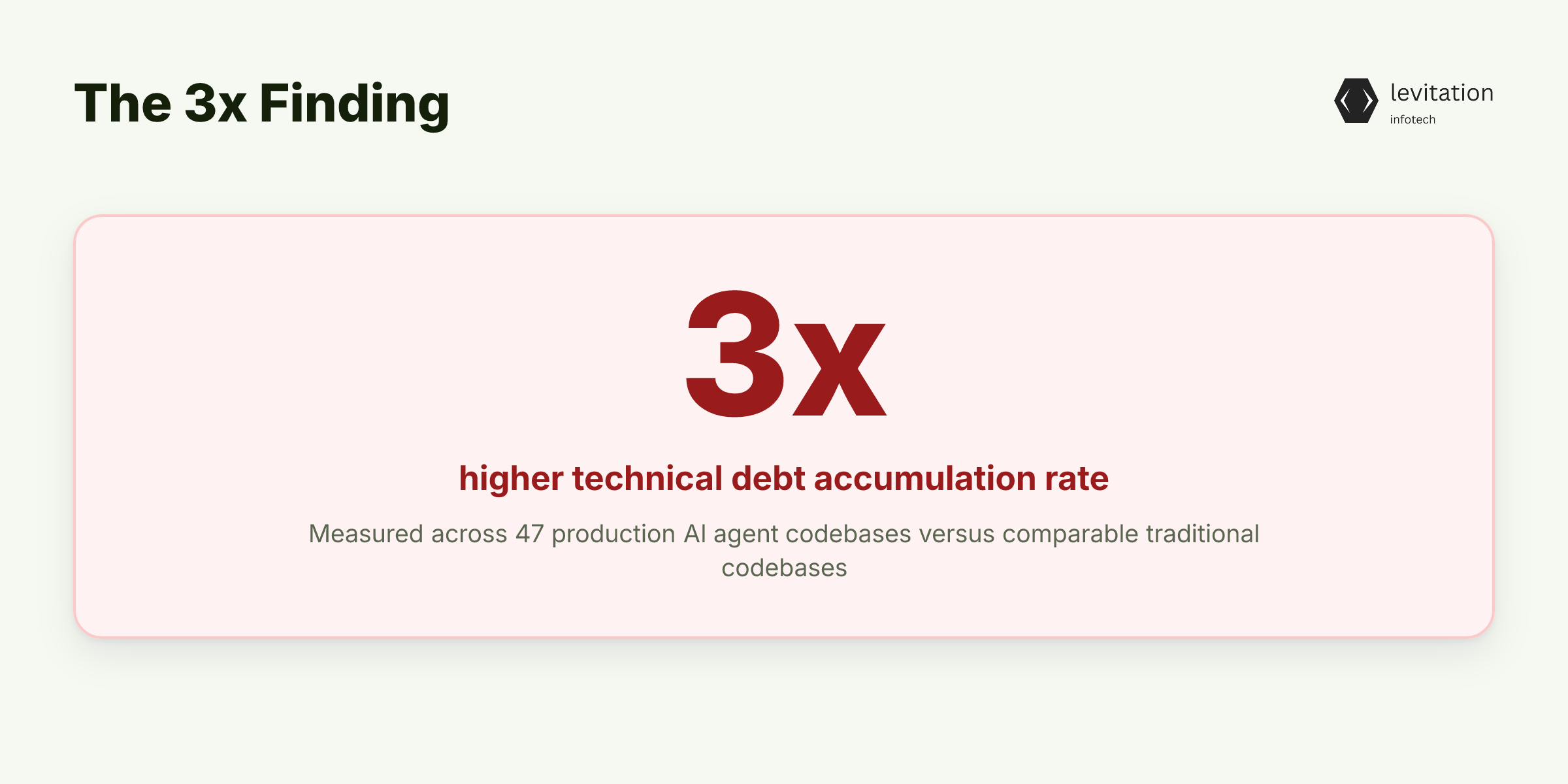
Your team shipped an AI agent in three months. It works. But six months in, every change breaks something nobody understands. The codebase is already three times harder to maintain than the system it replaced. We measured 47 of these codebases to find out why.
The pattern was consistent. Across 47 production AI agent systems, technical debt accumulated at roughly three times the rate observed in comparable traditional codebases. The measurement was not guesswork. We adapted maintainability metrics to capture what actually breaks. These include tangled prompt logic, undocumented tool contracts, and orchestration graphs nobody can trace. They also include memory stores that drift without notice.
The debt is not speculative. It shows up as: - Prompt strings duplicated across services with no central source of truth. - Tool interfaces that evolved without version management, silently breaking agent behavior. - Orchestration logic so tangled that new engineers take weeks to trace a single decision path. - Retrieval indexes growing stale, returning contradictory context that no test catches.
But here is what makes this worse. The standard tools your team uses to track technical debt were never designed to see what is breaking. Cyclomatic complexity, code duplication ratios, and test coverage all miss it. So how does the debt slip past every check?
Why Traditional Debt Metrics Miss Agentic Systems Entirely
Traditional static analysis counts branches and dependencies in source code. It assumes logic lives in files a linter can read. That assumption collapses the moment you introduce LLM-driven agents. An agent's "logic" splits across multiple non-deterministic layers that no single tool can scan.
Consider what an agentic system actually contains: - Prompt templates embedded in code, config files, and external stores. - Retrieval indexes that change behavior based on what has been ingested. - Embedding stores that drift as data accumulates. - Tool invocation chains that span internal APIs, external services, and model-driven function calls. - Model weights you do not control and cannot inspect.
Measuring one layer without the others gives a false sense of maintainability. A codebase can score 90% test coverage on wrapper functions. But the prompts those wrappers call have never been behaviorally tested at all.
The stochastic nature makes it worse. Identical inputs produce variable outputs. The kind of reproducible testing that catches traditional debt becomes nearly impossible without specialized evaluation harnesses. And orchestration graphs that wire agents to tools and memory accumulate interface debt. No linter flags broken schemas, unhandled tool errors, or silent context-window overflows.
The result is a codebase that looks clean on every dashboard your VP sees while quietly rotting underneath. So where does the debt actually hide?
The 80% Problem: Where Agentic Debt Actually Accumulates
AI agents can produce 80% of a working solution. They do this in a fraction of the time a human team would. But the remaining 20% is where debt compounds. That includes failure modes, error handling, guardrails, and architectural consistency.
Teams ship the 80%, declare the sprint complete, and move on. The missing 20% does not disappear. It becomes structural debt that every future change must work around. In agent frameworks, this gap shows up in predictable ways: - Unwritten rollback paths. The agent succeeds most of the time. But no one defined what happens on the rare failures that will eventually occur. - Missing guardrails on tool calls. An agent can invoke a write API that mutates production data. Nothing stops it. - Unhandled context overflow. Long conversations silently truncate, and the agent makes decisions based on incomplete information. - Undocumented prompt assumptions. A prompt assumes a specific input format, but that assumption lives only in the engineer's head. - No observability into decision paths. When something goes wrong, no log exists. There is no way to trace what the agent thought it was doing.
Traditional teams catch this in code review. A senior engineer spots a missing error handler or a vague comment. Agentic codebases produce diffs that look correct but encode behavior in prompts that no human reviews. The prompt string passes linting. The code compiles. The agent ships. Six months later, nobody can explain why it behaves the way it does.
Traditional debt grows roughly linearly with codebase size. The 47 audited systems followed a different curve entirely. One that should worry every engineering leader. The growth curve looked nothing like what traditional codebases produce.
Exponential, Not Linear: The Growth Curve Behind the 3x Ratio
Technical debt in agentic AI codebases accumulates exponentially rather than linearly. The reason is structural. The debt surface grows with every new tool, prompt variant, and orchestration branch. Each autonomous agent added to a system does not just add its own code. It multiplies the interaction space with every existing agent, tool, and memory store.
The combinatorial growth comes from the number of ways components can interact. It does not just come from the number of components themselves. Each new tool added to a registry does not just sit there. Every existing agent gains a new way to call it, be called by it, or fail because of it. The interaction possibilities scale with the square of the number of components. The surface area for failures expands faster than testing can keep up.
The transformer-based inference layer introduces another accelerant. Non-determinism means a change to a prompt can silently break behavior. This happens in downstream tool calls that were never tested together. The prompt looks fine in isolation. The tool call worked last week. But the combination produces an output nobody saw during development.
This is why a young agentic codebase can feel like an old traditional one. The debt-per-feature ratio is fundamentally different. Traditional debt scales with what you wrote. Agentic debt scales with what every component can possibly interact with. And that space grows faster than anyone can test.
The math is unforgiving. The 47 audited codebases showed exactly how this plays out in practice.
What the 47 Codebases Taught Us: Common Failure Patterns
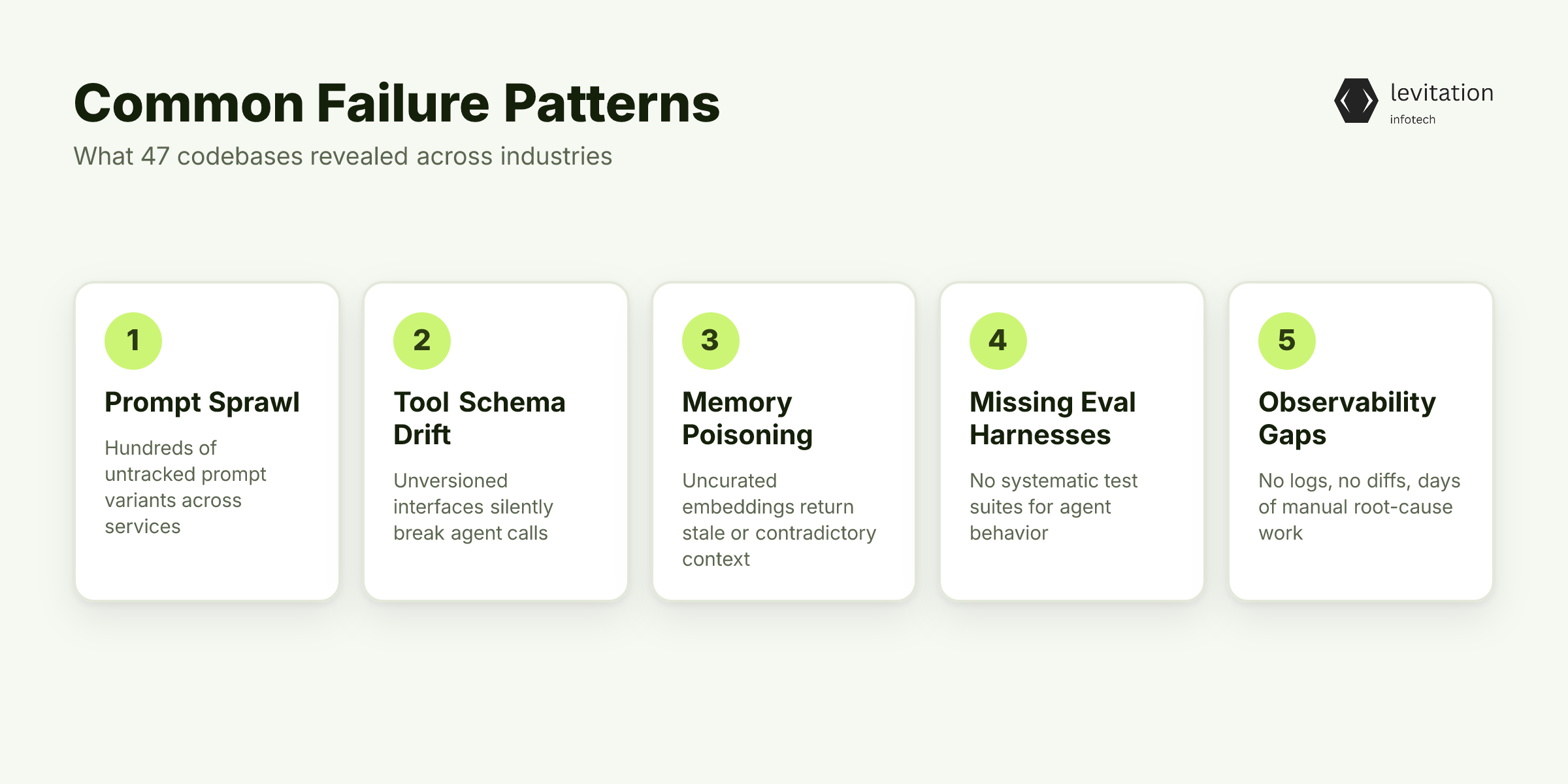
Five patterns showed up in nearly every audited codebase, no matter the industry or team size. These patterns explain why the 3x ratio is consistent rather than anecdotal.
Pattern 1: Prompt sprawl. Hundreds of prompt variants scattered across services, with no central registry. When behavior changes, nobody knows which prompts changed, when, or why. The blast radius of a single prompt edit becomes untraceable.
Pattern 2: Tool schema drift. Tool interfaces evolve without version management. A backend team renames a field, and agents start calling broken functions silently. The agent does not error. It just produces worse outputs because the schema it expected no longer exists.
Pattern 3: Memory poisoning. Embedding stores and RAG indexes grow without curation. Retrieval returns stale or contradictory context. The agent's "knowledge" becomes a junk drawer. No one notices because the system still produces answers, just wrong ones.
Pattern 4: Missing evaluation harnesses. Teams ship agents without systematic test suites for agent behavior. They rely on manual spot-checks, a few golden examples, and the developer's gut feeling. This pattern connects directly to what we covered in Why Your LLM Evals Approve Models That Fail. Ad-hoc testing cannot catch behavior that emerges from agent-tool interactions.
Pattern 5: Observability gaps. No logging of prompts, no diffs, no test results. When an agent misbehaves in production, root cause analysis takes days instead of minutes. Teams end up replaying conversations by hand and guessing.
Five patterns. Forty-seven codebases. The fixes are just as consistent.
Reversing the Curve: Structural Fixes for Agentic Debt
The teams that reversed the debt curve did not add more prompts or better models. They added engineering structure. Six interventions appeared repeatedly in the codebases that stabilized.
Step 1: Instrument everything. Log every prompt, every tool call, every model response, and every decision branch. Without this, you cannot measure debt, let alone pay it down. Instrumentation is the prerequisite for everything else.
Step 2: Build evaluation harnesses before features. Test suites for LLM agents must include behavioral assertions. They should not just include unit tests on wrapper code. Define what "correct behavior" means for each agent-tool interaction, and test it continuously.
Step 3: Build real-time dashboards. Surface debt metrics live: prompt variant counts, tool schema versions, memory store growth, orchestration graph complexity. The dashboards we describe in We Logged 312 RAG Outages. The Pattern Wasn't Retrieval apply the same pattern. They apply it to agentic systems. Visibility first, intervention second.
Step 4: Govern tool schemas with versioning and deprecation policies. Treat tool contracts like public APIs. They are the surface area your agents depend on. Breaking changes need the same care you give customer-facing interfaces.
Step 5: Curate memory and [embedding](/ai-ml-training) stores on a cadence. Schedule regular pruning of stale context, conflicting retrievals, and unused memory entries. Memory without curation is debt accumulation by default.
Step 6: Centralize prompt management. Move from copy-pasted prompt strings to a registry with diff history, ownership, and deprecation tracking. This mirrors the discipline of package management for dependencies, and it works.
The payoff compounds. Teams that built these structures saw debt patterns change once instrumentation and evaluation were in place. The speed advantage of agentic development is real. But the speed only holds if governance structures are in place from the start.
Teams that treated agentic debt as a first-class concern saw measurably different outcomes.
What Changes When You Treat Agentic Debt as a First-Class Concern
The difference shows up in three places: longevity, velocity, and onboarding.
Agentic systems with structural debt management outlast their initial models. This happens because the scaffolding is independent of the underlying LLM. The model changes. The team changes. The use cases evolve. But the instrumentation, evaluation harnesses, and governance hold up.
Engineering velocity stabilizes. Teams stop losing weeks to "mystery bugs" caused by untracked prompt changes or stale retrieval context. When something breaks, the fix takes hours instead of days.
Onboarding new engineers becomes tractable. When prompt registries, evaluation suites, and observability dashboards exist as documented systems, a new hire learns faster. They understand the agent's behavior in days, not months. The codebase has a memory that does not live only in senior engineers' heads.
The intelligent agent systems that survive the 3x debt problem share one trait. They treat prompts, tools, and memory as production infrastructure, not experimental artifacts. The distinction sounds semantic. It is not. Infrastructure gets versioned, monitored, tested, and maintained. Artifacts get left in a folder, reviewed once, and forgotten.
Sources
Research and references cited in this article:
- Medium
- What Is Technical Debt in AI Coding? Types & Impact Explained - Janea Systems
- Panel: Agentic AI Debt: Stochastic Behavior & Change | Future of Data and AI | Agentic AI Conference
- 7 Essential Metrics to Measure Tech Debt - Waydev
- The Hidden Technical Debt Of Agentic Engineering
- The 80% Problem: Why AI Agents Ship Fast But Create ...
- The agentic future has a technical debt problem
- 7 Ways agentic AI reduces technical debt during migrations
- Medium
- AI Agent best practices from one year as AI Engineer : r/AI_Agents
About the author
Mayank Singh is a software developer at Levitation Infotech, where he builds web and AI-powered applications across the company’s fintech, healthcare, and enterprise projects.