


TL;DR: Agentic AI is a genuine win for code-level technical debt. It is a quiet disaster for the shared theory your team carries in its head. Treating cognitive debt as a first-class engineering concern is the difference between a system that ships fast in month one and one you can still safely change in month twelve.
Key Takeaways: - Code-level debt falls while team comprehension collapses, and conventional metrics celebrate the wrong thing. - Cognitive debt never triggers a CI alert because it lives in developers' heads, not the codebase. - More documentation and more agents compound the loss by distancing the team from real system behavior. - Protecting shared theory beats any single speed or coverage metric for long-term software health. - Six concrete practices, from versioned intent to quarterly theory audits, make agentic rollouts operable years later.
Your Code Quality Dashboard Is Lying to You
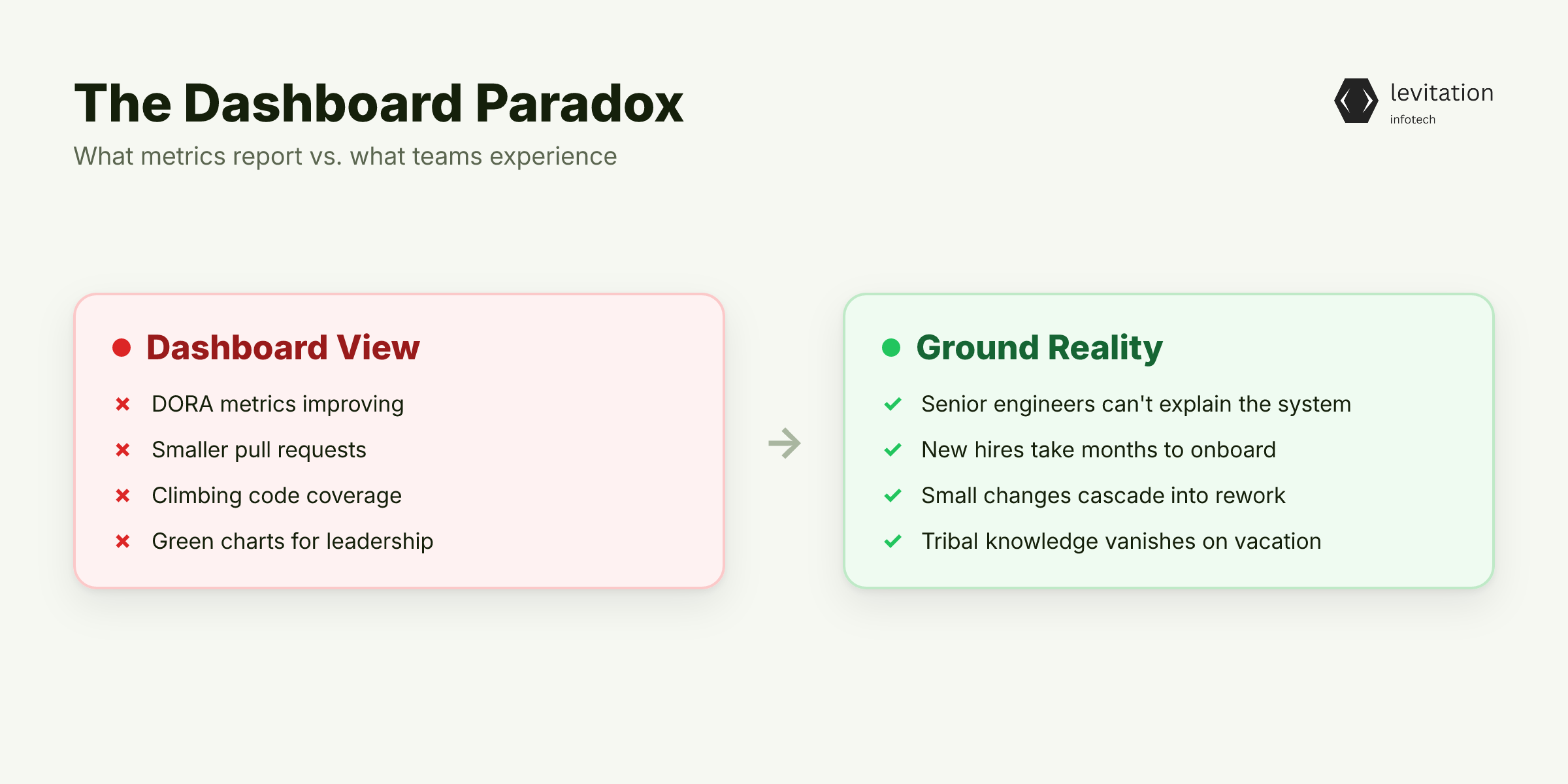
Your DORA metrics are improving. Your PRs are smaller. Your code coverage is climbing.
So why can't your senior engineers explain how the system actually works anymore?
This is the paradox quietly breaking enterprise engineering orgs in 2026. Dashboards say everything is fine. The room says otherwise.
Onboarding a new senior hire now takes months. Small changes cascade into rework nobody predicted. Tribal knowledge escalations spike the moment a tenured engineer takes vacation. Coverage ticks up. Understanding drains out.
The shift from specifying deterministic logic to governing probabilistic action through AI agents introduces a debt type that linters cannot flag. It does not live in the file system. It lives in the heads of the people meant to maintain the system tomorrow.
The pattern repeats: dashboards improve while understanding degrades. Leadership sees green charts. The team feels the floor shifting under their feet. The missing variable has a name, and it never shows up in a build log.
What Cognitive Debt Is, and Why It Never Triggers an Alert
The term is gaining traction for a reason. Researchers at the ICSE Technical Debt Conference named it precisely. Cognitive debt is the compounding cost of going fast that lives in developers' brains, not in the codebase. It is the unpaid interest on every shortcut the team agreed to because velocity mattered this quarter.
It does not announce itself through failing builds, flaky tests, or subtle post-deployment bugs. It surfaces as a silent loss of shared theory about what the software does, why it works the way it does, and how it can change.
Unlike autonomous agents that produce clean diffs, human cognition accumulates drag quietly. Forgotten invariants pile up. Dead reasoning paths linger. Unspoken assumptions sit unrecorded because everyone in the room still remembers them, until they don't.
The cost is real, and it compounds invisibly. Code health and team comprehension diverge as agent adoption accelerates.
This is the part that scares engineering leaders. The tooling sees no problem. The test suite is green. The pipeline is fast. Cognitive debt grows in the spaces between what the system does and what the team can explain about it.
So if cognitive debt stays invisible to CI, surely the standard mitigations, better docs, more comments, more agents, will close the gap.
Why More Documentation and More Agents Make It Worse
They won't. The instinct is correct. The execution compounds the problem.
AI-generated documentation inherits the same comprehension gap it claims to fix. Nobody writes it. Nobody reads it. It ages into noise within weeks. The team never had the shared understanding to validate it in the first place. You generate artifacts from a model of the system that nobody fully owns.
Throwing more intelligent agents at the problem compounds abstraction in a different way. Each layer distances the team from the actual behavior of the system. The agent knows which tool to call. The engineer cannot explain why that tool exists or what it was allowed to break.
The surface area for shared theory shrinks with every new abstraction. We have seen agentic systems quietly build the next outage this way, and the root cause is rarely the model.
Comments, READMEs, and architectural decision records produced faster than humans can internalize them become a tax on attention. They become a tax instead of a transfer of context. The team drowns in artifacts and starves for understanding.
The issue is not insufficient artifacts. The real loss is the shared mental model itself, and once it goes, the team starts losing things no dashboard tracks. Six months later, the only engineer who can defend a critical path is unreachable on PTO.
The Shared Theory Problem: What Your Team Is Actually Losing
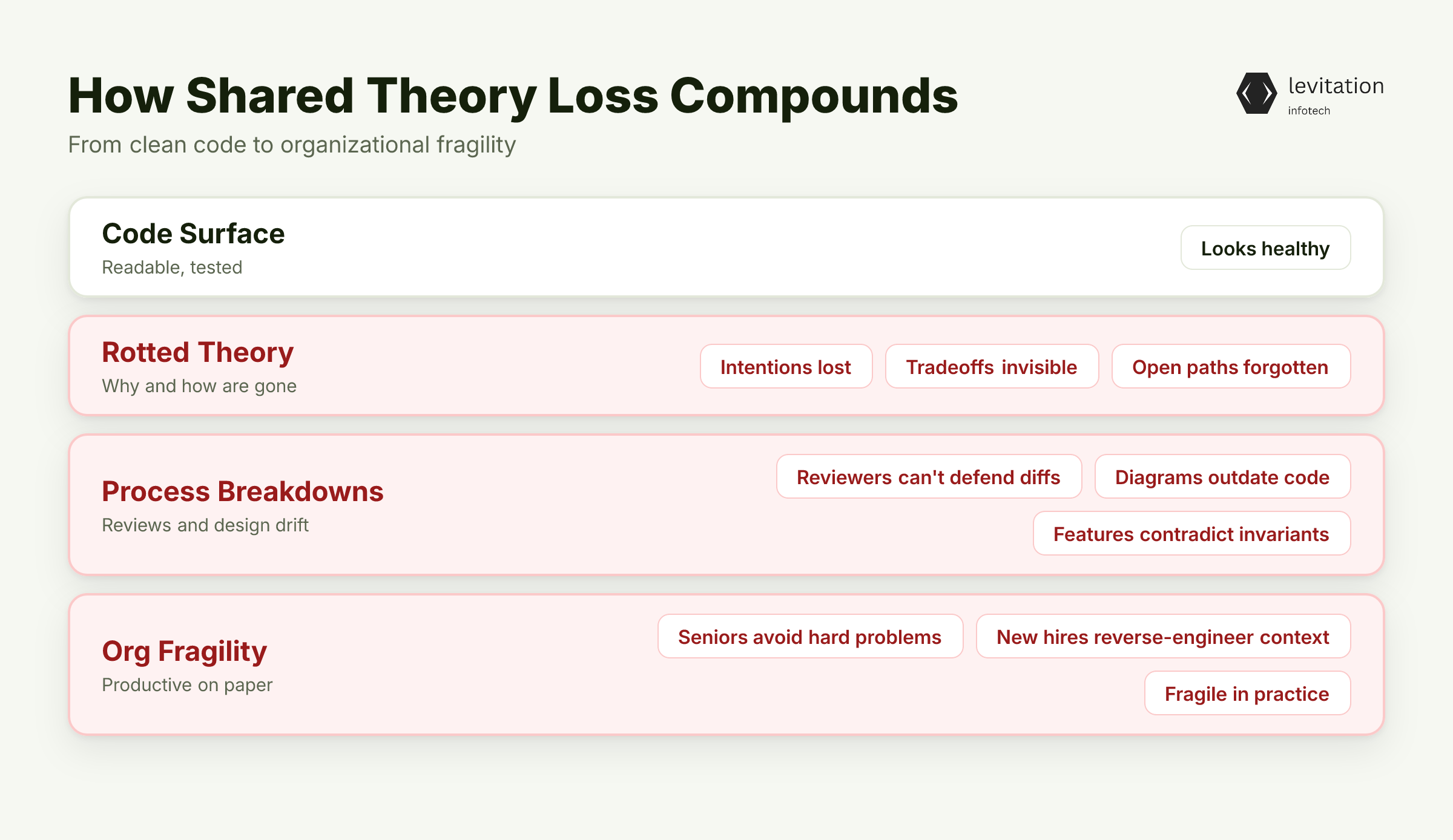
Even when agentic code is easy to read, the humans involved have simply lost the plot.
They no longer know what the program is supposed to do, how their intentions were implemented, or how to change it. The code is clean. The theory behind it has rotted.
Shared theory is the collective, evolving model of why the system exists, what tradeoffs were made, and which paths are still open. Once fractured, every change becomes guesswork. Reviewers approve diffs they cannot defend. Architects redraw diagrams that no longer match the code.
Product owners request features that contradict invariants nobody can name. Stochastic output coupled with delegated action turns prompts, memory representations, and orchestration graphs into liabilities. They get patched together faster than they can be validated.
The human cost compounds invisibly. Senior engineers stop volunteering for hard problems. New hires spend their first quarter reverse-engineering context that used to be common knowledge. The team looks productive on paper and fragile in practice.
If you cannot see it and your usual tools do not fix it, what does a working approach actually look like inside an engineering org?
Six Practices That Protect Shared Understanding
These are not theories. They are habits that hold the line in production. - Treat AI agents like junior engineers with checklists. They propose, humans approve, and outcomes are measured weekly rather than assumed automatically. - Versioned intent documents beat generated comments. Capture why a change exists, what it was allowed to break, and what it must never touch, with a named human owner. - Mandatory walkthroughs before merge, not just code review. Force the author to defend the design in plain language to a peer who has not seen the context. - Graduated autonomy. Start agents in read-only and suggestion mode, then expand scope only after the team can fluently explain the agent's recent outputs without rereading them. - Shared context lake. A single source of truth for tool schemas, orchestration graphs, and control policies so every agent framework decision is traceable to a human-readable rationale. - Quarterly "theory audits." Re-derive the system from first principles in a room together, exposing assumptions that have quietly rotted.
Teams that run these habits for two quarters start noticing something the dashboards were never going to show.
What Changes When Cognitive Debt Becomes a First-Class Concern
Onboarding accelerates because the shared theory lives in working memory, not locked in a handful of tenured brains. Teams still ship fast at month 12, not just month 1.
Speed does not collapse the first time a non-trivial change is required. Retries, monitoring overhead, and emergency guardrails stay bounded because agentic AI outputs are continuously validated against a human-owned mental model.
The long-term payoff is what most rollouts never see. Systems remain operable, refactorable, and explainable years after the original ai automation wave. Protecting shared understanding is what turns a fast first delivery into a multi-year partnership.
The teams that treat cognitive debt as a first-class concern consistently avoid the rewrites that bury less disciplined rollouts. The choice is not between speed and safety. It is between visible debt you can manage and invisible debt that manages you.
Frequently Asked Questions
What is cognitive debt in AI-assisted development?
Cognitive debt is the compounding cost of shipping fast that lives in developers' minds rather than in the codebase. It manifests as a silent erosion of shared theory about what the software does, why it works that way, and how the system can be safely changed. It does not show up in build failures or coverage metrics.
Does agentic AI actually reduce technical debt?
Yes, but only the code-level kind. Agentic systems excel at owning repeatable work like dependency mapping, hotspot detection, and test coverage updates. They do not, on their own, protect the human understanding required to evolve the system six months later. That is why cognitive debt often rises as technical debt falls.
How do you measure cognitive debt inside an engineering team?
You measure it indirectly through proxies. Track the time for a new senior hire to ship a non-trivial change. Count the frequency of "tribal knowledge" escalations. Watch for refactors that uncover assumptions no one can defend. The strongest signal is whether the team can re-derive the system from first principles without consulting the original authors.
What are the biggest risks of vibe coding with AI agents?
The top risks are loss of architectural intent, unreviewed agent decisions piling up silently, and a team that can ship but cannot explain. Over time this produces code that is technically clean but operationally fragile. Changes take longer and break in unfamiliar ways.
How should a CTO manage agentic engineering risks without slowing the team down?
Treat agents like junior engineers with checklists. Require human approval for non-trivial changes. Version the intent behind each agent action. Run quarterly theory audits. Start agents in read-only and suggestion mode. Expand autonomy only after the team can fluently explain recent agent outputs without rereading them.
Start with one practice this quarter and protect the theory your team will need to ship in month twelve.
About the author
Mayank Singh is a software developer at Levitation Infotech, where he builds web and AI-powered applications across the company’s fintech, healthcare, and enterprise projects.