


Your agent passed every test. Your postmortem names a root cause. Neither tells you what actually broke, because the failure happened inside a runtime layer your observability stack doesn't even know exists.
TL;DR: Agentic AI systems fail in production for reasons that have nothing to do with the agent code. The failures live in the runtime around the model. Credentials, data scopes, API contracts, write effects, and decision chains are the real risks. Standard observability stops at the LLM boundary. To make postmortems honest again, leaders need a governance layer. They also need an observability model that treats the agent runtime as a first-class system component. It must be designed in before the first incident, not bolted on after.
Key Takeaways: - The agent code is the smallest part of a real agentic system. The runtime is where production outages actually originate. - Standard tracing stops at the LLM call boundary. It leaves the dozens of decisions and tool calls that follow invisible to your current stack. - The more autonomous an agent becomes, the stricter its governance must be. Never looser. - Replay-capable observability plus pre-deployment governance make postmortems reconstructable instead of guesswork.
Your Postmortem Is Lying to You About the Agent
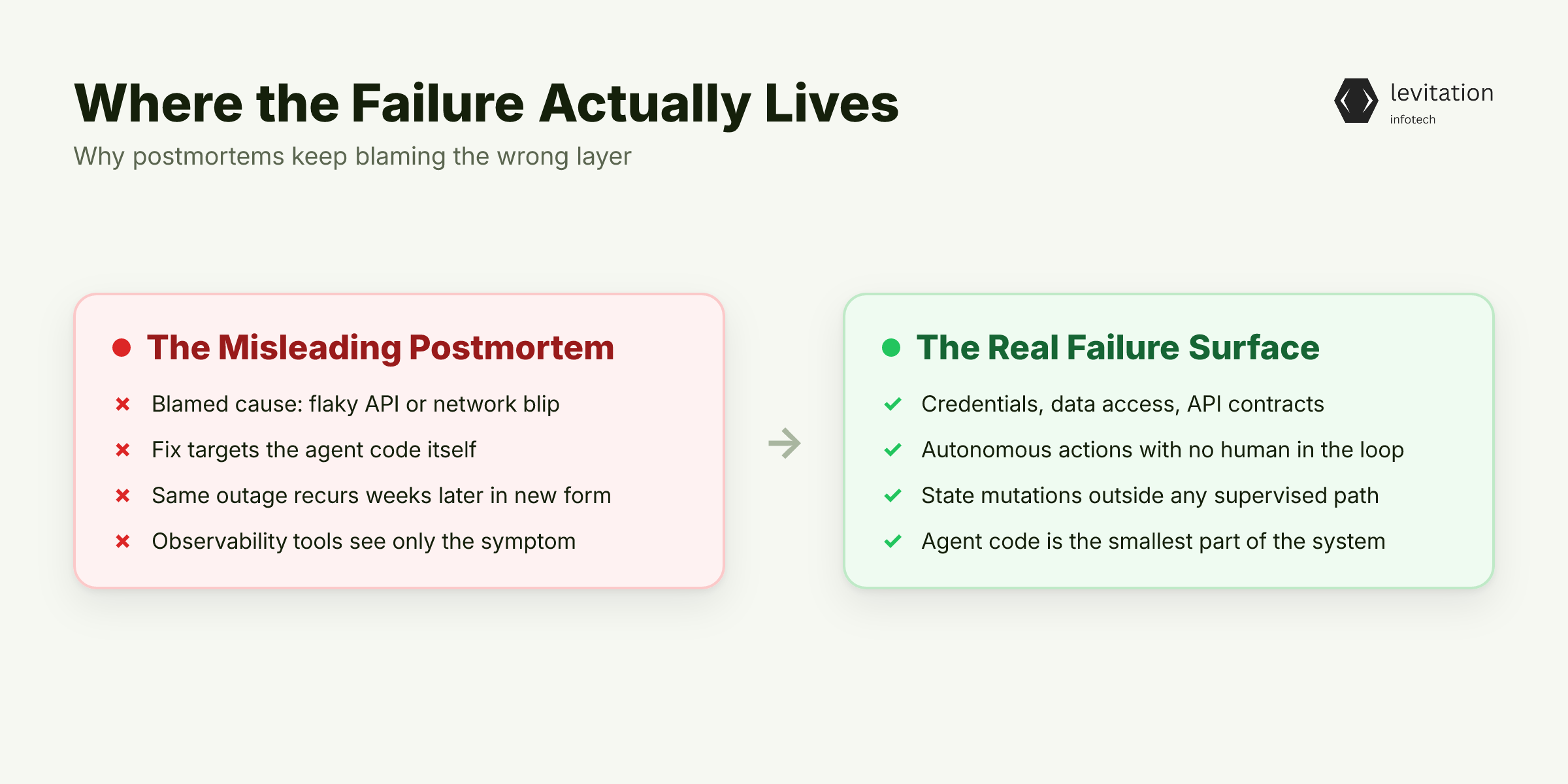
The pattern is familiar. A team builds an agent. It passes every test. The demo works. Soon after launch, something breaks, and the postmortem blames a flaky API or a network blip.
The fix goes in. The team moves on. The same outage recurs weeks later, wearing a different costume.
The cause is almost never where the postmortem points. The real failure lives in the infrastructure around the agent. The credentials, the data it can reach, the API contracts, and the actions it takes when no human is watching. In regulated industries, the same shape shows up again and again.
The agent code is the smallest part of the system. Everything around it is where production risk quietly accumulates.
This is why AI agents in production behave so differently from agents in demos. The demo path is a clean, supervised conversation.
The production path is an autonomous loop. It touches credentials, queries data, and mutates state with no human in the chain.
But if the failure isn't in the agent code, where exactly is it hiding? And why does every observability tool you already own miss it?
Why Traditional Postmortems Cannot See Agentic Failures
Your APM traces look fine. Latency is green. Error rate is within SLO. And yet the agent produced a wrong answer, wrote bad data, or escalated a permission boundary nobody approved.
The reason is structural. Standard distributed tracing stops at the LLM call boundary. The trace shows "agent called model, model returned text, end of span."
Everything the agent decides after that call happens in an unwatched gap. Which tool to invoke, what data to retrieve, what to write, how to chain the next step. There is no shared transaction ID across those steps, no consistent schema, and no decision-level audit trail.
A single user request can trigger dozens of tool calls in a non-deterministic chain. Each one runs in its own little bubble.
When a postmortem tries to reconstruct the sequence, the team stitches log fragments and prompt snippets by hand. Templates make this worse.
They assume deterministic code paths. They ask "what changed?" expecting a diff, a commit, a config flag. Agentic systems are non-deterministic by design. There is no clean before and after to compare.
We covered the broader shift in how AI outages differ from microservices. The postmortem gap is where that difference hurts most.
Engineering velocity metrics break down for the same reason. Deployment frequency and MTTR were calibrated for predictable systems where a deploy maps to a known behavior change. When the system itself is making decisions, those metrics stop measuring anything honest.
Production AI agents often run in systems where the team can no longer fully explain every behavior path.
From a cloud security angle, the gap is more dangerous still. An agent that retrieves data it was not supposed to read leaves no signature your detection rules will catch.
The same goes for an agent that writes to a system it was not supposed to touch. The action looks authorized, the credentials were valid, and the IAM policy was satisfied. The harm happened anyway.
So the postmortem doesn't fail because your team is incompetent. It fails because the failure lives in a layer that doesn't appear on any architecture diagram you've drawn. So what does that layer actually look like?
The Five Debt Layers Hiding Inside Your Agent Runtime
Once you know what to look for, the debt shows up in five distinct layers. Each is annoying on its own. Together, in the same system, they form an outage waiting for a trigger. - Credential sprawl. Agents accumulate tokens, service accounts, and scoped keys faster than IAM policies can be reviewed. A new tool integration means a new credential. A deprecated tool leaves an orphaned key. Over months, the agent's effective permission set is wider than anything the security team approved. - Data scope drift. An agent built to read one table gradually gets prompted into reading twelve. There is no schema-level audit trail, so nobody notices when the agent's effective data access quietly tripled. The shift is invisible until the agent surfaces data it was never meant to see. - API contract changes. Upstream providers deprecate endpoints, rename fields, and tighten rate limits. The agent retries with stale tool definitions and produces silent partial failures. A response that used to return five fields now returns three, and the agent writes a half-formed record to the database. - Write-side effects. Agents that act, not just retrieve, create data mutations nobody traces back to the prompt that caused them. A refund is issued. A ticket is closed. A record is updated. The action happened. The reason it happened is buried in a reasoning trace no one stored. - Decision opacity. The chain that led an agent to choose action A over action B gets compressed into a log line nobody reads. The reasoning is in the model's context window, and once the session ends, it is gone. You can see what the agent did. You cannot see why.
Cloud security teams feel layer one and two first. AI governance teams feel layer four and five. Nobody feels all five at once, which is exactly why no single dashboard catches the outage in time.
These five layers share one uncomfortable property: the more autonomous your agent becomes, the more important each one gets. That's the paradox nobody warned you about.
The Autonomy Paradox: Smarter Agents Demand Stricter Guardrails
Most teams ship agents with a simple mental model: more autonomy means more value. Let the agent decide. Trust the model. Reduce human steps.
The reality tells a different story. The more autonomous the system, the more human oversight it requires, not less. An agent that always asks permission is annoying but safe. An agent that decides on its own is valuable until it isn't.
Autonomy without AI governance produces an outage nobody can reconstruct. The tradeoffs are real.
Strict controls reduce agent utility. The model gets slower, the prompts get more constrained, the workflows feel less magical. Loose controls produce unexplainable failures. The postmortem becomes guesswork, and trust in the system erodes with every incident.
The answer is structured, auditable autonomy. Not maximum freedom. Not maximum restriction. A defined blast radius, a clear escalation path, and a runtime that can answer "why did this happen" for every action.
Teams that get this right ship agents that work for years without drama. They treat governance as a first-class engineering problem, not a compliance afterthought.
So how do observability and governance actually have to look in practice?
Observability Patterns That Actually Catch Agent Outages
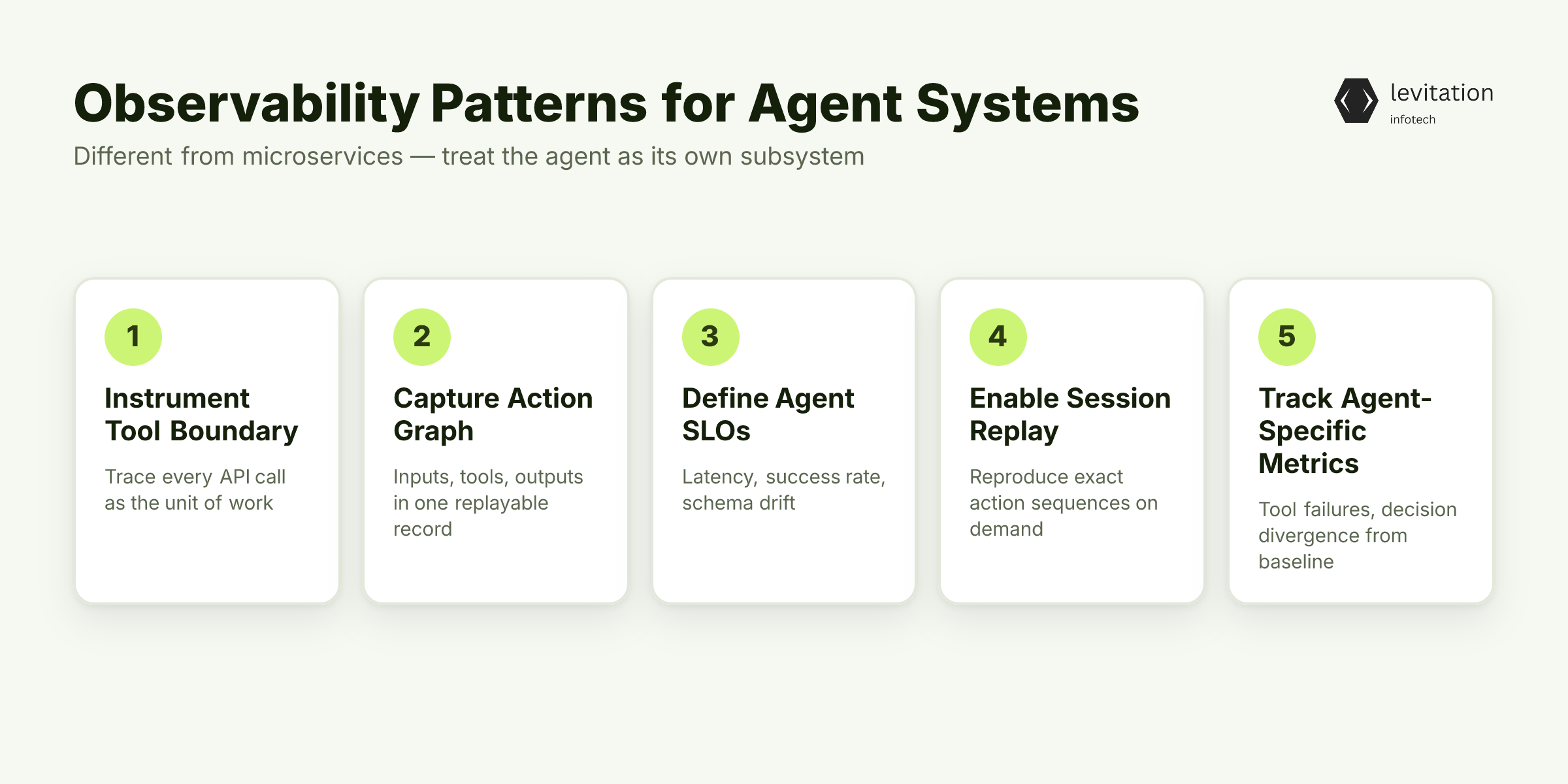
Observability tells you what happened. The patterns below work for agentic systems, and they look different from what you built for microservices. - Instrument the tool boundary, not the LLM. Every API call an agent makes needs the same tracing treatment as a microservice hop. The LLM is a black box. The tool call is not. Treat it as the unit of work. - Capture the prompt-to-action graph as a first-class artifact. Inputs retrieved, tools called, outputs written, in one correlated record. If your stack cannot replay a session end to end, it is not ready for agents. - Treat the agent runtime as a distinct system component. Give it its own SLOs: latency for tool calls, success rate per tool, drift in output schemas. The AI agents running in your stack are a subsystem, and they need subsystem-level metrics. - Replay capability is non-negotiable. Given a prompt, you must be able to reproduce the agent's exact action sequence in an isolated environment. Without replay, every postmortem is archaeology. - Tie velocity metrics to agent-specific signals. Tool call failure rate and decision divergence from baseline are more honest than deployment frequency. As we explored in why AI coding assistants break engineering metrics, the old metrics were never designed for systems that decide for themselves.
The practical impact shows up fast. Teams that retrofit observability after the first outage reach stable production much later.
Teams that design it in from the start ship faster. Cloud security teams also benefit: replay data is the cleanest way to prove a data access was within scope during a review.
Governance decides what is allowed to happen next. You need both, and the governance piece has to exist before the first incident, not after.
Governance Built Before the First Outage, Not After
Governance retrofitted after an outage tends to over-correct. Strict rules get added in panic, agents get throttled into uselessness, and the team quietly bypasses the controls. The fix is to define the boundary before the agent ever touches production data.
A workable governance layer has four concrete parts: - Define the agent's blast radius in writing. Which data it can read. Which systems it can write to. What it must escalate to a human. The blast radius is a contract, not a guideline. - Approval gates for new tool integrations. Every API the agent can call is a security and compliance decision. Treat it like a vendor onboarding, not a code review checkbox. - Audit trails for prompt changes. A production prompt is now a production configuration. Version it. Review it. Treat a prompt change with the same rigor as a schema migration. - Periodic agent behavior reviews. Sample decision traces. Compare against the documented policy. Close the gap before users find it for you.
Teams that ship governance early avoid the panic cycle entirely. They treat the runtime as a production system from the first commit.
When these layers are in place, something changes in your postmortems. The difference is visible within a single incident.
What a Postmortem Looks Like When You Get This Right
The shift shows up in the postmortem itself. The root cause names the specific tool call, the prompt that triggered it, the data scope it touched, and the credential it used.
There is no hand-waving. There is no "the model behaved unexpectedly." There is a clear chain from input to action.
Remediation becomes a code change in the governance layer, not a retry or a config tweak. The runtime is updated to block the exact action path that produced the failure. The same outage cannot recur, because the system that allowed it no longer does.
Long-lived production systems are not lucky. They are instrumented, governed, and reviewed from day one. This is the work AI governance is supposed to do. It is also why the most disciplined teams treat the agent runtime as a production system from the first commit. The postmortems look different because the runtime underneath them is different.
Frequently Asked Questions
What is agentic engineering debt?
Agentic engineering debt is the accumulation of unresolved infrastructure, observability, and governance gaps in the layers surrounding AI agents.
It includes credential management, data scope, API contracts, write-side effects, and decision opacity.
It is invisible until it causes a production outage, and traditional postmortems struggle to identify it. The failure happens outside the agent code itself.
How is agentic engineering debt different from regular technical debt?
Regular technical debt lives in code and configuration a developer wrote.
Agentic engineering debt lives in the runtime that surrounds the agent: the tool integrations, credential scopes, data access patterns, and decision chains that no single person fully designed.
It compounds faster because autonomous agents expand their own surface area without human review.
Why do standard observability tools miss agentic AI failures?
Standard tracing stops at the LLM API boundary. The dozens of tool calls, data retrievals, and write actions an agent performs after that call happen in a gap with no shared transaction ID, no consistent schema, and no decision-level audit trail.
You are seeing a log of model completions, not the agent's actual behavior.
What metrics should CTOs track for agentic AI systems?
Beyond deployment frequency and MTTR, CTOs need tool call failure rate, decision divergence from baseline, write-side effect volume, credential scope utilization, and replay success rate.
These metrics measure the system around the agent, which is where the real risk and the real velocity signal live.
When should agentic AI governance be implemented?
Before the first production deployment. Governance retrofitted after an outage tends to over-correct, producing brittle controls that limit agent utility.
Structured governance, including defined blast radius, approval gates for tool integrations, versioned prompts, and periodic behavior reviews, needs to exist alongside the agent from day one.
Want a checklist of the governance and observability pieces covered here, sent to your inbox?
Sources
Research and references cited in this article:
- The hidden technical debt of agentic engineering
- The agentic future has a technical debt problem
- Agentic AI in 2026: From Hype to Hard Problems - Logituit.com
- 8 agentic coding trends shaping software engineering in 2026 - Tessl
- Hidden Technical Debt in Agentic Systems
- What is AI Agent Observability? Steps & Benefits
- Observability for Agentic AI Systems - The Why, What and How
- AI agent observability – The measured leap | Deloitte US
- AI Agent Observability: Executive Guide to Governance & Risk
- What Is AI Agent Observability and Why Is It Important?
- Governance of Agentic Artificial Intelligence Systems | Insights | Mayer Brown
- Essential Guide to Agentic AI Governance Frameworks for Future Systems| NiCE
About the author
Mayank Singh is a software developer at Levitation Infotech, where he builds web and AI-powered applications across the company’s fintech, healthcare, and enterprise projects.