


TL;DR: AI systems fail quietly in ways your existing incident management cannot detect. Microservices announce failures with HTTP errors and stack traces. AI systems return plausible-but-wrong outputs that pass every health check. Treating AI incidents as a special case of microservice incidents is a false equivalence that leaves teams blind to silent degradation, data drift, and model rollback complexity for weeks at a time.
Key Takeaways: - Your model can degrade for weeks while every dashboard stays green and every latency metric holds steady. - AI failures fall into three categories (data, model, integration) that each demand different detection signals and remediation paths. - Model rollback and shadow evaluation must be first-class deployment patterns, not afterthoughts bolted onto CI.
Your Model Wrapped in a Container Is Not a Microservice
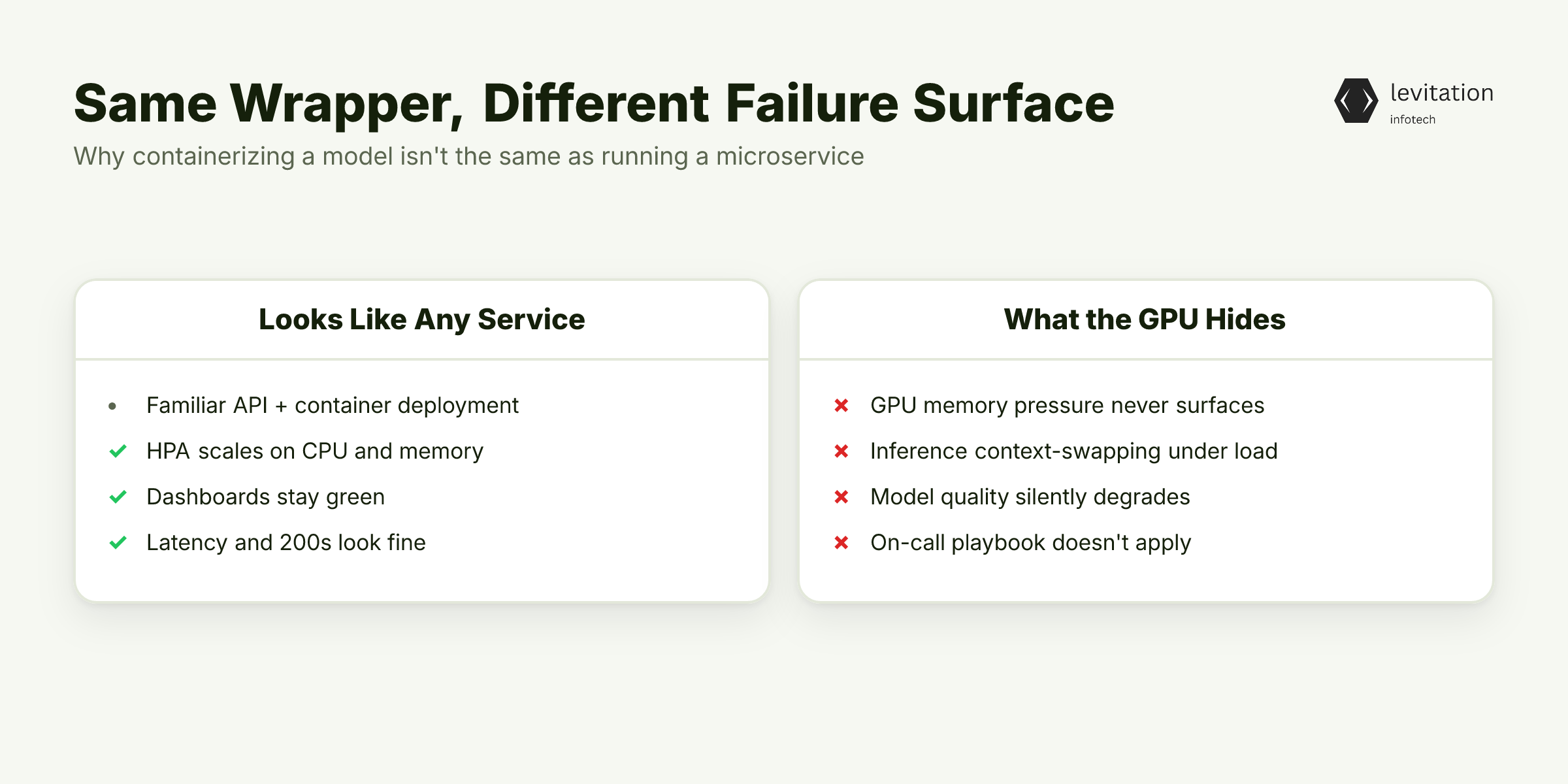
Your model has been silently degrading for three weeks. Your dashboards are green. No alerts fired. Customers are getting worse recommendations every day, and your incident management process has no playbook for this.
This is the default state of most production AI systems that were deployed using microservice playbooks. The pattern looks familiar. Wrap a model behind an API endpoint, drop it in a container, deploy to Kubernetes, add autoscaling, wire up Grafana. Suddenly it feels like every other service in your stack.
But GPU memory pressure behaves nothing like CPU memory pressure. Under load, inference containers spend significant time on internal context-swapping. Standard Kubernetes resource metrics don't surface this. Your HPA scales on CPU and memory, but neither signal captures what's actually happening on the GPU. Teams that learn this the hard way often discover it through GPU budget bleed they never planned for.
Teams underestimate how different production AI systems are because the early demos look deceptively normal. Latency looks fine. Error rates look fine. The model returns 200s. Until you check the actual quality of those responses, and realize the system has been broken since the third week of deployment.
The infrastructure feels familiar, but the failure modes underneath it are completely different, and your existing incident playbooks don't account for any of them. The most dangerous assumption is that a container-wrapped model behaves like every other service you operate, when the failure surface underneath is fundamentally foreign to your on-call rotation.
The Failure Modes Your Incident Playbook Wasn't Written For
Traditional incident management was built for systems that fail loudly. A microservice crashes, returns a 500, times out, or throws an exception. Your monitoring catches it. Your on-call gets paged. The postmortem has a stack trace.
AI systems don't return 200 or 500. They return plausible-but-wrong answers that pass every health check. This is the dangerous false equivalence at the heart of the problem.
Model drift is silent degradation. No error logs. No stack traces. No exception alerts. Your recommendation engine starts suggesting products nobody wants, but the API never fails. Your fraud model starts approving more bad transactions, but the response code is still 200. By the time anyone notices, the damage compounds.
Data poisoning and adversarial inputs bypass traditional input validation entirely. A microservice checks if a request is well-formed. An AI service also needs to check if a request was designed to break it. Your standard WAF rules weren't written for prompt injection or feature-space attacks.
Interpretability gaps make root cause analysis nearly impossible. When a microservice misbehaves, you read the code. When a model misbehaves, you often cannot explain why outputs changed because the model itself is a black box. Your on-call engineer has no debugger to attach to.
Traditional ITSM tools are not equipped to handle these unique machine learning failures, and assuming they are creates a blind spot that grows with every deployment. The zero trust mindset that works for service-to-service authorization needs an analog for model inputs, outputs, and behavior.
Knowing the failure modes are different is only step one. The harder question is which ones to prepare for first, and they don't all behave the same way.
Three Failure Categories That Demand Different Response Strategies
AI failures aren't a monolith. They fall into three distinct categories, and each one requires its own detection signal, severity classification, and remediation path.
Upstream failures: Data drift and data quality degradation. Input distributions shift. Feature pipelines break. A vendor changes their schema overnight. Your model performance collapses, but no code changed. The fix lives in the data layer, not the model layer, and the detection signal is statistical drift on incoming features. We covered this in depth in our drift detection guide, and the core issue is that monitoring request volume tells you nothing about input quality.
Internal failures: Model degradation. Concept drift, bias amplification, confidence calibration drift. These happen inside a model that is technically running perfectly. Every health check passes. Every infrastructure metric is green. The model is just slowly becoming wrong in ways that are invisible to standard monitoring. The fix is rollback or retrain, and the detection signal is output distribution shift.
Downstream failures: Integration cascade. Your upstream service changes its API, and now your feature pipeline serves stale data. The model receives last week's features and makes confidently wrong predictions. This is the silent staleness problem that propagates through your system without tripping a single alert. The fix lives in pipeline versioning, not the model.
Each category needs a different response: - Data failures: roll back the feature pipeline, validate input distributions, quarantine the affected traffic - Model failures: roll back to a known-good model version, trigger shadow evaluation, alert the data science team - Integration failures: identify the upstream change, pin feature versions, verify pipeline freshness
Effective AI incident response must account for the entire lifecycle of the system, from data collection to post-deployment monitoring. This is fundamentally different from microservice incident response, which usually starts and ends at the service boundary.
Detecting these failure categories requires a level of observability that goes well beyond what your existing Grafana dashboards were designed to capture.
AI Observability Goes Beyond Metrics, Logs, and Traces
Your existing observability stack was built for microservices. Metrics, logs, and traces. Prometheus, Grafana, Jaeger, ELK. These tools are excellent for request-level visibility. They are nearly useless for AI-specific failure detection. If you're noticing that your dashboards are misleading you, this piece on observability lying about health covers the broader pattern.
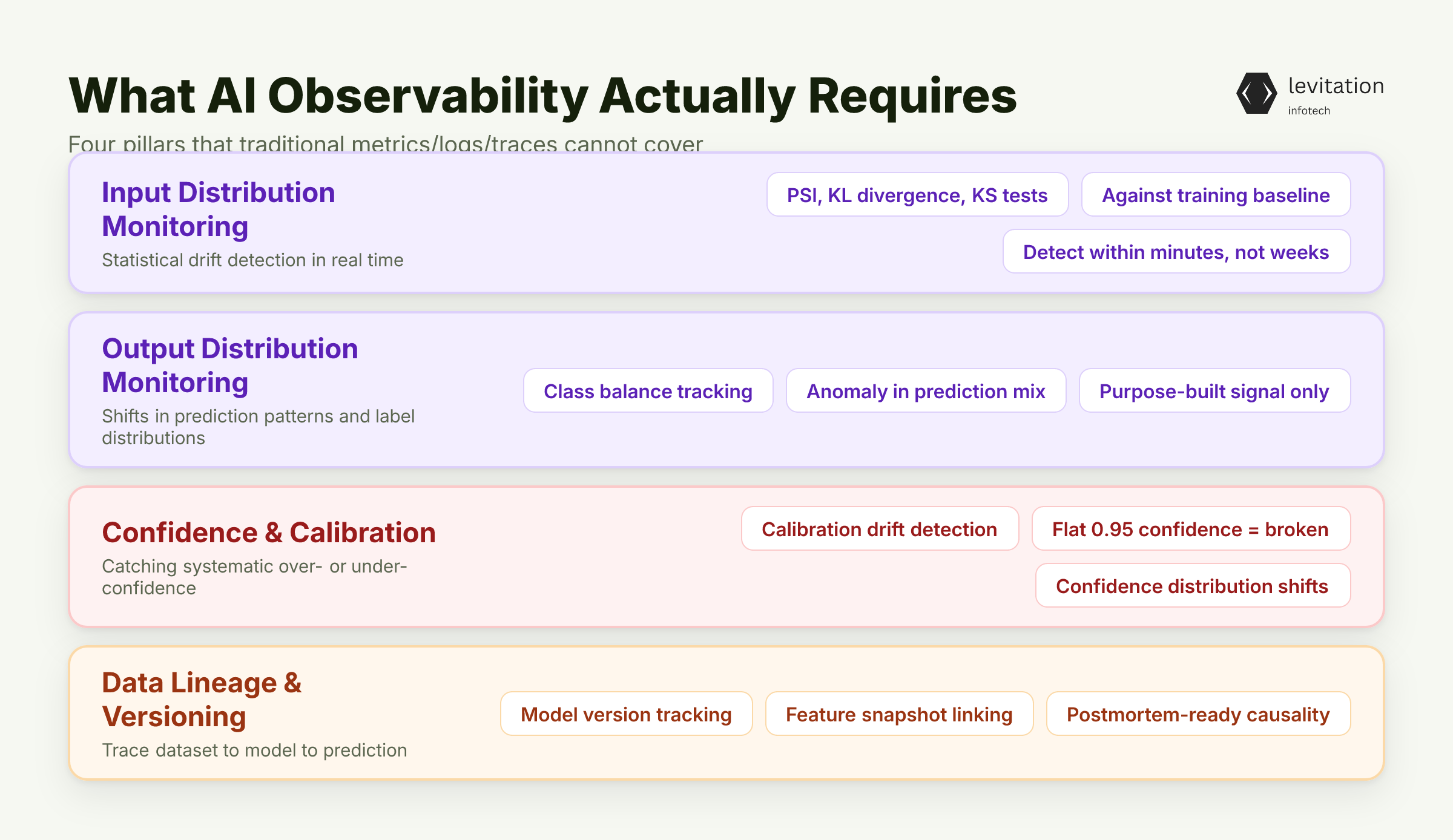
Here's what AI observability actually requires:
Input distribution monitoring. Statistical drift detection on feature distributions in real time. Not request volume. Not error rate. Actual distributional tests like PSI, KL divergence, or KS tests running continuously against your training baseline. If your "age" feature starts looking different from training, you need to know within minutes, not weeks.
Output distribution monitoring. Detecting shifts in prediction patterns and label distributions. Your model suddenly predicts "class A" 80% of the time when it used to be 40%. That's a signal. Standard observability won't catch it. Only purpose-built monitoring can.
Model confidence and calibration tracking. Catching the moment a model becomes systematically overconfident or underconfident. A model that says "0.95 confidence" on every prediction is broken. A model whose confidence distribution shifts is probably also broken. Neither is visible in standard metrics.
Data lineage and feature store versioning. Tracing which version of which dataset trained which model, so postmortems can actually find the cause. When the bad prediction happens three weeks later, you need to know which model version, which feature snapshot, and which input distribution were involved.
Capturing and correlating metrics, logs, and traces across the entire ML lifecycle is non-negotiable, and it is a different problem from microservice observability. Treating it as a subset of devops observability is a mistake that costs teams months of wasted effort.
Observability tells you something is wrong. The next step is knowing exactly what to do about it, which means rewriting your runbook from the ground up.
Building an AI Incident Response Playbook That Actually Works
A good AI incident response playbook has three layers, each catching failures the others miss.
Layer 1: Detection at the input boundary. Real-time input validation and statistical drift detection on incoming feature distributions. This is your first line of defense. If incoming data looks nothing like training data, you stop trusting predictions before they reach users.
1# Example: KS-test on incoming feature distributions2from scipy.stats import ks_2samp34def detect_drift(live_features, training_baseline, threshold=0.05):5 drift_signals = {}6 for feature in live_features.columns:7 stat, p_value = ks_2samp(8 live_features[feature],9 training_baseline[feature]10 )11 if p_value < threshold:12 drift_signals[feature] = p_value13 return drift_signals
Layer 2: Detection at the model boundary. Model performance monitoring with shadow evaluation against ground truth labels on a continuous sample of traffic. Every prediction gets logged. A fraction gets compared against delayed ground truth. When accuracy drops below threshold, you know before your users do.
Layer 3: Response and rollback. Automated rollback to a known-good model version with feature flag isolation, so remediation takes minutes instead of hours. If you cannot roll back a model faster than you roll back a Kubernetes deployment, your MLOps pipeline is broken.
Runbook structure: - Detection signal: what fired and why - Severity classification: data, model, or integration - Investigation path: which dashboards, which logs, which team - Remediation: rollback, retrain, or fix pipeline - Postmortem: model version, data snapshot, input distribution shift
Human-in-the-loop escalation matters for ambiguous failures that no automated system can classify correctly. Not every AI incident is clear-cut. Some need a data scientist to interpret the signals.
Model versioning and shadow evaluation must be first-class deployment patterns, not afterthoughts bolted onto a CI pipeline. Your service mesh can handle traffic routing for canary model deployments, but only if you've built the versioning layer to support it. The gap between a demo and a production-ready system is where most AI initiatives stall.
Building all of this in-house is possible, but the timeline is longer than most CTOs expect, and most teams hit the same architectural walls along the way.
What Changes When You Treat AI Incidents as a Distinct Discipline
When AI incidents get their own playbook, runbook, and response process, three things change.
Mean time to detection drops dramatically. Silent degradation that took weeks to surface now gets caught in hours through automated drift alerting. Your team finds out about problems before customers do, not after.
Incidents become explainable. Postmortems reference the exact model version, data snapshot, and input distribution shift that caused the failure. No more "the model seems wrong" hand-waving. You can point to the specific change that broke things.
Model rollback becomes routine. Not a multi-day fire drill requiring a war room. A standard operation that takes minutes, like any other deployment. The fear of shipping models evaporates when the failure path is known and bounded.
Engineering teams stop fearing AI deployments and start iterating faster. The bottleneck shifts from "what if it breaks?" to "how fast can we ship the next version?"
The right cloud infrastructure foundation makes the difference between a pilot and a system that survives contact with real traffic.
Frequently Asked Questions
Q: How is AI incident management different from traditional incident management?
A: Traditional incident management assumes systems fail loudly. HTTP errors, crashes, timeouts. AI systems fail quietly. They keep returning responses, but those responses may be wrong, biased, or degraded. AI incident management requires monitoring input and output distributions, model confidence, and data quality, not just error rates and latency.
Q: What are the most common AI failure modes in production?
A: The three most common categories are data drift (upstream input distributions shift away from training data), model degradation (concept drift, bias amplification, and calibration drift inside the model itself), and integration failures (upstream pipeline changes cause feature staleness). Each requires different detection signals and different remediation strategies.
Q: Can I use my existing ITSM tools for AI incident management?
A: Existing ITSM platforms can handle the workflow side: ticketing, escalation, communication. But they cannot detect AI-specific failure modes on their own. You need AI-specific observability tooling layered on top, plus custom runbooks that account for non-deterministic model behavior and the need for instant model rollback.
Q: How do I detect model drift in production?
A: Statistical drift detection on feature distributions, comparing live inputs against training data distributions in real time, is the first layer. Output distribution monitoring, which detects shifts in prediction patterns, is the second. The most mature approach combines both with periodic shadow evaluation against labeled ground truth to measure actual performance regression.
Q: What's a realistic timeline to build AI incident readiness?
A: A focused MVP for AI incident readiness covers basic input monitoring, output distribution tracking, and a model rollback pipeline. A fully mature AI incident management program adds shadow evaluation, automated drift response, and integrated ITSM workflows on top of that foundation. For teams operating in regulated environments, IAM controls around model access and audit trails are non-negotiable additions to the scope.
Sources
Research and references cited in this article:
- Incident Management for AI,ML System Failures
- Why traditional ITOps is failing to keep up with the unique ...
- AI Failure Modes: Detecting Issues Before Trust Breaks | Robert X posted on the topic | LinkedIn
- AI SRE vs. Traditional Incident Management
- Incident management for AI systems | AI Governance Lexicon | VerifyWise
- Observability in MLOps: Comprehensive Monitoring of ML Models and Pipelines - MLops, Data Science
- Enhancing AIOps Observability with MLOps Techniques
- Top AI Observability Trends Shaping 2026 Incident Ops
- What is observability in AIOps? - IBM
- How AI Is Transforming Observability and Incident Management in 2026 | Xurrent
- AI Incident Response Tools to Look For in 2026 | Galileo
- AI Incident Management Tools: Complete Evaluation Guide
About the author
Mayank Singh is a software developer at Levitation Infotech, where he builds web and AI-powered applications across the company’s fintech, healthcare, and enterprise projects.