


TL;DR: Legacy fraud controls judge the final transaction. Agentic payments need proof of who acted and what authority they held. Replace point checks with mandate-scoped credentials and pre-authorization policy checks. Expand through shadow testing and tightly capped mandates.
Key Takeaways: - A valid payment credential proves possession, not delegated intent. - Agentic payment controls must bind identity, mandate, token, behavior, and transaction. - Shadow authorization and capped mandates should precede broader live payments.
Your First Agent Can Pass Every Legacy Fraud Rule
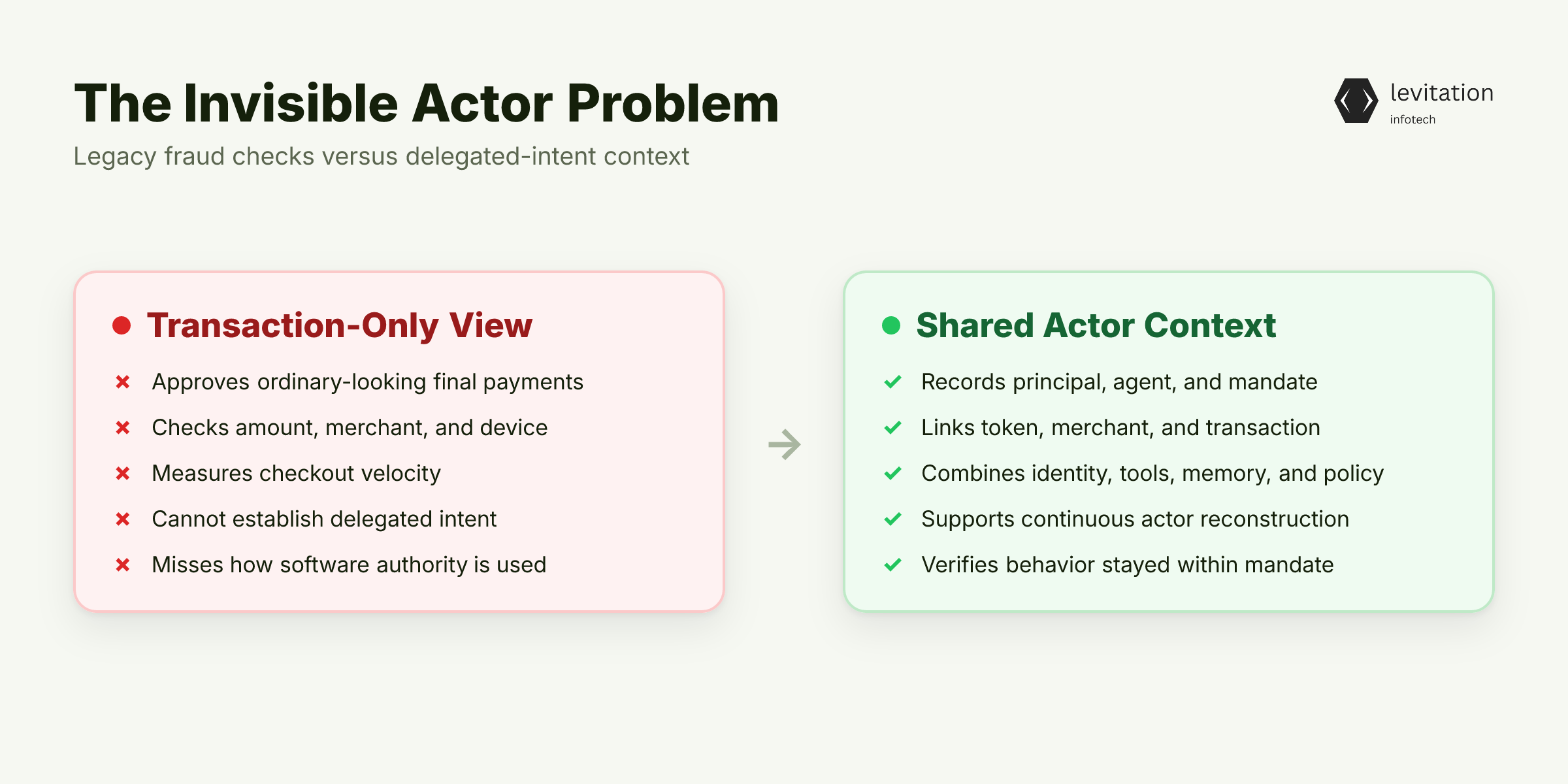
The cleanest fraud result tells you the least. Your engine sees a normal amount at an approved merchant, so it approves.
The Transaction Is the Final Event, Not the Whole Story
Recurring payments replay fixed instructions. An agentic payment chooses timing, amount, and destination within its mandate.
That changes the unit of risk from a payment instruction to delegated decision-making.
A procurement agent buys approved cloud capacity. It waits for a price change, then retries a failed order. It chooses between two approved vendors.
Each event looks ordinary. Together, these events reveal how delegated authority is being used. Can a final transaction check reveal that pattern?
The Legacy Rule Collision
Your current stack may answer familiar questions: - Does the amount match normal customer behavior? - Is the merchant trusted? - Does the device match the expected customer? - Is checkout velocity normal?
That list describes payment risk. It does not establish delegated intent. How do you prove that the agent had authority to act?
Find the Invisible Actor
Map every proposed agentic flow using six records: - Principal: The person or business that owns the funds and grants authority. - Agent: The software identity requesting payment. - Mandate: The approved purpose, limits, and conditions. - Token: The scoped credential or its reference. - Merchant: The recipient, category, and relevant context. - Transaction: The final payment attempt and outcome.
Any system that sees only the token or order has no actor context.
Payment execution is only one part of AI agents. Identity, tools, memory, and policy must feed the same shared record so fraud, identity, and operations teams can reconstruct the decision.
For a CTO, the question goes beyond whether one payment looks fraudulent. Can the platform continuously establish who acted? Can it prove what authority the agent held and whether the behavior stayed legitimate?
Tightening amount and merchant rules cannot fix a control plane that never sees who acted. Why does that failure grow worse when the actor is software?
Why Point-in-Time Fraud Scoring Misses AI Agent Abuse
That missing actor context is why point-in-time fraud scoring fails. The system evaluates an event without understanding the decisions that produced it.
Human-Behavior Models Meet Non-Human Actors
Models built around human purchasing patterns read retries, merchant changes, and shifted timing as warning signs.
Agents also perform those actions for legitimate reasons. Human-centered models read normal agent behavior as mandate abuse while missing deliberate abuse.
Before escalating an anomaly, separate three causes: - Malicious delegation abuse, such as repeated unauthorized exceptions. - Ordinary model variation inside approved behavior. - Integration or configuration errors, such as a broken merchant mapping.
Collapsing these causes creates broad false positives. It also hides real abuse behind noisy alerts. How can one alert reveal which cause matters?
One Payment Can Hide a Sequence
Authorization captures the last event. It does not explain the earlier searches, delegated tool calls, retries, or merchant changes that produced it.
Consider an agent that checks three suppliers, changes its choice twice, then buys from the third. The final order looks unremarkable.
Risk assessment needs retained context: - Agent identity - Mandate reference - Decision sequence - Cumulative spend - Merchant exposure - Revocation state
Keep these as separate signals. A combined score obscures the exact relationship that proves or disproves abuse. Each signal should remain inspectable, with its own timestamp, source, and relationship to the mandate.
Those records are necessary, but they do not settle credential ownership. Does possession prove authorization?
Possession Is Not Authorization
A valid token proves that a credential can be used. It does not prove that the requesting software is the trusted agent.
Replay does not invalidate a token. The wrong agent can hold it, and its delegation can expire.
This is possession, not authorization.
Integrated fintech solutions must join payment processing, identity, policy, and risk telemetry. Otherwise each component sees a different version of the same payment.
If point-in-time scoring cannot identify the actor, authorization must move upstream to the delegation chain. Which links must that chain contain?
Replace the Transaction Check with a Delegation Chain
That move changes the unit of authorization. It moves from "Is this payment acceptable?" to "Is this payment permitted for this actor?"
Principal -> Agent -> Mandate -> Token -> Transaction
Each link answers a different question: - Principal: Who owns the funds and grants authority? - Agent: Which software identity is acting? - Mandate: What may it do, where, and when? - Token: Which delegated credential is being used? - Transaction: Does this payment fit the permitted action?
Credential validity at the token link cannot substitute for authority at the principal and mandate links.
The chain must be enforceable, not merely documented. What should each mandate contain?
Make the Mandate Machine-Enforceable
A mandate must be enforceable by software, not prose in a prompt or a PDF.
Express restrictions as structured policy fields: - Approved merchants and categories - Per-transaction and cumulative spending caps - Validity windows - Permitted transaction conditions
A policy engine evaluates those fields before approval. It also returns a reason code for every decision.
Prompt text alone cannot guarantee enforcement. It can guide behavior, but it cannot stop a payment.
Rules still leave one gap. What must bind each credential to its mandate?
Bind Credentials to Delegated Authority
Give the agent a mandate-scoped token, not the user's actual payment credential.
The token carries or references its authority boundary. The payment layer checks that boundary before every use.
A stolen token should fail outside its merchant, category, amount, or time scope.
A scoped token limits one failure mode. What else must succeed before funds move?
Three Decisions Must Succeed Together
Authorization succeeds only when all three gates pass:
- The agent is authentic.
- The transaction fits its mandate.
- Current behavior passes the risk threshold.
Failure of any gate blocks authorization. There is no checkout-time override.
Each gate protects one request. How should trust persist across later sessions?
Trust Must Persist Beyond Checkout
Keep a trusted-agent state and behavior profile across sessions. Track cumulative spend, repeated exceptions, merchant movement, and revocation status. That state must inform every later authorization decision.
Gradual abuse appears as a series of permitted-looking exceptions. The sequence reveals the drift.
When evaluating top AI companies for fintech in India, require a working delegation chain. A polished demo or accurate model does not prove mandate enforcement.
A mandate creates only a boundary on paper. Pre-transaction enforcement turns it into a control. Yet enforcement still sits outside the payment path. Where must it enter?
Enforce Mandates Before Authorization, Not After Settlement
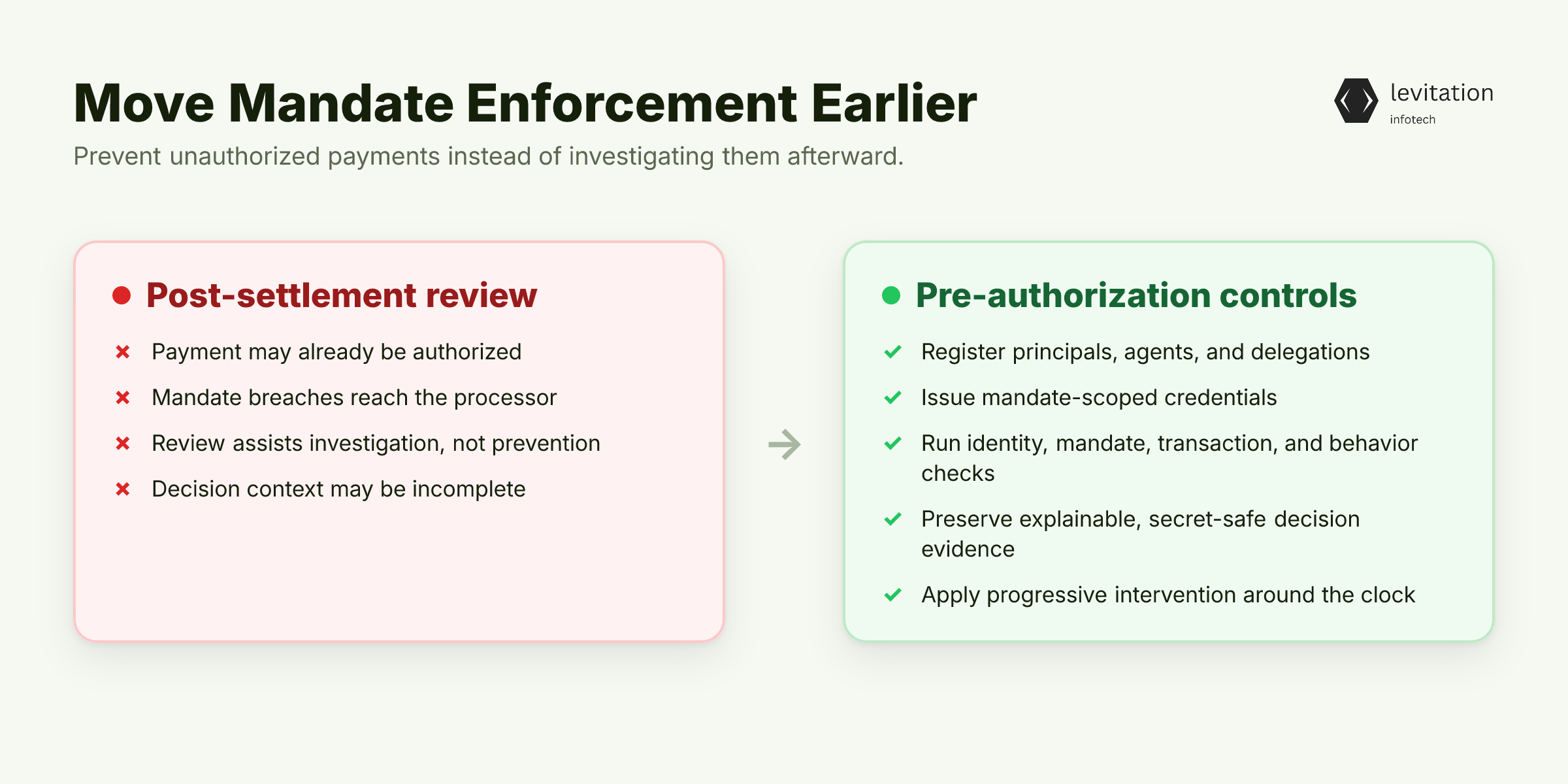
Paper boundaries fail at execution unless every payment decision consults them. The mandate must sit inside the authorization path.
Issue a Mandate-Scoped Credential
Credential issuance should be a controlled act: - Register the principal, agent, and delegation. - Validate authority and mandate conditions. - Issue a token bound to approved merchants, categories, limits, and validity windows. - Record token, agent, principal, and mandate links.
Each record should have an owner and an auditable lifecycle.
The records establish a chain. Who checks that chain before the processor sees the request?
Evaluate Policy at Decision Time
Apply these controls before the payment authorization request reaches the processor.
Run four checks together: - Identity: Is this the registered agent? - Mandate: Does the authority permit this action? - Transaction: Does the payment match current risk rules? - Behavior: Does cumulative activity remain legitimate?
Post-settlement review helps investigation. It cannot prevent a payment already authorized. The pre-authorization event must preserve enough context to explain the outcome.
Those checks need richer context. What must the authorization event include?
Give Transaction Authorization Agent Context
Authorization needs agent context, not just card and order fields.
Include these records in the decision event: - Agent ID and mandate ID - Token reference, without sensitive credentials - Principal or delegated authority - Merchant, amount, and cumulative spend - Decision timestamp and policy version - Reason codes and intervention outcome
These fields let teams explain why approval happened. Logs must protect secrets while preserving evidence.
More context makes each decision explainable. How should the system respond when risk changes?
Add Progressive Intervention
Not every exception deserves the same response: - Approve low-risk activity inside the mandate. - Trigger step-up verification for explainable exceptions. - Deny and revoke clear mandate breaches.
Agents can act continuously and outside staffed hours. Intervention must work around the clock.
A clear breach demands revocation. What must revocation actually change?
Make Revocation Operational
Revocation is operational only when it changes execution state.
It must block the token, cancel outstanding instructions, update trust state, and open the incident workflow.
Join AI agents, policy enforcement, and payment execution while keeping each layer independently auditable.
Correct architecture can still fail under adversarial sequences, so the launch plan needs evidence rather than optimism. The design must face attack. Which boundaries should red-team tests target first?
Red-Team Agent Fraud Before a Live Agent Can Spend
Even a sound control plane remains vulnerable to adversarial sequences. Your tests must attack the delegation boundary directly.
Test the Boundary, Not Just the Happy Path
Launch tests must cover more than the happy path. Fraud tests must prove the boundary.
Build an attack matrix covering: - An authentic token used by the wrong agent. - A token replayed outside its mandate. - Cumulative spending that approaches a cap. - A revoked mandate. - Legitimate activity that must not be falsely declined.
Define the expected decision and evidence for every case before testing.
Each case tests a boundary. How do you expose a slow breach spread across time?
Test Behavior Across Time
Individual transactions can hide a slow breach. Replay multi-step sequences across sessions and merchants.
Test repeated exceptions, unusual merchant movement, and authorization patterns that breach combined limits.
Then vary order, timing, and failure responses. The control must survive a changed path.
The tests now provide evidence about the controls. Which launch gates should decide whether they work well enough?
Launch with Measurable Gates
Set pass and fail thresholds before tests begin.
Use these measurable gates: - Mandate-breach approvals - Unauthorized approval rate - False-positive rate - Anomaly-detection lead time - Revocation completion time - Authorization decision latency
Accuracy alone hides business harm. These gates expose control failures and customer friction. Assign each gate an owner and a documented response for both pass and fail outcomes.
This follows the same discipline as your fraud model needs an error budget, not better accuracy.
The thresholds create a go or no-go decision. How should production expand without losing that discipline?
Use a Staged Production Sequence
Move into production in deliberate stages: - Shadow authorization mirrors decisions without live spending. - Live payments begin with capped, low-risk mandates and limited categories. - Expansion follows consistent control evidence and rehearsed incident playbooks.
Each stage has a defined exit condition and an owner.
The final stage gates depend on partners. What evidence should you demand before trusting one?
Choose Partners with Production Evidence
Partner selection deserves the same scrutiny.
Use production evidence when comparing top AI companies for fintech in India. Also run direct tests of mandate enforcement, identity binding, monitoring, and launch governance.
Once those gates are measurable, the final challenge is turning controls into an operating model. What must that model support to make expansion repeatable?
Launch Narrow, Measure the Trust Plane, Expand Deliberately
Measurable gates prevent reckless expansion. An operating model makes expansion repeatable across teams, mandates, and merchants.
Autonomy Becomes Commercially Usable
Mandate-bound controls let the business accept agent-driven demand without exposing unrestricted payment credentials.
The agent gains room to act while the business retains a narrow authority boundary. That balance creates bounded autonomy. What happens when one agent behaves badly?
Losses Become Bounded and Recoverable
Scoped tokens and cumulative limits cap what one bad agent can reach.
Anomaly intervention and rapid revocation contain harm before it becomes an unbounded payment incident.
These controls do not make loss impossible. They make it bounded, visible, and recoverable. Containment does not eliminate investigative ambiguity. What evidence must each dispute preserve?
Fraud Investigation Gains Evidence
Every disputed payment should answer five questions: - Who delegated the authority? - Which agent acted? - Which mandate and token applied? - Which policy version decided? - What behavior preceded the transaction?
Preserve the delegation chain, reason codes, behavior history, and policy version.
Tool calls also need durable evidence, as your AI agent audit trail can otherwise go dark.
That lets investigators separate a compromised agent from a customer dispute, model error, or merchant issue.
The evidence supports each investigation. Which shared metrics should reveal weak trust controls early?
The Trust Plane Becomes an Operating Metric
Turn the trust plane into an operating metric.
Track: - Share of payments bound to a verifiable mandate - Agents under intervention or revocation - Mandate-breach approvals - False declines - Time to contain suspicious behavior
Authorization, fraud, and incident teams must share this picture.
Start with limited merchants and capped mandates. Broaden categories only after control evidence stays consistent.
Sustainable agentic payments combine fintech solutions, verifiable AI agents, and clear risk ownership. They are not an ungoverned automation initiative.
The first live payment will test the system. The next question is whether your trust plane can prove every decision.
Frequently Asked Questions
Q: What are agentic payments?
Agentic payments are transactions initiated and executed by AI agents within a user- or business-approved mandate. They often proceed without human approval at each checkout.
Unlike fixed-schedule payment automation, an agent may dynamically choose timing, amount, and destination within its permitted authority.
Q: How is AI payment fraud different from traditional payment fraud?
Traditional fraud controls evaluate a transaction or human behavior at one point in time. Agentic fraud also requires verifying the agent's identity, delegated authority, mandate, and behavior across multiple actions and sessions.
Q: How do you secure agentic transactions?
Authenticate the agent and bind its payment token to a mandate that software can enforce. Evaluate policy before transaction authorization, and monitor cumulative behavior for anomalies. High-risk exceptions should trigger step-up verification, denial, or revocation.
Q: Does tokenization make agentic payments safe?
No. Mandate-scoped tokenization limits what a delegated agent can do. It does not prove that the agent is trustworthy or behaving legitimately. Combine it with agent verification, transaction authorization, and continuous fraud controls.
Q: What should a CTO test before launching agentic payments?
Test cross-agent token misuse, mandate breaches, cumulative-limit evasion, and revoked delegation. Also test unusual multi-step sequences and legitimate transactions that should not be falsely declined.
Which link in the delegation chain will fail first when real conditions move faster than the launch plan?
About the author
Mayank Singh is a software developer at Levitation Infotech, where he builds web and AI-powered applications across the company’s fintech, healthcare, and enterprise projects.