


TL;DR: High accuracy can hide a fraud model that catches no fraud. Replace accuracy as the release criterion with an error budget tied to a fixed period. Enforce that budget through release gates, monitoring, and clear ownership.
Key Takeaways: - Accuracy can reward a model that labels nearly every transaction legitimate. - An error budget converts model behavior into accepted business loss and operating limits. - Versioned policies and live budget monitoring turn accepted risk into release, rollback, and ownership decisions.
Accuracy Can Hide a Completely Broken Fraud Model
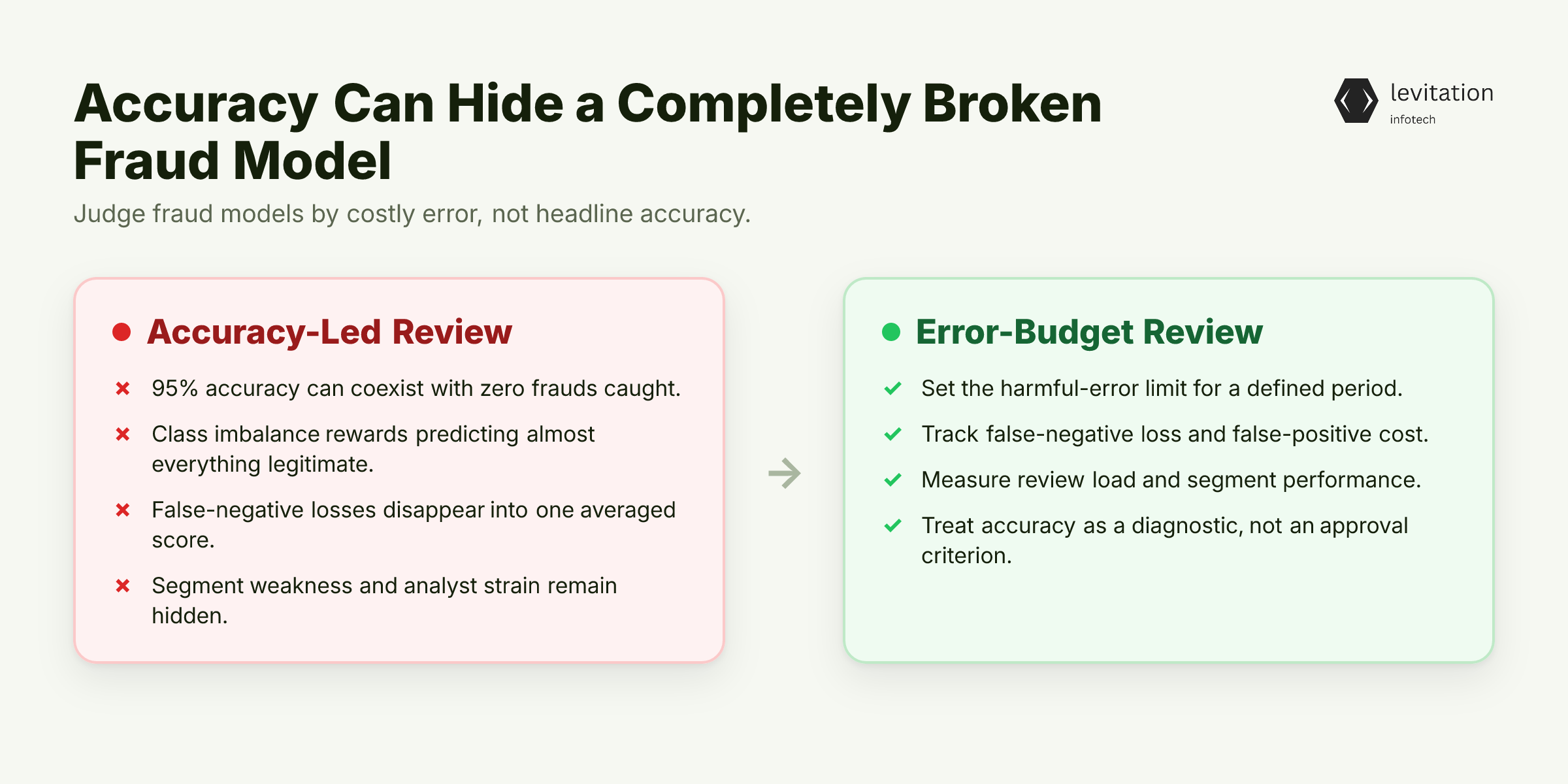
A fraud model can be 95% accurate, capture zero frauds, and still pass an accuracy-based review. The missing question is not whether the score looks good. It is how much costly error the business can afford.
Consider a review file of 100 transactions. Five are fraudulent. The model calls every transaction legitimate.
It makes 95 correct predictions, misses five frauds, and reports 95% accuracy. That model has caught nothing. Yet its score looks strong on paper.
Accuracy divides correct predictions by all predictions. When fraudulent cases are rare, class imbalance rewards the safest-looking behavior: predict almost everything as legitimate.
Fraud decisions have asymmetric costs: - False-negative loss: A fraudulent transaction proceeds and creates direct financial harm. - False-positive cost: A legitimate transaction triggers investigation, review work, and customer friction. - Review load: More suspicious activity can consume analyst capacity needed for other cases. - Segment risk: A healthy portfolio average can hide serious weakness in one channel or customer cohort.
Accuracy becomes one diagnostic statistic, not an approval criterion. CTOs should require false-negative loss, false-positive cost, review load, and segment performance before accepting a deployment.
The better question is simpler: how much harmful model error can the business absorb during a defined period? That framing turns fraud detection monitoring from a score dashboard into a business control.
If accuracy is the wrong unit of risk, a better threshold or model will not fix the decision underneath it.
Why Better Scores Still Produce Worse Business Outcomes
Precision, recall, and AUC sharpen the diagnostic picture. None measures financial loss, operating capacity, or customer impact directly.
Each metric answers a different question: - Precision: When the model flags a transaction, how often is it truly fraudulent? - Recall: How many known frauds did the model catch? - AUC: Can the model rank suspicious cases above legitimate ones across thresholds?
Those questions are useful, but thresholding turns metrics into a business decision.
Lowering the threshold can catch more suspicious activity. It can also send more legitimate transactions to manual review and create customer friction. Raising the threshold does the reverse.
Neither direction is automatically better. The right point depends on the value of missed fraud and investigation cost. It also depends on reviewer capacity and the harm caused by false declines.
Aggregate reporting can make this trade-off look cleaner than it is. A portfolio-wide result can remain stable while one payment channel, geography, device type, or customer cohort gets worse.
The same trap appears in canary releases that pass while weak zones remain.
Report performance by important transaction segment, channel, geography, and customer cohort where lawful and appropriate. Portfolio averages alone cannot tell you where harm concentrates.
Fraud outcomes often arrive after the original decision. Offline scores can look healthy until production evidence contradicts them.
The team needs a concrete deliverable: a threshold curve showing expected business loss, review volume, and customer-impact guardrails across candidate thresholds. Select an operating point against those constraints, not against the highest recall.
This work remains distinct from MLOps SLOs. Those protect the serving path. The threshold curve decides which errors the business can afford.
The missing control is not another model metric. It is an explicit limit on the harm those metrics can create.
Define the Error Budget in Business Loss
Set a time-bounded loss limit
Set an approved ceiling on model-caused financial and operating harm over a defined period. Fraud operations, risk, product, and the business unit should share ownership.
Each group governs part of the trade-off: operations owns review capacity, product owns customer impact, and risk owns policy. The business unit owns the financial consequence.
A period without a start and end is not a budget. It is only a goal. The next decision is how to express the harm.
Express harm in one decision currency
Use expected money loss as the primary measure. Keep manual-review capacity and customer friction as separate guardrails when they cannot be turned into credible cost estimates.
Remaining budget = approved budget - estimated false-negative loss - false-positive operating cost - customer-friction cost.
False-negative loss estimates the harm from fraud allowed through. False-positive operating cost includes investigation and handling work. Customer-friction cost captures measurable harm when evidence supports it.
Publish provisional and confirmed values separately. Recent decisions need provisional estimates. Older decisions with mature labels need confirmed outcomes.
Mixing them creates false confidence and obscures sudden changes in fraud behavior. Model quality must therefore remain separate from platform health.
Separate model quality from platform reliability
Model errors and platform failures need different controls: - Model quality: False negatives, false positives, threshold behavior, and segment performance. - Serving availability: Whether the model returns a decision when required. - Inference latency: Whether that decision arrives before the business deadline. - Feature freshness: Whether the decision uses current, valid inputs. - Decision coverage: How many eligible transactions receive a model outcome.
Each deserves a distinct SLO. Platform failures require a rules-based or manual fallback. That fallback protects the business but consumes operating capacity, and the budget still needs segment-level visibility.
Allocate visibility by segment
Maintain a company-wide budget and report budget burn and model performance by important transaction segments.
A healthy average must not conceal a costly hotspot. Segment visibility also tells leadership where capacity, model changes, or policy intervention will have the greatest effect.
A generic reliability budget measures permitted downtime. A fraud budget quantifies the economic and operating harm allowed by model decisions. Versioned model risk controls must make that distinction explicit.
A budget that lives only in a presentation will not constrain a release. It has to enter the delivery pipeline as versioned policy.
Make the Error Budget a Release Gate
Version the policy
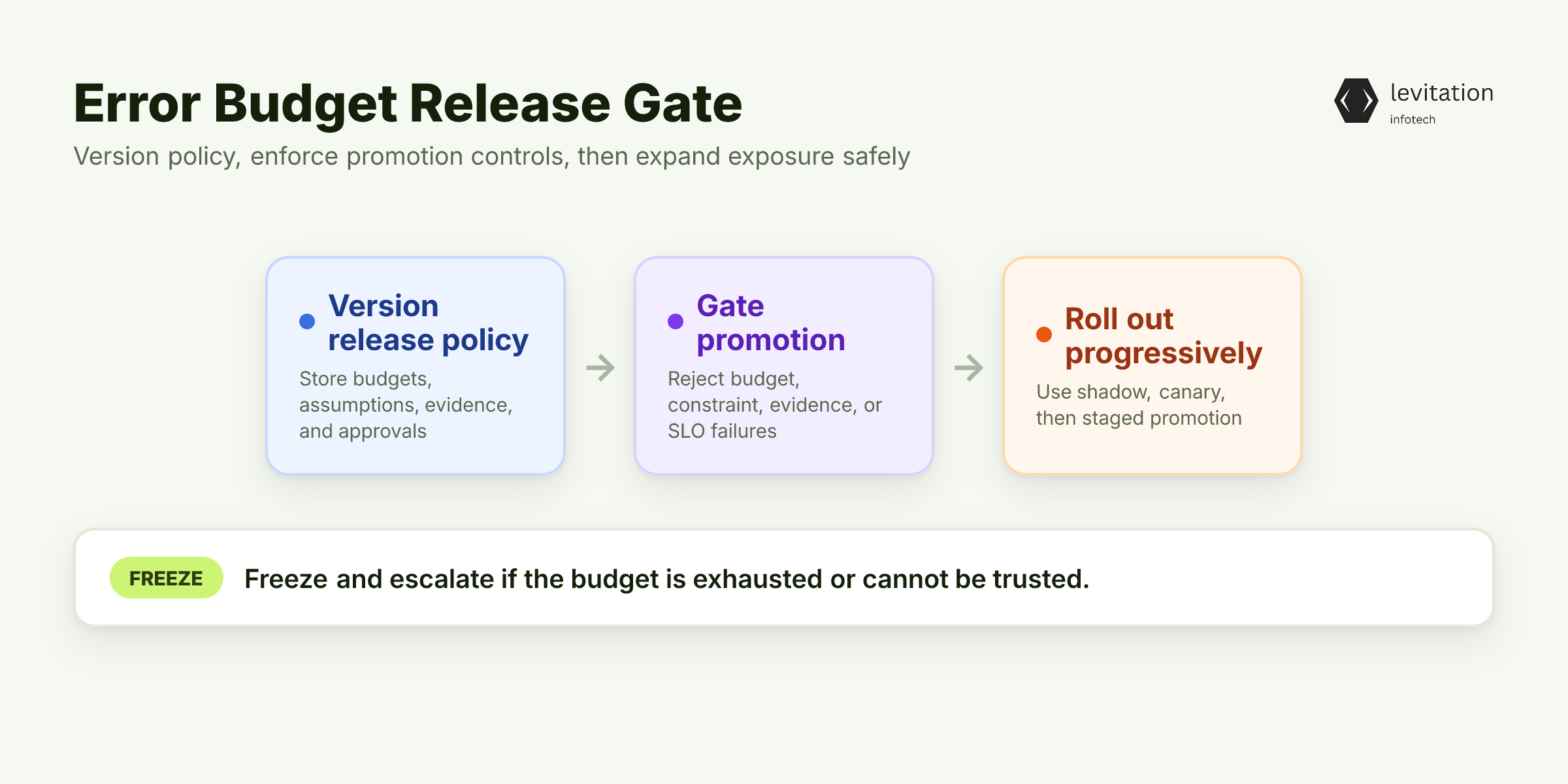
Store the release policy beside each model version in the model registry. A reviewer should see why the candidate was allowed to move.
The release record should contain: - The approved loss budget and its period. - Threshold assumptions and expected loss estimates. - Important segment definitions. - Hard model risk constraints. - Required evidence and approvals. - Rollback triggers and approved decision-makers.
A reviewer cannot audit a registry entry if its assumptions are not explicit. That model registry problem applies directly to fraud releases. That evidence needs to block promotion when it falls short.
Gate promotion
Make the evaluation pipeline reject a candidate when its expected loss exceeds the approved budget. Reject it when a hard constraint fails or required segment evidence is missing.
Use a compact policy card with four explicit actions: - Reject: Expected business loss exceeds the approved limit. - Reject: A hard model risk constraint fails. - Reject: Required segment evidence is absent. - Freeze and escalate: The budget is exhausted or cannot be trusted.
Leave numerical thresholds to the organization. Universal values ignore transaction value, review economics, and customer consequences.
The release gate should also require MLOps SLOs. One model can produce excellent decisions while the serving path fails. Another can meet latency targets while relying on stale features.
Serving availability, decision latency, feature freshness, and inference failures belong beside model-quality evidence. Those controls become essential as soon as the candidate reaches live traffic.
Roll out progressively
Do not send a candidate straight to full traffic. Use shadow evaluation, a canary, and staged promotion.
Shadow evaluation compares decisions without changing live outcomes. The canary then exposes a limited share of traffic. Staged promotion expands exposure only while the candidate stays within budget.
Compare the candidate with the champion on estimated budget burn, review load, decision coverage, and outcomes with mature labels. Investigate differences before each expansion, and keep the rollback path ready before exposure grows.
Define the rollback path in advance
Identify which model, threshold, feature, or data condition triggers rollback. Name the person approved to act. Document the manual or rules-based fallback that protects the business during investigation.
A rollback path written after an incident is too late. It is an instruction for a future moment when speed and authority matter.
These controls belong inside the broader model risk controls. Require reviewable label assumptions, threshold overrides, fairness checks where applicable, and documented acceptance of residual budget consumption.
A release gate works only if fraud detection monitoring sees budget burn before delayed labels turn it into a postmortem.
Monitor Fraud Errors Before Labels Arrive
Track provisional and matured outcomes
Label every estimate with its time window. Do not compare recent provisional decisions directly with fully confirmed historical cases.
Track the time each decision has had to mature. Show how much of the portfolio remains provisional. This prevents incomplete evidence from looking like stable performance. That distinction becomes especially important when drift appears before labels mature.
Separate drift from degradation
Monitor feature and data drift for investigation. Use changed input distributions to explain unusual model behavior, but do not treat drift as proof of degradation.
Use estimated error burn, segment performance, and outcomes with mature labels to judge whether model decisions create more harm.
The distinction prevents a familiar failure. Teams investigate every distribution shift while missing continued budget consumption. The remaining budget needs a single operating view.
Put the remaining budget on one dashboard
The fraud operations dashboard should show: - The approved loss budget. - Estimated and confirmed consumption. - Current budget burn rate. - False-positive load. - Available review capacity. - Label maturity. - Performance for each important segment.
Alert on sustained budget burn and loss of decision coverage. Do not page the team for a single unusual metric without context.
Route each alert to someone able to adjust the threshold, roll back the model, or increase review capacity. An alert without authority is only an observation.
Measure operating feedback
Track queue growth, analyst workload, override rates, and customer-impact signals. These are leading indicators of stress before final fraud labels arrive.
A growing review queue shows that the current threshold strains operations. A rise in overrides points to analyst distrust. Customer complaints reveal friction hidden by aggregate scores.
Close the loop after every incident and threshold change. Update the budget assumptions, monitoring policy, and model registry record. Fraud AI and its audit cost show why model gains cannot be separated from governance work.
These operating signals belong inside the same control loop as model risk controls.
The remaining error budget must change a decision before it becomes an incident report, which makes ownership the final requirement.
Move Model Ownership from ML Teams to the Business
ML teams should own model mechanics, testing, and technical operation. Business leaders must own the loss the organization accepts from those mechanics.
Give every CTO the same governance question. How much error budget remains, where is it consumed, and who has authority to spend it?
Create a one-page budget charter. It should name: - The business owner. - The fraud operations lead. - The model owner. - The risk representative. - The approval authority. - The review cadence. - The response for healthy, constrained, and exhausted states.
This structure gives teams controlled release speed, earlier intervention, explicit risk ownership, and an audit trail. It does not promise a specific fraud-reduction result.
The build-versus-buy decision also changes. The real question is who can operate this governance system for the life of the model. It is not who can train the first version.
The governing principle is simple: the objective is not zero errors. It is visible, deliberate, accountable error within a limit leadership has explicitly accepted.
Several practical choices will decide whether the limit works: measurement, service targets, metric selection, label delays, and review cadence. The next review will show whether those choices are operational controls rather than documentation.
Frequently Asked Questions
What is a fraud model error budget?
It is the approved limit on financial, operating, and customer-impact harm caused by fraud-model decisions during a defined period. Unlike accuracy, it gives teams an explicit tolerance for error. It also provides a basis for release, monitoring, and escalation decisions.
How is a fraud model error budget different from an MLOps SLO?
An MLOps SLO defines a target for a service or operating signal. The error budget shows how much room remains before that target is breached. A fraud model needs both.
Use SLOs for serving health and feature freshness, plus an economic budget for decision harm.
Which metrics should replace accuracy in a fraud model review?
Use expected fraud loss, false-negative value, false-positive operating cost, review capacity, customer-friction measures, and segment performance. Retain precision, recall, and AUC as supporting diagnostics. Treat none as the release decision by itself.
How should fraud loss be measured when labels are delayed?
Report provisional estimates and confirmed outcomes separately. Update the budget as labels mature.
Show estimation uncertainty and burn rate on the dashboard. This lets teams act before final outcomes arrive.
When should a fraud model error budget be reset?
Review the budget on a fixed schedule. Reset it whenever fraud patterns, model behavior, business costs, or important operating conditions change.
The next governance review should begin with remaining budget, not another model leaderboard.
About the author
Mayank Singh is a software developer at Levitation Infotech, where he builds web and AI-powered applications across the company’s fintech, healthcare, and enterprise projects.