


TL;DR: Application logs prove your LLM was called. They say nothing about what the agent did at the tool boundary, where the consequential work actually happens. An AI agent audit trail that survives real-world review has to be instrumented at the middleware layer around every tool call, not at the model endpoint.
Key Takeaways: - The audit gap is architectural, not a logging volume problem. It starts where the agent's action leaves the LLM and crosses into a downstream system. - A surviving audit trail records session initiator, agent identity, policy binding, tool version, full tool input/output, and state change as linked events. - Wrap every tool call in middleware. Propagate a single correlation ID. Persist to an append-only store that lives outside the agent's read path. - Run the 72-hour test on your last agent incident before you buy anything. Five questions will tell you whether your trail holds or whether you are reconstructing fiction.
The first time a security team discovers their AI agent audit trail is broken, the agent has usually already done something it shouldn't have. The logs show the LLM was called. They show nothing about what the agent did next.
You Have Application Logs. You Don't Have an AI Agent Audit Trail.
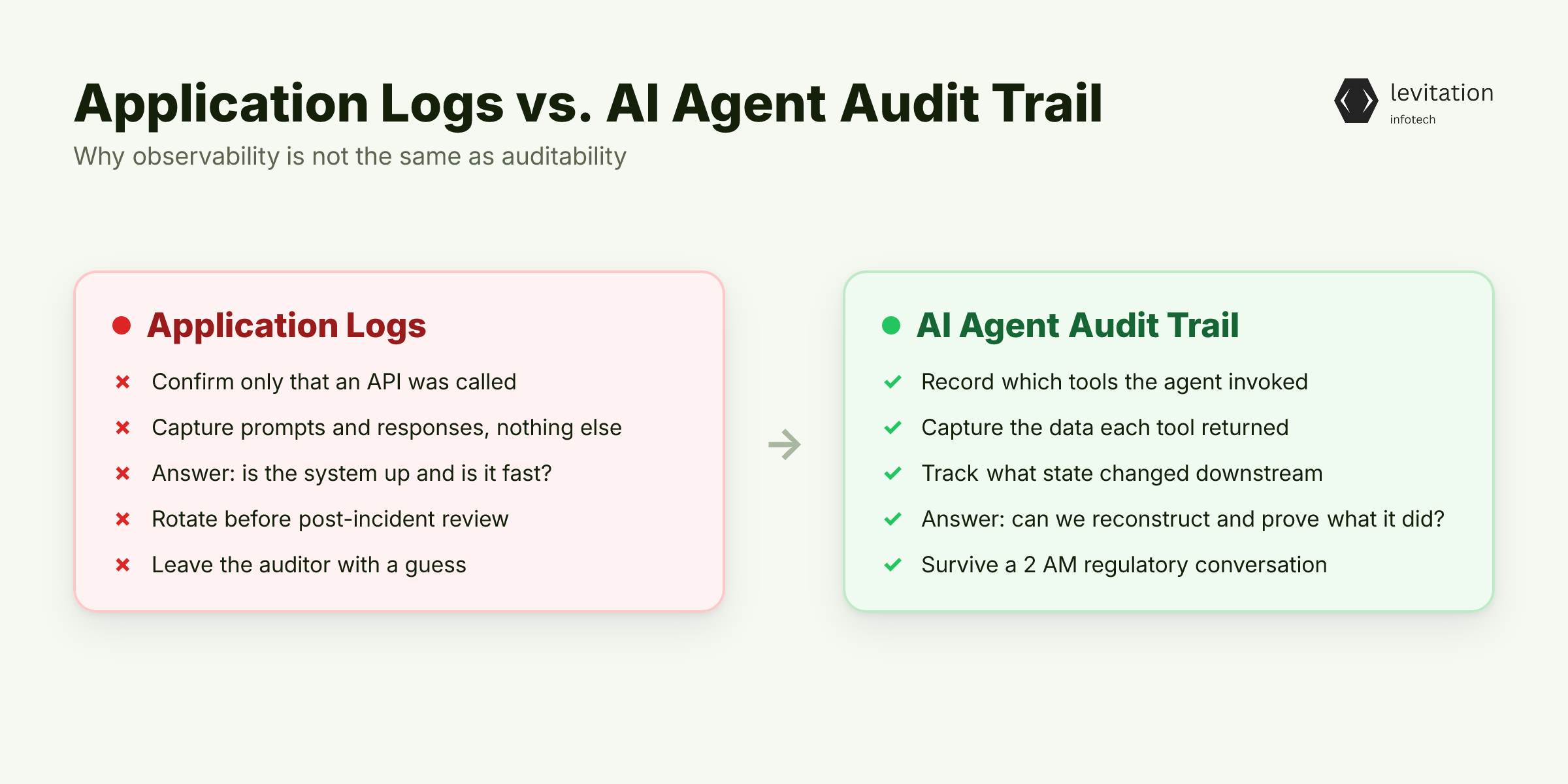
Application logs are not the same thing as an AI agents audit trail. They confirm an API was called. They do not record which tools the agent invoked, what data those tools returned, or what state changed downstream.
The distinction sounds academic until you are standing in a post-incident review. You are trying to explain a consequential action the system took. The only evidence you have is a record of the model being prompted. That answer does not survive a regulatory conversation.
Most CTOs discover the gap during incident response, not during design. By then the causal chain is unrecoverable, the logs have rotated, and the only honest answer to the auditor is a guess: "the LLM was queried, and something happened after that." Auditors do not accept guesses.
The deeper problem is a category confusion. Observability asks: is the system up, and is it fast? Auditability asks: can we reconstruct what it did, and can we prove it? Once AI agents take autonomous action, the second question becomes the only one that matters at 2 AM. Open-source agent toolkits make the gap worse, because they ship with a default logger that captures prompts and responses and nothing else.
The reason this gap exists has a specific shape, and it is not about logging volume.
The Tool Boundary Is Where Every Audit Trail Dies
The LLM call is the visible event in your logs. The tool invocation is the consequential one, and it lives in a separate system your LLM logger cannot see.
Your agent calls the model, gets back a structured function call, and dispatches that call to an internal service. The service returns data the agent folds into its next prompt. The middleware that wraps the LLM sees the first half of that loop. It sees the second half only if you built it to.
Orchestration layers make this worse. Most production agents run behind a LangChain-style abstraction that retries, summarizes, or transforms requests between the model and the tool. Each transformation step silently rewrites the causal link. The prompt the auditor sees in the LLM log is not the prompt the tool received. The tool input that matters was mutated by an intermediate handler that no one instrumented.
Infrastructure logs make teams overconfident. Kubernetes audit, cloud audit, and container runtime logs prove the agent was scheduled. They do not prove what it did. Your LLM gateway logs everything, but inference logs nothing useful. The audit log can confirm a pod ran at 14:32:07. It cannot confirm which model the pod called, which tool it invoked, or which row in which database it touched.
If the boundary is the problem, the fix has to be designed around what crosses that boundary.
Anatomy of an Audit Trail That Survives a Tool Call
A tool call is not a single event. It is a small transaction with at least four participants. The session initiator starts the run. The agent identity acts on it. The policy bounds what the agent can do. The tool produces a side effect. Each one needs its own entry. Each entry needs to link to the others by correlation ID, not by timestamp.
The minimum viable record per tool call is: - Session initiator, with the user, tenant, or system that started the run - Agent or workflow identity, with the version of the agent definition - Policy binding, naming the rules, approval scope, or human authorization that permitted the action - Tool name and version, since "get_customer" in v3 is not the same tool as "get_customer" in v4 - Full tool input, serialized in a way that is queryable later - Full tool output, including the data the agent saw, not just a summary - Downstream state change, with the resource that was modified and the before/after diff
Chain-of-thought and retrieved context must be persisted alongside the tool call, not summarized away by the orchestration layer. The summary is what the agent used. The raw record is what AI compliance reviewers will need when they ask why the agent retrieved a customer record it had no business seeing.
Model output, policy decision, and human authorization must be logged as distinct, linked events. They are not the same thing, and regulators will not treat them as the same thing. A model suggested an action. A policy rule approved it. A human signed off. Three different events. Collapsing them into one log line is how teams fail reviews they thought they had passed.
Knowing what to capture is half the answer. Where you instrument the capture is the other half.
The Middleware Pattern: Instrument the Boundary, Not the Model
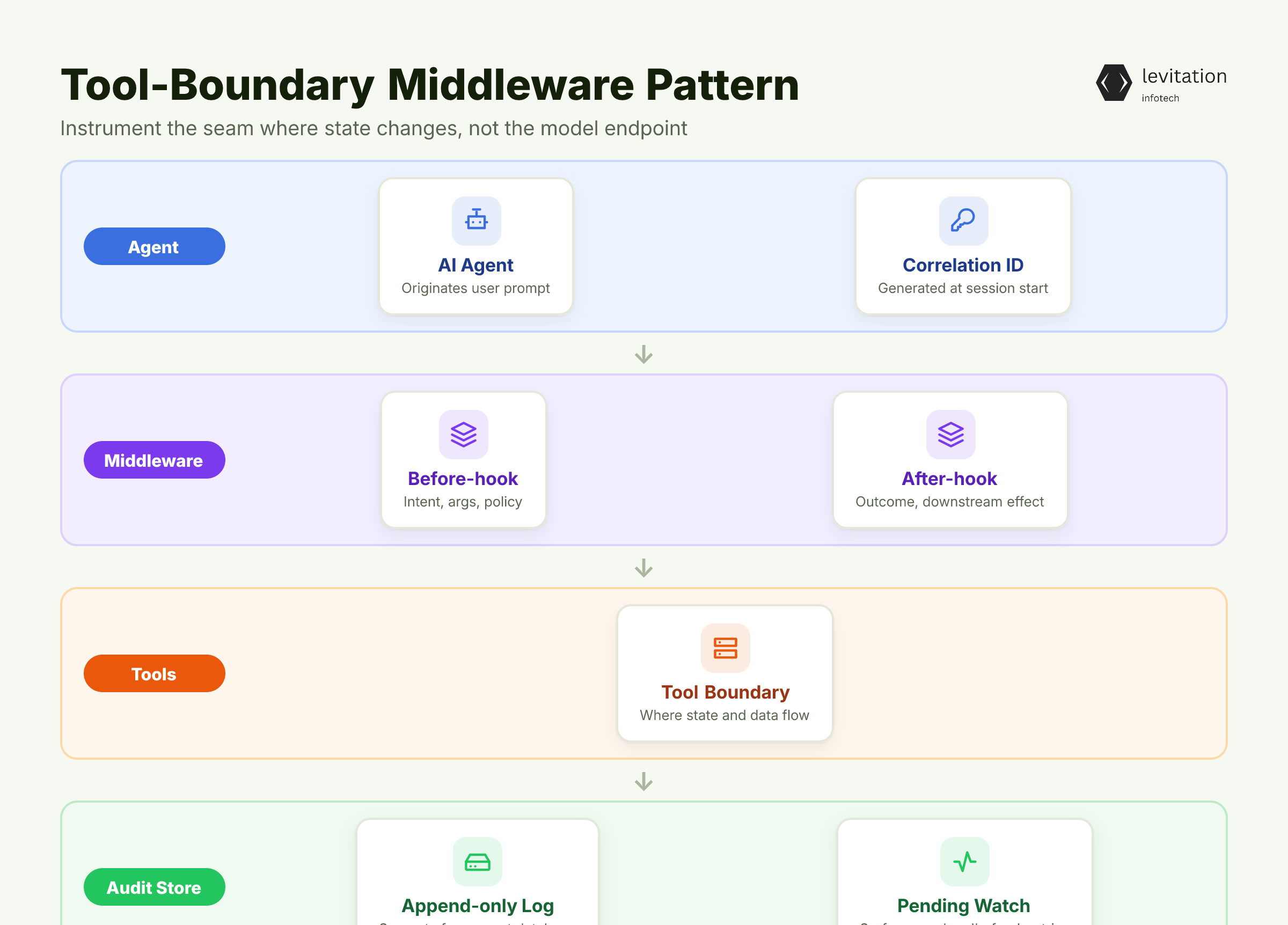
Most teams instrument the wrong seam. They log at the model endpoint because that is the easiest place to drop a handler. What they need to log is the tool boundary, because that is where state changes and data flows.
The middleware pattern wraps every tool call in a layer that emits a structured, tamper-evident log entry before execution and another after the response returns. The "before" entry captures intent: who is calling, which tool, with which arguments, under which policy. The "after" entry captures outcome: what the tool returned, what the agent did with the result, and what downstream effect the agent triggered. The pair forms a closed transaction. If the "after" never lands, the "before" is a pending write that surfaces in your monitoring.
A single correlation ID has to propagate from the original user prompt through every downstream tool call. Without it, you have a pile of orphaned tool events you cannot stitch back to a session. The ID is generated at session start, attached to every log line, and passed as a header on every internal call. The format is unimportant. The discipline is everything.
Persist logs to a write-once or append-only store. Never to the same database the agent reads from. Co-location creates a conflict of interest your auditor will flag the moment they see the same credentials in both paths. If your agent can read its own audit log, your auditor will ask whether it can also rewrite it. The honest answer should be no.
This pattern has matured through repeated iteration across regulated industries. The teams that got it right treat the middleware as a first-class service with its own SLO. They do not treat it as a wrapper someone added during the incident that finally woke them up. Extending an existing LLM stack to add this layer is cheaper than rewriting, but only if the extension lives outside the agent's process boundary.
Architecture is necessary but not sufficient. The real test comes when someone has to reconstruct an incident at 2 AM.
The 72-Hour Test: Five Questions That Expose the Gap
Pick any AI agents incident or anomaly from the last 90 days. Pretend an external auditor has asked you to reconstruct it. Try to answer five questions: - Who started the session, and from which tenant or system? - Which agent or workflow identity acted, and which version of its definition? - What policy bound the session, and which approval scope or rule applied? - Which tools were called, with what inputs, and what did each tool return? - What was the final state change, and which resource was modified?
Most teams fail on question four. Tool calls were never persisted at the boundary. Only the LLM call was. The honest answer becomes "the agent had access to the customer database, and we cannot tell you which query it ran." That answer is fatal in any review modeled on AI compliance expectations from NIST or the EU AI Act.
This is a self-audit, not a vendor evaluation. Run it on your current stack before you evaluate anything else. If your team cannot answer all five questions from your existing logs, the gap is in your instrumentation, not in your tooling. A new platform will inherit the same blind spot unless you fix the boundary first.
What Changes When Your Trail Actually Holds Up
Compliance reviews shift from narrative reconstruction to structured query. Your team filters by agent, time range, tool, or policy outcome and pulls the exact record. The review meeting stops being a debate and starts being a query.
Incident response compresses from days to hours. The causal chain is already persisted at the boundary. You are not reverse-engineering behavior from logs that were never designed to capture it. You are reading a transaction log that was designed for exactly this moment.
Agent deployment velocity goes up. Governance teams stop blocking launches they cannot verify. The audit trail becomes the approval mechanism, not the bottleneck. Teams operating in security-critical environments report a measurable shift. Risk reviews move from "show us your tests" to "show us your trail." The first is subjective. The second is queryable. When the trail is structured, queryable, and tamper-evident from day one, governance teams stop being the bottleneck they were before the instrumentation existed.
The agent did the work. Your trail proves it did the right work. That is the entire game.
Frequently Asked Questions
What is an AI agent audit trail?
An AI agent audit trail is a chronological, tamper-resistant record of every input, reasoning step, LLM call, tool execution, and final output produced by an agent. Unlike application logs, it persists the full decision path. It includes which tools were invoked, what data they returned, and which policy or human authorized the action.
Why aren't Kubernetes or cloud audit logs enough for AI agents?
Infrastructure audit logs capture scheduling, RBAC decisions, and resource mutations. They prove an agent was scheduled. They cannot prove what the agent did inside the application layer. They cannot show which model it called, which tool it invoked, or what data it accessed.
What should an AI agent audit trail include for tool calls?
Each tool call entry should capture the session initiator. It should record agent or workflow identity, the policy binding the session, the tool name and version, full tool input and output, and the downstream state change. Without these, you cannot reconstruct whether the agent stayed inside its authority.
How do you build an audit trail for an agent that chains multiple tool calls?
Use a correlation ID that propagates from the original user prompt through every downstream tool call. Wrap each tool invocation in middleware that emits a structured log entry before and after execution. The trail must link all calls in causal order, not just timestamp order.
What frameworks or standards require an AI agent audit trail?
The NIST AI Risk Management Framework emphasizes runtime context and traceability for autonomous systems. OWASP's Agentic AI Top 10 lists explainability and auditable decision trails as prerequisites for enterprise-scale deployment. Sector-specific rules, such as SR 11-7 in banking and the EU AI Act for high-risk systems, extend these requirements to specific industries.
About the author
Mayank Singh is a software developer at Levitation Infotech, where he builds web and AI-powered applications across the company’s fintech, healthcare, and enterprise projects.