


TL;DR: Extending your LLM stack with managed APIs looks like it saves months of build time. In practice, it turns every prompt into an unprovable event. Auditors treat these as regulated risks. The fix is not fewer vendors. Treat every model call like a financial transaction. Then layer five controls that make any extension defensible.
Key Takeaways: - Auditors map LLM calls to KYC, AML, access control, structured reporting, and tamper-proof logs. These are the same primitives they apply to fintech infrastructure. - Multi-vendor inference diversification grows the audit surface. Each provider brings a new data addendum. It brings a new log format. It brings a new residency question too. - Build-vs-extend is a risk-layer question. Extend at the application layer. Build at the decision layer where regulators accept no black boxes.
The Extend Trap: Why Plugging In Another API Makes Audits Harder
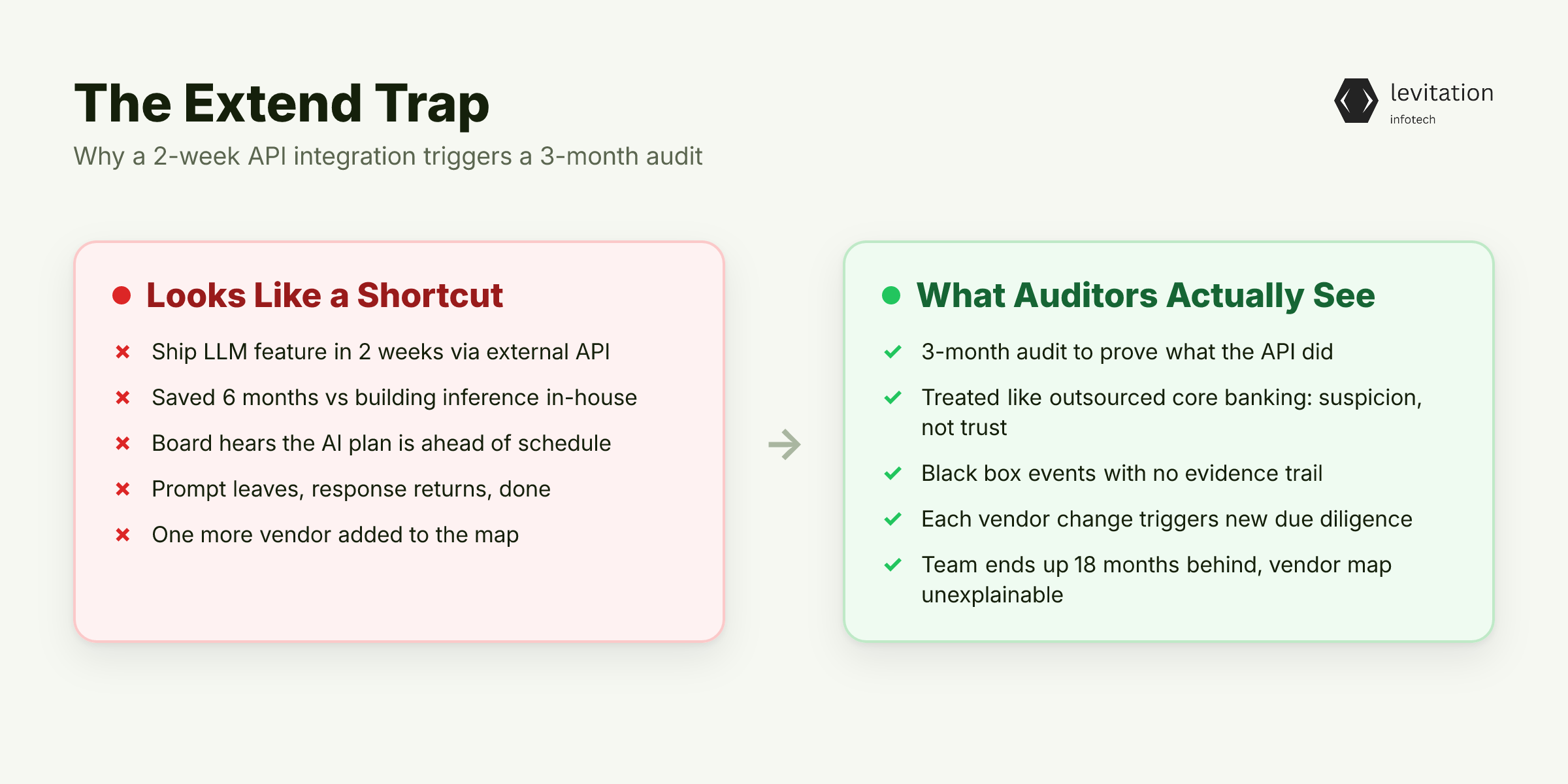
Your team can ship an LLM feature in two weeks. Just call an external API. Your auditor will spend three months proving you can't prove what that API did. The extension that looked like a shortcut just became your biggest compliance liability.
This is the reflex every CTO knows. Building production LLM inference infrastructure takes six months. Calling a hosted model takes a Tuesday. So the team extends, ships, and tells the board the AI plan is ahead of schedule.
What nobody mentions is the audit tail. Every external call becomes a black box event in your logs. You know the prompt left your perimeter. You know a response came back. You have no way to prove what the model did with the data in between.
Auditors treat that gap the same way regulators treat outsourced core banking: with suspicion, not trust.
The math is brutal. A two-week integration often triggers a three-month audit fix. This happens because the evidence trail was never designed. Each vendor change adds another round of due diligence. The team that "saved six months" ends up eighteen months behind. They end up with a vendor map they cannot fully explain.
So what exactly are auditors looking for? What turns a cheap extension into an expensive one?
What Auditors Actually Look For in an Extended Stack
Auditors test for five primitives. Every one of them gets harder when the model lives outside your perimeter. - KYC-equivalent caller identity. Who started this prompt? Are they authorized to use this model on this data? - AML-style output screening. Does the response expose sanctioned entities? Does it expose PII or policy violations that should have been blocked? - Access controls at the inference boundary. Can a junior user's prompt reach a model with access to regulated data? - Structured reporting. Can you produce a regulator-ready report of every model interaction in a set window? - Tamper-proof audit log infrastructure. Can you prove the log was not rewritten after the fact?
These requirements were written for fintech and crypto exchanges. They now map directly onto EU AI Act high-risk system duties and NIST AI documentation standards. The categories are the same because the risks are the same: an unprovable decision flowing from opaque infrastructure.
Every primitive gets harder when the model lives outside your perimeter. You cannot log what you do not control. You cannot control what you cannot version. You cannot version what you cannot pin.
The chain of custody breaks at the API boundary. That is exactly where auditors look first. Quantized models make this worse because the version you pinned today may be silently re-quantized tomorrow.
Most teams assume multi-vendor diversification solves this. It actually makes the audit surface worse.
The Provider Concentration Problem Nobody Talks About
Spreading inference across three providers sounds like de-risking. Auditors read it as three times the undocumented attack surface.
Each new provider brings a new data processing addendum. It brings a new log format that does not match your existing schema. It brings a new data residency question that may conflict with your other two. It also brings a new model version to track. The provider will silently update weights behind a stable endpoint name.
The diversification that looked like resilience looks like three different explanations you owe an auditor. This is the blind spot in your AI stack that audits always find first, because it is the question auditors ask before any other.
The right path is to extend the existing API gateway's plugin and policy model to LLM traffic. When the gateway already enforces identity, rate limits, and audit logging, controls are already in place. Adding LLM routes to the same plane is simple. Controls live in one place, not three.
The provider still changes underneath. The policy and observability surface stays the same.
Teams that treat LLM traffic as a separate plane end up rebuilding the same compliance stack for every provider. Teams that route LLM calls through existing infrastructure spend their audit time on substance. They do not spend it matching three log formats.
The fix is not fewer vendors. It is deciding which layer of the stack actually owns the risk.
Treat Every LLM Call Like a Financial Transaction
An LLM call in a regulated workflow carries the same audit weight as a wire transfer. It should be logged, signed, and reproducible. If not, it should not exist.
A common audit finding looks like this. An ensemble model returns a credit decision with high confidence. No calibration check was run. Three checks would have caught the miscalibration: Platt scaling, isotonic regression, and a miscalibration flag. They are cheap and automatic. None were applied.
The risk band shown to the loan officer was wrong. The whole response should never have been displayed. This is why explainable AI still fails its first external audit more often than teams expect.
This is the LLM version of double-entry bookkeeping. Calibration checks, PII filters, and policy screens are all automatic. They are cheap and almost never used.
Teams treat the model as the system. The model is only one part. It also needs guardrails. Building the model training and fine-tuning pipeline without the validation layer is like shipping a payment system without reconciliation.
The two-layer pattern is simple. Run cheap automatic checks on every output. If they fail, fall back to a set template that returns a known-safe response.
This pattern turns an opaque AI decision into a reproducible, audit-ready event. Automatic checks act as a set gate. No response reaches a downstream system until it passes.
Once you accept that frame, the build-vs-extend question answers itself.
The CTO's Build-vs-Extend Decision Matrix
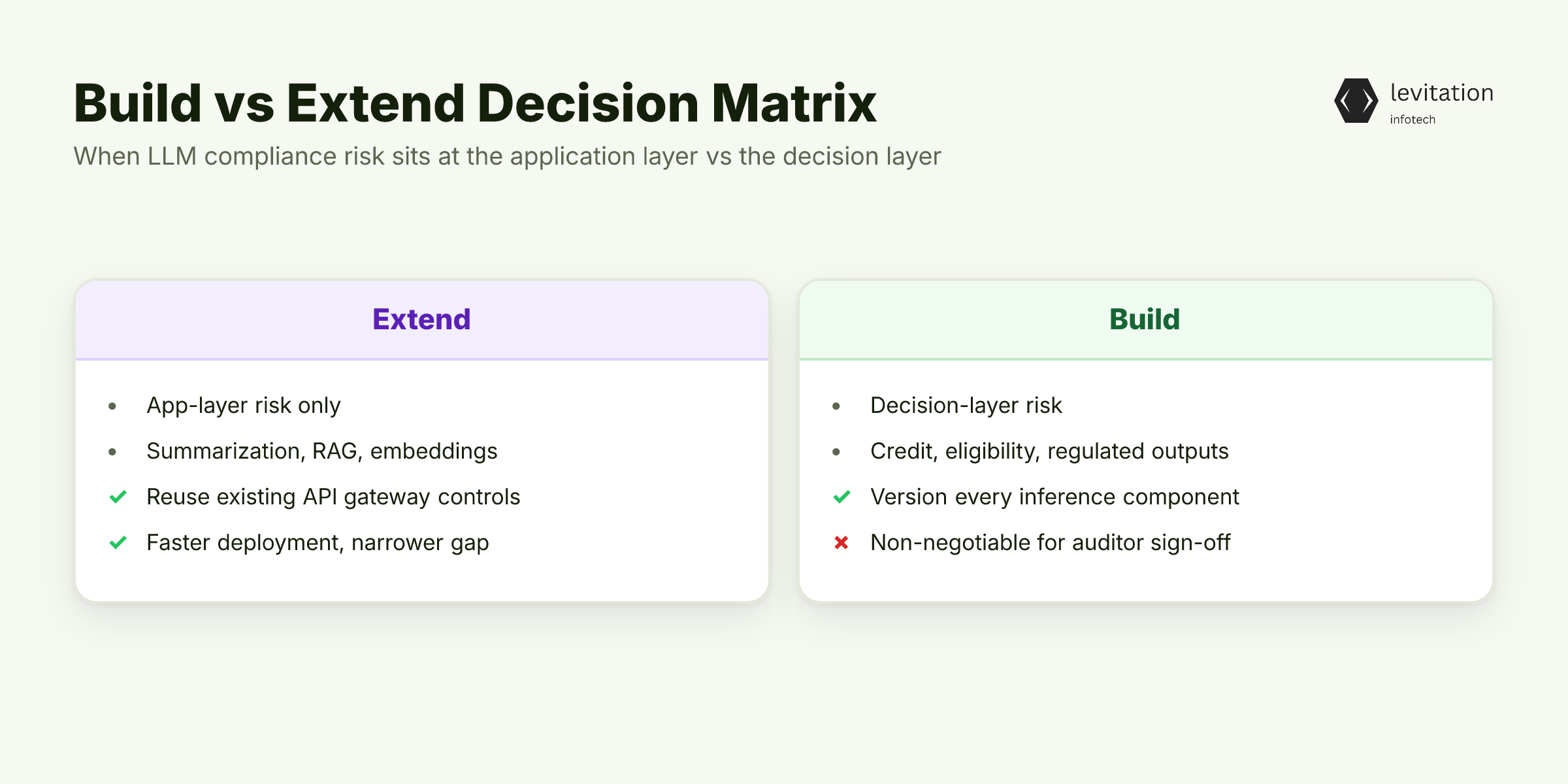
Three inputs decide the answer: your operational footprint, your existing infrastructure, and the layer where regulatory risk lives.
Extend when the risk is at the application layer. Summarization, RAG retrieval, and embedding generation. These are calls where the model shapes a response. A downstream system still owns the regulated decision.
If you already have an API gateway with policy enforcement, identity spread, and audit logging, use it. Route the LLM traffic through it. You get the controls you already paid for.
Build when the risk is at the decision layer. This covers credit decisioning, eligibility logic, and regulated outputs. Those outputs drive an action a customer or regulator can challenge. Auditors will not accept a model version you cannot reproduce, recalibrate, or replay.
That requires versioning every part in the inference path: model weights, tokenizer, retrieval index, prompt template, and policy checks. For this layer, the build is non-negotiable, even if the model itself is hosted.
The speed gap is real but narrower than teams assume. A typical deployment with the right control plane runs faster than fully in-house builds. The control plane is already in place.
The bottleneck shifts from plumbing to policy. The difference is the control plane, not the model.
Whichever side of the line you land on, the same five controls decide whether an auditor signs off.
Five Controls That Make Any Extension Audit-Ready
These five controls turn any LLM extension from a liability into a defensible part. - Provenance logging. Every prompt, context window, retrieval result, model version, and response stored as a signed, append-only event. Retention matched to your regulatory clock, not your storage budget. Your LLM gateway logs everything, but inference logs nothing without this layer in place. - Inference-layer access control. Role-aware policies enforced at the gateway. A prompt from a junior user cannot reach a model with access to regulated data. Identity spreads from your existing auth layer, not from a separate LLM-specific scheme. The RAG and embedding architecture sits behind the same policy plane. - Output validation. Automatic checks for calibration, PII leakage, and policy violations on every response. Set fallbacks when checks fail. No silent passes. - Vendor risk register. A living document mapping each provider to data residency, sub-processor list, breach notice SLA, and embedding retention policy. Reviewed quarterly, not at vendor onboarding. - Reproducibility. The ability to replay any past response with the exact model version and retrieval snapshot. Not possible without versioning every part. This includes the embeddings index and the prompt template. It also includes the policy checks at the time of the call.
When these five are in place, the extension stops being a liability. It starts being a feature, because the control plane outlives any single provider or model version.
What Compliance Maturity Actually Buys You
Audit cycles drop from open-ended fix to evidence review. The logs, controls, and fallbacks are already in place. So the auditor's job shifts from "prove the system works" to "verify the proof exists."
Vendor concentration risk becomes a known amount you can price. You have a register, a contract, and a fallback path for each provider. Concentration risk does not go away, but it stops being a surprise.
Teams that build this discipline once stop re-litigating it per project. The control plane becomes a shared asset. New LLM features ship faster because the audit infrastructure is already there.
That is why the discipline grows. The same control plane gets reused across projects. Each reuse cuts the marginal cost of the next regulated feature.
Teams that invest in the control plane early ship faster in year two, year three, and every year after. The ones that wait rebuild the same plumbing for every new feature.
Frequently Asked Questions
What is LLM stack compliance and why does it matter for CTOs?
LLM stack compliance is the discipline of proving that every model call meets regulatory and internal standards. It covers data handling, access control, and decision traceability. It matters because regulators now treat AI systems like core financial infrastructure. Unprovable model behavior becomes a board-level risk the moment you serve a regulated customer.
How do you assess AI vendor risk before extending your stack?
Audit the provider's data processing addendum, sub-processor list, model versioning policy, and embedding retention window before integration. Confirm whether support staff can view your prompts. Check how fast derivative artifacts are deleted. Also check whether you can replay past responses with the exact model version. If any of these are unclear, the extension adds undocumented risk.
When should a team build vs extend an LLM stack for compliance?
Extend when the regulated risk is at the application layer. Do this when you already have policy infrastructure that can absorb LLM traffic. Build when the risk is at the decision layer: credit, eligibility, or any output that drives a regulated action. Auditors will not accept a model version you cannot reproduce or recalibrate.
What do auditors specifically look for in an LLM-powered system?
Auditors test for KYC-equivalent caller identity and AML-style output screening. They check access controls at the inference boundary. They want structured reporting and tamper-proof audit log infrastructure. The EU AI Act adds duties on high-risk systems around transparency, human oversight, and technical documentation. NIST maps these to its AI Risk Management Framework.
How long does it take to make an LLM stack audit-ready?
For teams that start with the right control plane in place, a regulated deployment runs faster. It runs faster than building from scratch. The control plane already exists. The bottleneck is almost never the model. It is the logging, versioning, and access-control plumbing that auditors require.
Sources
Research and references cited in this article:
- AI Compliance in the LLM Era: Regulatory Guide 2026
- Best AI governance platforms for LLM applications (2026): Eval, audit, and enforce - Articles - Braintrust
- SOC 2 for AI Companies (2026): What Auditors Test First
- Best EU AI Act compliance tools for enterprise AI programs in 2026
- Audit Compliance in AI & LLM Frameworks | DataSunrise
- The Hidden Cost Crisis in AI: Why LLM Spend Is Today’s Biggest Black Box
- The state of vendor risk in the AI era. AU
- Lock-In in the Age of AI: Risks and How to Avoid Them | Kong Inc.
- AI Vendor Risk Assessment Questionnaire for Compliance (2026)
- Managing AI Risks in the Vendor Ecosystem | Optiv | Learn More
- Top 5 LLM Governance Platforms for Enterprises in 2026
- Medium
About the author
Mayank Singh is a software developer at Levitation Infotech, where he builds web and AI-powered applications across the company’s fintech, healthcare, and enterprise projects.