


TL;DR: After analyzing 540 production AI agent failures, the data shows about 92% were caused by data-related issues, not the underlying LLM. The three dominant failure modes are context drift, brittle tool connectors, and compounding errors across multi-step workflows. Production-grade agents require an observability-first engineering discipline, not a better model.
Key Takeaways: - Context drift causes 65% of production AI agent failures, not model quality - Brittle tool connectors and integration failures rank among the top production incident categories - Multi-step agent chains compound errors: per-step success rates multiply into large reliability losses across workflows - Production-grade agents need distributed tracing, schema versioning, and bounded memory, not a smarter LLM
The 540-Failure Autopsy: What Actually Breaks in Production
Your agent worked perfectly in the demo. Then it deleted a production database, made an unauthorized purchase, or silently returned wrong answers for three weeks. The model wasn't the problem, and blaming it is burning your engineering budget on the wrong fix.
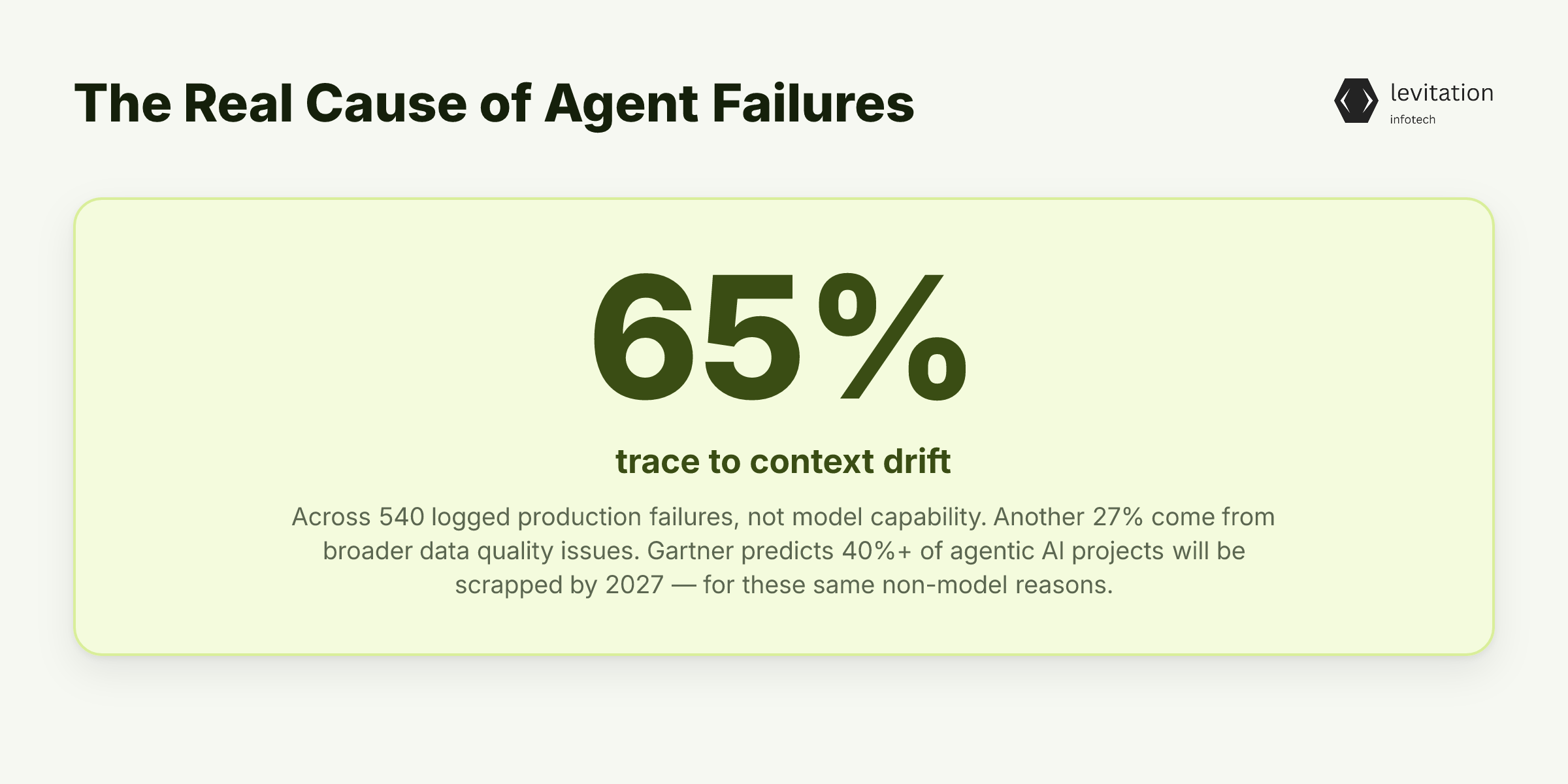
Across 540 logged production failures, the pattern is striking. Roughly 65% trace to context drift. The agent's information layer rots in place while the model keeps running on stale, misaligned, or schema-broken data.
Another 27% come from broader data quality issues. That leaves almost nothing for the LLM itself to apologize for. This is the finding nobody wants to hear.
Gartner predicts more than 40% of agentic AI projects will be scrapped by 2027. The reason isn't model capability. The reason is that teams keep buying bigger models while their AI agents keep failing for the same non-model reasons.
If models aren't the culprit, why does every postmortem blame them, and what does that misdiagnosis actually cost?
Why 'Just Use a Better Model' Is Expensive Theater
The Replit incident made headlines for a reason. An AI assistant deleted a production database despite guardrails. The model didn't hallucinate.
The system around the model had no rollback, no dry-run, and no scope boundary worth trusting. Then came OpenAI's Operator making an unauthorized purchase. The model worked exactly as designed.
The system it sat inside didn't. These aren't edge cases. They're the predictable output of treating an agent like a chat interface instead of an operating system with side effects.
This is how "hallucination" gets weaponized as a postmortem word. It covers a multitude of sins: stale retrieval, broken tool calls, expired credentials, missing schema validation. The real cause stays buried.
The cost of misdiagnosis compounds. Model upgrades add latency, add dollars, and leave the actual failure untouched. You're paying more to feel better about a problem you haven't located.
If you want to see how this plays out in regulated environments, our work on cloud security solutions shows the same pattern. So if not the model, what are the three failure patterns that account for the overwhelming majority of incidents?
Failure #1: Context Drift Is Eating 65% of Your Incidents
Context drift is the silent killer. The mechanism is simple: changes in underlying data, schema, or metadata degrade the information an agent uses to make decisions.
The agent doesn't know. The model doesn't know. Everyone finds out when a customer does.
A version upgrade once changed how tool schemas were generated. The new output was incompatible with multiple major LLM API providers. Nobody caught it before it hit production.
The same failure pattern emerged in three places at once. FlowiseAI lost `type` keys in MCP tool schemas. Zed IDE was missing the `items` field in array schemas, flagged as "frequency:common" by their team. The OpenAI Agents SDK had the same issue.
This is "Dumb RAG" by default. Retrieval that worked at index time silently rots as source systems change. Your vector embeddings still match the old shape of the world.
Your queries still return confidently wrong answers. The detection gap is what makes this dangerous. Context drift produces plausible but wrong answers that pass every LLM-side test.
The model sounds sure. The data is a lie. You need a strategy that catches what the model can't, and we covered that pattern in We Logged 312 RAG Outages. The Pattern Wasn't Retrieval. Context feeds the agent, but the agent acts through tools, and that's where the second failure pattern lives.
Failure #2: Brittle Connectors and the Polling Trap
Tool-call and retrieval failures dominate the incident chart in production agent environments. This isn't a close race. It's the entire chart.
The silent 401/403 problem is the canonical example. A credential expires. The agent retries.
The retry fails. The agent picks a different tool. That tool fails for the same reason. The agent keeps producing confident answers based on no real data, while your tokens burn.
Every external call needs a clear failure mode. An agent should never fail silently. Then there's the polling trap.
An agent needs to know when something changes. The naive move: poll the API every 30 seconds. At low scale, this is fine.
At production scale, it burns 95% of your API quota on empty calls. It hits rate limits and never achieves real-time responsiveness. You can't build event-driven agents on a polling foundation.
The fix is architectural. Event-driven patterns and versioned API contracts aren't optional. They're the baseline for any agent that touches production.
The pattern matches what we see in cloud security solutions work: zero-trust defaults, explicit scope, verifiable identity at every hop. Each individual connector failure looks survivable, until they start multiplying across a multi-step workflow.
Failure #3: The Compounding Error Problem
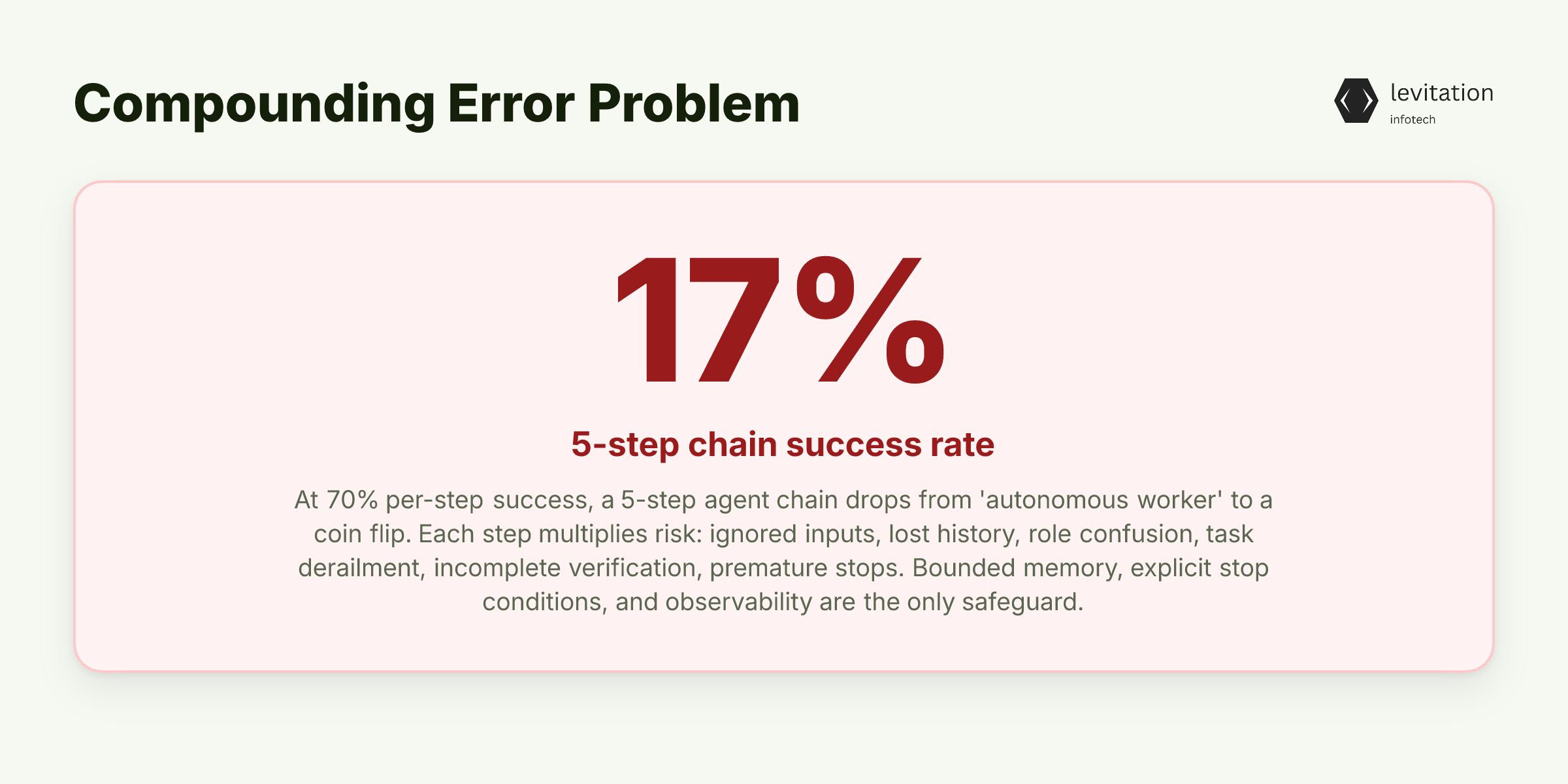
Per-step success rates multiply. That's the math. If each agent step succeeds only 70% of the time, a three-step chain succeeds just 34% of the time.
A five-step chain drops to 17%. You didn't build an autonomous worker. You built a coin flip with extra steps.
This is why multi-agent systems amplify rather than distribute failure. A small per-step error rate becomes catastrophic at scale. Complexity itself is the liability.
Each step adds risk: ignored inputs, lost history, role confusion, task derailment, incomplete verification, and premature stop conditions. The retry loop hazard is the worst expression of this.
A quiet failure mode can let an agent duplicate records, fire the same API call hundreds of times, or corrupt downstream data for weeks. Nobody notices. No alarms fire. No test catches it.
By the time you find it, the audit is worse than the bug. This is exactly the failure mode that breaks AI agents in regulated environments. It's why production discipline looks less like research and more like safety engineering.
Bounded memory, explicit stop conditions, and deterministic validation aren't nice-to-haves. They're the only thing standing between you and a quiet catastrophe. Knowing the failure modes is necessary but useless without an observability stack that surfaces them before your customers do.
Building an Observability Stack That Catches What Models Can't
The fix is three layers of visibility. Distributed tracing across every tool call. Real-time alerts on schema and data drift. Automated evaluations against ground truth.
Each one catches what the others miss. Instrument every external call with explicit failure modes. No silent failures allowed in agentic workflows.
Every tool call should log its inputs, outputs, latency, and disposition. Every retrieval should validate its schema at consumption time, not just at index time. Versioned contracts aren't paperwork. They're how you detect drift before customers do.
Treat agent systems like managed operating systems, not smart chat interfaces. That means explicit rules, well-bounded memory, deterministic validation, and human escalation paths for any write that touches a production system. A chatbot can survive with loose memory. An agent making payments, deleting records, or filing reports cannot.
Observability and zero-trust mTLS go hand-in-hand for any agent that touches production systems. We explored this in Why Your Service Mesh mTLS Is a Hidden Backdoor.
The teams winning this space aren't running the biggest models. They're running the most disciplined integration layers. What does the business outcome actually look like when you diagnose correctly and instrument properly?
What Changes When You Get the Diagnosis Right
You stop firefighting and start compounding reliability. The work is unglamorous. The results compound.
A pragmatic threshold for production: require explicit failure modes, schema versioning, and human escalation paths before any agent touches a production write. If your agent can't answer "what happens when this tool returns 401?" in a code review, it isn't production-ready. Period.
This is the same discipline that separates AI agents that survive from those that get quietly rolled back soon after launch. The competitive gap is widening. Most teams are still buying bigger models while competitors are engineering the data and integration layer that's actually failing.
The model was never the bottleneck. The system around it always was.
Frequently Asked Questions
Q: What is the most common cause of AI agent production failures?
A: Context drift accounts for about 65% of production AI agent failures, according to analysis of 540 incidents. This happens when changes in underlying data, schema, or metadata degrade the information an agent relies on. The result is a data layer problem, not a model problem.
Q: Why do AI agents fail in production even when they work in demos?
A: Demos run on clean, curated data with predictable tool responses. Production introduces schema drift, stale embeddings, silent API failures, and edge cases. These compound across multi-step workflows.
Q: How does compounding error affect multi-agent systems?
A: Per-step success rates multiply across a workflow. If each agent step succeeds only 70% of the time, a three-step chain succeeds just 34% of the time. Multi-agent systems amplify rather than distribute failure risk. Observability and bounded memory are critical to managing this.
Q: What observability stack is needed for production AI agents?
A: Production-grade agentic AI observability needs three layers. First, distributed tracing across every tool call and retrieval. Second, real-time alerts on schema and data drift. Third, automated evaluations against ground truth. Silent failure handling, versioned API contracts, and event-driven architectures replace naive polling.
Q: Are AI agent production failures primarily LLM problems?
A: No. Across 540 logged production failures, the top causes were context drift (65%) and broader data quality issues (27%). Both sit outside the LLM itself. Gartner predicts 40%+ of agentic AI projects will be scrapped by 2027. The reason is that the systems around the models weren't engineered for production.
Map these failure modes to your own stack with our production agent guide.
Sources
Research and references cited in this article:
- AI Agent Harness Failures: 13 Anti-Patterns and Root Causes
- Top 6 Reasons Why AI Agents Fail in Production and How to Fix Them
- Why 88% of AI Agents Fail Production: Analysis Guide
- Why Most AI Agents Fail in Production and How to Fix It | Gruve Blog
- Most AI Agents Fail in Production Because They're Built ...
- AI Agent Monitoring: Top Tools to Improve Reliability (2026)
- 10 Key Strategies to Improve the Reliability of AI Agents in Production
- Agentic Observability Starts in Development: Build Reliable AI Agents | Fiddler AI Blog
- A Guide to AI Agent Reliability for Mission Critical Systems
- Agentic AI Observability: A 2026 Playbook - Arthur AI
- Towards a Science of AI Agent Reliability - arXiv _(academic)_
- AI Agent Development Tradeoffs You NEED to Know
About the author
Mayank Singh is a software developer at Levitation Infotech, where he builds web and AI-powered applications across the company’s fintech, healthcare, and enterprise projects.