


TL;DR: AI agent prototypes ship in hours, but traditional vendor onboarding runs 6 weeks. The mismatch is structural, not paperwork. Fix it by treating agent risk as runtime action risk and building an onboarding pipeline around the action chain.
Key Takeaways: - An agent's risk changes every run, so vendor diligence that vets a static product misses the real attack surface. - Run risk is a property of the action chain: instruction, retrieval, tool call, identity, state change. - A chain-based pre-flight check compresses onboarding to days without losing governance.
On Tuesday, a marketing ops team spun up an AI agent in an afternoon and handed it CRM access. By Wednesday, security was asking who audits it. By Friday, procurement was still chasing SOC 2 reports from a vendor they onboarded last quarter, for a different tool entirely. The agent was already writing data back to the warehouse. Your vendor risk process was not built for this.
The Hours-Long Agent vs. The Weeks-Long Vendor Process
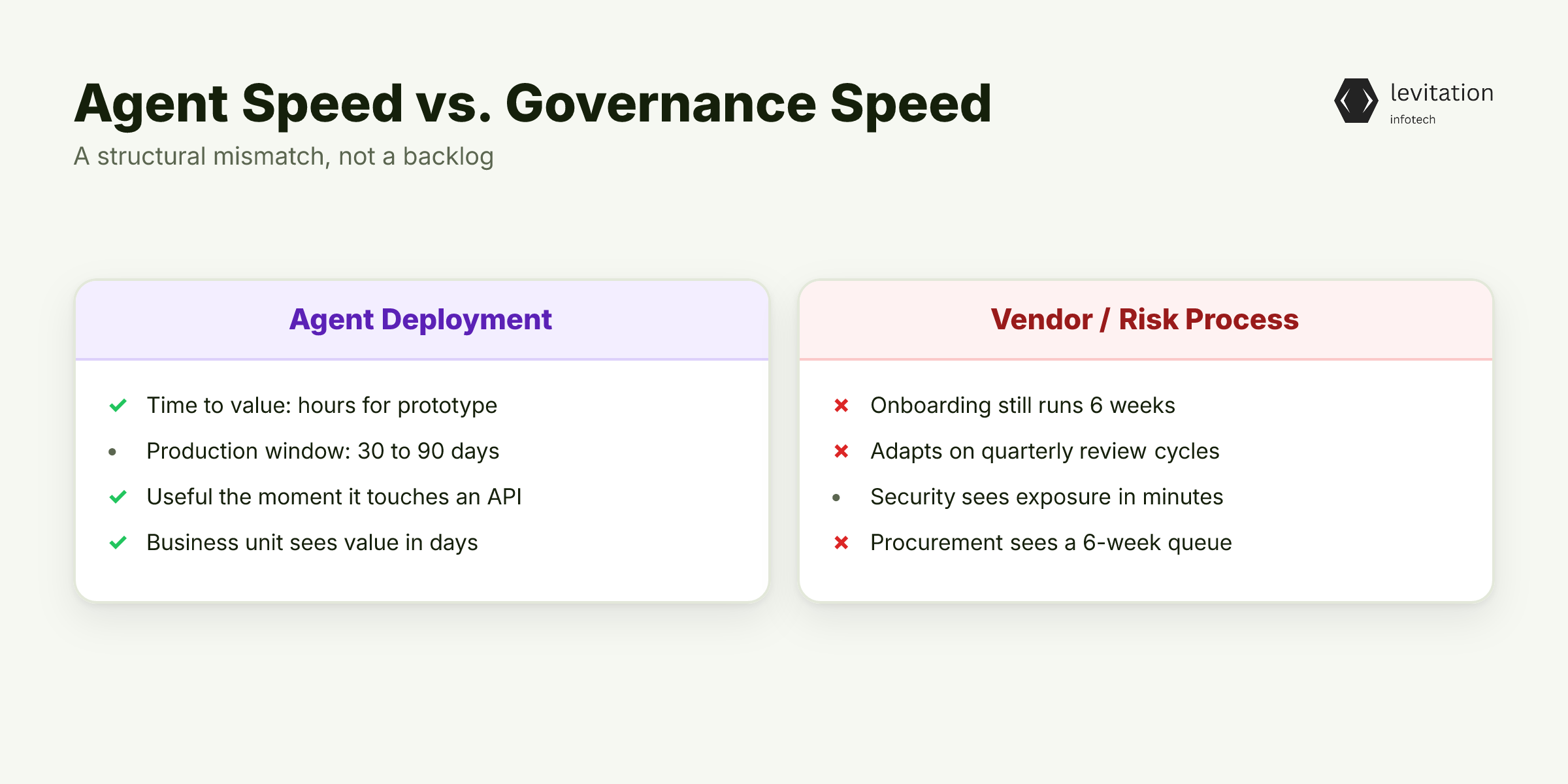
A no-code prototype ships in hours. A governed multi-system rollout hits production in 30 to 90 days. Vendor onboarding for the same agent still runs 6 weeks, even when AI tools speed up the paperwork.
The gap is not a backlog. It is a structural mismatch.
The agent becomes useful the moment it touches an API. The risk process adapts on quarterly review cycles. The result is predictable: the business unit sees value in days, security sees exposure in minutes, and procurement sees a 6-week queue.
CTOs sign off on agent access faster than their security teams can spell the agent's name. That is not a governance failure inside one team. It is the wrong shape of governance for the thing being governed.
For a sharper read on the deployment side, this AI agent deployment timeline walks through how the 30 to 90 day window breaks down. On the vendor side, our vendor risk management for AI work keeps finding the same gap: nobody designed these processes to ask the right questions of an agent.
Why Traditional Vendor Risk Frameworks Break for Agents
Classical vendor risk assumes a static product. A SaaS tool. A database. A piece of hardware with a fixed behavior surface.
You audit it once, attest to it annually, and trust the perimeter.
AI agents are not static products. They reason over context, select tools, call APIs, and produce different action chains on every run.
Two runs of the same agent against the same prompt can take different paths. There is no fixed surface to audit. There is a moving one.
Each step in the chain inherits the trust of the step before it. A manipulation early in the chain can quietly authorize an action at the end. Prompt injection plants instructions inside documents, emails, or tool responses the agent treats as trusted context.
Poisoned memory fragments replay the same trick weeks later. The agent does not know it has been compromised. Your SOC 2 questionnaire does not ask.
Vendor due diligence that vets the training data and the model card misses the runtime attack surface. The real question: what is the agent doing at 2:14 PM on a Tuesday when it pulls a poisoned doc from a shared drive?
This gap bites teams after go-live, not before it. Our third party risk for AI engagements keep landing on the same conclusion: the questionnaire is not the bottleneck. The questions are wrong.
Speeding up the old questionnaire is not the answer. The thing being assessed has changed shape.
Agent Risk Is Runtime Action Risk, Not Model Risk
A traditional model answers a question and stops. An agent takes that answer and acts on production systems.
The danger is not that the model reasons poorly. It is that flawed reasoning now flows into real actions that downstream systems trust.
Frameworks like NIST AI RMF and MITRE ATLAS give a common vocabulary, and they are the right starting point. But both predate widespread agentic deployment.
They were written for a world where risk lived in the model card. Today, risk lives in the action chain.
What a dynamic risk profile actually means
Risk changes per prompt, per tool call, per retrieved document, not per release. The same agent can be safe in one run and dangerous in the next.
A static attestation cannot capture that. Only continuous observation can.
Our NIST AI RMF mapping work shows where the standard covers agentic risk and where it stops short. Use it as a starting point for mapping controls to your program. The harder question is what replaces the static attestation when the agent keeps shifting its own risk surface, which is where runtime observability for agents becomes essential.
Why the audit log matters more than the model card
What the agent did, with which identity, against which system, is the only signal that lets you govern it. The model card tells you what the vendor claims. The action log tells you what actually happened.
The systems still running in production share one trait: their audit logs were designed to survive contact with auditors. The model cards were not.
Once you see risk as a property of the action chain, the onboarding problem reframes itself. You are not vetting a vendor's model. You are vetting a chain of decisions that runs inside your perimeter.
Building an AI Agent Onboarding Pipeline That Closes in Days, Not Quarters
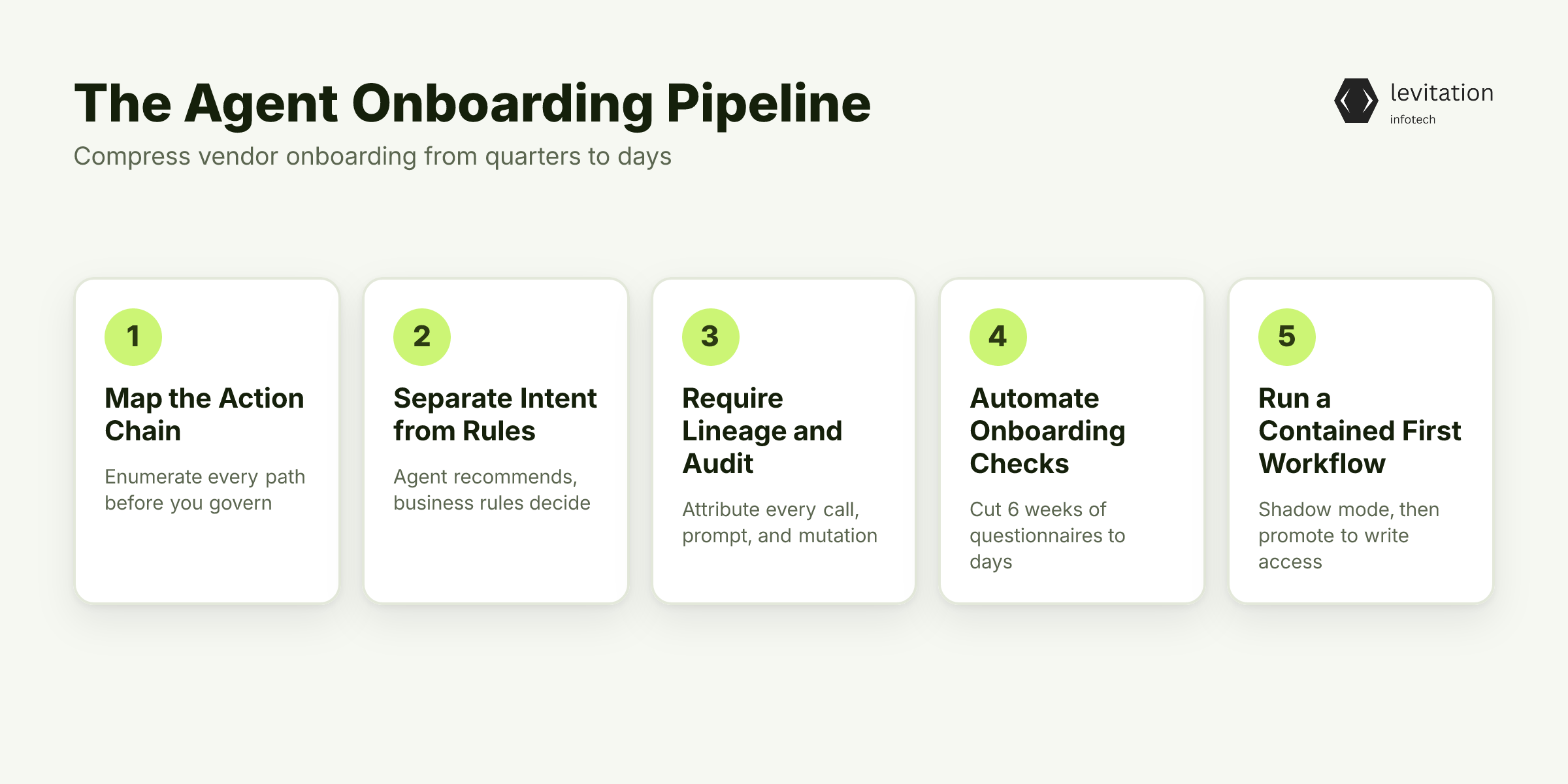
The fix is a pipeline built around the chain, not the vendor. Five steps, ordered, and you can compress the administrative layer to days while keeping the technical review honest.
Map the chain before you map the model
Enumerate every action path: instruction, retrieval, reasoning, tool selection, API call, production state change. If you cannot draw the chain, you cannot govern it. Skip this and the rest is theater.
Define what the agent interprets versus what your business rules decide
Keep the blast radius of misinterpreted context small. Let the agent classify, summarize, or recommend. Let your rules approve, mutate, or send. This is the single biggest lever for reducing runtime exposure.
Our AI agent onboarding playbook walks through this split. The contained workflow deployment pattern shows how to enforce it without slowing the team down.
Demand lineage and audit before go-live
Every tool call, identity use, and state mutation must be attributable to a request, a prompt, and a context snapshot. No lineage, no production.
Treat 6 weeks of vendor onboarding as a floor, not a ceiling, for new agent categories
Compress it to days by automating the questionnaire against the action chain. The questions change. The speed does not have to.
Use a contained first workflow
Pick one high-volume process. Run it in shadow mode against live data. Only then promote it to write access.
Documented production rollouts run 30 to 90 days for a first contained workflow. That predictability comes from doing steps one through four in order, not from skipping them. This is the pattern that holds up under audit pressure, not just under demo pressure.
The chain model tells you what to look for. The controls are what make the agent governable, not just observable.
The Five Controls Your Vendor Risk Process Must Add for Agents
These five controls turn an action chain into a governable system. Add them to your existing vendor review, and you stop assessing promises and start observing behavior.
Runtime observability. A tamper-evident log of every agent action with the prompt, retrieved context, tool, identity, and target system attached. If you cannot replay a run, you cannot defend it.
Scoped, short-lived credentials. The agent holds the minimum identity needed for the current action and nothing more, rotated per task. This is non-negotiable. For the mechanics, our agent credential scoping guide is the cleanest place to start. It is also what most zero-trust programs already want for service accounts. Traditional zero trust stops the engineer at the perimeter and waves the agent through. Flip that.
Human-in-the-loop gates on high-stakes tool calls. Any action that mutates production state, sends external communication, or moves money requires explicit approval. The patterns are well understood, which is why we wrote up human-in-the-loop patterns with concrete examples.
Provenance tracking for prompts and context. Every retrieved document and memory fragment is versioned, signed, and traceable to its source. If a poisoned document causes a bad action, you need to know which one, when, and from where.
Kill switch and blast-radius containment. One command revokes all agent credentials and quarantines pending actions without manual cleanup. Test it. Then test it again.
With those controls in place, the question stops being "did we approve this agent?" The real question is: can you see what it is doing right now? That shift is where the payoff lives.
What Changes When Agent Risk Is Treated as Runtime Risk
Your risk posture moves from periodic attestation to continuous assurance. You govern what the agent is doing, not what the vendor claimed it would do. Vendor onboarding compresses from a quarter-long gating ceremony to a days-long pre-flight check against the action chain.
The same controls that close the agent risk gap also catch shadow AI. Any agent operating without lineage or scoped credentials is visible by definition. Our continuous AI assurance and shadow AI detection practices were built around this convergence.
Procurement, security, and the business unit that wanted the agent stop fighting. They start running the same checklist.
You can answer the board's question, "who has production access right now and what are they doing?" in real time, for humans and agents alike.
This posture holds up under audit pressure. It also keeps a 30 to 90 day production rollout from drifting into an uncontrolled rebuild.
Levitation builds these pipelines end to end and runs them in production.
Frequently Asked Questions
How long does AI agent vendor onboarding actually take?
Documented deployments show a governed AI agent reaches production in 30 to 90 days. Vendor onboarding paperwork for AI agents typically runs about 6 weeks. With a chain-based risk model and automated pre-flight checks, the administrative part compresses to days. The shadow-mode validation against live data still needs the full window.
What is the difference between AI agent risk and traditional AI risk?
Traditional AI risk is static. It ties to a model's design and training data and changes only at retraining.
AI agent risk is dynamic because agents reason over context, call tools, and act on external systems on every run. A manipulation at any step in the chain can authorize a downstream action the model itself was never asked about.
What is runtime action risk in the context of AI agents?
Runtime action risk is the risk that an agent takes an unintended or unauthorized action against a production system during a live run. It focuses on what the agent did, with which identity, against which API, rather than on the model's training or alignment. This is the surface that prompt injection, poisoned memory, and credential misuse actually attack.
Which frameworks should a CTO align AI agent risk management with?
The most cited starting points are the NIST AI Risk Management Framework for governance structure and MITRE ATLAS for threat taxonomy. Both predate widespread agentic deployment, so supplement them with controls specific to action chains: scoped credentials, human-in-the-loop gates, and tamper-evident action logs.
Can AI agents help speed up their own vendor onboarding?
Yes. AI agents already handle administrative steps in vendor onboarding, which is part of why the 6-week figure exists. The risk is treating that speed-up as a substitute for the chain-based technical review the agent will operate inside.
About the author
Mayank Singh is a software developer at Levitation Infotech, where he builds web and AI-powered applications across the company’s fintech, healthcare, and enterprise projects.