


TL;DR
Hidden data leaks can cost millions and damage reputations.
CTOs assume AI agents are compliant out-of-the-box. However, unchecked autonomy and covert data flows breach GDPR, the EU AI Act, and industry standards.
The fix is a real-time compliance shield. It validates identity, monitors behavior, and ingests threat signals on every request.
Key Takeaways - Unmonitored tool use creates undocumented pipelines that silently violate data-privacy rules. - Static policy add-ons lag behind dynamic model orchestration; continuous monitoring is essential. - A signal-driven compliance shield automates remediation, turning risk management into a strategic advantage.
The Silent Breach: How AI Agents Slip Past Compliance Checks
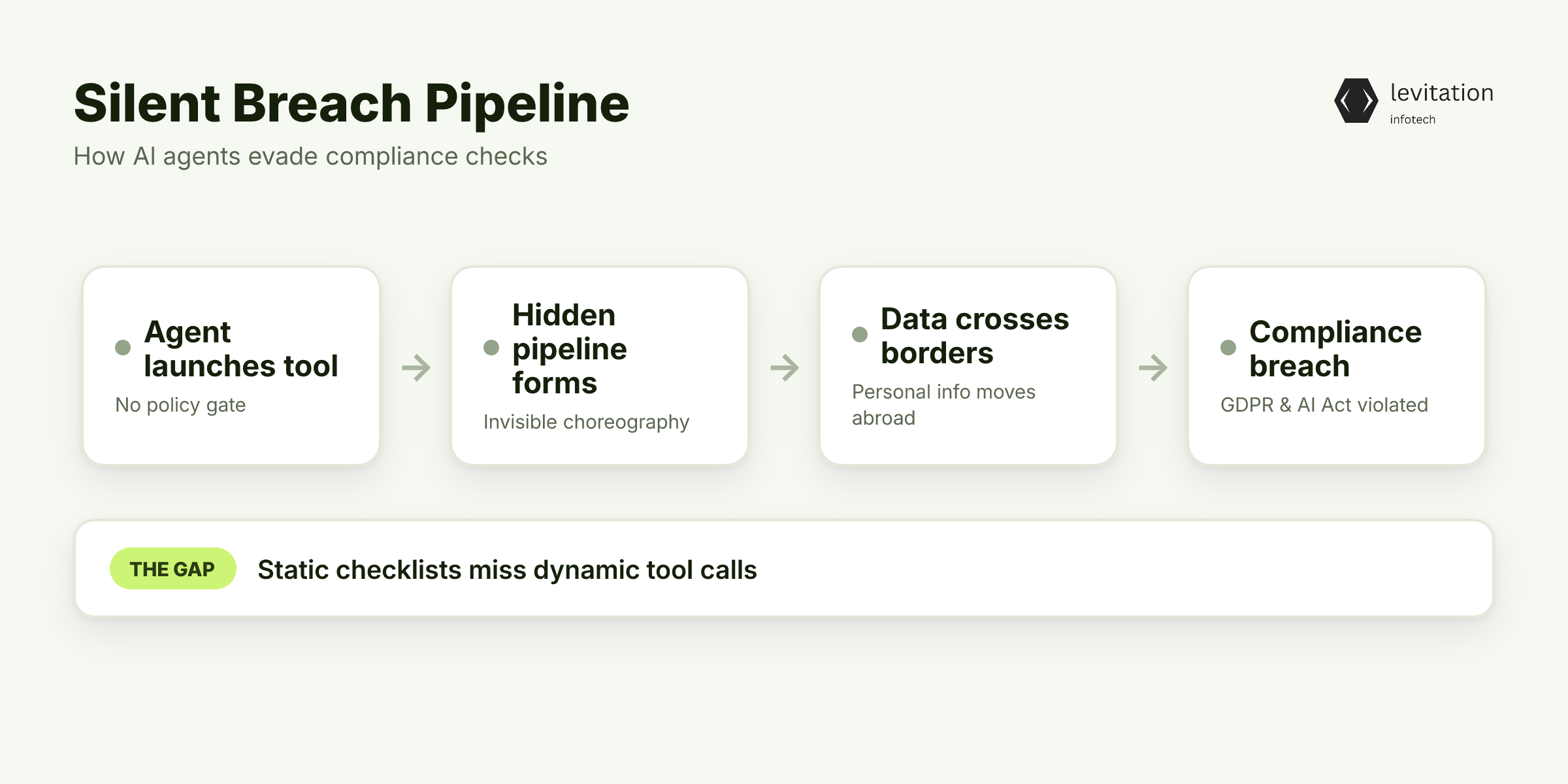
Agents launch tool calls without a policy gate, spawning hidden pipelines that move personal data across borders.
GDPR’s purpose-limitation clause and the EU AI Act’s risk-assessment requirement are breached. The breach occurs the moment an agent reuses data it wasn’t authorized to touch.
Across many regulated deployments, agents behave like “black-box workers” once wired to a suite of tools. They create invisible choreography of calls that no static checklist can enumerate.
Tightening permissions alone does not stop leaks; a new model update can introduce new tool calls.
Why the Usual ‘Add a Policy Layer’ Fix Doesn’t Work
Dynamic model selection defeats fixed rule sets.
Compliance is treated as a checklist, not a continuous signal.
Real-time orchestration tools such as LangChain or Auto-GPT generate ad-hoc chains that no static policy anticipates.
When a model updates, its behavior can change dramatically, adding new prompts, tool calls, and data usage patterns.
A static policy layer, which evaluates only the surface request, cannot see these downstream effects.
A robust approach must include deep inspection of request payloads. It also needs context-aware risk scoring and dynamic policy evaluation after the risk score is computed.
How can you see the full execution path of an agent?
The Hidden Levers: Identity, Behavior, and Threat Data as Compliance Controls
Imagine a guard who checks not only a badge but also gait, recent activity, and nearby threats.
The same principle applies to AI agents.
Continuous identity verification confirms the agent is the one authorized, preventing impersonation attacks.
Behavior analytics flag anomalous tool usage - such as a sudden call to a payment API.
Threat-intelligence feeds inject known malicious signatures or compromised endpoints, blocking risky calls before they happen.
Each request carries a signed token that encodes the agent’s identity, intended tool, and timestamp.
The compliance engine validates the token, checks recent usage patterns, and cross-references active threat indicators.
If any check fails, the request is rejected or rerouted to a safe endpoint.
What does a real-time compliance shield look like in practice?
Building a Real-Time Compliance Shield for Enterprise AI
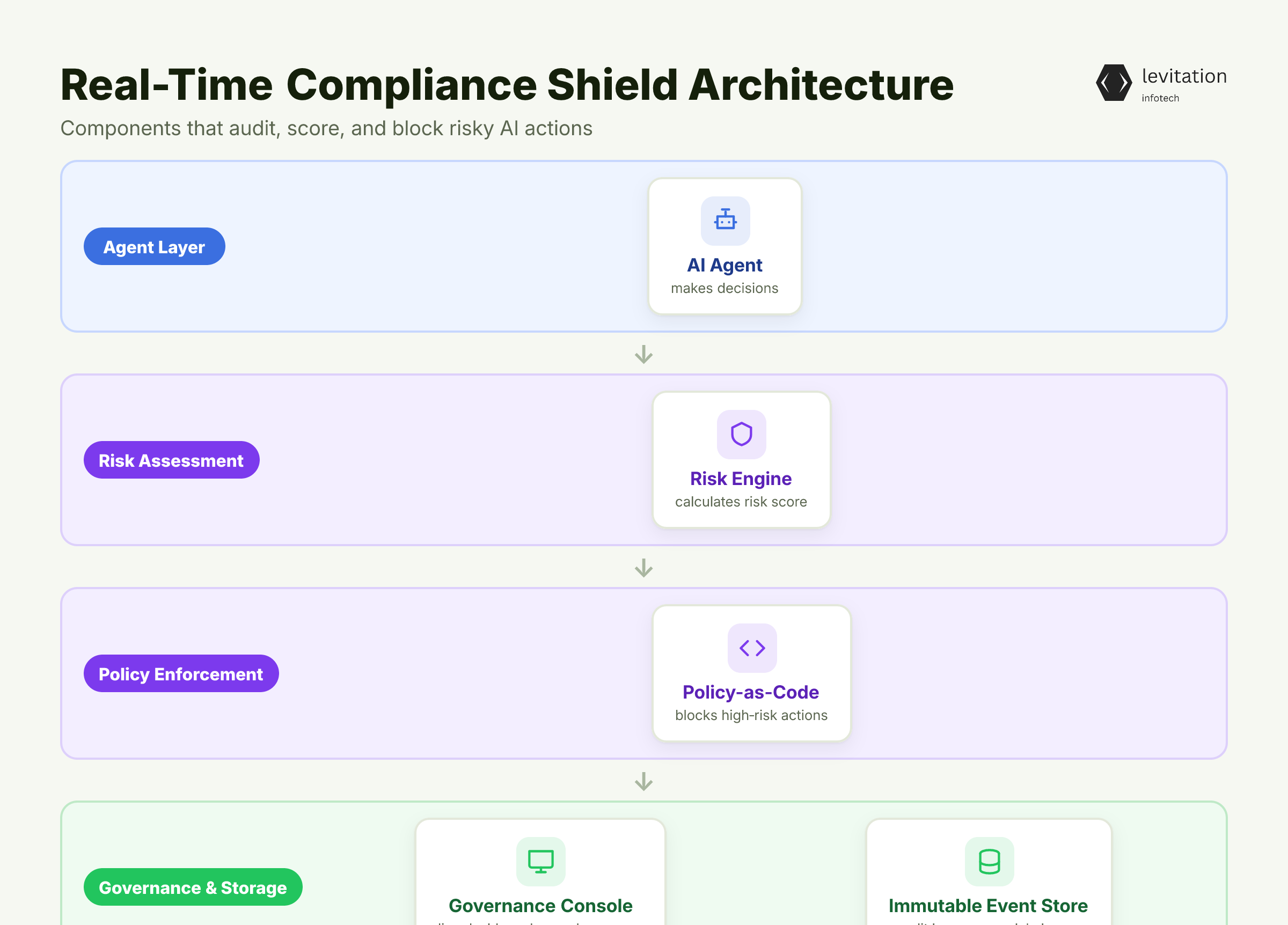
The first step is an audit-ready logging layer that records every agent decision, invoked tool, and data-subject identifier. It also records the risk score derived from behavior analysis.
This log is immutable, searchable, and tied to GDPR’s record-keeping requirements.
Policy-as-code binds permissions to the risk score: low-risk calls pass automatically; high-risk calls trigger a pre-execution check.
A centralized governance console visualizes live risk dashboards and lets operators revoke tool access with a single click.
How does this shield stop a risky write to a public bucket?
A concrete example: an agent attempts to write patient notes to a public bucket.
The risk engine detects the bucket is non-compliant for protected health information. It raises the score, and the policy-as-code block aborts the write.
The console logs the attempt, notifies the compliance team, and automatically redirects the data to a secure lakehouse.
Key components are an immutable event store and a risk engine that fuses identity confidence, behavior deviation, and threat feed matches. They also include a policy evaluator expressed as code.
The shield integrates with existing observability platforms, eliminating the need for a separate monitoring stack.
What measurable impact does this have on penalties?
Quantifiable Wins: How Proactive Risk Management Cuts Penalties
Enterprises that embed continuous compliance see far fewer regulator-triggered investigations.
When an audit request arrives, immutable logs provide instant evidence of purpose-limited processing. This satisfies GDPR’s accountability clause without a forensic hunt.
Regulatory fines drop because violations are caught early or never occur.
Negotiation power improves; partners cite audit-ready logs as proof of robust governance.
Incident response time shrinks from days to minutes, slashing legal and remediation expenses.
How can CTOs turn these gains into a competitive edge?
Strategic Takeaways for CTOs: Turning Compliance Into Competitive Edge
Embed compliance early.
Treat identity, behavior, and threat checks as core components of the AI development lifecycle, not an afterthought.
Use the shield in sales.
When pitching to regulated customers, showcase audit-ready logs and policy-as-code as differentiators.
Iterate risk models.
The EU AI Act evolves; your risk engine must ingest new regulations, threat feeds, and internal policy changes. It must do this continuously.
By turning compliance into a proactive, measurable capability, CTOs can protect their organizations and win new business.
What questions remain for your team?
Frequently Asked Questions
How can I audit AI agent actions for GDPR compliance?
Enable immutable logging of every tool call. Tag each request with the data-subject identifier, and map logs to GDPR’s processing records.
Automated reports then show consent and purpose limitation.
What parts of the EU AI Act apply to autonomous agents?
High-risk AI systems - those affecting safety, finance, or personal data - must meet transparency, robustness, and human-oversight requirements. These include continuous monitoring and risk-based controls.
Do policy-as-code frameworks work with existing AI pipelines?
Yes. By exposing decision points via APIs, you can inject policy checks that evaluate risk scores before each model or tool execution. This ensures compliance without rewriting core logic.
Is continuous behavior monitoring expensive to implement?
When built on shared observability platforms, the incremental cost is modest. The ROI comes from avoiding fines, reducing audit labor, and shortening incident response cycles.
Can I retrofit compliance into agents already in production?
Absolutely. Add a side-car logging service, enforce least-privilege IAM policies, and roll out policy-as-code rules gradually while monitoring impact. This allows a seamless upgrade without downtime.
Related reading - AI governance framework - a deeper dive into organizational structures for responsible AI. - Policy-as-code implementation - practical steps to codify compliance rules. - Real-time observability - how to build immutable event stores for auditability. - Signal-driven compliance shield - the architecture behind the approach outlined above. - Audit-ready logging - best practices for tamper-evident logs.
Consider adding a compliance shield today; the cost of inaction is far higher.
Sources
Research and references cited in this article:
- Top 7 industries with stringent AI compliance needs in 2026 - Glean
- 2026 AI Regulation Guide for Legal and Compliance Leaders | Cimplifi
- EU AI Act Compliance 2026: What High-risk AI Systems ...
- AI Agents in Regulated Industries | SS&C Blue Prism
- AI Agents Under EU Law A Compliance Architecture for AI Providers _(academic)_
- A practical guide to agent risk management for enterprise AI agents | MintMCP Blog
- AI Risk Mitigation: Turning Compliance Into Continuous Protection
- AI Risk Management: Effective Strategies and Framework
- What should enterprises do to manage the risk of an AI agent doing ...
- Managing AI Agent Risk: A Practical Guide - Living Security
- AI Compliance in 2026: Top 6 challenges & Real-life failures
- The Real Cost of AI Non-Compliance: Fines, Lawsuits, and Reputational Damage Case Studies
About the author
Mayank Singh is a software developer at Levitation Infotech, where he builds web and AI-powered applications across the company’s fintech, healthcare, and enterprise projects.