


TL;DR: Traditional AI inference keeps GPUs powered 24/7, wasting most of a data center’s electricity. Serverless inference spins up GPUs only when a request arrives, cutting idle power and delivering up to 70 % energy savings. Deploy a warm-pool, KV-cache strategy on a GPU-enabled serverless platform and you’ll see the bill shrink while latency stays sub-second. Can a serverless approach really tame that waste?
Why Indian Data Centers Are Burning Energy on AI Inference

Telecom operators and fintech firms load their edge sites with dozens of RTX 3090-class cards to serve real-time fraud checks and speech-to-text pipelines. The rush to meet sub-second SLAs forces teams to provision enough GPUs for peak traffic, even though the average load hovers at a fraction of capacity. Idle servers still run fans, power supplies, and cooling loops. A GPU-heavy node draws roughly the same wattage at low utilization as at full throttle. Multiply that by many over-provisioned racks and a large share of the data-center’s power budget is consumed by idle hardware. The waste shows up in higher electricity bills, larger cooling footprints, and a carbon ledger that no compliance officer wants to sign off on. But simply adding more GPUs won’t solve the waste problem. What if the problem lies in how we allocate compute?
The Flaw in Traditional GPU Provisioning: Idle Power and Scaling Delays
Static allocation means you spin up a fixed pool of GPU servers and leave them humming all day. When traffic dips, the GPUs stay hot, the fans spin, and the cooling system works overtime. The result is a constant power draw that ignores actual demand. Manual scaling attempts to trim the pool after hours, but the process introduces latency. Operators must open tickets, adjust autoscaling thresholds, and wait for the orchestrator to spin new instances. Each scaling event triggers a cooling cycle: fans ramp up, chillers engage, and the data-center’s PUE spikes. Human error - mis-set thresholds lead to throttling or over-provisioning - erodes the very savings the extra GPUs were supposed to deliver. Could a different model avoid these pitfalls?
Serverless AI Inference: Dynamic GPU Allocation That Cuts Energy Use by 70%
Serverless inference treats every request as an event. The platform provisions a GPU, runs the model, returns the result, and then tears the instance down. Because you only pay for the milliseconds the GPU is active, idle power drops to near-zero. Research confirms a 70 % reduction in energy costs when you move from a static pool to an event-driven model. Pay-per-use billing aligns spend with actual load, eliminating the need for over-provisioned clusters.
1apiVersion: serving.k8s.io/v12kind: Service3metadata:4 name: llm-inference5spec:6 template:7 spec:8 containers: - name: inference9 image: myorg/llm:latest10 resources:11 limits:12 nvidia.com/gpu: 113 autoscaling:14 minReplicas: 015 maxReplicas: 2016 metrics: - type: External17 external:18 metric:19 name: request_rate20 target:21 type: AverageValue22 averageValue: "10"
The YAML shows a Kubernetes-native serverless service that can scale to zero when no requests arrive. The `request_rate` metric drives GPU allocation in real time. - Dynamic allocation: GPU lives only while processing. - Pay-per-use: billing per inference call, not per hour. - Zero idle: power draw drops dramatically during off-peak.
How do teams keep latency low when the GPU appears only on demand?
How Event-Driven Cold-Start Elimination Drives Green AI at Scale
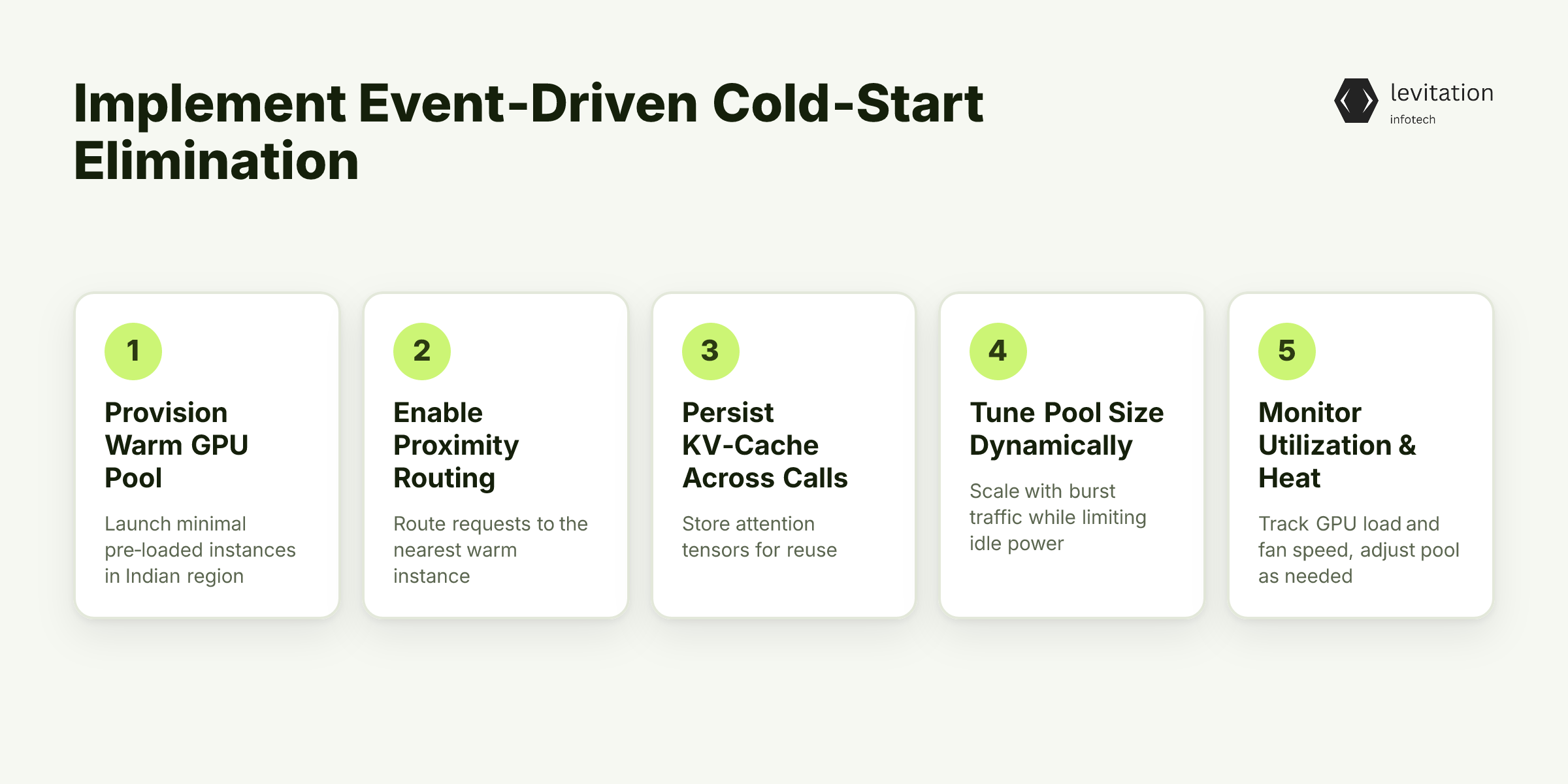
A naïve serverless function suffers a cold-start penalty. The first request must load the model into GPU memory, initialize the runtime, and allocate the device, adding several seconds of latency - unacceptable for fraud detection or voice assistants. Warm-pool strategies keep a minimal set of GPU instances pre-loaded. When a request arrives, the platform routes it to the nearest warm instance, shaving milliseconds off the response. The key is to keep the pool small enough to avoid idle power, yet large enough to handle burst traffic. Smart caching of KV-cache and attention tensors further reduces work. By persisting these intermediate states across requests, the model avoids recomputing the same attention patterns for similar inputs, lowering GPU utilization per request and heat generated. - KV-cache reuse cuts computation per token. - Cooling impact: lower GPU temperature reduces fan speed.
What steps are needed to bring this design to an Indian cloud?
Deploying Serverless Inference in an Indian Cloud: Step-by-Step Blueprint
Pick a serverless platform with GPU support. Major Indian providers expose GPU-accelerated functions via managed Kubernetes + KEDA. Choose the region closest to your user base to cut network latency. Define autoscaling policies that use request latency and GPU utilization as signals to scale the number of GPUs.
1apiVersion: keda.sh/v1alpha12kind: ScaledObject3metadata:4 name: inference-scaler5spec:6 scaleTargetRef:7 name: llm-inference8 minReplicaCount: 09 maxReplicaCount: 1010 triggers: - type: prometheus11 metadata:12 serverAddress: http://prometheus:909013 metricName: gpu_utilization14 threshold: "70"
Integrate KV-cache warm-up scripts. On container start, run a short inference pass that loads common token embeddings into the cache and store it in a shared memory volume so subsequent pods can reuse it instantly. Monitor power draw per inference by attaching a sidecar that reads GPU power metrics via NVIDIA’s DCGM exporter and pushes them to your observability stack. Alert when average power per request exceeds a threshold. Validate latency and energy metrics with a load test that simulates peak traffic. Compare cold-start latency with warm-pool latency and record power consumption. Adjust `minReplicas` until you hit the sweet spot where energy use is minimal without breaching SLA. - Choose platform: AWS Lambda GPU, GCP Cloud Run GPU, or local edge with KEDA. - Autoscale on latency < 50 ms, GPU util > 70 %.
What impact does this architecture have on the bottom line?
Business Impact: Cost Savings, Sustainability, and Faster Time-to-Market
Energy bills drop by up to 70 %, turning a massive OPEX line into a modest expense. Research notes an 18 × cost advantage per millisecond for high-utilization workloads, meaning every extra microsecond you shave translates into a huge dollar saving. Reduced power draw also shrinks the carbon footprint. For a typical fintech deployment handling a large volume of transactions, the emissions cut aligns with Green AI initiatives and the growing pressure from regulators to demonstrate sustainability. Time-to-market accelerates dramatically. A serverless stack can be provisioned in a few months, compared with many months for building a custom GPU farm. The speed gives finance and telecom players an edge in rolling out new features, such as real-time credit scoring or on-device speech translation. - Energy cost: -70 % vs. static GPU pool.
What questions do customers still ask about this shift?
Frequently Asked Questions
How does serverless AI inference differ from traditional cloud inference?
Serverless inference spins up GPU resources only when a request arrives and charges per execution, while traditional inference keeps a pool of servers running 24/7, leading to higher idle power consumption.
Can serverless inference meet low-latency requirements for real-time applications?
Yes, by using warm-pool GPU instances and caching techniques like KV-cache, cold-start latency can be reduced to milliseconds, making it suitable for most real-time workloads.
What are the main energy-saving mechanisms behind the 70 % reduction claim?
Dynamic allocation eliminates idle GPUs, event-driven scaling matches compute to demand, and optimized cooling from lower overall utilization cuts power use dramatically.
Is serverless AI inference compatible with on-premise data centers in India?
Many Indian cloud providers offer hybrid serverless platforms that can run on private edge locations, allowing enterprises to keep data on-premise while still benefiting from serverless scaling.
How quickly can a typical enterprise see ROI after switching to serverless inference?
Industry data shows breakeven can be reached in under four months for high-utilization workloads, thanks to the steep drop in energy and operational costs.
Ready to cut waste and boost performance? Contact us to start.
Sources
Research and references cited in this article:
- India AI Impact Summit 2026 Session on Resilient, High ... - Facebook
- Energy demand from AI - IEA
- AI data center energy in 2026 - by David Mytton - dev/sustainability
- AI Data Centers Energy Consumption in 2024–2026: Trends, Projections, Environmental Impact Investment Opportunities | TTMS
- Ensuring efficiency in India's data centres - Turner & Townsend
- On-Premise vs Cloud: Generative AI Total Cost of Ownership (2026 ...
- Edge vs. cloud TCO: The strategic tipping point for AI inference | CIO
- Cloud vs On-Premises vs Hybrid AI Inference - SoftwareSeni
- AI Inference as a Service: Serverless, Scalable, and Cost-Efficient
- AI Inference Power Consumption and GPU Electricity Costs - Spheron
- AI Use-Case Compass — Telecom, Energy & Utilities - Medium
- How Serverless Inferencing Cuts Energy Costs in Data Centers
About the author
Mayank Singh is a software developer at Levitation Infotech, where he builds web and AI-powered applications across the company’s fintech, healthcare, and enterprise projects.