


TL;DR: Every enterprise running more than one AI agent already has a control plane. It lives in prompts, environment variables, Slack threads, and a spreadsheet nobody audits. The EU AI Act's 2 August 2026 deadline converts that accidental control plane into a compliance liability. The path forward is to replace it with a declarative state machine, not another dashboard.
Key Takeaways: - The "do we need an AI control plane?" question is wrong. If you run more than one agent, you already have one, and it is probably a spreadsheet. - No vendor will sell you the missing integration layer because connective tissue does not have a product SKU. - The EU AI Act's high-risk obligations (Articles 12, 14, 19, 26) are now in force. They make a spreadsheet-based control plane a defensible compliance violation. - A real AI control plane is a state machine, not a dashboard. It enforces policy in the request path. It does not just observe what already happened. - The fix is straightforward if the team treats it as infrastructure-as-code from day one.
Your AI Control Plane Is Already a Spreadsheet
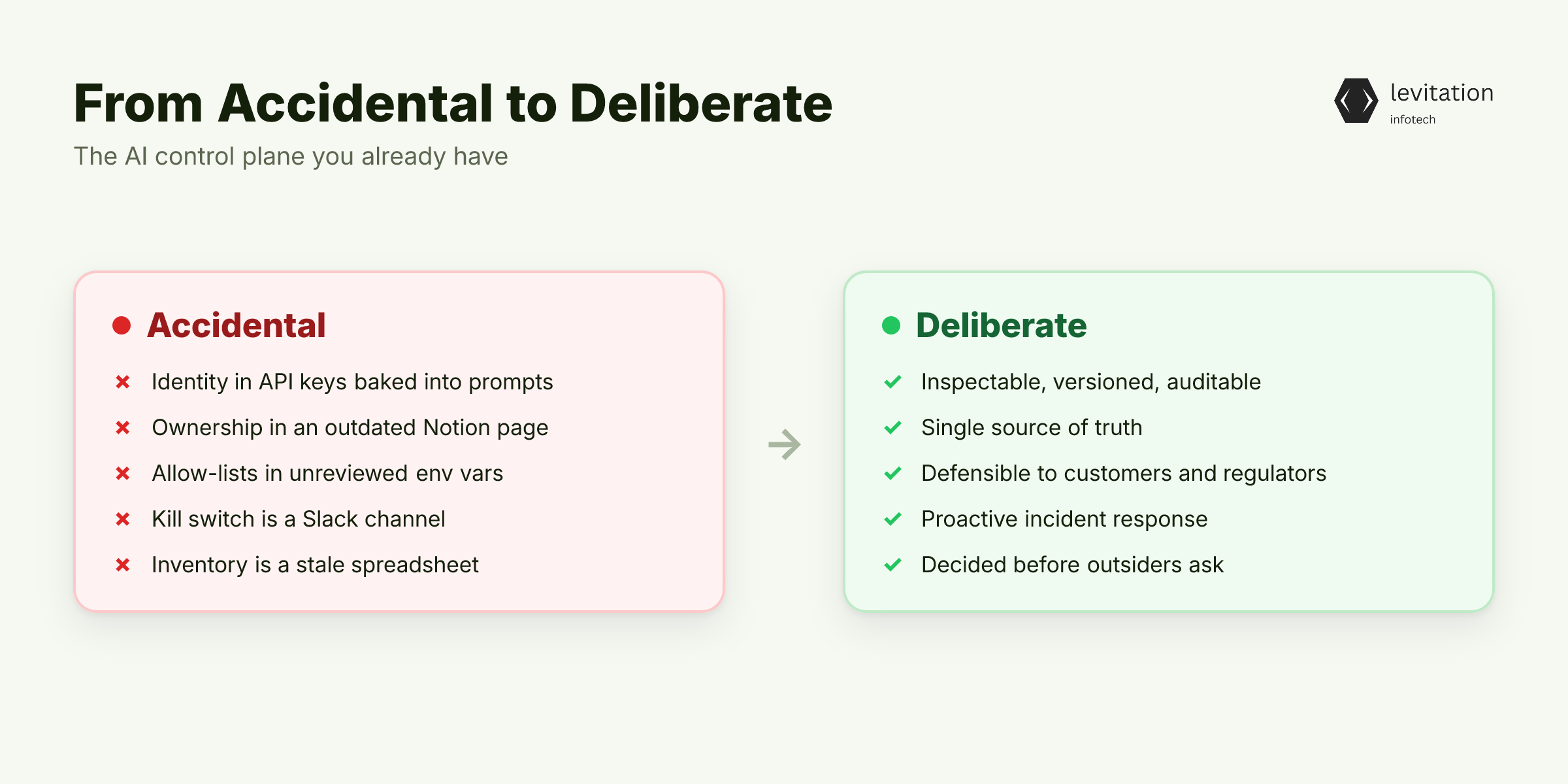
Ask your platform team three questions. How many AI agents do we run in production? Who owns each one? Can you shut one off right now? If the answer involves a spreadsheet, a Slack thread, or a "let me check", you already have an AI control plane. It is just an accidental one.
Most enterprises that run more than a handful of agents have quietly assembled the same accidental system. Identity lives in API keys baked into prompts. Ownership lives in a Notion page that is two months out of date. Allow-lists live in environment variables nobody reviews. The kill switch is a Slack channel and a person who might be on vacation. The only honest inventory of what is running is a spreadsheet someone exported from a cloud console three weeks ago.
This accidental control plane does real work. It just does it badly. Nobody can inspect it, version it, or audit it. When an incident happens, the team reconciles three sources of truth and hopes the data lines up.
The question is not whether to build a control plane. The only real decision is whether the one you already have becomes deliberate. That decision must come before someone outside your company asks the same three questions. That person could be a customer, a regulator, or a journalist. They will get an answer you cannot defend.
If every enterprise already has one, accidental or not, why is nobody selling the deliberate version?
Why No Vendor Will Sell You the Missing Layer
Walk any AI infrastructure vendor's website and you will find a control plane product. The model gateway vendor calls it a control plane. The observability vendor calls it a control plane. The prompt registry vendor calls it a control plane.
Each of them is correct, and each of them is selling you their own product repositioned as the center of gravity.
What none of them will sell you is the layer that makes those components enforceable as one system. The connective tissue. The thing that decides which agent is allowed to call which tool. It picks the model, the data, and records the decision. Your GRC team can query the audit trail on Tuesday morning.
Connective tissue does not have a product SKU. It does not show up in a quarterly revenue line. The buyer's job is to assemble that layer yourself. Nobody on the vendor side is paid to tell you about that part.
This is the dirty secret of the AI vendor landscape. Every vendor optimizes for their own surface area. Nobody is paid to make the seams between vendors work.
Scale has not changed this. It has only made the gap larger, the gap between what gets demoed and what runs in production. Each large deployment assembles the same missing layer from scratch, and the cost shows up on incident reports long before it appears on any P&L.
Assembling that layer yourself sounds like a build project. Until you realize the regulator just set the deadline for you.
August 2026: The Compliance Deadline You Didn't Plan For
The EU AI Act's high-risk and transparency obligations began applying on 2 August 2026. This is not a future problem. The deadline has passed. The enforcement clock is running right now.
Four articles matter: - Article 12 requires automatic event logging over the system's lifetime. Not sampled logs, not quarterly exports. Automatic. - Article 14 mandates effective human oversight, meaning a human with authority and competence must be able to intervene. - Article 19 sets retention rules for those logs, with timelines that depend on the use case. - Article 26 obligates deployers to assign oversight to people with real competence and authority, not a Slack channel.
A spreadsheet cannot satisfy any of these. It cannot produce automatic event logs because it is not in the request path. It cannot support effective human oversight because it does not enforce anything. It cannot answer an auditor's question about retention because it is not append-only. It cannot demonstrate competence of overseer because it has no concept of ownership beyond a cell in column C.
The audit trail you need is the one your AI agent cannot produce once a prompt has been processed.
The regulatory framing changes the conversation. It converts an architectural hygiene problem into an enterprise AI governance liability with enforcement teeth. Fines, market access restrictions, and contractual exposure with customers who themselves must prove compliance.
Compliance tells you the control plane must exist. It does not tell you what shape it should take. The vendors won't either, so you need a definition that holds up under audit.
A Control Plane Is a State Machine, Not a Dashboard
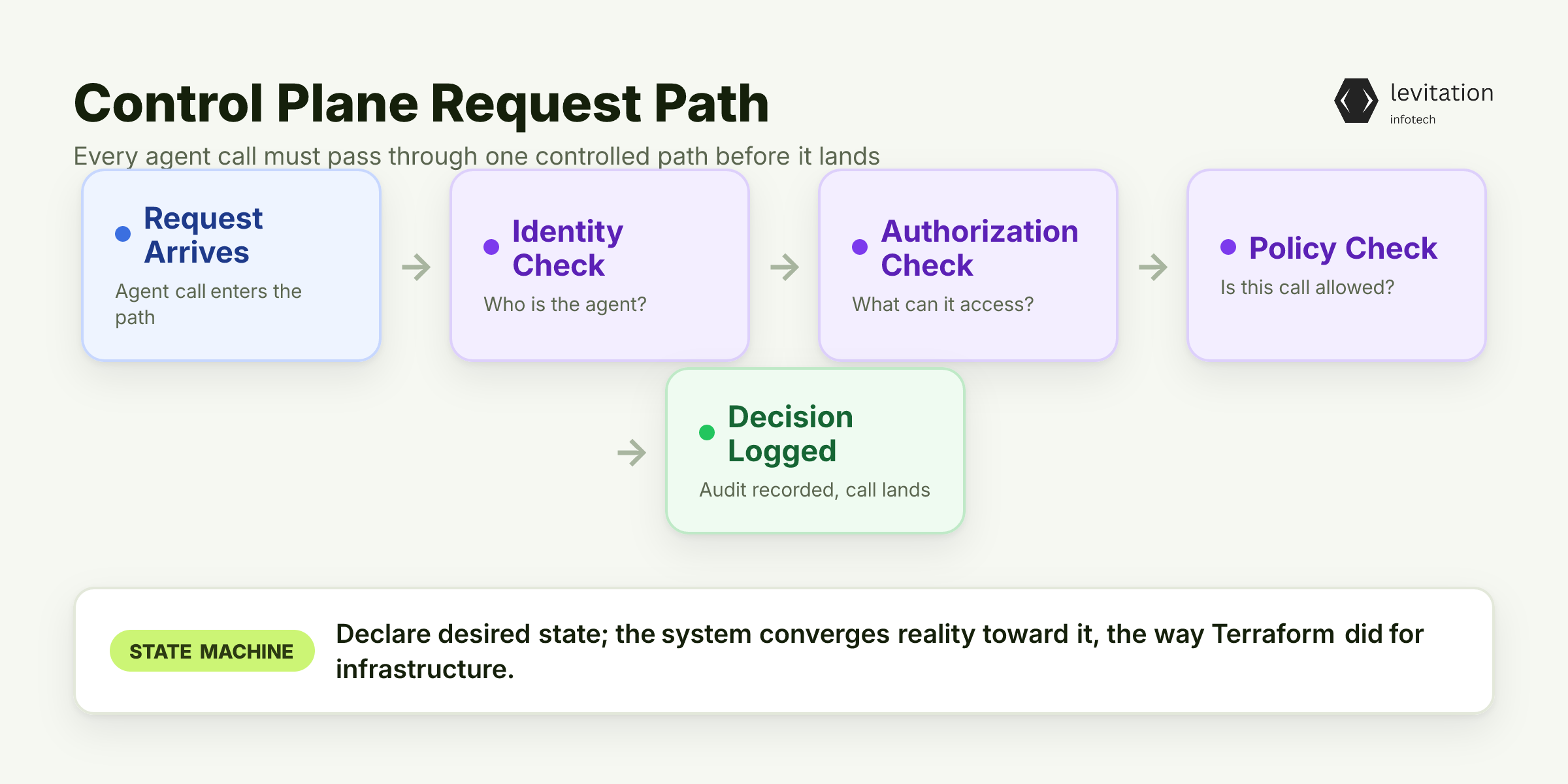
The control plane and data plane split comes from networking. The control plane makes routing and policy decisions. The data plane carries traffic. The same separation must hold for AI agents.
Most "AI control plane" products on the market violate it the same way. They are dashboards over the data plane. They observe what happened. They do not decide what is allowed to happen. They do not enforce that decision in the request path.
A dashboard can tell you yesterday an agent called the wrong tool. A control plane can stop today's call before it lands.
A real control plane is declarative. You describe desired state: which agents exist, what policies apply, who owns them, what they can call, what they cannot. The system converges reality toward that state.
This is the same model Terraform brought to infrastructure, and it is the right mental model for AI infrastructure governance. Policy-as-code. Agent registry as code. Audit trail as code.
The mechanism is straightforward. Every agent request must pass through a single controlled path. In that path, identity is checked. Authorization is checked. Policy is checked. The decision is recorded. Only then does the call land.
The dashboards you already have can read from that same path, but they cannot replace it.
You cannot govern AI you cannot see, and you cannot see what you did not put in the request path.
Teams that treat the control plane as a state machine end up with enterprise AI solutions that last. Declarative control planes do not get bolted on after the third incident.
If the control plane is a state machine, the spreadsheet has a schema. It just never had columns. Here is the schema it should have had.
The Four Tables Your Spreadsheet Should Have Been
The accidental control plane is not wrong because it is a spreadsheet. It is wrong because it has the wrong columns. Replace those columns with four code-defined tables, and the spreadsheet becomes a system.
Agent Registry. Identity, version, owner, capabilities, risk classification, cost characteristics. The single source of truth for every agent in production. No agent runs without a row in this table. No row exists without a human owner. The registry answers "what do we run" and "who is responsible" in a single query, not a three-week export.
Policy Registry. Executable rules. Which models are allowed. Which data classifications each agent can touch. Which tools each agent can call. Which spend limits apply per agent and per owner. Stored as code, not wiki pages, and enforceable at the point of use. The registry answers "what is allowed" in a single evaluation, not a committee meeting.
Audit Log. Every prompt, every tool call, every policy decision, recorded with retention that satisfies Article 19. Append-only, queryable, exportable to SIEM and GRC tooling. The log answers "what happened" without requiring the on-call engineer to grep three log shippers at 2 a.m.
Kill Switch. A tested, immediate path to disable any agent. Not a Slack thread to a person who might be on vacation. A documented, exercised, monitored mechanism that any responder can trigger. The kill switch answers "can we stop it" without delay, not at the next quarter's review.
Implementation approach: version these four tables in Git. Converge them through a controller. Expose them through one enforcement proxy that every agent call must pass through.
Teams that follow this pattern ship a deliberate enterprise AI solutions deployment when they treat it as infrastructure rather than as a feature.
The schema is clear. The harder question is how long the engineering actually takes, and why in-house teams consistently underestimate it.
From Spreadsheet to System
Most teams overcomplicate the rollout. They try to migrate every agent, codify every policy, and satisfy every audit question in parallel. That is the path to a project that never ships.
The path that works is sequenced. - Month 1. Inventory every agent that touches production data, even the ones the spreadsheet forgot. Shadow agents exist. Vendor agents exist. Demo agents that escaped into a staging environment exist. The output of this month is a v0 Agent Registry, honest and complete. - Months 2-3. Codify the three to five policies that actually block incidents. PII egress. Spend caps. Model allow-list. Tool scope. Wire them into the request path. Do not codify the 47 policies from your governance framework. Codify the ones that prevent a phone call from the CISO. - Months 4-5. Stand up the audit log and the kill switch. Then run a tabletop exercise. Have your CISO pretend to be a regulator. Pick an agent. Try to disable it immediately. Try to answer "what data did this agent touch in the last 30 days" from the log alone. Fix everything that fails. - Month 6. Declare the control plane GA. Retire the spreadsheet. Put the new system behind the same change-management process as the rest of your infrastructure. A control plane that lives outside change management is just an undocumented spreadsheet with a different file format.
The full engagement lands when teams follow the sequencing above. Experienced teams apply that sequencing from day one, not after months of trial and error.
That sequencing works. The harder question is what changes once it is live, and why most teams underestimate that change.
What Operational Maturity Actually Looks Like
A deliberate control plane changes what "AI governance" means inside your company. It stops being a quarterly review with a slide deck. It becomes a continuous, enforced control. This is the same shift that moved infrastructure from change tickets to Terraform.
The maturity is measurable. You can count how many agents you can disable on demand. You can count how many policy violations you blocked last week. You can count how many audit questions you answered from the log instead of a person.
The accidental spreadsheet does not survive the first real incident. The deliberate control plane does. The teams that have made this shift retain their systems, refine them, and build on top of them. The teams running off spreadsheets learn the same lessons every incident and rebuild from scratch.
This is the difference between a portfolio of compounding AI investments and a portfolio of abandoned pilots.
If you are standing up a control plane for the first time, treat it as infrastructure, not as a compliance deliverable. The teams that get this right are the ones whose AI investments compound. The teams that get it wrong are the ones who explain to their board every January why last year's agent is being rebuilt from scratch.
Frequently Asked Questions
What is an AI control plane? An AI control plane is the centralized governance and enforcement layer. It decides which AI agents exist, what they can reach, and who owns them. It also decides whether each request can proceed. It is a state machine, not a dashboard. It enforces policy in the request path. It does not just observe what already happened.
How is an AI control plane different from an LLM gateway? An LLM gateway routes prompts to models and often adds caching or rate limiting. An AI control plane is broader. It manages the full agent lifecycle: identity, ownership, policy, audit, and kill switch. This covers LLMs, tools, MCP integrations, and agent-to-agent calls. The gateway can sit inside the control plane. It is not the control plane.
Do I need an AI control plane if I only run a few agents? If you run more than one agent in production, you already have a control plane. It is just accidental, scattered across prompts, environment variables, and spreadsheets. The question is not whether to build one but whether to make the existing one deliberate before the EU AI Act's August 2026 obligations make the accidental version a compliance violation.
What does the EU AI Act require for AI agent logging? Article 12 requires automatic event logging over the system's lifetime. Article 14 requires effective human oversight. Article 19 sets retention rules for those logs. Article 26 requires deployers to assign oversight to people with real competence and authority. A spreadsheet cannot satisfy any of these.
How long does it take to build an AI control plane? A focused build lands in about six months when sequenced: inventory in month one, the few high-value policies in months two to three, audit log and kill switch in months four to five, and GA in month six. In-house teams often overrun because they try to build the integration layer and the components in parallel instead of converging on the four tables first.
About the author
Mayank Singh is a software developer at Levitation Infotech, where he builds web and AI-powered applications across the company’s fintech, healthcare, and enterprise projects.