


TL;DR: A cleaner database map can hide a wider authorization blast radius. Centralize policy intent, carry delegated identity through every hop, and enforce decisions at each data boundary before moving production workloads. Physical consolidation comes last.
Key Takeaways: - Fewer databases do not mean fewer independent permission interpretations. - Delegated agents need shared policy context, near-data enforcement, and complete delegation records. - Consolidation succeeds only after access paths prove equivalent policy behavior.
Fewer Tools, More Concentrated Authorization Risk
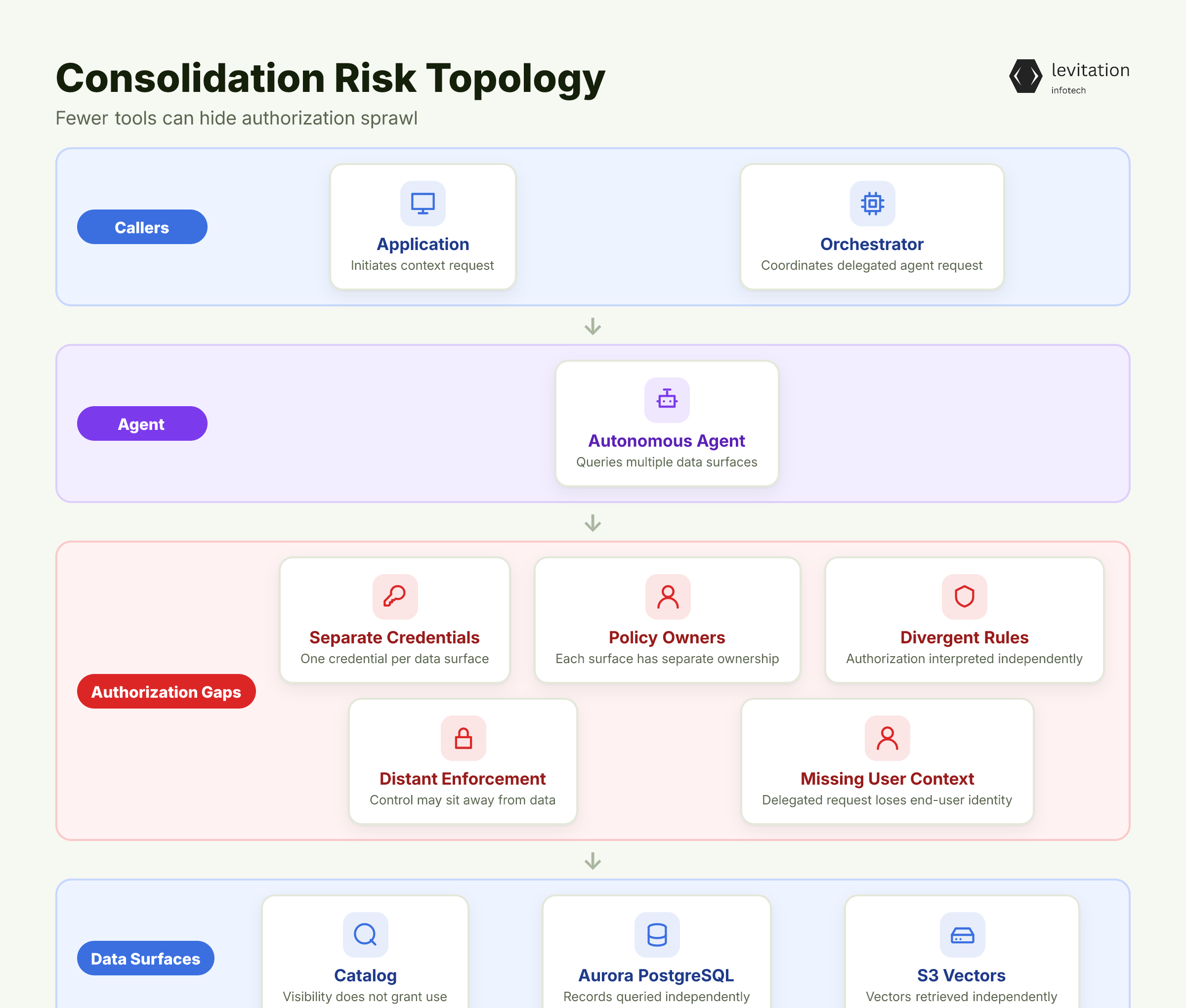
Consider an agent that requests context from a catalog, then queries Aurora PostgreSQL and S3 Vectors with separate credentials. That creates three services, one request, and no consistent answer about who was allowed to see what.
Consolidating databases can reduce the number of systems your team secures, monitors, upgrades, and recovers. It does not merge the rules those systems interpret.
Here is the uncomfortable part. Fewer tools can create false comfort while authorization sprawl becomes harder to see.
Imagine an application and orchestrator in front of an autonomous agent. The agent reads records from Aurora PostgreSQL, retrieves vectors from S3 Vectors, and consults a catalog, index, or cache.
Each surface adds a credential, owner, and enforcement behavior. The catalog knows what exists. Catalog visibility alone does not decide who can use what.
Count independent permission interpretations, not databases. Track three signals: - Independent permission interpretations across the AI path - Access paths without enforcement near the data - Delegated requests missing end-user context
Create a one-page topology deliverable. Include columns for data surface, classification, caller, credential, policy owner, enforcement point, and audit destination.
The AI database consolidation architecture guide helps frame that topology. The AI data access control checklist helps expose permission gaps before they become production paths.
Consolidation can create a governed shared layer with consistent access controls and auditing. Without policy unification, it merely concentrates policy sprawl.
A cleaner topology can still hide divergent policy paths. The first break appears when an agent inherits a human's intent without inheriting a coherent authorization model. Why do static roles break under that delegation?
Why Static Roles Break Under Delegated Agents
Static roles answer a narrow question: what can this principal do? Agentic systems ask more. What should this principal do now, for this action, against this resource, under these conditions?
RBAC remains the baseline. It gives service and agent identities stable roles. But a delegated request changes the question.
An agent with the same role reads a support ticket, then exports customer data because the resource and action changed.
That role sprawl appears in Your AI Agent Has More IAM Roles Than Your Senior Engineer. More roles do not create a coherent authorization model.
Suppose a sales leader asks an agent to retrieve a customer record. The agent calls a retrieval service with its own credential, then writes derived context to a cache.
If the database logs only the service identity, it shows what the agent touched. It does not show who asked or whether the user's rights survived the hop.
A delegated identity chain has four parts: - End user - Agent or service - Requested action - Target resource
Auditing only the final service identity breaks that chain. You can reconstruct machine behavior, but not human intent.
RBAC assigns roles. ABAC evaluates context at decision time. Useful attributes include resource, action, tenant, sensitivity, purpose, and environment.
Neither model works well alone. RBAC alone cannot express every contextual exception. ABAC without clear role ownership becomes an unreadable decision system.
Discretionary access control turns dangerous when every store makes its own grant decision. Policy ownership and enforcement then scatter across product teams.
Use the RBAC and ABAC for AI agents guide to combine stable roles with dynamic attributes. Designing delegated agent identity covers the chain an auditor must reconstruct.
Build a decision inventory with these fields: - Subject and delegated principal - Resource and action - Contextual attributes - Enforcement point - Deny behavior - Required audit event
Attributes can express the decision, but only if every downstream data boundary receives and enforces the same context. What architecture can carry that context to every data boundary?
Centralize Policy Intent, Enforce at the Data Boundary
Oracle documents a useful pattern. A centralized metadata layer, such as Autonomous AI Data Catalog, sits alongside fine-grained controls applied through database execution.
The important word is alongside. Central visibility does not replace enforcement close to data.
That pattern separates logical consolidation from physical consolidation. A shared catalog and policy layer can govern distributed data. It need not move every workload into one database.
Build the architecture in three layers: - Control plane: Stores metadata, policy ownership, and versioned policy intent. - Decision context: Carries user, agent, resource, tenant, and contextual attributes. - Execution layer: Authorizes queries and data access inside each database or retrieval service.
Three invariants keep the design coherent: - The same policy semantics apply across stores. - Deny decisions are enforced close to data. - Audit events preserve the full delegated identity chain.
Engine features differ, but the contract must define equivalent outcomes without claiming unsupported parity.
Across surfaces, the catalog supplies shared context. Each database or retrieval service enforces the decision at its own boundary.
The Unified control planes for AI data guide covers the logical layer. Database-native authorization patterns covers enforcement close to the data.
An application-layer permission check is not a substitute for database-level enforcement. Agents can issue direct queries, indirect calls, or cached requests that skip the check.
The target architecture is clear. The hard part is deciding what to move first. Which paths can move without changing permission behavior?
Map Every AI Data Path Before Moving Workloads
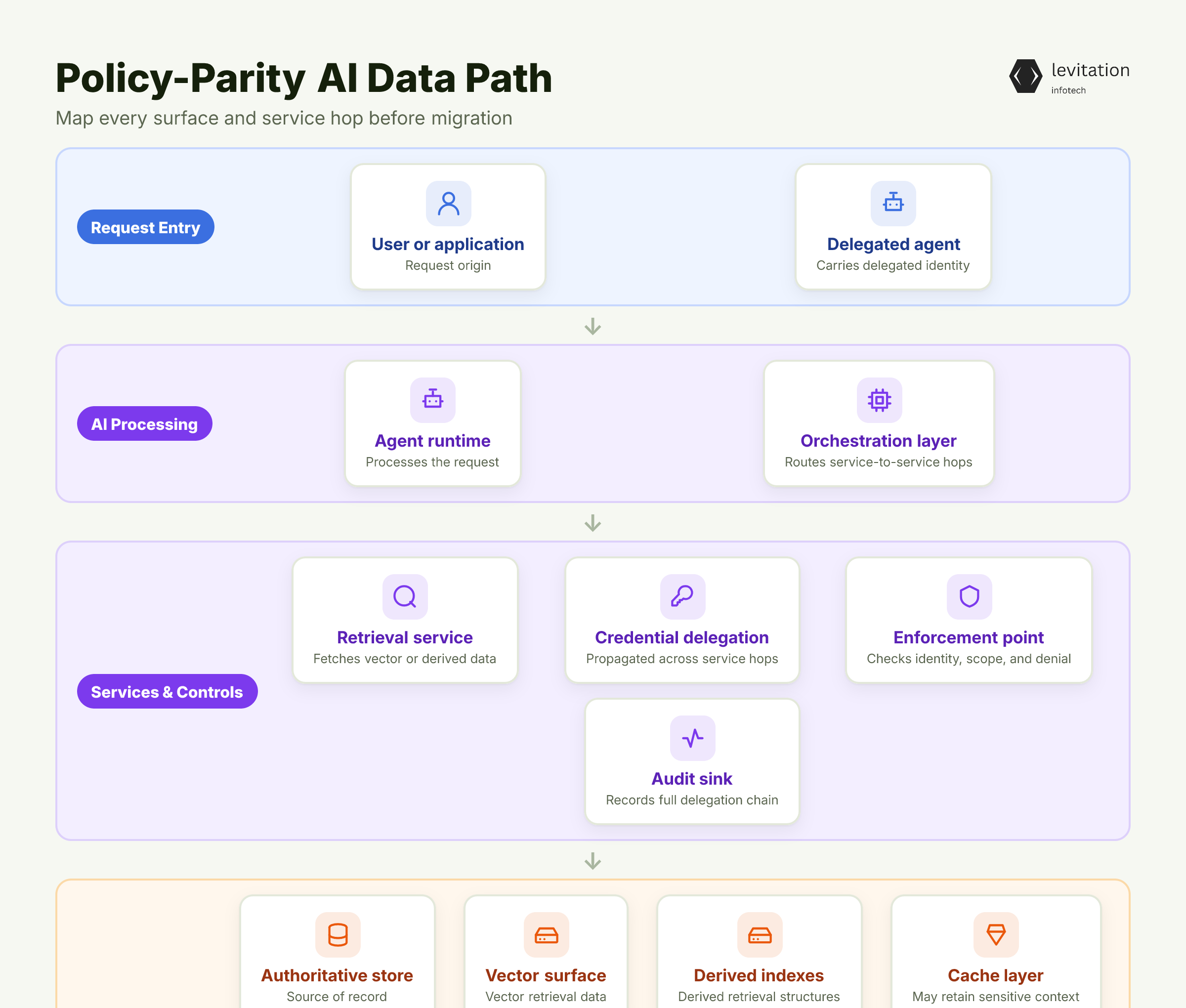
Moving a database is visible. Changing permission behavior during the move is dangerous.
Treat consolidation as a policy-parity exercise, not a lift-and-shift project. Before any production workload moves, prove five gates: - Identity propagation: The end user and delegated agent survive every hop. - Resource scoping: The target cannot widen during delegation. - Deny behavior: Missing context or policy cannot silently become allow. - Audit completeness: Every decision retains the full delegation chain. - Failure handling: The safe outcome is defined when context or policy is unavailable.
Use the AI data inventory template to record these controls for each workload. Mark any unsupported behavior before choosing a migration date.
Sequence the move around policy gaps, not product novelty or short-term convenience. A familiar database with scattered permissions is riskier than a new store with proven parity.
The first gate is simple: name every place the AI path can touch data.
Build the Data-Surface Inventory
Start with every surface used in the request. Include authoritative stores, derived indexes, vector retrieval surfaces, caches, replicas, and supporting services.
Record S3 Vectors and Aurora PostgreSQL deployments when they sit in the AI path. Include any supporting catalogs, indexes, or caches that retain sensitive context.
For each surface, record its data owner, sensitivity, callers, credential type, authorization mechanism, and audit sink.
Verify each product's actual enforcement point. Do not assume that catalog visibility or service-level authentication provides database-level control.
Use the Vector data governance checklist for vector-specific inspection. Apply the same discipline to every relational and derived data surface.
The inventory shows where data lives, but the exploitable path is the request that moves between those places. Where does that request go next?
Trace Delegated Requests Across Service Hops
Follow one request from the user or application through the agent, orchestration layer, retrieval service, target database, cache, and response.
Capture credential delegation, service-to-service hops, policy evaluations, resource rewrites, and any path that bypasses the expected enforcement point.
The trace becomes a policy-parity checklist. Identity context, resource scope, deny semantics, and audit expectations must survive each hop.
Record unsupported controls, compensating safeguards, owners, and remediation order in a gap register. Migration does not begin while a critical gap lacks an owner.
The Tracing AI request paths guide turns this topology into an end-to-end review.
With the paths mapped, the team can define a contract that survives each engine and protocol. How do you turn that contract into a testable control?
Turn Data Access Control into a Testable Contract
Authorization should be a versioned interface between the control plane and execution layer. It should not remain a folder of product-specific settings.
Keep the contract provider-neutral. Map equivalent semantics across S3 Vectors, Aurora PostgreSQL, and other databases without claiming unsupported parity.
Test both halves of the system. Verify the policy decision and the point where that decision is enforced. A correct central decision still fails when a downstream service bypasses it.
Make policy versions, deny behavior, audit requirements, and unsupported attributes visible in every adapter and rollout plan.
The Authorization testing for AI systems guide connects policy tests with the real request path.
A central decision record cannot protect a database that accepts a broader credential or weaker resource filter.
Start by making every decision carry the same minimum facts.
Define a Canonical Decision Contract
Every decision should carry: - Decision and policy version - End-user identity - Delegated agent or service identity - Resource, action, and tenant - Sensitivity or purpose attributes - Enforcement point and audit identifier
ABAC attributes should supplement baseline role assignments. They should not conceal which role granted the starting permission.
Define how deny decisions and unknown attributes behave. Missing context needs a deliberate outcome. It cannot depend on each database's default behavior.
Preserve the user-to-agent delegation chain in the audit record. A downstream service must explain not only what happened, but on whose behalf it happened.
The Canonical AI policy schema provides a provider-neutral starting point.
A canonical contract works only if each database enforces it at the right boundary. How do you prove that enforcement?
Test Enforcement at Every Boundary
Build a test matrix covering: - Direct-user access - Agent-on-behalf-of-user access - Cross-tenant denial - Stale-policy behavior - Unsupported attributes - Downstream bypass attempts - Audit-event completeness
Map the contract through engine adapters. Document every unsupported predicate and the compensating control that covers it.
Run policy tests in CI. Reconcile runtime decisions against audit records. Roll out through staged canaries with explicit rollback criteria.
The Policy regression testing and Runtime audit reconciliation guides cover both sides of this loop.
When enforcement becomes testable, consolidation creates a governance capability, not merely a smaller infrastructure footprint. What does that capability change for the business?
The Payoff Is Governed AI, Not Fewer Databases
Shared metadata improves consistency, common policy semantics improve access control, and preserved delegation context improves auditability.
Physical consolidation can also reduce operational overhead, but only after policy parity is established.
The business payoff is not fewer databases. It is the ability to deliver AI workloads with authorization decisions that are explainable, testable, and auditable across every data boundary.
Which workflows become safer to automate when governed AI access becomes reusable infrastructure rather than a one-off integration?
About the author
Mayank Singh is a software developer at Levitation Infotech, where he builds web and AI-powered applications across the company’s fintech, healthcare, and enterprise projects.