


TL;DR: AI has quietly turned your SaaS subscription into an infrastructure commitment. Costs are volatile, notice periods stretch longer, and economics now run on usage. Your procurement team keeps approving it as software. The next renewal is a five-year architectural decision dressed as a monthly line item. The frameworks most enterprises use were never designed for what AI SaaS has become.
Key Takeaways: - The same AI product sold per seat is often a usage-priced commitment in disguise. AI products also bundle with seat-based core products, masking the consumption economics underneath. - Subscription-era procurement optimizes for predictable seats and predictable cost. AI has made both unpredictable. - The defensive move is renegotiating five contract clauses. The offensive move is building usage telemetry before you sign, not after.
Your SaaS Contract Is an Infrastructure Commitment Now
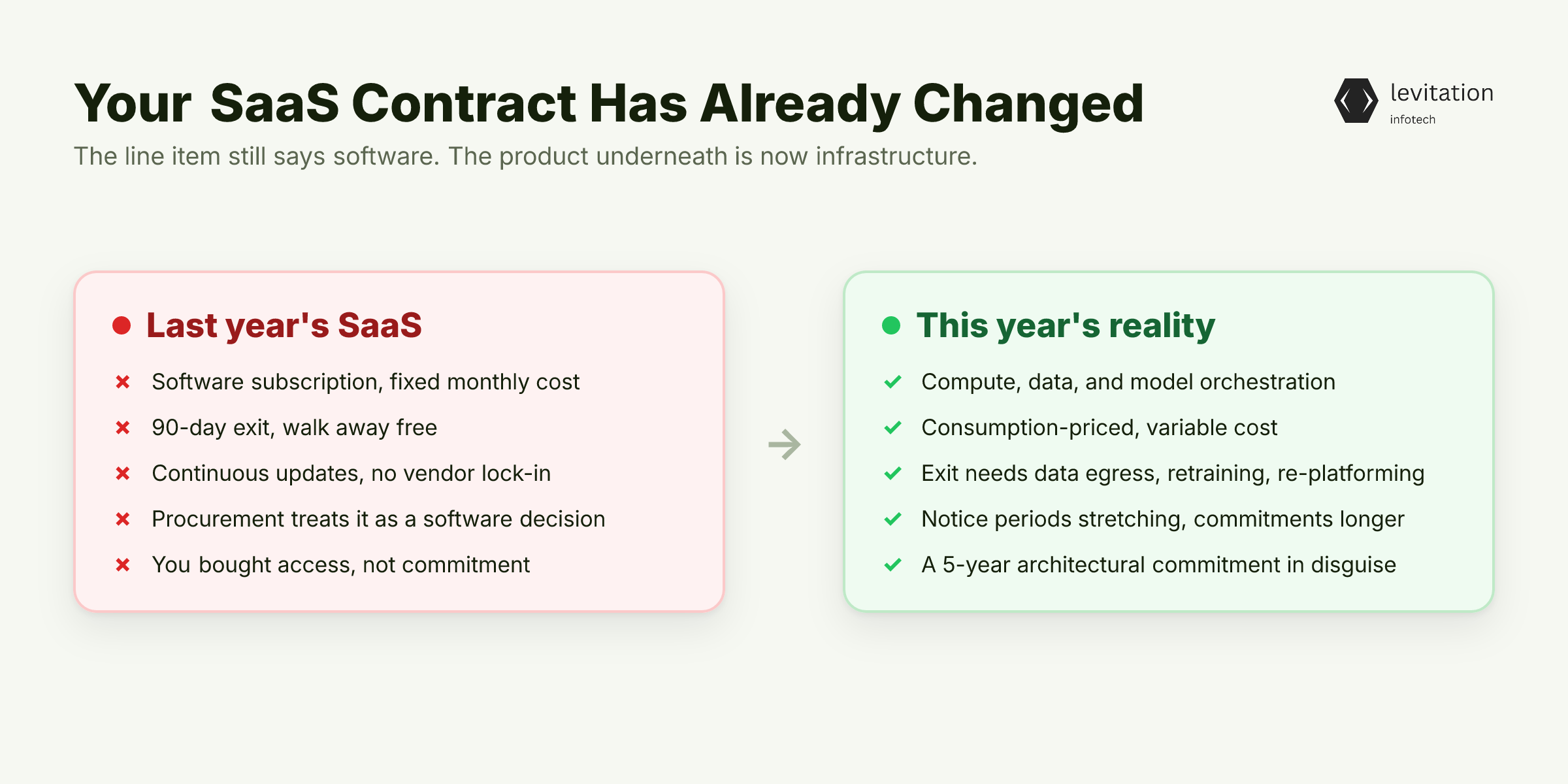
Last year you signed a SaaS contract for software. This year you're paying for infrastructure, and your procurement team is still approving software renewals. That gap is where your budget is leaking.
SaaS was sold as the cure for vendor lock-in. Pay monthly, get continuous updates, walk away with 90 days' notice. The whole model ran on flexibility.
You bought access, not commitment. AI is dismantling that promise, not by changing the terms on page one, but by changing what you're actually buying. The line item still says "software subscription."
The underlying product is now compute, data, and model orchestration priced by consumption. The contract you signed last year looks nothing like the one you're living with today. Most organizations haven't noticed.
Pricing has shifted from fixed to variable. Notice periods are stretching as vendors lock in longer commitments. Cancellation terms that once protected you now require architectural unwinds: data egress, model retraining, prompt re-platforming.
Your next SaaS renewal is no longer a software decision. It's a five-year architectural commitment disguised as a subscription. This isn't a procurement team failure. It's a category failure.
The frameworks they're using were never built for what AI SaaS has become. The AI vendor repricing patterns showing up across 2026 contracts aren't anomalies. They're the new baseline.
So why is procurement still buying software when the product has already become infrastructure?
Why Subscription-Era Procurement Can't See This
Most procurement playbooks rest on three assumptions: predictable seats, predictable cost, and predictable renewal cadence. They were built for a world where buying software meant buying access for a known number of users on a known budget.
AI breaks all three. Costs are dynamic because compute scales with usage. Usage is volatile because AI adoption spreads unevenly. A single power user can consume far more compute than a casual one at the same seat price.
Finance can't forecast which department becomes the next hot spot. ROI is often unproven at procurement time, so the contract lands before anyone measures value. AI products are frequently still sold bundled with seat-based core products.
Procurement is reviewing a software line item while the vendor is quietly repricing the AI layer underneath. Per-seat models fail when value scales with usage, not headcount. The contract language didn't change. The underlying product did, and procurement teams are reading the wrong document about it.
A subscription framework asks "how many seats?" An AI commitment asks "how much consumption can you absorb before bill shock?" Different questions, different answer sheets. The SaaS contract optimization frameworks most enterprises still run are optimized for the first question. So what actually shifted under the hood, and why are vendors so eager to move you off per-seat pricing?
What AI Actually Did to Your Contract Economics
Three mechanics drive the repricing, and each one breaks subscription assumptions independently. Together, they've rewritten the contract. - Dynamic cost-to-serve. Every AI inference carries a real compute cost. When usage is unpredictable and GPU prices fluctuate, a vendor can't lock in flat per-seat fees without losing margin on heavy users. - Volatile usage curves. Adoption rarely follows a smooth ramp. A team discovers a use case, the bill climbs, then optimization drops usage. Finance can't forecast that. - Unproven ROI. The buyer can't point to a clean business case at signing. The vendor knows it, and prices accordingly.
Mature AI vendors converge on hybrid pricing for these reasons. A predictable base fee recovers fixed costs. A variable usage component protects margins without bill shock. Mature vendors are repricing around consumption because they can show incremental willingness to pay for AI features.
This isn't a vendor tactic. It's math. The patterns are visible across creative, design, and productivity tools where sticker prices look low but consumption curves run much higher under heavy use. The AI enterprise software cost benchmarks keep surfacing the same truth.
The sticker price is a fiction, and the consumption curve is the real number. Vendors who hide that curve are hoping procurement won't ask. So if the economics have already shifted inside the contract, what clauses should a CTO be negotiating before the next renewal lands?
The Contract Clauses That Actually Matter Now
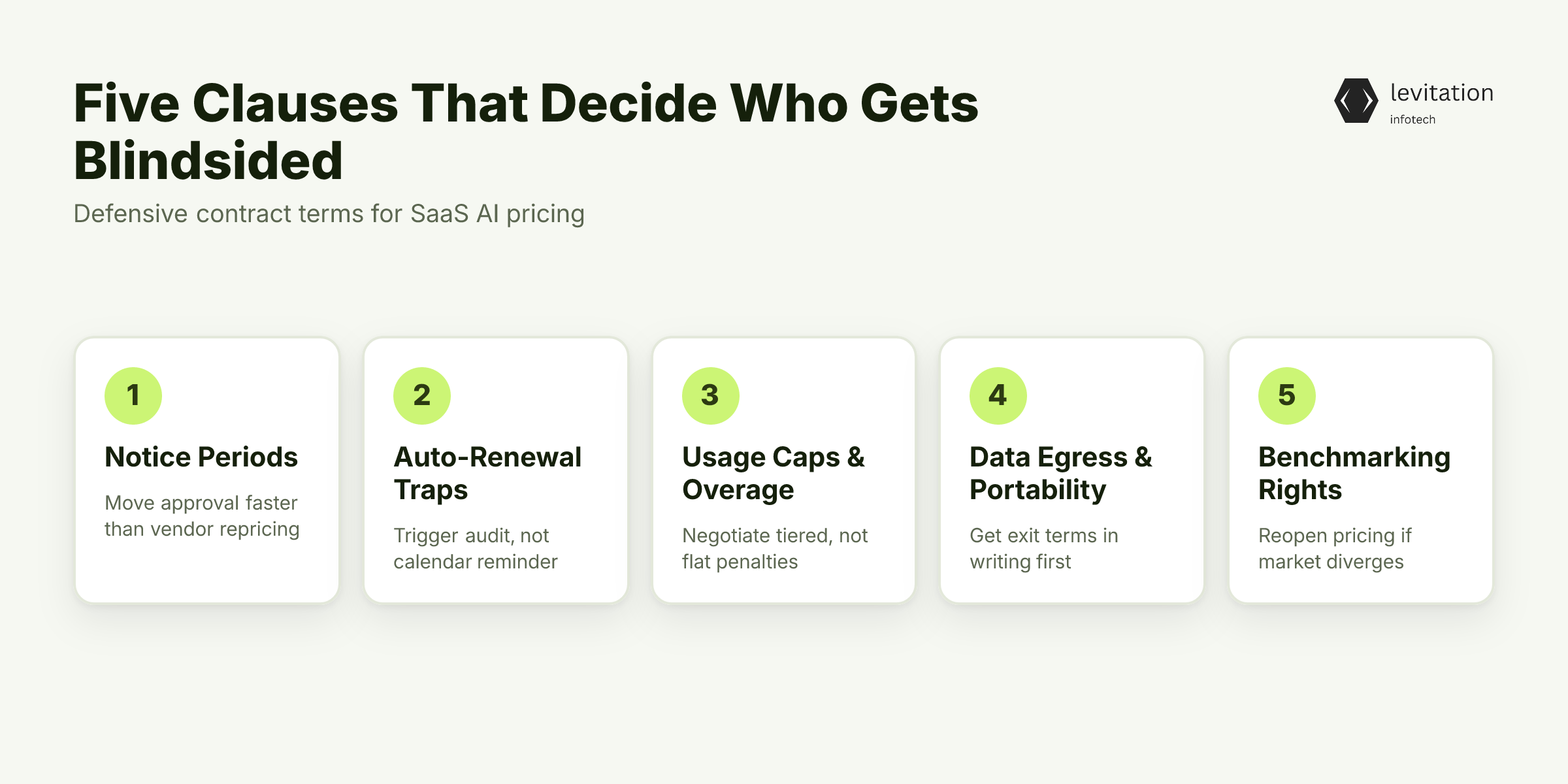
Contract language is the defensive layer. Five clauses separate organizations that get blindsided from those that don't.
Notice periods on pricing changes. AI vendors are extending the notice window for price adjustments as repricing cycles accelerate. Your internal approval cycle has to move faster than theirs. Otherwise, you lose the right to push back before the new rate takes effect.
Auto-renewal traps. Multi-year terms at "AI-enhanced" rates that lock in usage-based pricing before you've measured consumption. The renewal auto-fires, and you're committed to a variable cost you haven't stress-tested. Any auto-renewal clause should trigger a usage audit, not a calendar reminder.
Usage caps and overage rates. The real ceiling on your spend. Negotiate tiered overage, where the per-unit cost drops as you cross thresholds, rather than flat penalties that punish burst usage. The difference between tiered and flat on a single bad month can be the entire year's savings.
Data egress and model portability. What happens to your fine-tunes, embeddings, and training data if you exit? Most contracts are silent, and unwinding AI workloads is a multi-quarter project. Get portability terms in writing before you sign.
Benchmarking rights. Contractual ability to reopen pricing if the vendor raises rates materially relative to market. AI pricing is still moving fast, and the rate you sign at today may be uncompetitive within a couple of years. Benchmarking clauses turn that risk into an advantage.
The enterprise AI governance checklist most organizations use covers none of these, because it was written for seat-based software. CTOs winning this round treat the contract as a five-year architectural decision. The same blind spot that makes why your AI control plane is a spreadsheet a real risk is the one that makes contract clauses invisible until renewal.
Contract language is the defensive layer. The offensive layer is governance, and that's where most enterprises are losing ground. So what does AI-era governance actually need to look like?
Building AI-Era SaaS Governance
Subscription-era governance tracked license counts and renewal dates. AI-era governance needs three things procurement never asked for. - Token-level usage telemetry. Per-seat reports can't show which team is consuming disproportionately more compute than casual users. Without per-call or per-token visibility, your first signal of overspend is the invoice. - Cost attribution by department and use case. Chargeback models built on seat counts collapse when one team's AI use case costs more than the rest of the org combined. Every consumption unit needs a business dimension. - ROI dashboards tied to outcomes, not access. The wrong question is "how many users are active?" The right question is "what business outcome did each usage pattern produce?" Without that, you can't separate a productive power user from an expensive experiment.
The CTO role shifts here, from procurement gatekeeper to consumption architect. You're not just buying access anymore. You're designing how the organization uses AI, which models it touches, and which workflows qualify for premium tiers.
Speed matters. The gap between "we have a dashboard" and "we have a contract we understand" is where the savings live. The pattern is consistent: organizations that instrument usage before they sign get an edge at the negotiating table. Those that sign first pay to discover what they bought.
So what does the enterprise look like once procurement has actually caught up to what AI did to the contract?
What Changes When Procurement Catches Up
Renewals stop being surprises. Consumption budgets replace seat-count forecasts. Finance gets predictability without freezing innovation. You stop asking "how many users do we have?" and start asking "what's the cost per resolved ticket, per loan decision, per document processed?"
Negotiations shift from "best price per seat" to "best unit economics per outcome." Outcome-based pricing is where mature AI contracts are heading. The vendor gets paid for verified results, not access. The first contracts in this model are already landing, and they require a different kind of evidence on the buyer's side.
The same logic that makes measuring AI ROI structurally hard is what makes outcome-based pricing a structural solution. Systems designed this way tend to last. Contracts that match how the product actually behaves become an advantage instead of friction.
What holds in finance and healthcare procurement applies across regulated industries. The CTO who builds this capability becomes the bridge between finance, procurement, and engineering, instead of the bottleneck between them.
Frequently Asked Questions
How is AI changing SaaS pricing models in 2026?
AI is shifting SaaS from flat per-seat subscriptions toward hybrid and usage-based pricing. A predictable base fee plus a variable component tied to consumption is replacing the old model. Costs are dynamic because compute scales with usage.
ROI is often unproven at signing, and usage is volatile because adoption patterns are unpredictable. That's why mature vendors are repricing around outcomes rather than access.
What should a CTO negotiate in an AI SaaS contract?
Focus on five clauses. First, pricing-change notice periods: aim for as much lead time as the vendor will allow. Second, usage caps with tiered overage rates. Third, data egress and model portability rights.
Fourth, benchmarking rights to reopen pricing on material increases. Fifth, auto-renewal terms that don't lock in usage-based rates before you've measured consumption.
Why is per-seat pricing failing for AI products?
Per-seat pricing creates a margin problem for vendors when value scales with usage rather than headcount. Every additional seat becomes a fixed-fee loss on a variable cost base. For buyers, it also misallocates cost.
A single heavy user can consume far more compute than a light user at the same seat price. That's why hybrid and usage-based models are winning.
How do you track AI SaaS costs across an enterprise?
You need token-level usage telemetry rather than seat-level reporting. You need cost attribution by department and use case so each business unit sees its own consumption. You need ROI dashboards tied to business outcomes rather than license counts.
Without these three, you can't negotiate the next renewal from a position of knowledge.
What's the difference between subscription and infrastructure commitments in SaaS?
A subscription commitment assumes predictable cost, short cancellation windows, and feature-based value. You pay for access. An infrastructure commitment assumes volatile consumption, longer notice periods, and outcome-based value.
You pay for throughput. AI has quietly moved most enterprise SaaS into the second category while contracts still use the first category's language.
See the shift in action in our enterprise AI case studies.
About the author
Mayank Singh is a software developer at Levitation Infotech, where he builds web and AI-powered applications across the company’s fintech, healthcare, and enterprise projects.