


TL;DR: The BI Bench benchmark tested 8 AI data tools against the same complex production database. Only Basedash (92.1% accuracy, 28.6s response) and Codex (90.9% accuracy, 54.3s response) cleared the accuracy and latency bar needed to beat cost of capital. The 6 losers failed not because their models were weak, but because they couldn't handle live, messy schemas - a gap that vendor demos will never expose.
Key Takeaways: - 6 of 8 popular AI data tools failed when benchmarked on a real production schema, including widely used names like Hex and Claude Code. - Basedash ranked first on both accuracy and speed, making it roughly 1.9× faster than Codex at a comparable accuracy level. - CTOs who buy AI tools on vendor demos are making capex decisions on marketing assets - benchmark on your own data before signing anything.
Most AI Tools Don't Beat Cost of Capital - Here's the Proof
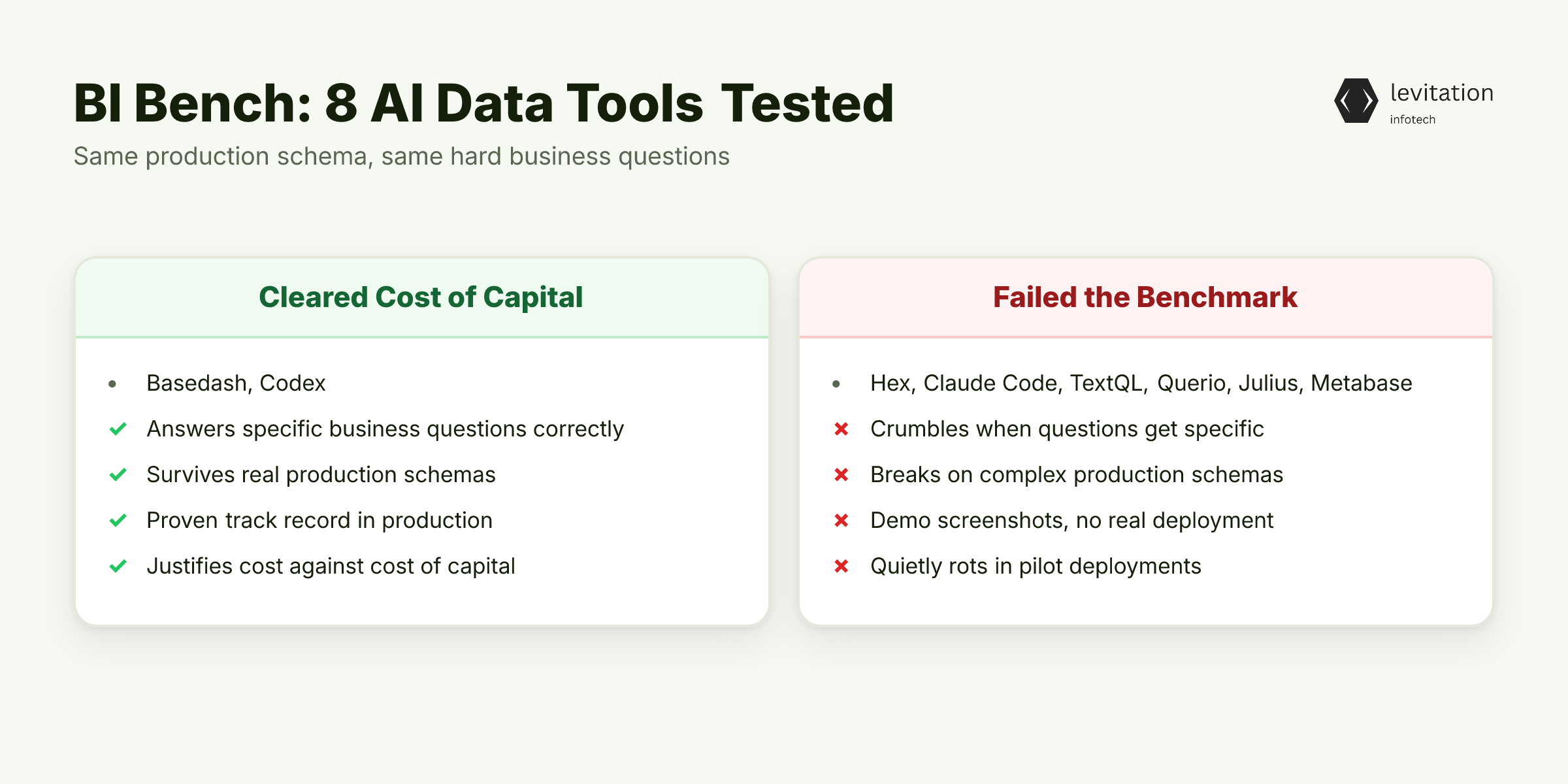
We ran 8 AI data tools against the same production database with the same hard business questions. Six of them failed to clear cost of capital. The other two exposed a gap that most vendor demos will never show you.
The benchmark is called BI Bench, and it was designed to answer one question: can an AI agent sit down in front of a real, messy production database and return a correct answer to a hard business question? Eight tools were tested: Basedash, Codex, Hex, Claude Code, TextQL, Querio, Julius, and Metabase. All of them got the same set of difficult questions. All of them faced the same complex, production-grade schema.
Only Basedash and Codex produced results that could justify their cost against typical cost of capital thresholds. The other six - including widely used tools like Hex and Claude Code - crumbled when the questions got specific and the schema got real. The industry narrative that "AI is transforming analytics" doesn't survive contact with a real schema and a real business question.
This is not a small finding. Across enterprise AI solutions shipped in regulated industries, the difference between a tool that survives production and one that quietly rots in a pilot is almost always this kind of head-to-head benchmark. Vendors with a track record of production deployments tend to have done this work already. The ones pitching on demo screenshots haven't.
But the gap between the winners and losers isn't about raw model capability. It's about something more fundamental that almost every public AI benchmark misses.
The Demo-to-Production Gap Nobody Talks About
Vendor demos use clean sample datasets. Production databases have hundreds of tables, ambiguous column names, undocumented relationships, and years of business context baked into naming conventions that no model has ever seen. A column called `cust_status_code` means something very different in a retail system than in a banking ledger, and no public benchmark can capture that.
Here's the pattern we keep seeing: AI tools that score well on public benchmarks routinely underperform on real schemas with business-specific context. The drop isn't subtle. It's a cliff. The BI Bench used a complex production-grade schema specifically to expose this gap, and most tools crumbled against it.
The reason matters for procurement. CTOs who evaluate AI on vendor demos rather than their own data are making a capex decision on a marketing asset. That sounds harsh, but the mechanism supports it. A tool that performs well on a demo and fails on your schema will silently produce wrong answers, erode analyst trust, and get abandoned once users lose confidence. The cost of that abandonment - in licenses, integration work, and political capital - is rarely recovered. An evaluation on a real production schema, backed by custom software development to wire the right plumbing, is a fraction of that write-off.
So what did the top 2 tools actually do differently that let them handle real-world complexity?
Basedash and Codex: What the Winners Shared
Basedash ranked first with 92.1% accuracy and the fastest average response time at 28.6 seconds per task. It was both the most accurate and the fastest tool tested. Codex came second at 90.9% accuracy but took 54.3 seconds per task, making Basedash roughly 1.9× faster at a comparable accuracy level. Both tools handled the hard cases that broke the other six, and both did it without human hand-holding.
The shared advantage wasn't model size or brand. It was architecture. Both tools were architected from the ground up for live production environments, not for academic benchmarks. Their core difference: native context handling for live schemas, not just training-data recall. They introspect the schema at query time. They read column comments, infer relationships from foreign keys, and reconcile ambiguous names against actual data distributions. The other six tools in the benchmark relied heavily on patterns learned in training, which works fine on textbook SQL but fails on a schema nobody outside your company has ever seen.
For CTOs evaluating enterprise AI solutions, this distinction between "demo-tuned" and "production-tuned" is the single highest-signal filter available. Ask one question: does the tool introspect a live schema at query time, or does it work from a snapshot? That question alone eliminates most of the field.
Accuracy gets the headlines. But the 1.9× speed gap is what quietly destroys ROI - and most procurement conversations never even measure it.
The Latency Tax: Why Slow AI Tools Destroy ROI
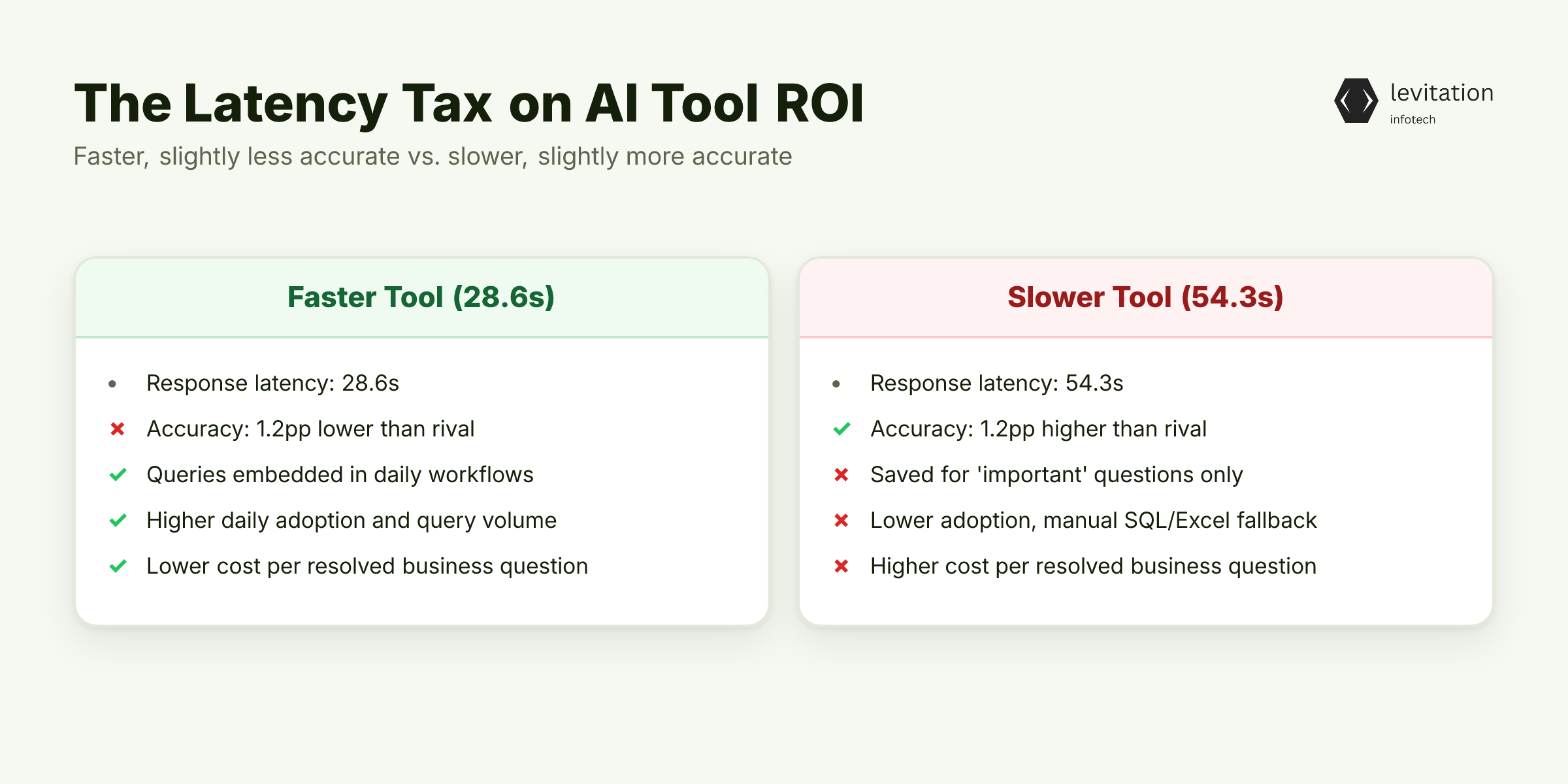
Response time multiplies across query volume. The ~25-second latency gap between a 28.6s tool and a 54.3s tool, when multiplied across query volume, produces cumulative user wait time that scales with adoption. That wait time isn't theoretical. It's people staring at a spinner instead of doing their job, and it shows up directly in adoption metrics.
A 30-second threshold tends to separate adopted tools from abandoned ones in productivity tooling. Below it, queries get embedded into daily workflows. Above it, users save the tool for "important" questions and route everything else back to manual SQL or Excel. The slower "accurate" tool often costs more per resolved business question than a faster "less accurate" one, because adoption is the real multiplier on ROI.
Here's the math that matters. At the same accuracy, a 28.6s tool tends to see higher daily adoption than a 54.3s tool. Higher adoption means higher query volume, which means better amortization of a fixed license cost. The accuracy gap between Basedash and Codex is 1.2 percentage points. The adoption gap driven by latency is far larger. Procurement committees that fixate on accuracy deltas miss this entirely. Teams that need to justify spend to a CFO understand it intuitively. The cost of custom software development to wrap a slow tool in caching or query pre-warming is rarely worth it when a faster tool exists off the shelf.
If accuracy and speed are the two axes, how should a CTO actually evaluate a new AI tool before writing a check?
The CTO's AI ROI Evaluation Framework
A four-step process works. Skip any step and you buy on vibes. - Step 1: Benchmark on your own data. Never buy on a vendor's curated demo. Use a broad set of real business questions against your actual production schema, with the same toolchain your team uses daily. - Step 2: Measure both axes. Track accuracy (percentage of questions answered correctly) and median response time. Reject any vendor who refuses to share both numbers, or who insists that "speed depends on the question." - Step 3: Calculate fully loaded cost per resolved query. Add model API cost, infrastructure, and human validation time. Divide by queries that actually drove a business decision. A tool that hallucinates cheaply is still expensive. - Step 4: Compare against cost of capital. If the tool's annual cost as a percentage of measurable business value exceeds your hurdle rate, it fails regardless of how impressive the demo looked. This is the test that enterprise AI solutions buyers should run before any contract is signed - a step that becomes even more important given how often stated strategy diverges from actual tool usage, as detailed in Your AI Strategy Says Three Models. Your Engineers Use Eleven.
The deployment horizon matters too. An enterprise AI deployment via an experienced partner typically reaches production much faster than an in-house team without prior production AI experience can manage. That time delta materially changes the time-to-ROI calculation. Every extra month of deployment pushes the payback period further out, and AI projects that look good on paper quietly fall below cost of capital before they stabilize. Partnering with a team that has shipped custom software development on top of AI models in production cuts that risk.
When you apply this framework, the difference between the 2 winners and the 6 losers becomes obvious - and the right tool starts paying for itself fast. Miss any of the four steps, and you end up back in the vendor demo room, wondering where the next two years of budget went.
What Changes When You Pick an AI Tool That Actually Clears Cost of Capital
Adoption compounds. Tools that return correct answers fast get used daily, and daily-use tools generate compounding query volume and decision impact. A tool that clears the 30-second threshold once stays under it; a tool that misses it rarely recovers. Daily users find new questions to ask, and those questions generate new insights that justify more seats, more queries, and more integration work. This is the same adoption compounding that has reshaped the entire SaaS stack, as AI Just Repriced Your SaaS Contract showed last quarter.
Engineering teams stop rebuilding internal AI wrappers. When the right tool exists and works, the team redirects capacity to custom software development that creates competitive moats - the proprietary logic that actually differentiates your business. This is where compounding happens. Every quarter spent debugging a brittle AI wrapper is a quarter not spent on the work that wins deals.
Long-term production stability is the last piece. Long-lived production systems are typically the ones where the underlying AI choice was sound on day one. We see this pattern at Levitation, where long-term client retention tracks closely with deployments that passed this kind of benchmark on real data before they were ever signed.
The compounding effect of accuracy + speed + adoption is what separates tools that beat cost of capital from tools that look good in a sales deck. Get the first decision right, and the rest of the AI roadmap gets easier. Get it wrong, and your team spends the next two years explaining why the "AI initiative" didn't move the needle.
Frequently Asked Questions
Q: What was the BI Bench benchmark and which tools were tested?
A: BI Bench tested 8 AI data analysts - Basedash, Codex, Hex, Claude Code, TextQL, Querio, Julius, and Metabase - against the same set of difficult BI questions run on a real, complex production database. It was designed to measure how well each tool handles real business questions rather than curated demo datasets.
Q: Why did only 2 out of 8 AI tools beat cost of capital?
A: Most tools failed because they couldn't maintain both high accuracy and low latency on a real production schema. Only Basedash (92.1% accuracy, 28.6s response) and Codex (90.9% accuracy, 54.3s response) cleared the combined threshold required to justify their cost against typical enterprise cost of capital.
Q: How should a CTO benchmark AI ROI before purchasing?
A: Run a broad set of real business questions against your own production schema. Measure accuracy (correctness) and median response time, then calculate fully loaded cost per resolved query. Compare the annual cost as a percentage of measurable business value against your hurdle rate - if it exceeds cost of capital, the tool fails regardless of demo quality.
Q: Why does response time matter as much as accuracy for AI ROI?
A: Latency multiplies across query volume and drives user adoption. Tools exceeding 30-second response times see sharp drops in daily usage, which collapses the query volume needed to amortize the tool's cost. A 1.9× speed difference at equal accuracy can determine whether an AI tool becomes embedded in daily workflow or gets abandoned after the pilot.
Q: How long does an enterprise AI deployment typically take?
A: With an experienced implementation partner, a production-grade enterprise AI deployment typically reaches production faster than an in-house team without prior experience can manage. In-house teams without prior production AI experience take substantially longer for comparable scope, which materially extends the time-to-ROI horizon and often pushes the project below cost of capital before it stabilizes.
About the author
Mayank Singh is a software developer at Levitation Infotech, where he builds web and AI-powered applications across the company’s fintech, healthcare, and enterprise projects.