


TL;DR: AI underwriters can issue decisions that violate the Equal Credit Opportunity Act. They can also break the CFPB's new medical debt ban. They can break state usury caps too. Most production logs cannot prove any of this happened. The fix is not a better model risk management program. It is a six-field decision record. That record is captured at inference time. It uses pre-hoc constraint checks and tamper-evident storage. CTOs who build this layer convert AI underwriting from a regulatory liability into examiner-grade infrastructure.
Key Takeaways: - Standard model risk management checks aggregate model behavior. It does not defend individual AI-influenced decisions to a regulator. - A defensible audit trail captures six specific fields at decision time. Those fields include the feature vector. They include the model version. They include the decision boundary values. They also include the override trail, adverse action reason codes, and retention metadata. - Pre-decision constraint engines and immutable storage are the only way to keep AI underwriting legally defensible at production latency. - Teams that treat compliance as infrastructure ship new lending products in weeks, not quarters. They move that fast because the audit data is already being collected.
The Approval You Can't See Until a Regulator Does
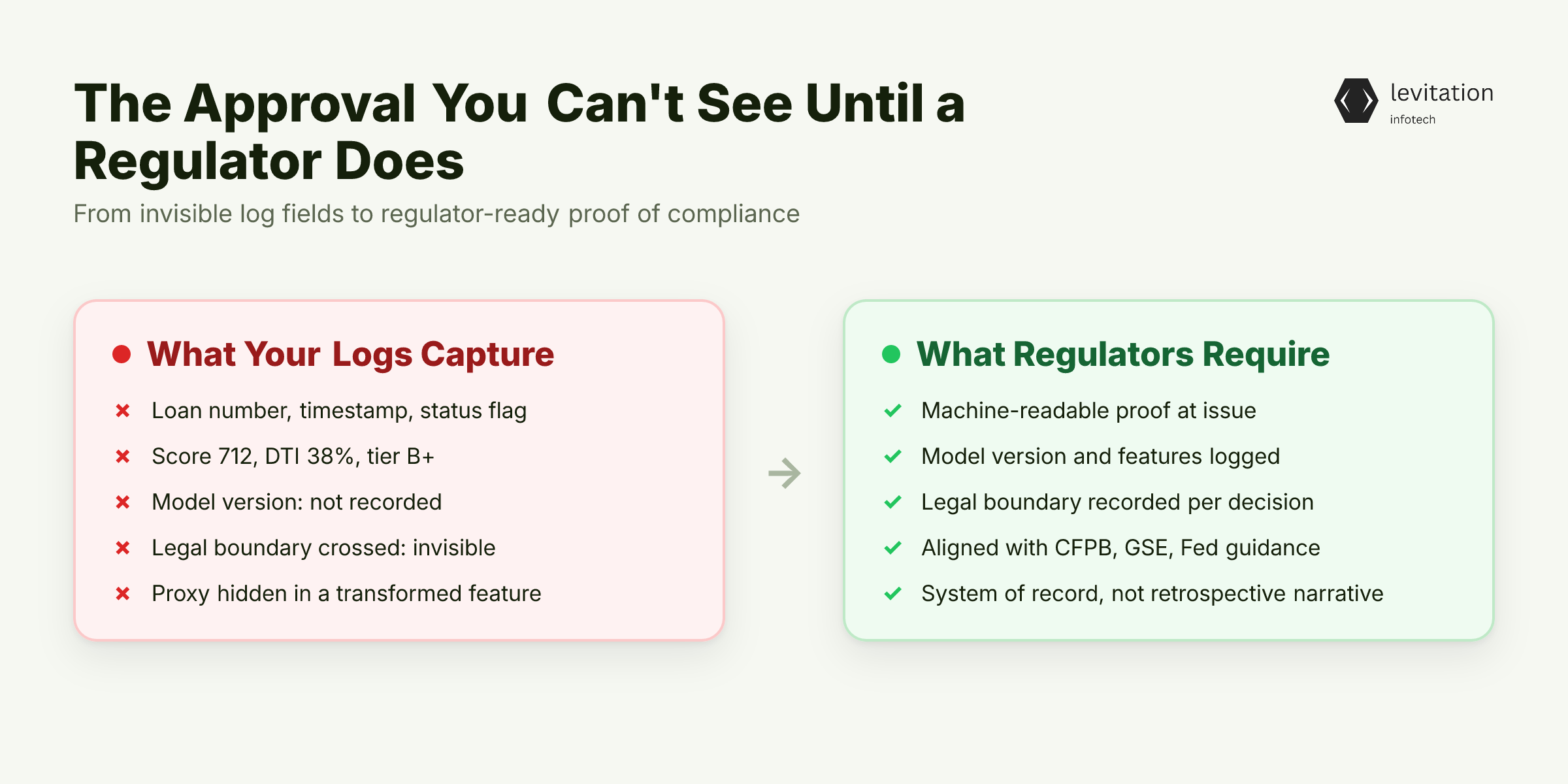
Your AI underwriter can issue a decision that violates the Equal Credit Opportunity Act. It can also break the CFPB Personal Financial Data Rights Rule. It can break your state's usury cap too. Your application logs will record the loan number, the timestamp, and a status flag. They will not record the legal boundary the decision crossed. They will not record the model version that produced it. They will not record the protected-class proxy. That proxy is hidden in a transformed feature.
That gap is the real problem. CTOs see AI underwriting as a throughput play. It runs in milliseconds per decision, with no human in the loop, at scale. Regulators now see it as a system of record. It must produce machine-readable proof of compliance, not retrospective narratives. The shift in 2026 is sharp. Federal banking agencies have published guidance. The CFPB has published guidance. The GSEs have published guidance. Fannie Mae's AI/ML governance Lender Letter and the CFPB final rule on automated underwriting disclosures don't just permit AI in mortgage underwriting. They specify how it must be governed. They specify how it must be documented. They specify how it must be explained.
The danger is that the model output looks normal. A score of 712, a debt-to-income ratio of 38%, a price tier of B+. None of those fields signal that the model used a medical debt proxy. That proxy is buried inside a third-party credit feature. None of them signal that the applicant's ZIP code pushed the model past a fair lending threshold. The application log shows a clean approval. The legal violation stays invisible. It stays invisible until a regulator subpoenas the model and the data behind it.
Most CTOs respond by pointing at their model risk management program. That's the wrong defense. Strong AI credit scoring governance is necessary, but MRM is a regular discipline. The question is what your infrastructure does at the millisecond a decision is issued.
Why Model Risk Management Catches Drift, Not Crimes
Model risk management has a specific job. It checks that the model performs as designed. It runs quarterly bias testing. It runs annual validation cycles. It runs holdout accuracy checks. It runs calibration scores. It answers the question, "is this model still fit for purpose?" It does not answer, "did the decision we just issued to a specific applicant cross a legal line?"
That distinction matters because fair lending liability attaches to individual decisions. Disparate impact under ECOA and Regulation B is a per-applicant claim. Aggregate fairness scores on a holdout set do not cure a single non-compliant decision. A model can pass every MRM gate and still produce an approval that violates the law. The violation lives in the interaction between one applicant's features and one model's threshold. It does not live in a population-level statistic. This is also why your MLOps pipeline is undermining model safety. It treats validation as the finish line instead of the floor.
The failure mode is straightforward. MRM catches drift, not crimes. If a feature's distribution shifts over time, MRM flags it. If a specific applicant's inputs trigger a decision that crosses a protected boundary, MRM never sees it. Compliance teams read explanations after the fact, when liability has already attached. AI underwriting decisions need pre-hoc constraint checks. Most stacks have neither.
The cost of this gap is uneven. A model that drifts costs you a retraining cycle. A decision that violates fair lending costs you an enforcement action. It costs you a consent order. It costs you an examiner. That examiner now treats every model in your stack as suspect. Banking software and compliance infrastructure is what determines whether the second scenario ever happens. The data layer that turns a decision into a defensible record matters. Most engineering teams have not yet invested there.
The Six Fields That Separate a Legal Approval from a Lawsuit
A legally defensible AI lending decision is not a score. It is a structured record. Six fields, captured at inference time, in a single write. Miss any one, and your defense to a regulator collapses.
Here is what the record must contain: - Input feature vector at decision time. The exact values the model saw. Not a summary, not a hash. Protected-class proxies hide in transformed features. A regulator will want the raw inputs to reproduce the decision. - Model identifier and version. The EU AI Act treats creditworthiness AI as high-risk under Annex III. A regulator will ask which model version produced the decision. It will ask what the model was trained on. It will ask whether it had approval to operate at that point in time. - Decision boundary values. The threshold the applicant's score crossed. The debt-to-income ratio used. The price tier assigned. The cut-off that flipped a decline to an approval. This is the field that lets you prove no protected attribute shifted the boundary. - Override trail. Every human-in-the-loop adjustment, with the human's identity and reason code. Unlogged overrides are the single most common enforcement finding in AI lending examinations. - Adverse action reason codes mapped to actual decision drivers. This satisfies the CFPB's automated underwriting disclosure rule. Generic codes like "insufficient credit history" do not survive scrutiny. The model used a different variable to deny. - Retention metadata. Timestamp plus the 6-month minimum logging window. That window is required by the EU AI Act for high-risk systems. It should be extended to align with CFPB examination cycles.
The six fields are not optional metadata. They are the contract between the model and the regulator. The model returns a decision and a record. The record is the product. Anything less and you are running blind. AI in fintech production systems treats these fields as non-negotiable infrastructure, not as a logging afterthought. Knowing what to log is one thing. Building a system that captures all six fields without adding latency to every decision is another.
Building the Audit Trail: Architecture for Regulated AI Lending
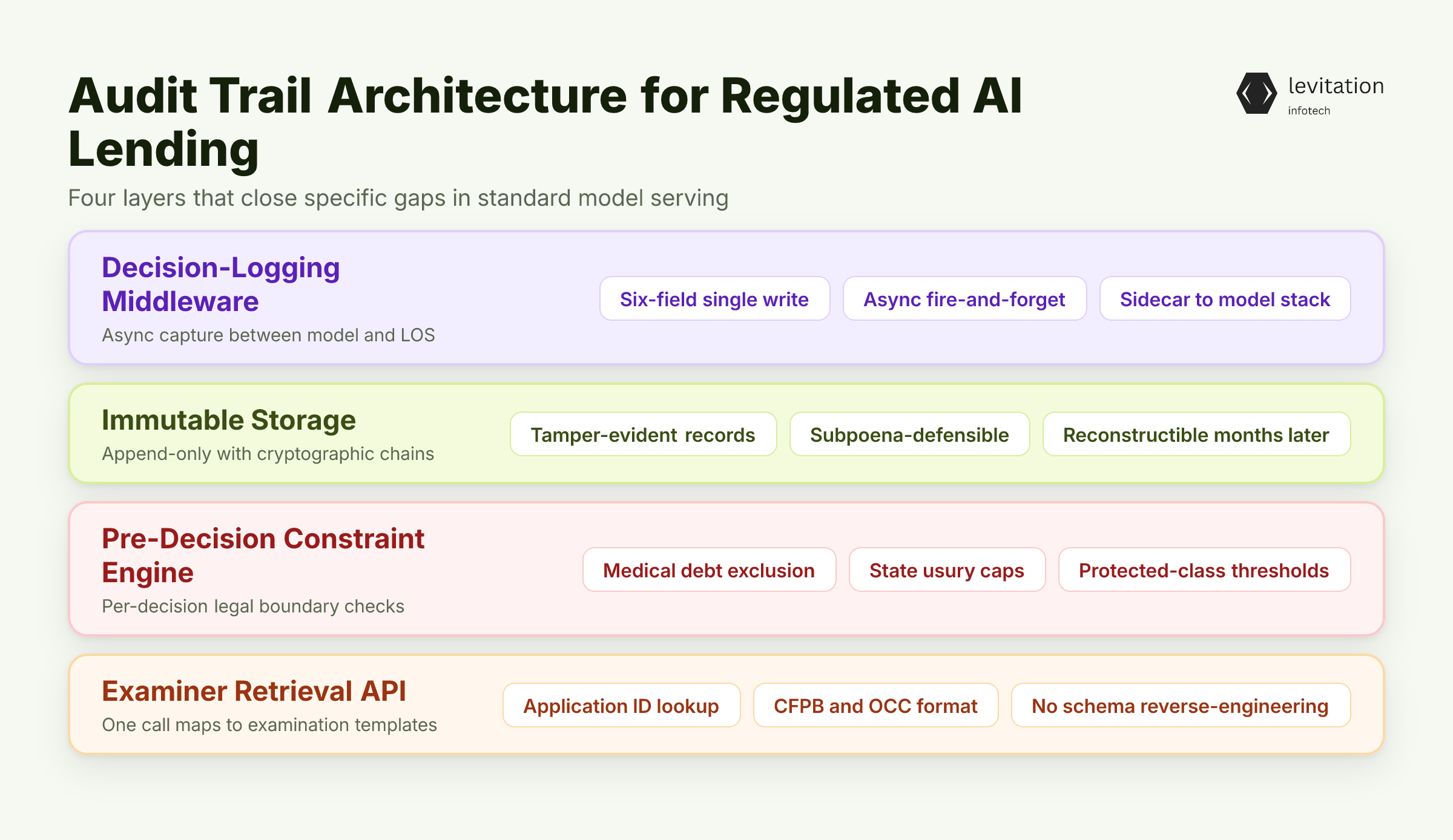
The architecture has four layers. Each layer is designed to close a specific gap in standard model serving.
Decision-logging middleware. This sits between the model inference layer and the loan origination system. It captures all six fields in a single write. The overhead varies based on persistence backend and field serialization cost. The capture runs asynchronously, so the decision returns to the LOS without waiting for the write to commit. You keep the latency advantage of AI underwriting because the write is fire-and-forget on the request path.
Immutable storage with cryptographic hashing. Append-only, not mutable logs. A regulator will subpoena your records. Tamper-evident storage is the only defensible posture. Mutable application logs can be altered before production. Cryptographic chains cannot. This is the same discipline behind explainable AI in AML. The record has to be reconstructible months later, under oath.
Pre-decision constraint engine. A rules layer that checks the model's output against legal boundaries before the approval is returned. It handles medical debt exclusion, state usury caps, and protected-class neutral thresholds. If the model output violates a constraint, the decision is blocked. It may be escalated. It may be downgraded, depending on the rule. This is the layer MRM cannot provide. It operates per-decision, not per-quarter.
Retrieval API for examiner queries. One call returns the full decision record for a given application ID. The record is formatted to map directly to CFPB and OCC examination templates. Examiners should not need to reverse-engineer your schema. If your examiner-facing API is harder to use than your customer-facing one, you have built the wrong system.
The integration pattern matters as much as the components. Deploy as a sidecar to the existing model serving stack, not as a rip-and-replace. A sidecar deployment pattern runs faster than an in-house rebuild. The in-house rebuild requires new infrastructure before the first decision is captured. The speed advantage is not just operational. It is regulatory. Every month your audit trail is not capturing data is a month of decisions you cannot defend. Payment systems and LOS integration patterns work the same way. Layer the compliance infrastructure next to the production system, not through it. The objection every CTO hears from their risk team: doesn't this kill the latency advantage of AI underwriting?
The Tradeoff Your Risk Team Is Mispricing
The real tradeoff is not latency versus compliance. It is one enforcement action versus years of AI infrastructure investment. CFPB consent orders in the AI lending space carry costs that build up. Those costs build up across every regulator with jurisdiction over your institution. A single finding can trigger simultaneous reviews from the OCC, the FDIC, and state attorneys general. The cost of one bad decision spreads through your entire institution. This is the same pattern that makes AI automation undermining compliance so dangerous at scale. The faster you ship, the faster you accumulate un-defensible decisions.
The teams that scale AI underwriting fastest in 2026 are the ones with strong compliance infrastructure. That infrastructure lets them expand into new products. They do so without re-opening the model. They cover auto, unsecured personal, BNPL, and small business. Each product carries a different regulatory question. Without audit trails, each new product means a new validation cycle. It means a new MRM gate. It means a new six-month delay. With audit trails, the data examiners ask for is already collected. The constraint engine handles new product rules by configuration, not by rebuild.
Surprisingly, adding audit infrastructure often improves model performance. The constraint engine catches data leakage and feature drift in real time. It does not wait months later for a quarterly review. You find out a feature is no longer predictive when it actually stops being predictive. You don't find out when the next MRM cycle runs. The same pre-hoc checks that block an illegal approval also block a stale one.
This is the work AI for fintech production deployments demands. It calls for infrastructure that builds up, not infrastructure that gates. The cost of getting it wrong is the cost of a regulatory finding. It is not the cost of a few extra milliseconds. So what does the operating model look like once this infrastructure is in place?
What Changes When Your AI Can Defend Every Decision
Examiners move from adversarial to collaborative. The difference between a long review and a short validation is this. Can you answer their first question in one API call? When the answer is yes, the rest of the review is procedural.
Product velocity builds up. New lending products ship in weeks. They ship in weeks because the audit trail is already collecting the data examiners will ask for. You don't rebuild the compliance layer for each launch. You configure the constraint engine for the new product's rules and ship. Defending one product's AI decisions becomes defending all of them. The architecture is the same.
Defensibility builds up over time. Systems that survive sustained regulatory scrutiny are typically the ones that never had a material finding. The architecture made illegal decisions impossible to issue silently. The CTO's positioning shifts. It shifts from "we use AI and hope it stays compliant." It shifts to "we run AI lending with examiner-grade evidence on every decision." That is a different conversation with the board, the regulator, and the next product launch.
The fintech fraud detection and AI compliance layer that catches illegal approvals is the same engineering discipline. That discipline also catches fraudulent ones. Both require structured, immutable, queryable records of every decision your system made. Build it once. Use it for every regulator who asks.
Frequently Asked Questions
What makes an AI underwriter decision legally non-compliant?
An AI lending decision becomes non-compliant when it produces an outcome that violates a specific legal constraint. Disparate treatment under ECOA/Reg B qualifies. Use of medical debt as a factor under the CFPB Personal Financial Data Rights Rule also qualifies. Pricing above a state usury cap qualifies too. Aggregate model fairness scores do not cure an individual non-compliant decision.
Does the EU AI Act apply to US-based AI lending?
The EU AI Act applies to any AI system whose output is used in the EU. That includes credit decisions for EU residents. For US-only operations, CFPB guidance and Fannie Mae's AI/ML Lender Letter set the binding standard. The EU's 6-month minimum logging requirement for high-risk systems has effectively become the global baseline. It has become the baseline for AI audit infrastructure.
How long must AI underwriting decisions be logged?
The EU AI Act requires a minimum of 6 months of logging for high-risk AI systems. US regulators have not specified a fixed retention period. Examination cycles look back across multiple years of decision history, however. Practical guidance: log at the EU's 6-month minimum for operational access. Also archive to long-term immutable storage for the full examination window.
Can a human override fix an illegal AI approval?
A documented human override with a reason code can shift liability from the model to the underwriter. It only works if the override is logged. It needs the human's identity, timestamp, and stated basis. Undocumented overrides have been the basis of recent CFPB enforcement actions. Overrides made before the model's full output is reviewed have also triggered those actions.
What is the difference between model risk management and AI audit trails?
Model risk management is a regular governance discipline. It focuses on aggregate model performance, bias testing, and validation cycles. AI audit trails are a production data layer. They capture every individual decision. The capture includes the inputs, model version, and reasoning needed. That reasoning is needed to defend that specific decision to a regulator. MRM without audit trails leaves a gap. That gap is one that examiners are now actively looking for.
Sources
Research and references cited in this article:
- Key 2025-2026 Regulatory Compliance and Lending Law Changes: Data Privacy, AI, and Consumer Protection — Winnow
- AI in Financial Services: Popular Use Cases and the Regulatory Road ...
- AI Agent Compliance for Financial Services (2026)
- EU Fintech Regulations 2026: 9 Changes You Must Prepare For
- USA Fintech Laws and Regulations 2026
- AI Audit Trail Requirements: 2026 Checklist for Finance, ...
- AI in Lending: Trends, Use Cases & Implementation Guide - LoanPro
- AI Decision Audit Trails: Regulator Rules June 2026
- AI Risk Management for Lenders: 2026 Compliance Guide
- AI-powered fraud: 5 trends financial institutions need to understand in 2026 - Thomson Reuters Institute
- PDF AI In the Mortgage Industry
- Impact of AI-Driven Risk-Based Pricing on Loan Approval Efficiency in Rural Non-Banking Financial Services | Advances in Consumer Research
About the author
Mayank Singh is a software developer at Levitation Infotech, where he builds web and AI-powered applications across the company’s fintech, healthcare, and enterprise projects.