

TL;DR: Forty-four of 47 AI build vs buy frameworks recommend buying. The three that recommend build matter more than the consensus. They expose a lock-in trap most CTOs walk into blind. The answer for most enterprises is hybrid, anchored by an abstraction layer that lets you swap foundation models without rewriting systems.
Key Takeaways: - Vendor-led AI deployments succeed at about 67% vs 33% for in-house builds. This gap is driven by the compounding risk that long build timelines introduce. - The three outlier matrices recommended build under conditions the median framework doesn't capture, like proprietary data moats or regulatory constraints. - An abstraction layer between your applications and vendor models blocks lock-in. It also lets you swap models without downstream rewrites.
44 Out of 47 Matrices Say Buy, and That's the Wrong Question
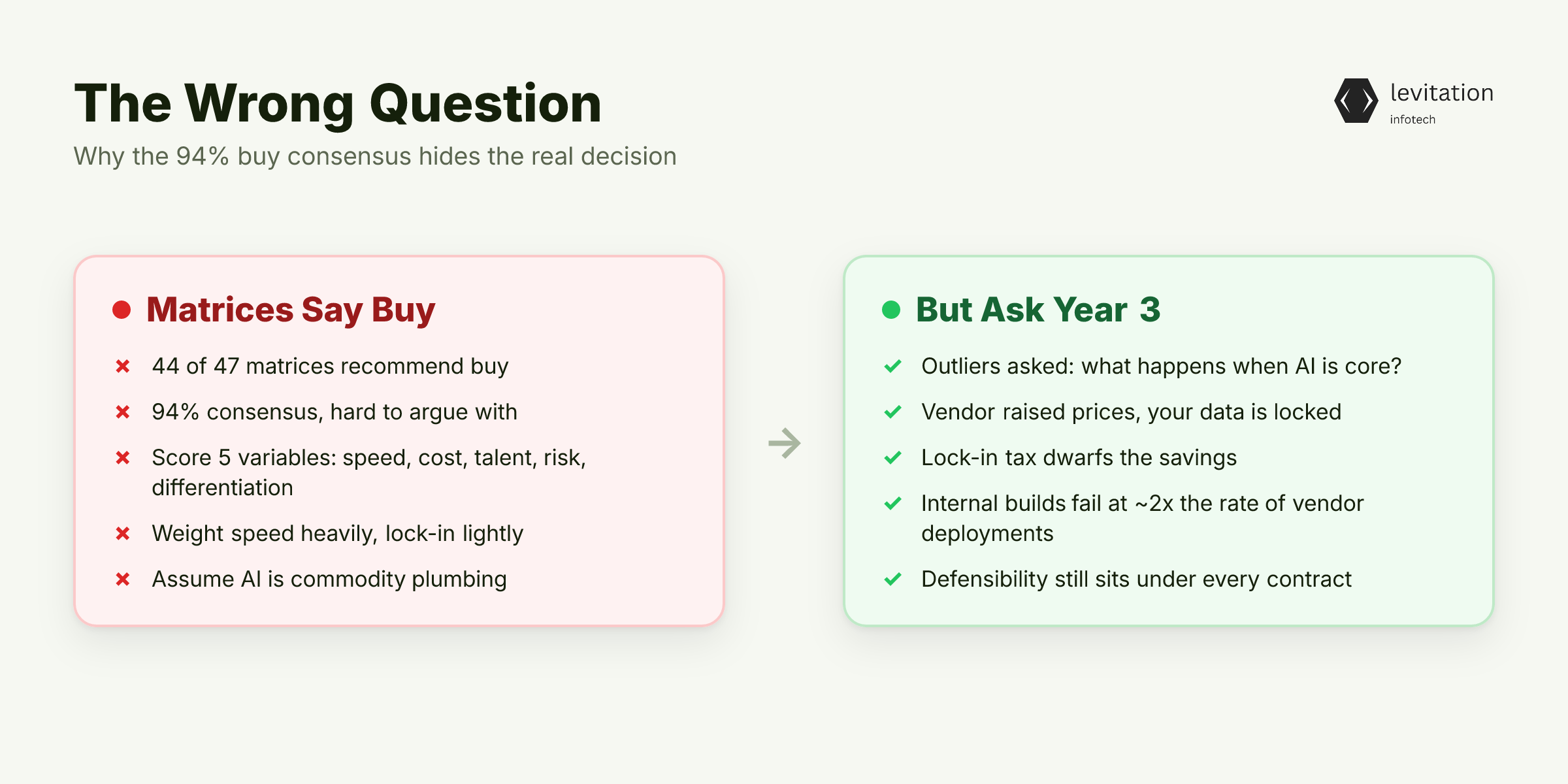
Every procurement framework points the same direction. Buy. 44 of 47 evaluated matrices recommend buying off-the-shelf AI over building in-house. That's a 94% consensus. Hard to argue with on a slide.
But here's what the consensus hides. Counting matrices doesn't equal counting correct decisions.
Most matrices score the same five variables: time-to-value, total cost, talent needs, risk, and differentiation. They weight speed heavily and lock-in lightly. They produce "buy" because the math tilts that way for the median use case.
The three outliers that recommended build weren't contrarians. They were answering a different question. They asked: what happens in year three, when the AI is core to the product? The vendor has raised prices. Your data is locked inside their platform. That question changes the math.
The dominant "buy" recommendation rests on one unspoken assumption: the AI layer is plumbing. A commodity you buy and forget. For most use cases (chatbots, document summarization, ticket routing) that assumption holds. For others, it hides a multi-year lock-in tax that dwarfs the savings.
The buy recommendation looks like a solved problem. So why do internal AI builds fail at nearly twice the rate of vendor-led deployments? Enterprise AI solutions bundle speed and reliability. The question of long-term defensibility still sits underneath every contract.
The 67% vs 33% Success Gap That Nobody Talks About
Vendor-led AI deployments succeed at about 67%. Build-from-scratch projects succeed at about 33%. That's a 2x gap most procurement talks skip past.
The cause isn't quality of engineering. It's timeline.
A typical vendor-led production AI deployment ships faster because the infrastructure, serving layer, and integration patterns are pre-built. An in-house build has to build that infrastructure from scratch. The extra time grows risk across many dimensions: model obsolescence, team attrition, and shifting business requirements.
The difference sounds like a project management problem. It's actually a survival problem.
Foundation models change on quarterly cycles. A multi-year build risks launching on an architecture already obsolete. The team you hired for one foundation model generation is now retraining for the next.
The business requirements that justified the project have shifted twice. By the time an in-house build reaches production, you may be solving for a different problem than the one you started with. This compounding risk shows up across the board. It even shows up in the fintech AI cost forecast failures that blow up under shifting assumptions.
Speed isn't a convenience metric for AI. It's the main risk variable. Every extra month of build time compounds model obsolescence, team attrition, and shifting stakeholder expectations.
Vendor deployments collapse this risk window by shipping before the next model generation shift.
If buying is so dominant, the three matrices that recommended build must have seen something structural. They did.
What the 3 Outlier Matrices Saw That the Others Missed
The three outliers didn't reject the speed argument. They rejected the idea that speed is the only variable. They recommended build under conditions the median framework doesn't capture. - The AI capability was the core competitive differentiator, not a feature bolted on. - The training data was proprietary and couldn't be copied by any vendor's model. - Regulatory or data residency needs made vendor processing structurally impossible.
In these cases, "buy" fails for a reason no procurement matrix captures. Vendors can't ship a brain trained on your proprietary domain. They can't expose their weights. And they can't promise that your data never crosses a border your regulator cares about.
The contrarian insight: the three outliers were optimizing for moat, not speed.
Most procurement frameworks optimize for speed. A minority of companies are optimizing for moat.
For the rest, the right answer is neither pure build nor pure buy. It's hybrid. Buy the platform, the infrastructure, the model serving layer. Build the application logic, the data pipelines, the domain intelligence that sits on top.
Accepting the hybrid model is easy. Building it so you don't end up locked in is the actual hard problem.
The Abstraction Layer Architecture That Blocks Lock-In
The lock-in fear is real, but the response most teams pick is wrong. They buy nothing because they're afraid of being stuck. The better response is architectural.
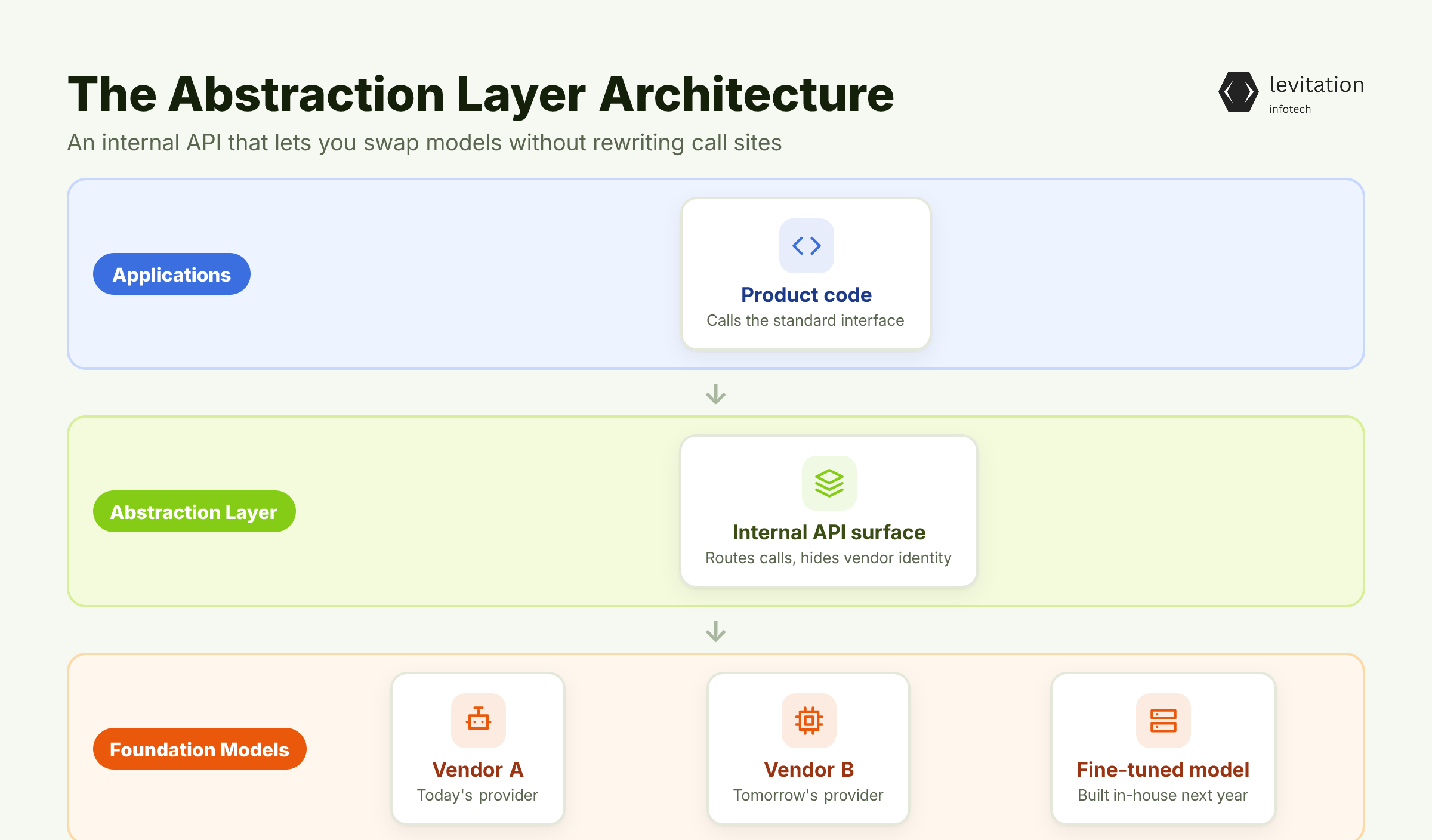
The abstraction layer is an internal API surface. It sits between your applications and any vendor model. Your product code calls a standard interface.
That interface routes to one foundation model today, another tomorrow, or your own fine-tuned model next year. Downstream systems never know which model answered. Agent frameworks have already started collapsing this surface, but the principle holds for any model-driven workload.
This pattern delivers three structural benefits: - Model portability. Swap foundation models without rewriting call sites, retraining teams, or re-validating compliance. - Bargaining power. Vendors know you can leave. Pricing pressure stays healthy. - Model evolution. Adopt new architectures as they ship, instead of waiting for a multi-quarter migration.
Layer governance on top. Run a vendor review cadence with quarterly checks of model quality, cost, and roadmap.
Bake exit clauses and data export guarantees into every contract. Set a hard rule: no single vendor holds more than 40% of your AI spend. That ceiling forces competitive tension.
Teams that adopt this approach build systems designed to outlast individual model generations. Their architectural discipline signals something most vendor pitches can't promise: durability.
Architecture alone doesn't make a decision. Here's the matrix a CTO can actually run on Monday morning.
A CTO's Build vs Buy Decision Matrix That Actually Works
Most build vs buy matrices are vendor brochures with extra steps. Here's one that produces a decision, not a debate.
Score each of these five questions as yes or no based on whether the condition applies to your situation. - Is this AI capability a core differentiator for our business? - Is our time-to-value under 9 months? - Is our training or inference data non-sensitive and vendor-shareable? - Do we have senior in-house AI talent that can own the build? - Are regulatory constraints minimal for this workload?
If 3 or more answers point toward "buy" (no, no, yes, no, no), default to buy with an abstraction layer. If 3 or more point toward "build" (yes, yes, no, yes, yes), go hybrid. Split or even count, and hybrid is the default: buy the platform, build the differentiation.
The governance checklist that travels with every decision: - Contract clauses requiring data export in standard formats on 90 days' notice. - Data portability tested quarterly, not just promised on paper. - Model abstraction as a non-negotiable architectural need. - Vendor concentration cap at 40% of total AI spend. - Exit runbook kept alongside the production system, not after a crisis.
Each scenario maps to a deployment arc. Pure buy with generative AI vendors ships faster because the integration surface is pre-built.
Hybrid with abstraction layer runs longer than pure buy but shorter than full build, because the platform side absorbs the heavy lifting. Pure build, when warranted, stretches across multiple model generations and the business shifts that follow. In cases where the alternative is being out-competed, the math shifts.
The frameworks look good in slides. Here's what actually changes when a CTO runs this in practice.
What Changes When You Get This Right
The delta isn't theoretical. Production-ready AI systems ship on vendor timelines instead of stretching across multiple model generations. Lock-in risk is structurally contained because the abstraction layer makes vendor switching a config change, not a rewrite.
The compounding effect is what matters. Systems that absorb model shifts, price hikes, and compliance changes without a rebuild separate working AI from a perpetual migration project. That's what architectural discipline measures: systems that keep working because they were built to evolve.
CTOs who run this framework stop relitigating the build vs buy debate every quarter. They ship AI capabilities.
The board sees progress. Engineering sees momentum. Procurement sees a process that produces decisions instead of endless review cycles.
This is the work firms like Levitation do with enterprise clients. They turn procurement paralysis into shipped capability, with the architectural discipline to evolve without rewrites.
That's the actual outcome. Not a matrix. Not a vendor pick. A working AI capability, shipped on time, with the option to evolve.
Frequently Asked Questions
Q: What percentage of enterprise AI projects fail when built in-house?
A: Build-from-scratch AI projects succeed at about 33%, compared to about 67% for vendor-led deployments. The gap comes from the compounding risk that a long build timeline introduces. During this time, foundation models, business requirements, and team composition all shift.
Q: How do you avoid vendor lock-in when buying AI?
A: The most effective mechanism is an internal abstraction layer, an API surface that isolates your applications from any specific vendor model. This lets you swap foundation models (e.g., one frontier model to another to your own fine-tuned variant) without rewriting downstream code. Pair this with contractual data portability clauses and a policy of capping any single vendor at 40% of AI spend.
Q: When does it make sense to build AI instead of buying?
A: Build wins when AI capability is your core competitive differentiator. It also wins when you have proprietary training data no vendor can copy. It also wins when regulatory constraints require full data and model residency. In practice, this applies to a narrow set of companies with very specific structural needs. The rest are better served by buy or hybrid models.
Q: How long does enterprise AI deployment take with a vendor vs in-house?
A: Vendor-led enterprise AI deployments ship faster than in-house builds. The gap matters disproportionately for AI because foundation models change on quarterly cycles. A long build risks launching on an obsolete model architecture.
Q: What is the build vs buy AI decision matrix?
A: It's a scoring framework that evaluates factors like competitive differentiation, time-to-value pressure, data sensitivity, in-house AI talent, and regulatory constraints. It produces a buy, build, or hybrid recommendation. The most effective versions add an architectural layer (an abstraction interface) that lets organizations capture buy-speed benefits while keeping the option to switch vendors or build internally later.
Sources
Research and references cited in this article:
- Build vs buy vs partner for enterprise agentic AI in 2026
- Build vs Buy AI Solution in 2026: Cost, ROI & Decision Guide
- Build vs. buy AI procurement software — key considerations
- Enterprise AI: Build vs Buy Decision Framework for Software
- Build vs Buy Enterprise AI: The Real Cost Analysis
- Avoiding Vendor Lock-In in AI Procurement | ITEA Journal (Vol 47, Iss 2)
- What is AI Vendor Lock-In—and Why Does it Matter?
- Avoid AI Vendor Lock-In: A Multi Model AI Strategy (2026)
- How to Mitigate IT Vendor Lock-in Risk in the Enterprise | NPI
- 5 AI Vendor Lock-In Traps Costing Enterprises Millions | Ability.ai
- AI Build vs Buy in 2026: A Decision Framework for Agencies
- Build vs Buy AI: What Enterprises Need to Know in 2026
About the author
Mayank Singh is a software developer at Levitation Infotech, where he builds web and AI-powered applications across the company’s fintech, healthcare, and enterprise projects.